
Libraries' Blog


When Middle East Met West
The Smithsonian Libraries and Archives exhibition, Nature of the Book, looks at the natural materials and evolving techniques in bookbinding from 1450-1850 as illustrated by our collections. As the exhibition emphasizes, the form of the European book could not have happened without the trade of natural materials to Europe from different parts of the globe – primarily Asia, the Middle East, and North Africa. That trade was the direct result of the Arab conquests and cultural expansion into Central Asia and other areas. The products were exchanged through centuries of global expansion that accompanied vibrant intellectual and craft development. Ideas, aesthetic and practical, traveled along with the trade of materials that created the Islamic binding style. The effect of all this on Europe was profound, and like much else, bookbinding was transformed.
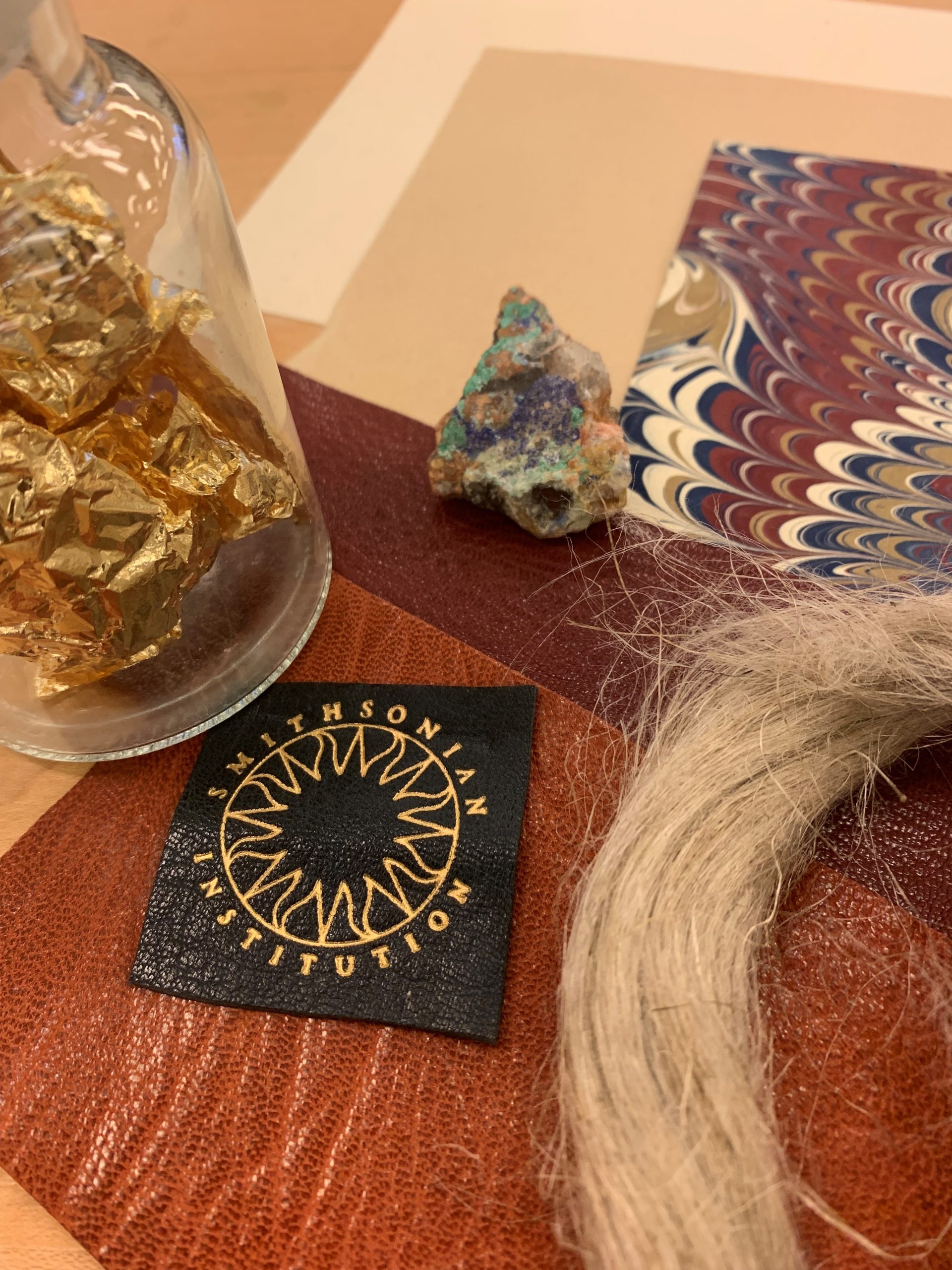 Goods such as goatskin, flax-based paper, and minerals for pigments entered Europe through Arabic trade routes. Artistic influences incorporated decorative marbled papers and gold tooling into Western binding practices.
Early books of North and East Africa were comprised of sheets of papyrus or parchment sewn onto plain wood boards. Arabic craftspeople added leather covering to the books, often made from tanned goatskin, that completely wrapped around the boards and spine. The books often included a characteristic envelope flap used as a page marker. The Islamic book structure generally resembles a modern hardcover book, using a binding style recognizable to many today.
 Goatskin cover for Qur’an, likely Syrian, later 1800’s.
What may not be generally known is that contemporaneous to this binding style, paper became one of the most far-reaching cultural influences offered by Arab trade and expansion. Paper has been the preferred and most familiar surface for writing and printing for centuries. It could be made quickly in large quantities. Paper was light and flexible, and it easily received type setting and inks following the development of movable type in the 15th century. As a result, it eventually replaced the use of costly parchment, made from animal skins.
Modern paper can be traced to Central Asia about the 8th century, when fibers from various plants like flax and hemp were woven into linen. The textile waste was shredded, mixed with water, and beaten to make pulp. Sheets of rag paper were formed when the pulp was dried on a screen. The shredding and pulping technique moved to this area from China where, several centuries earlier, hand-made papermaking directly used the long fibers from sub-tropical plants that were similarly shredded and beaten into a pulp.
Muslim settlements in the region of Samarkand adopted this new papermaking method which spread to Iran, Turkey, India, Africa, and Europe, making the Arabic world the largest producer and trader of this versatile linen rag paper. The Italian paper mill Fabriano mastered Arabic methods of paper making learned by the Spanish, shifting the source of fine paper to a European market by the 15th century. A 600-year old volume printed on Fabriano paper is featured in the exhibition.
 De re militari (1532). These illustrations are printed on Fabriano paper which is recognized for its clarity, brightness, and flexibility. The Fabriano mills date from the 13th century when Arab paper-making traditions reached Italy.
The paper pages in Islamic binding structures were coated with sizing using plant starches and burnished with stone pestles or glass balls leaving a shiny surface. Organic plant-based dyes were used to color the pulp. Calligraphic manuscript was used with intricately colored designs and images, using precious minerals for color and gold illumination. Gold leaf was traditionally used to embellish the pages of Islamic religious manuscripts. Qur’ans were considered prized possessions and the use of gold was a sign of their importance.
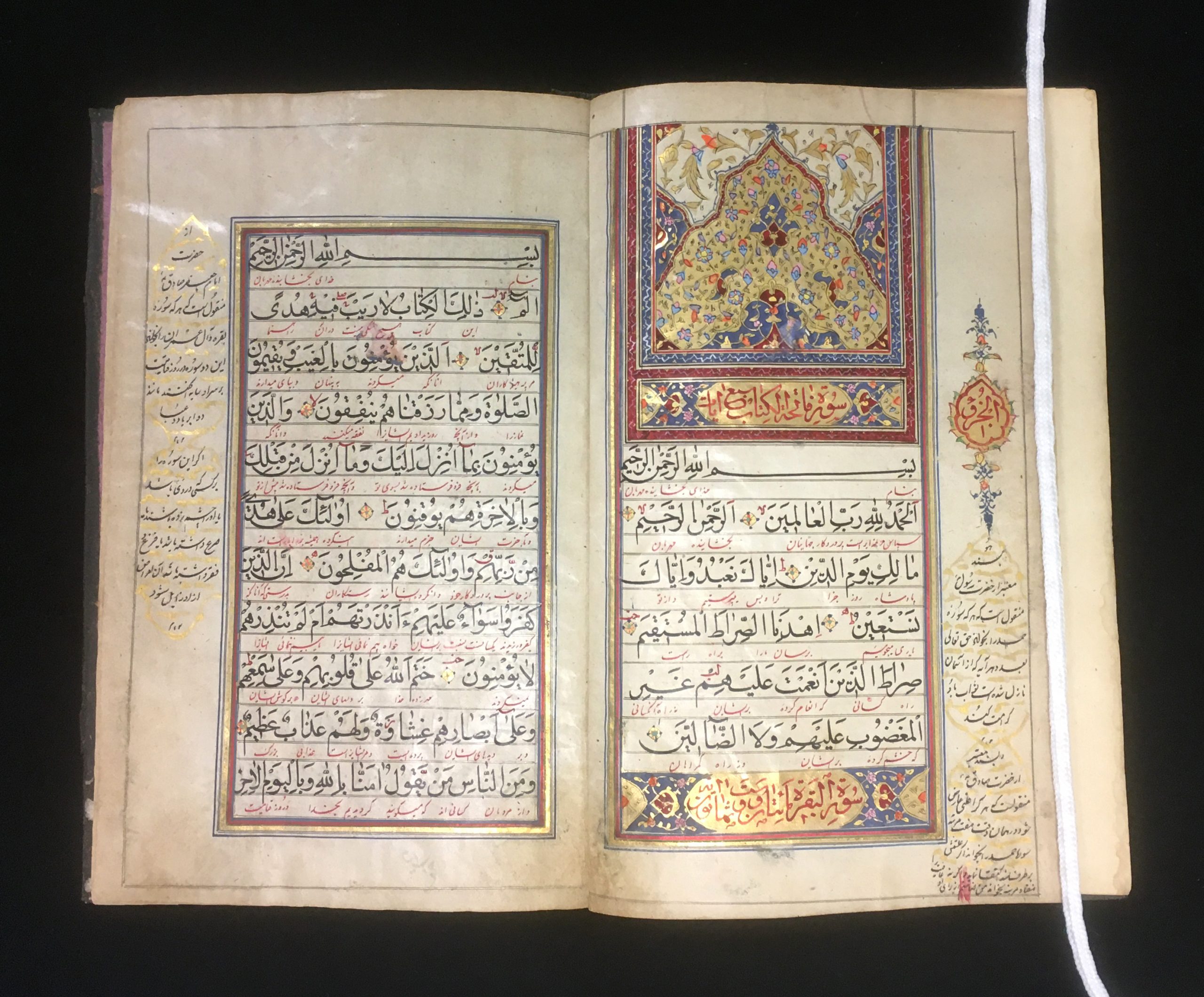 Qur ʾan (partial), Qajar-period Iran, 1800’s. Sheets of gold were used to decorate manuscript pages made of burnished paper.
Goatskin covers dyed bright colors with ornate gold tooling and decorative colored marbled paper that was borrowed from Arabic book design, became increasingly popular by the 16th century in Europe, introduced by goods traded through Italian ports.
 Amphitheatrvm æternæ (1615). Dyed goatskin and the craft of gold tooling were imported to Europe via Italian ports trading with North Africa and the Middle East.
A sophisticated level of design and decoration, in addition to the use of paper, allowed Arabs to enhance the functional and artistic improvements that have had a lasting impact in the development of the book.
Through the Loupe: A Staff Profile of Audiovisual Archives Specialist Analiese Oetting
This is the third in a series of ongoing blog posts from Smithsonian Libraries and Archives’ Audiovisual Media Preservation Initiative (AVMPI), spotlighting the labor of Smithsonian media collections staff across the Institution. Analiese Oetting currently serves as Audiovisual Archives Specialist (contractor) with the National Museum of American History’s Archives Center (NMAH-AC).
 Audiovisual Archives Specialist Analiese Oetting with the National Museum of American History’s Archives Center film collections.
Walter Forsberg: Hi Analiese, thanks for meeting today. Can you tell our Unbound readership where you’re working, today?
Analiese Oetting: Hi Walter. Yes, of course, I am in my office at ‘American History,’ which I am actually rarely in. Usually I work downstairs doing film inspection. But, we are moving spaces soon and they will be tearing down the area we’re in right now. The designer just sent tile swatch samples, and I think the renovated space will have less of a ‘dungeon vibe’ to it. [Laughs]
WF: Oh, that’s wonderful news. The basement of American History is a very historic space for film and media. If I remember correctly, that’s where the Office of Public Relations film and broadcasting section was located, beginning in 1967. There used to be a television studio there, even earlier, dating to when the building was first opened as the Museum of History and Technology in 1961…
AO: Yes, there are still several ‘Recording in Progress’ signs around, but no one’s recording much these days. It’s mainly me and the contractors installing a new fire alarm. [Laughs]
 Décor in the lower levels of the National Museum of American History reveal remnants of the Smithsonian’s in-house film production past.
WF: Can you speak a little bit about your role in working with audiovisual collections at the Smithsonian?
AO: I am the Audiovisual Archives Specialist (contractor), which is a touch misleading given that my current job is focused solely on working with the motion picture film collections. I’ve been here on contract for the past eight months and one of my main projects is inspecting and creating an item-level inventory of all film collections at the Archives.
WF: That’s such a key and elemental thing to create when it comes to audiovisual archives.
AO: Completely. Once we created that item-level inventory, it made looking at the collections and determining priorities for digitization much easier. The project funding my job is called, “Capturing the Moment,” and is supported by the generous National Collections Program. It has a focus on home movie collections and we’re getting close to the large-scale vendor digitization phase. In the next few months, we’ll start sending films to a vendor on a rolling basis. Hollywood director George Sidney’s home movies will be among the first material, which are really interesting. Usually home movie collections are shot by amateur filmmakers, which can be their principal appeal, but these were shot by a professional filmmaker. If you’re someone interested in the ‘golden age’ of Hollywood you will find these extremely fascinating. We’re also planning to scan the home movies of composer Harry Warren, with whom I’m less familiar. We’re looking at scanning about 75,000 feet of film.
WF: Jeepers Creepers! That’s over 30 hours of material! I’m so pumped for that.
AO: Getting it all into the DAMS [Digital Asset Management System] and creating access for those films is always our obvious goal.
 Audiovisual Archives Specialist Analiese Oetting hard at work inspecting film collections.
WF: While you work on all the procurement paperwork for that vendor-based scanning, I understand that you and NMAH Digital Archivist Leigh Gialanella are also digitizing some films as part of something called—correct me if I’m wrong—‘Scan Club’? Are you allowed to talk about Scan Club, or does that violate some rule of secrecy?
AO: Yes, Scan Club. I love Scan Club. It started because we needed a few things digitized for the AVMPI January Zoom with a View streamcast event. Thanks to NMAAHC’s [National Museum of African American History and Culture’s] Media Conservator Blake McDowell we were able to go next door and scan some old DuMont Television advertisements. First of all, it’s really lovely to be able to scan film in-house because of the slowness associated with federal procurement contracting with a vendor. With Scan Club we’re able to show up, scan film, get some stuff back immediately, and feel like we’re actually digitizing collections—all within the same day. It’s also incredible to get out of the museum basement, visit colleagues at another unit, and open dialogue. ‘What are you working on?’ ‘How do you do that?’ Meeting new people and faces— The fellowship of comparing notes in-person about projects is really nice, especially after the pandemic.
WF: Wow! I know that striving to be ‘Nimble’ is a key focus of Smithsonian Secretary Bunch’s five-year “Our Shared Future” strategic plan, and same-day film scanning sure sounds like it fits the bill! Can you talk about some of the recent films you’ve scanned?
AO: Last week, we scanned 16mm television kinescope film recordings from the Hills Bros. Collection. It is an interesting collection, and has a little bit of everything—home movies, baseball games, factory footage, promotional films, and even a few reels from a television program called, Shirley Temple’s Storybook from 1958. Hills Bros. coffee was a sponsor of many TV shows and the collection represents the breadth of materials you find in Archives Center.
 Advert sponsoring pre-game program, Lead Off Man with Vince Lloyd, broadcast May 13, 1962 live from Wrigley Field on WGN-TV. Collection item # Reel OF 395.13, Hills Bros. Coffee Company, Incorporated Records, 1856-1989, undated, Archives Center, National Museum of American History, Smithsonian Institution.
WF: I was researching about the Hills Bros.-sponsored 1962 TV program, Meet Me at Disneyland, and it appears that yours might be the only-known copy in existence. While the show was a little underwhelming and heavy on the Dixieland, the sequence of Fred MacMurray playing saxophone was satisfyingly curious.
AO: It’s always cool to know you have something unique. It’s always interesting to see what might pop up in a collection because even if you’re not necessarily interested in Hills Bros. Coffee. Having these little appearances by public figures like Walt Disney and Fred MacMurray that haven’t been widely seen by a modern audience is nice to have and fun to share!
 End credit title card from the 1962 KTTV television program, Meet Me at Disneyland, broadcast June 9, 1962. Collection item # Reel OF 395.12, Hills Bros. Coffee Company, Incorporated Records, 1856-1989, undated, Archives Center, National Museum of American History, Smithsonian Institution.
 Actor Fred MacMurray plays saxophone on the 1962 KTTV television program, Meet Me at Disneyland, broadcast June 9, 1962. Collection item # Reel OF 395.12, Hills Bros. Coffee Company, Incorporated Records, 1856-1989, undated, Archives Center, National Museum of American History, Smithsonian Institution.
WF: Can you speak about how you got interested in audiovisual archiving, and what your career trajectory has been?
AO: I was always super interested in film, and took film studies courses at York University during my undergrad. Like many fresh-faced 18 years olds in film school I thought I wanted to be a filmmaker. But, eventually it became clear at a certain point that I didn’t want to be a filmmaker, and I wasn’t super interested in academia or pursuing a PhD in cinema studies. I came across this program at Ryerson University—now, called Toronto Metropolitan University—for ‘Film Preservation and Collections Management’ and thought: this sounds cool as hell. I applied and got in, and when I got there everything really clicked into place. I was, like: ‘This is it!’ The program is very committed to providing internships and residency training.
WF: What were some of your practicuum experiences like?
AO: I did my internship at the Art Gallery of Ontario, working with a film collection they have from the 1960s and 70s of works by Canadian filmmakers—David Rimmer, Michael Snow, Joyce Wieland. There was a lot of time on the film bench, assessing condition and performing inspection. It was really nice to get that hands-on film handling experience. Then, I spent six months for my residency at the Vancouver Cinematheque in their film archive. The people there are lovely, they do great programming, and I undertook a lot of detective work about who donated specific films and updating their film database. That was also a reality check for me because it was messy—films don’t always show up, beautifully wound onto cores and in good condition.
WF: Did you have other archival jobs before arriving at the Smithsonian?
AO: In 2019 I got a job at the Sundance Institute straight out of grad school, working in their archives as a Digital Assets Assistant. That really blew my mind, and the job involved processing born-digital photos of current year-round events and programs and then also working on getting some of the older scanned materials into the DAMs. For a lot of that older stuff there’s no metadata, so most of that job is detective work, looking at past festival photos and figuring out: ‘Who’s that?’ ‘What film premiere was this?’ I really love that kind of work. In addition to festival materials, the Institute has saved a lot of documentation of their lab programs back to 1981.
WF: What are you working on next at the Archives Center?
AO: Day-to-day I’m always working on processing film collections, creating and updating finding aids for the the materials, working with interns to get things rehoused and also starting to document workflows and processes as I go along to sort of keep things consistent moving forward. We’re obviously very focused on our home movie preservation project at the moment, but always trying to identify other materials that need preservation, how best to get it done and how to make it accessible.
Three New Members Join Smithsonian Libraries and Archives Advisory Board
The Smithsonian Institution’s Board of Regents recently appointed Evelyn Dilsaver, Cathy Heron and David H. Lipsey to the Smithsonian Libraries and Archives Advisory Board. They join 17 prominent community and business leaders dedicated to building the Libraries and Archives’ collections, increasing digital initiatives, advancing education, progressing library and archival preservation, creating high-quality exhibitions and programs, and securing a financial legacy.
“I am excited to welcome three distinguished new members to our Advisory Board,” said Tamar Evangelestia-Dougherty, director, Smithsonian Libraries and Archives. “They each will bring diverse expertise and strengths to our work, furthering the Smithsonian Libraries and Archives’ important mission and reach with local and global audiences alike.”
The Smithsonian Libraries and Archives Advisory Board consists of members from across the United States. The mission of the board is to help the organization to provide authoritative information, steward the Smithsonian’s institutional memory and create innovative services and programs for Smithsonian researchers, scholars, scientists, curators, archivists, historians and other staff, as well as the public at large.
Evelyn Dilsaver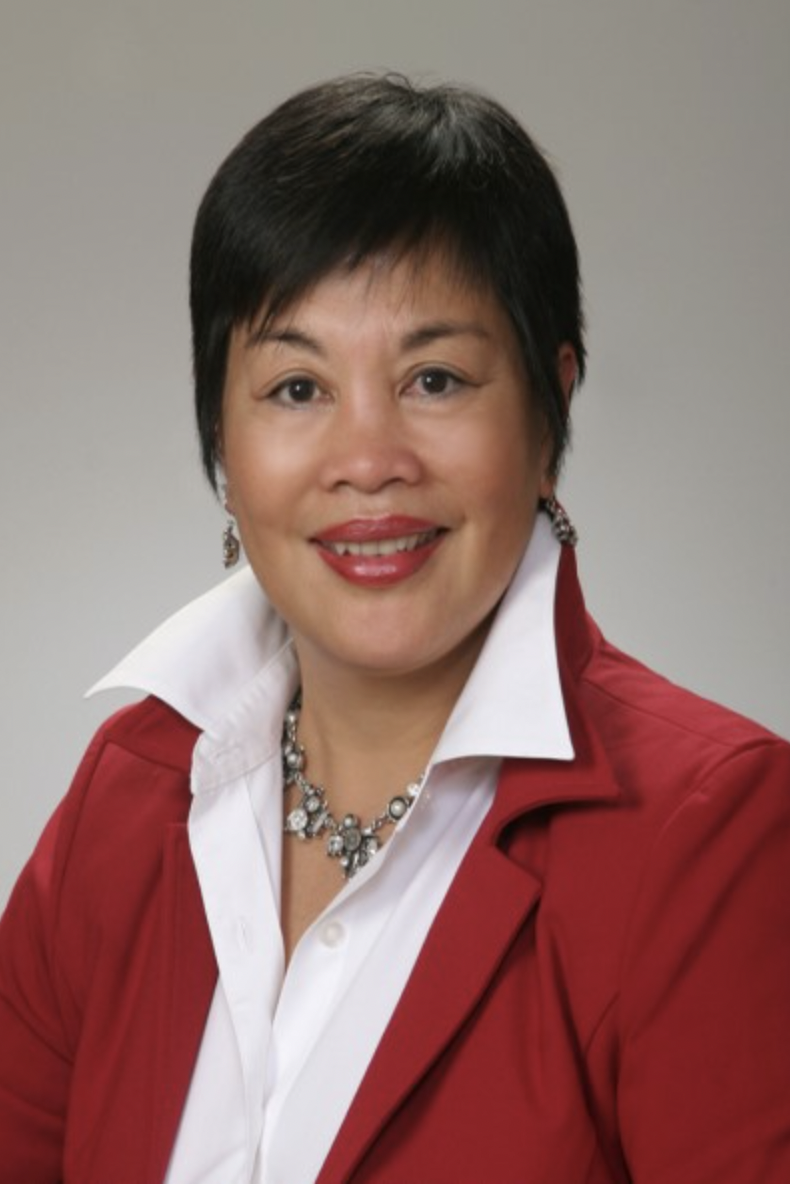
A CPA at Ernst, Evelyn spent the first 17 years of her career in the audit and finance function as Controller for a bank and for Charles Schwab and as CFO and Chief Administrative Officer for U.S. Trust, a wealth management firm. She was given the opportunity to hone her skills in marketing, business development, strategy, M&A and product development, culminating in the role of EVP of Charles Schwab, member of the Management Committee and President and CEO of Charles Schwab Investment Management.
Evelyn is a recognized leader in building motivated teams in the public and non-profit worlds. As President and CEO of Charles Schwab Investment Management she was responsible for all aspects of the business, growing the assets to over $200 billion while generating $1 billion in revenue.
Recognized in the community for her leadership, she has received San Francisco Business Times “100 Most Influential Woman” award, 2003-2009; CSU 2008 East Bay Alumnae of the year; 2014 “Outstanding Director;” and in 2018, Most Inspired Award by the SF Business Times. In 2016, she received an Honorary Doctorate in Humane Letters from Cal State University East Bay, NASDAQ 100 Directors in 2019 and a NACD directorship 100 Honoree for 2020. She is also a frequent guest speaker and panelist on board of director topics at NACD Global and Chapter events, Women Corporate Director events and on-boarding boot camps for aspiring directors. She also speaks on leadership skills at Employee Resource Groups and University MBA programs and as a moderator for programs at The Commonwealth Club.
Evelyn has served on several public and private boards and currently serves on public company boards for Tempur Sealy (TPX), Health Equity (HQY) and Quidel/Ortho (QDEL); global consulting firm Protiviti and Bailard REIT; and leadership roles in several non-profit boards, including as former Chair of The Commonwealth Club and of the Blue Shield Foundation, and Co-Chair of Women Corporate Directors Advisory Board. She formerly served on the boards of Blue Shield of California, Long Drugs, Tamalpais Bancorp, Aeropostale, High Mark Funds and the National Association of Corporate Directors NorCal chapter. She is a graduate of CSU East Bay and the Stanford Senior Executive Program.
Cathy Heron 
Cathy is a retired attorney with more than 40 years of experience in the investment management, tax and retirement regulatory fields. At the Capital Group Companies, one of the 10 largest investment management firms in the world, she served as General Counsel to Capital Bank and Trust, a trust bank for retirement assets and high net-worth individuals, and as a Senior Vice-President of the Fund Business Management Group of Capital Research and Management Company, the investment adviser to the American Funds. She was a founding member of the groups that established the largest 529 college savings plan in the nation and the American Funds industry-leading target date retirement funds. She also served as chair of Capital Group’s Retirement Plan Committee, responsible for administering plans covering more than 7,000 employees.
Prior to working at the Capital Group, Cathy was Senior Vice-President for Tax, Pension and International issues at the Investment Company Institute, the trade association for the US mutual fund industry. While living in Washington, she also worked in the Washington office of a major New York law firm, the national tax office of one of the largest international accounting firms and at the US Department of Labor, where she served as Special Assistant to the Solicitor of Labor.
Cathy earned her Bachelor of Arts degree from Wellesley College, her J.D. from Boston University School of Law and an LLM in taxation from Georgetown University Law School.
Cathy and her husband, Al Schneider, divide their time between homes in Manhattan Beach, Calif. and Arlington, Va.
David H. Lipsey
David H. Lipsey is a principal consultant and advisor working internationally on creating value from organizations’ digital assets – and setting in place the organizational and strategic processes to achieve success with this. David has been involved with the field of digital asset management (DAM) since its inception in 1998 and is a global leader in the field.
David’s work in DAM informs a deep experience in a diversity of both public and private sectors as well as content “types” – print, images, graphics, audio, video, CAD, aesthetic, medical, and software (gaming/VR/AR/data) assets. He is well known as a leader in setting the ever-changing context for how “digital” goes to work – and works in service of mission.
His work in the non-profit world includes the Library of Congress’s foundational National Digital Library, The Getty, The National Gallery of Art, The Canadian Museum for Human Rights, Sesame Workshop, The Ringling Museum, The PBS NewsHour, The National Board of Medical Examiners, WGBH (Boston), WNET (New York City) and many others.
His particular focus on digital content includes extensive work with insights gleaned from private sector experience with companies as diverse as General Motors, Hasbro, Lands’ End, HBO, Disney, PVH, Sony Music, Feld Entertainment, Garmin, A+E, Penguin Random House, The New York Times, Pearson and dozens more help to inform the meanings and value of DAM.
Previously, along with founding senior consulting roles, David served as Industry Principal for Media & Entertainment for SAP and was, prior to that, a Co-Founder of one of the first and still-leading providers of enterprise DAM software.
He serves as the Global Chair of the international DAM Conferences known as “The Art and Practice of Managing Digital Media”, including the global (virtual) conferences on DAM for Museums, attended in the past three years by more than 6,000 Museum, Library, Archive and Performing Arts professionals from 75 countries; he is a principal co-author of the widely used Digital Asset Management Capability Model, and a sought-after speaker in DAM. David co-founded the Rutgers University Professional Certificate in Digital Asset Management and is the Academic co-Director and an instructor. David was named the Rutgers University School of Communication & Information Sciences Instructor of the Year in May 2021. He is a frequent guest lecturer at numerous universities about DAM and is a co-founder of Toronto Metropolitan University’s Lab for Excellence in DAM.
David is a graduate of Phillips Academy (Andover, Mass.) and New College (Sarasota, Fla.). He resides in McLean, Va.
How To Take a Product Line on the Road
In the early 20th Century, a knock on the door might have come from a salesperson offering the latest in cosmetics or household supplies. How did salespeople at that time display their product line? What kind of vehicle did they use? A circa 1919 J. R. Watkins Co. trade catalog offers a few ideas.
The trade catalog is titled Catalogue and Price List of Wagons (circa 1919) by J. R. Watkins Co. As might be guessed from the catalog title, it mainly illustrates wagons. However, it also includes product sample cases for Watkins salesmen to carry when visiting customers.
 J. R. Watkins Co., Winona, MN. Catalogue and Price List of Wagons (circa 1919), front cover, company administration building.
As the catalog points out, first impressions can make a difference. It explains, “The man who is bright and neat and who drives up with a lively team and a handsome Watkins wagon finds his battle half won.” For that reason, J. R. Watkins Co. offered their salesmen specific types of wagons which were lettered with the Watkins name, salesman’s name, and types of products sold, such as extracts, spices, perfumes, etc. This was a form of advertising, and as the catalog further emphasizes, a Watkins wagon “will quickly pay for itself.”
The Watkins wagons were built by DeKalb Wagon Co. of DeKalb, Illinois. These wagons were ordered by J. R. Watkins Co. in large quantities and then sold to the Watkins salesmen. In the catalog, J. R. Watkins Co. explains that they sold the “wagon for cash at about what it costs us ordering in large quantities.”
For salesmen who preferred not to pay by cash, another option was offered at a higher cost. This was to buy it “on time” and charge it to their account along with goods ordered. In this situation, the salesman’s sureties were also required to sign the order.
What were the benefits of buying a Watkins wagon? For one thing, these wagons provided a convenient option for displaying products. A handy shelf was created by simply opening the rear door. The hinges of the rear door were at the bottom, allowing it to open out and making it level with the bottom of the body of the wagon. This created a shelf, or display area, for showing products to customers. The wagon illustrated below, labeled as Watkins Wagon Nos. 17 to 20, shows the shelf created from the rear door. For security purposes, the door had a lock and key.
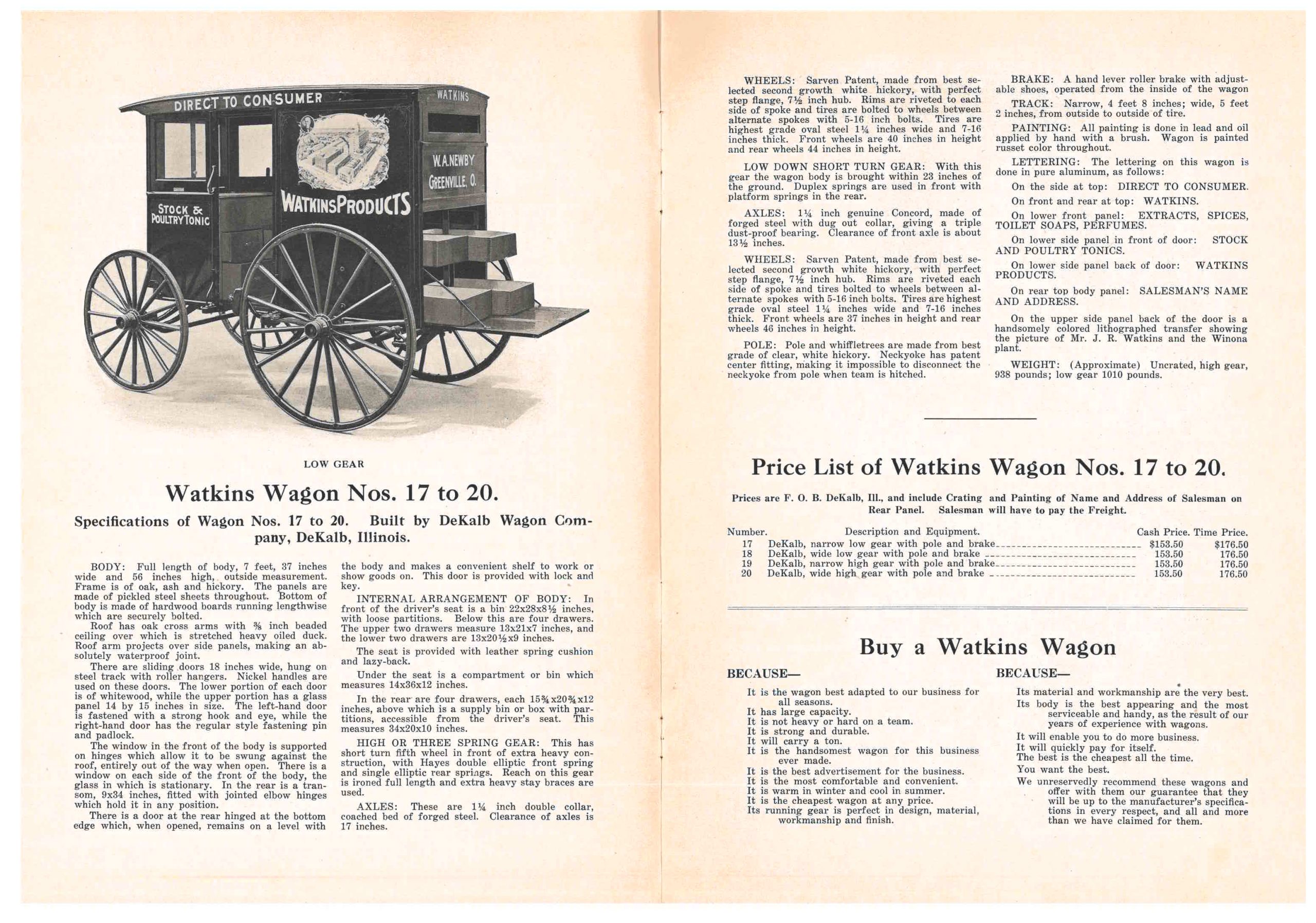 J. R. Watkins Co., Winona, MN. Catalogue and Price List of Wagons (circa 1919), unnumbered pages [4-5], Watkins Wagon Nos. 17 to 20 and reasons to buy a Watkins Wagon.Besides a place to display product samples when visiting customers, the shelf might also have been used as a workspace for organizing products in the wagon’s storage compartments, bins, and drawers.
As shown in the illustration below, four drawers were located above the rear door/pull-out shelf. Above those drawers, there was a supply bin. It was accessible from the driver’s seat. Another compartment or bin was located under the driver’s seat while four additional drawers and a bin were situated in front of the driver’s seat.
The catalog mentions the Watkins wagon will “quickly pay for itself.” How was that possible? Perhaps by using the wagon itself as a means for advertising. This was accomplished through custom lettering on the exterior of the wagon.
 J. R. Watkins Co., Winona, MN. Catalogue and Price List of Wagons (circa 1919), unnumbered page [4], Watkins Wagon Nos. 17 to 20.The wagon drew attention to the Watkins name in various ways. As shown in the above illustration, the company name “WATKINS” was painted towards the top of the rear of the wagon. It was also painted on the front of the wagon. A colored lithographed transfer was placed on the side of the wagon with a picture of Mr. J. R. Watkins, the founder of the company, along with an image of the company’s plant buildings in Winona, Minnesota.
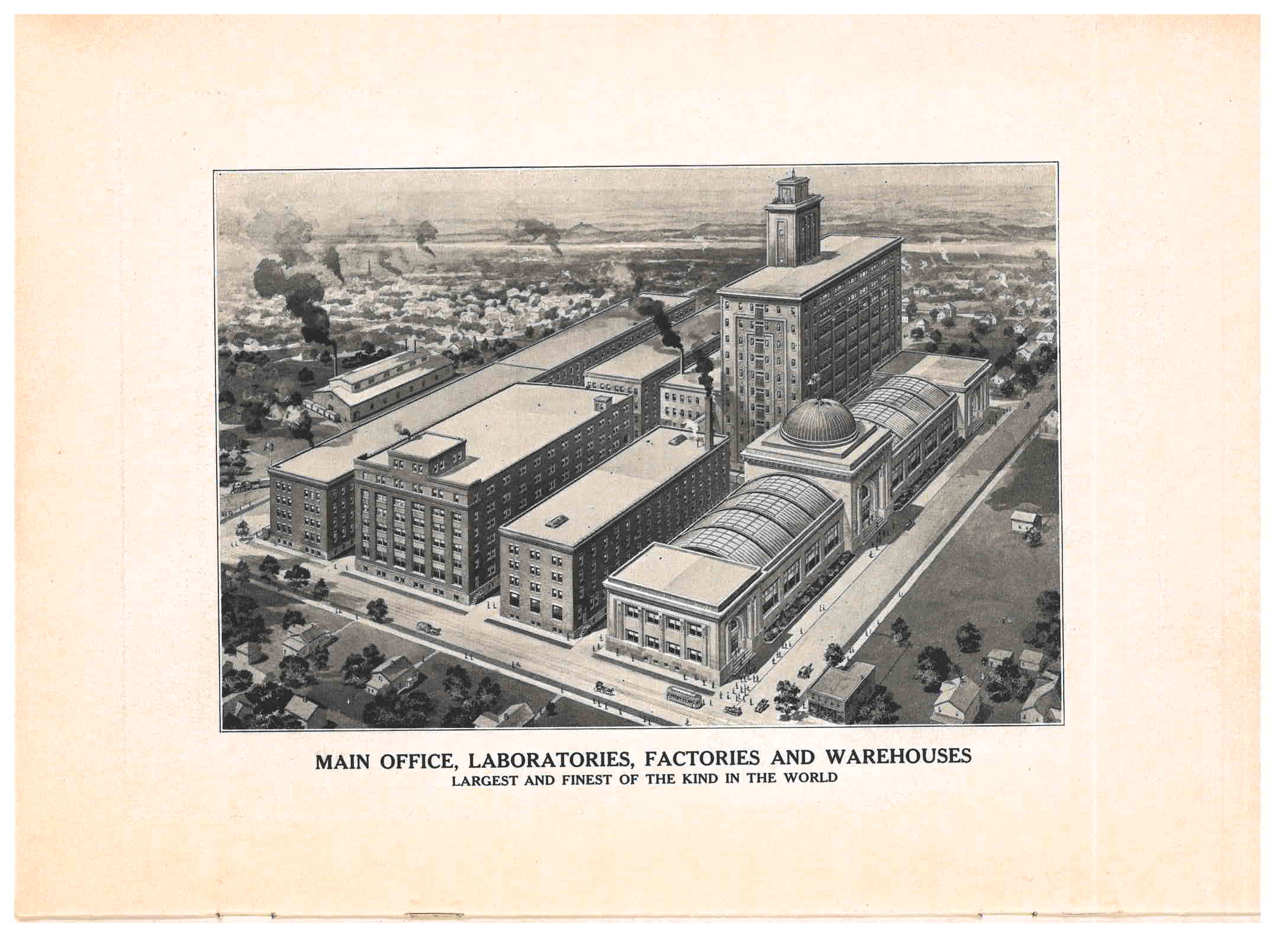 J. R. Watkins Co., Winona, MN. Catalogue and Price List of Wagons (circa 1919), unnumbered page [12], company’s main office, laboratories, factories, and warehouses.To further emphasize the company name, “WATKINS PRODUCTS” was lettered beneath the image of the company buildings. The name of the salesman and his address, such as city and state, were painted on the rear of the wagon above the door. Advertising the company’s ability to sell directly to customers, the wagon included lettering on the side near the top which read “DIRECT TO CONSUMER.”
The wagon also advertised the variety of Watkins products sold by their salesmen. Painted on the wagon’s lower front panel were the words, “EXTRACTS, SPICES, TOILET SOAPS, PERFUMES” while “STOCK & POULTRY TONIC” was painted on the lower side panel by the door. The Watkins wagon below (bottom), labeled as Watkins Wagon, Nos. 57 to 60, is lettered with “WATKINS REMEDIES” on its side. Overall, the wagon was painted in russet, a reddish-brown color.
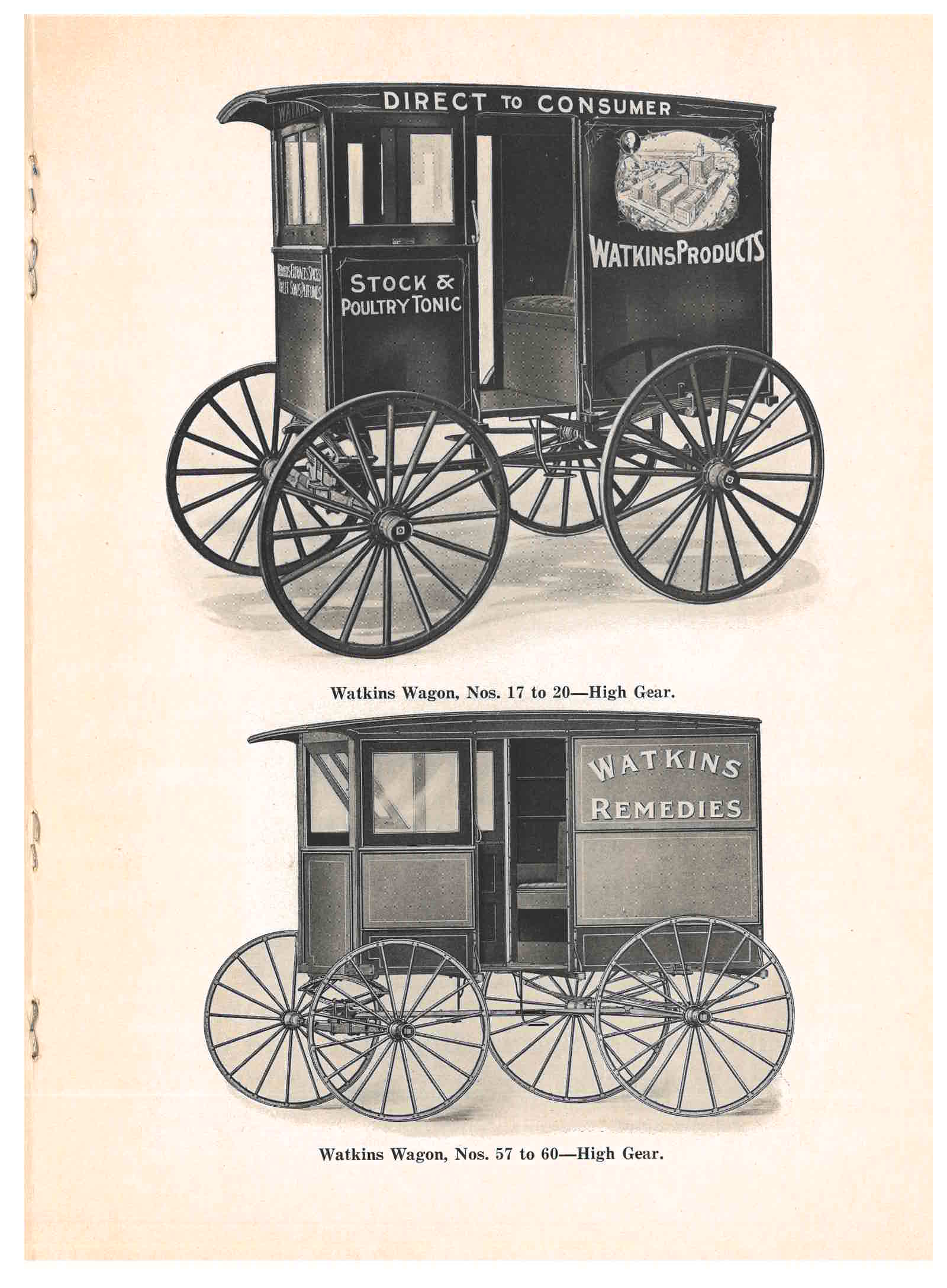 J. R. Watkins Co., Winona, MN. Catalogue and Price List of Wagons (circa 1919), unnumbered page [7], Watkins Wagon Nos. 17 to 20 high gear and Watkins Wagon Nos. 57 to 60 high gear.What happened when a Watkins salesman arrived at a customer’s home? How did he present items for sale? Perhaps he set them out on the rear wagon door/shelf or maybe he used a Watkins Sample Case. Sample cases provided a way to carry products to customers in a neat and organized manner. J. R. Watkins Co. offered two sizes, a small and large case. The small case measured 18 inches long, 12 ¾ inches high, and 6 ½ inches wide while dimensions for the large case were 17 ½ inches long, 18 inches high, and 7 inches wide. When filled, the large case weighed 46 pounds and the small case weighed 27 pounds.
Its exterior was covered with a waterproof vulcanized fiber trimmed with brass on each corner while the interior was fitted with black waterproof lining. The cases had a leather covered handle, three clasps to open and close, and a lock.
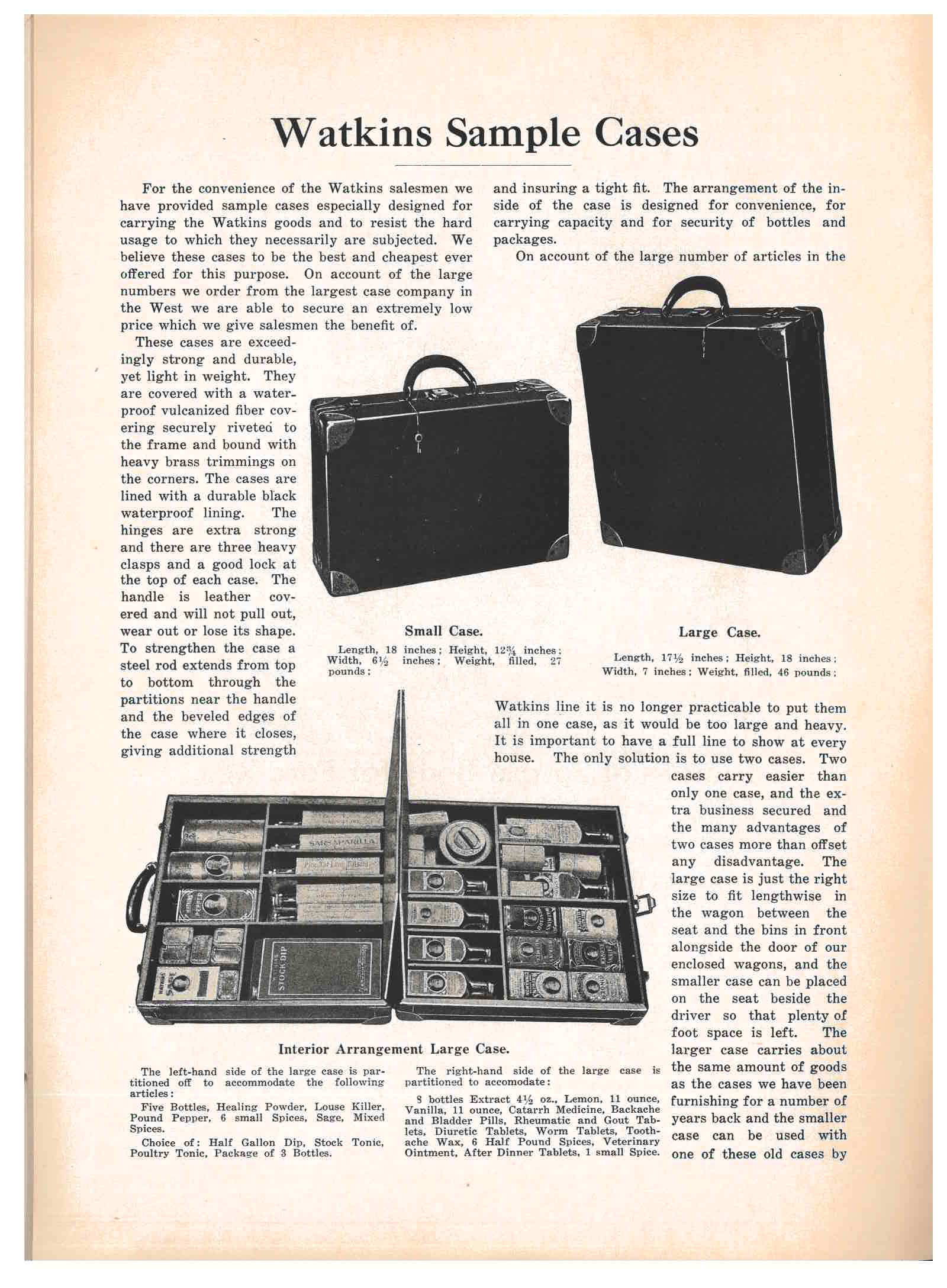 J. R. Watkins Co., Winona, MN. Catalogue and Price List of Wagons (circa 1919), unnumbered page [10], Watkins small and large sample cases (closed views) and large sample case (filled open view).For extra strength, each case was fitted with a steel rod extending “from top to bottom through the partitions near the handle and the beveled edges of the case where it closes.” The interior of each case included partitions to securely store products of varying sizes, though, as shown below, the right side of the small case did not have partitions.
 J. R. Watkins Co., Winona, MN. Catalogue and Price List of Wagons (circa 1919), unnumbered page [11], Watkins small sample case (filled open view).J. R. Watkins Co. recommended both the large and small cases to their salesmen because one case did not fit everything. The catalog even suggests locations in the wagon to stow these cases. The large case fit in the front of the wagon between the seat and front bins along the door lengthwise while the small case could be placed on the seat next to the driver. This provided ample foot space for the salesman.
Catalogue and Price List of Wagons (circa 1919) by J. R. Watkins Co. and other trade catalogs by J. R. Watkins Medical Co. are located in the Trade Literature Collection at the National Museum of American History Library.
AVMPI: Building Upon a Sound Foundation
It’s an enormous opportunity and a personal thrill to join the pan-Institutional Audiovisual Media Preservation Initiative (AVMPI). I’m excited to explore and work with some of the collections our team will digitize, preserve, and help to make accessible. As the Audio Preservation Specialist for AVMPI, I’m eager to ensure audio collections held here at Smithsonian Libraries and Archives – and across the broader Smithsonian – will be available in the future, as the initiative moves forward and fulfills its goals.
My interests in recorded sound preservation stem from my background as an audio engineer and musician, working in record stores, radio, live sound, and recording my friends and community. Socializing with “sound people” and learning about their interests has always been one of the most enjoyable elements of working in the audio world. In my travels, work, and crate-digging adventures, I’ve realized that so much of our recorded sound heritage has an incredible story to tell. In many cases, the most fascinating material never resurfaced beyond its original release format, did not get the full-scale production it deserved, or was on entirely non-commercial media in an archive. Preservation work felt like a great way to combine my audio engineering skill set with my interest in preserving these stories.
I arrive at the Smithsonian with some experience under my belt at other cultural heritage institutions, a digitization vendor, and academic libraries. My beginning as a career preservationist happened to start toward the beginning of recorded sound itself. I handled audio materials working as a volunteer at the Thomas Edison National Historical Park audio archive, which was close to my childhood home in New Jersey. Through digitization, some cataloging, and watching curator Gerald Fabris work, I had my first glimpse into what it looked like to meet best practices and keep things organized. From there, I was hired at a preservation vendor that was facilitating bulk digitization for Edison materials. I led the quality control team and learned about more complex workflow development and iteration. Acting as the final checkpoint for many incredible projects, including some Smithsonian work, I learned about metadata and transfer errors. After my time at the vendor, I moved to the University of North Carolina to perform audio preservation and reformatting under the leadership of the top-notch team at the Southern Folklife Collection. While at UNC, I obtained an Information Science master’s degree, which bolstered my understanding of many of the more formal information processes that happen in a large organization. I had a wonderful time working last summer as a Junior Fellow at the Library of Congress working with Kate Murray on the Sustainability of Digital Formats website — this provided some fantastic insight into practical elements of digital preservation and file format structure. Prior to arriving at the Smithsonian, I was in Columbus, Ohio, leading the beginning stages of The Ohio State University’s audiovisual digitization and preservation program.
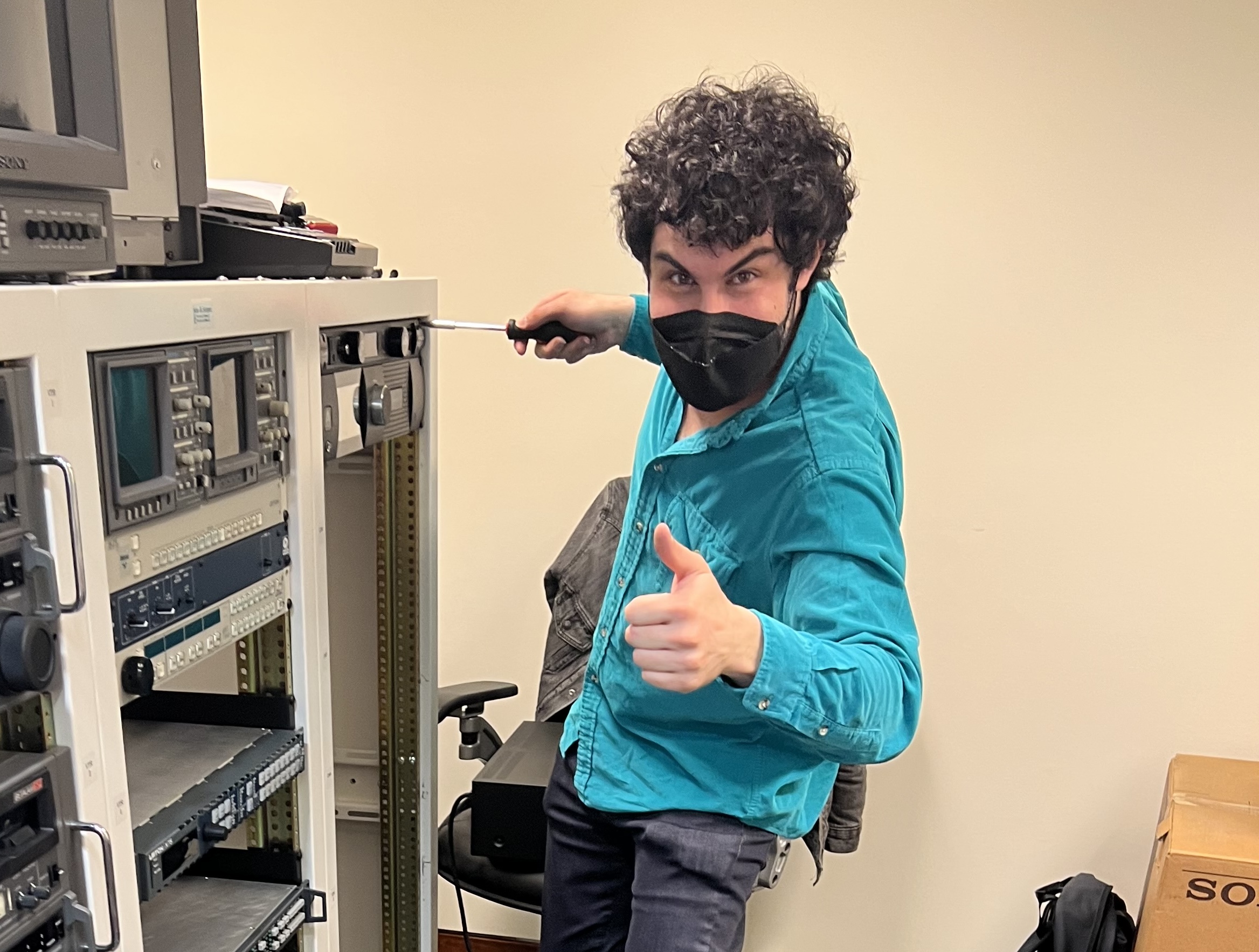 Reconfiguring the audio setup at the NMAI Cultural Resource Center. Photo: Siobhan Hagan
In my new role as Audio Preservation Specialist, I’m tasked with handling and facilitating the stabilization and preservation reformatting of many pieces of material — tapes, cartridges, discs, cylinders, belts, and more. I’ll also develop and undertake quality control for our audio digitization processes. AVMPI’s goal of serving as a centralized resource means that some of my first priorities are to shape unified standards and workflows, such as file embedded metadata and tape baking and cleaning. I have also been evaluating much of our audio equipment and performing minor repairs to ensure AVMPI obtains quality reformatting results. I hope to serve as an advocate throughout the Institution for its audio collections, building upon the great work already happening at Smithsonian in this domain, with many of our Task Force members providing helpful advice and context. Collaboration across the Institution with Smithsonian staff across AVMPI’s various labs and priorities will be a key part of supporting the Initiative.
I have encountered many moments that resonate personally with why I (and, I’d imagine, many of us) make careers out of preservation: recordings of people who may have known relatives of mine; rare documentation of important historical events; incredible multitrack recordings and demos of some of my favorite music; fascinating technological experimentations in the concept of taking moving air particles and wrangling them into some other domain — whether it be grooves, tiny magnetic specks, or light.
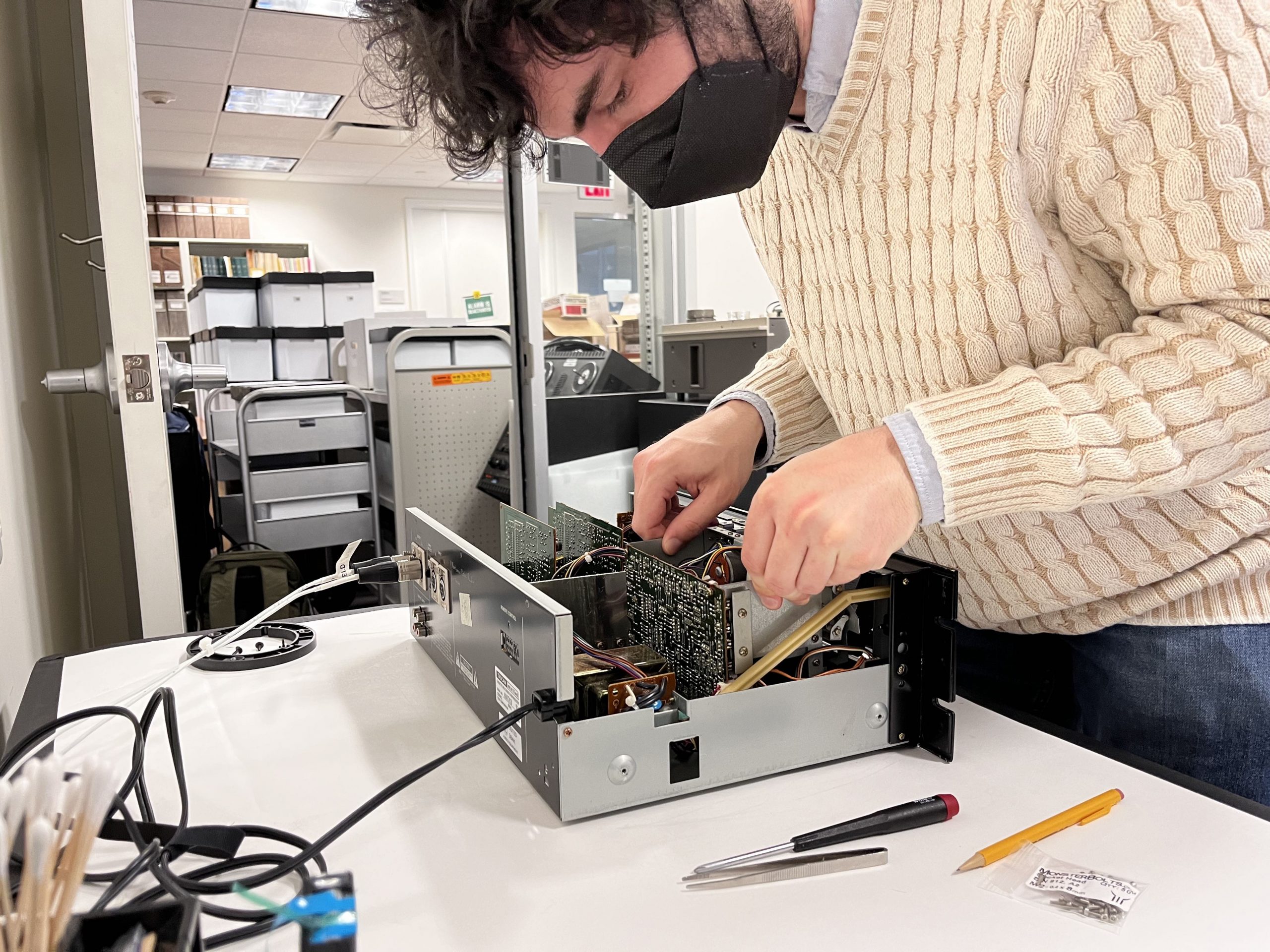 Ensuring one of our Tascam compact cassette decks is ready for preservation use. Photo: David Walker
One of my strongest passions in this field is extending our preservation practices into the technical information necessary to perform this work. Ensuring the longevity of specialized knowledge surrounding the unsupported legacy equipment we use to migrate our audiovisual cultural heritage is an urgent need. As a “digital native” who came of age in an era of less mechanical parts and more microscopic, surface-mount components, I am grateful to mentors and engineers who are willing to pass on important skills. Much of this is facilitated through several organizations full of wonderful people, such as the Association for Recorded Sound Collections, the Audio Engineering Society, and the International Association of Sound and Audiovisual Archives. However, as folks retire and this information leaves the field, it is becoming apparent that we need to actively collect technological information and make it accessible in innovative ways to combat “degralescence.” This is important, especially so that those without the resources of major institutions can retrieve information from obsolete carriers at high quality. Skill-sharing, organization of information, and documentation are crucial to this, and I hope to make such tasks part of my work here at the Smithsonian.
I look forward to sharing some wonderful digitized material, fun technical challenges, and more from AVMPI in future blog posts!
The ABCs of the Corcoran Artist Files: the Ls
In the series called “The ABCs of the Corcoran Artist Files” the American Art and Portrait Gallery (AA/PG) Library will explore artists through the materials from the recent Corcoran Vertical File Collection donation by featuring artists whose surnames begin with that letter. This time we are looking at the artists whose last names start with L. This exhibition and blog post were curated and written by Emily Moore, the Instruction and Outreach Archivist at the University of Oregon, who was a 2019 summer intern at the AAPG Library. After a pandemic pause, materials are once again on display in the library.
The discovery of a vertical file collection is an act of exploration – a loose construction of a life and career, presented visually through ephemeral materials. Dealing in both the personal and professional, these signifiers pique the interest of researchers and art explorers alike, encouraging the finder to continue to follow the line of a paper narrative. This opportunity for discovery occurs in a time capsule, in the unmapped elements of the research puzzle, encouraging the resolution of paper pieces put together in an organic, instinctual way. While working in the Corcoran files, I underwent a process of discovery that revealed personalities and art, both wonderful and strange, including the pulpy and brutal photos of Bud Lee and the early digital art pioneer Ruth Leavitt.
 Bud Lee’s photo of actor Clayton Moore portraying the character the Lone Ranger.
Born in New York as the son of a career diplomat, Bud Lee (1941-2015) was known for his striking, off-beat, and slightly surreal photographs and portraiture, appearing in publications including Life, Rolling Stone, Esquire, Harper’s, Town & Country, Vogue, Ms., and Mother Jones. His “kitschy, whimsical and Fellini-esque” work covered a wide spectrum of subjects, including the cover of Al Green’s Let’s Stay Together, portraits of legendary directors Francois Truffaut, Frederico Fellini, and Michelangelo Antonioni, and an incredible double portrait of Church of God founders and leaders Dr. O.L Jaggers and Miss Velma.[i]
In addition to his shots of celebrities and art, Lee’s work in education and Civil Rights included documenting four days of rioting in Newark, unrest that left 26 dead and hundreds injured. His image of Joe Bass, aged 12, lying on the ground, shot during an altercation between looters and the police, appeared on the cover of Life brought the “long, hot summer” of 1967 into homes all over America.
Towards the end of his life, Lee suffered a stroke that left him blind in one eye and paralyzed down his whole left side. Exalted as both an artist and journalist, the addition of Lee to the vertical file collection at the AAPG Library provides fascinating and often arresting information both on the work of Lee, and the lived experiences of his many subjects.
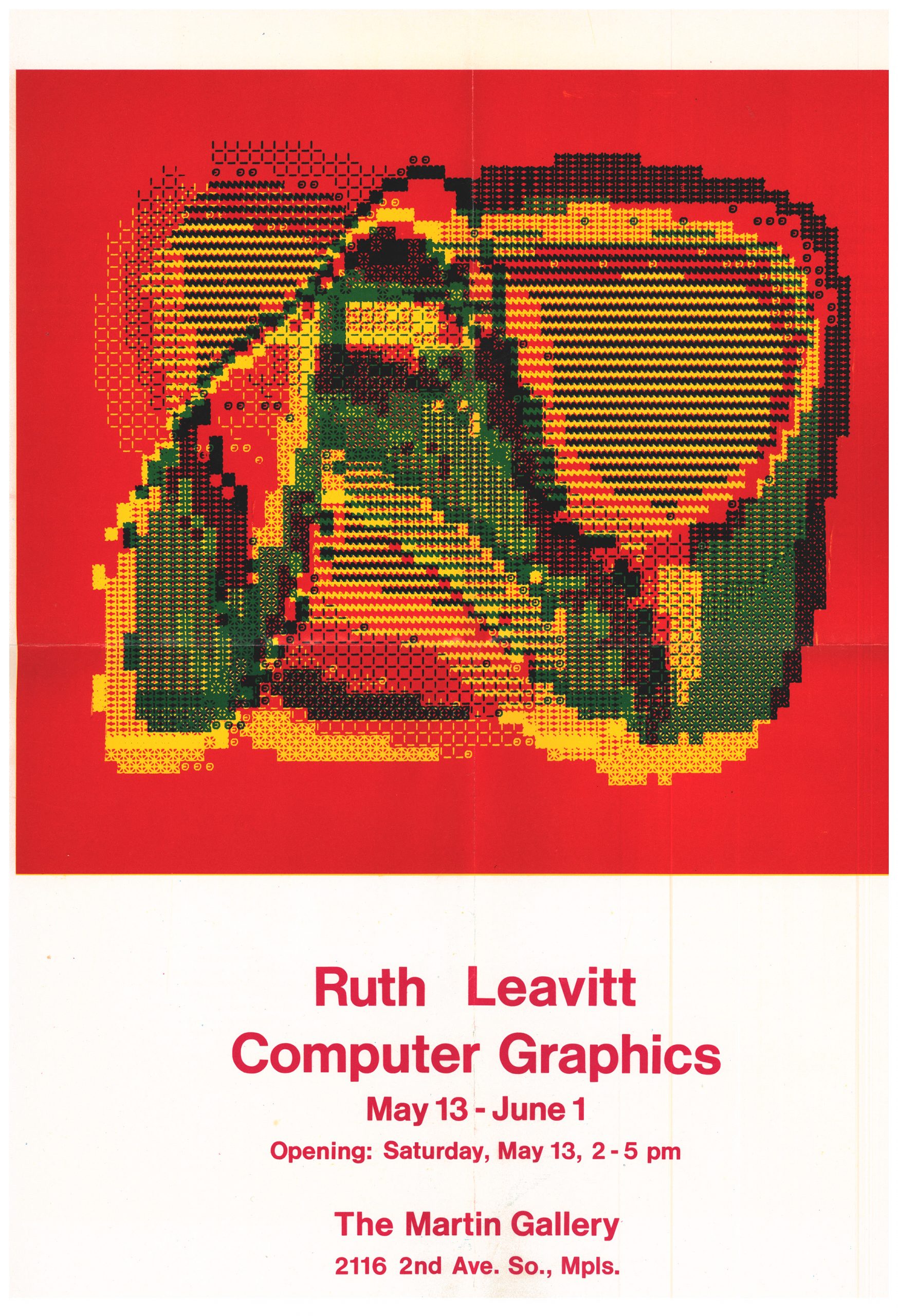 Poster for Ruth Leavitt exhibition at the Martin Gallery, May 13 to June 1, no year provided.
The work of Ruth Leavitt is simultaneously mechanical and organic, and an early example of the exploration of art and technology. Originally introduced to computers by her husband, a computer science professor, Leavitt “learned through osmosis” and brought an Abstract Expressionist sensibility to the format.[ii] While studying with Peter Busa, a fellow Abstract Expressionist who also explored Indian Space painting, Leavitt shifted from the instinctual, physical painting of the Expressionist style to the data-driven, “conscious decision making” of working with a computer as co-collaborator.[iii] After using early software to experiment with distortion and transformation, Leavitt quickly grew frustrated with the technical limitations of existing programs and decided to write her own. Working with coders, Leavitt’s first program stretched and distorted her drawings, which went from “hard-edge, constructivist in style” to having the “lyrical qualities of Abstract Expressionism.”[iv] Through different iterations of her first program, Leavitt explored the dimensions of line and mass, as well as three-dimensional, projected figures and the concepts of attraction and repulsion. These experiments eventually resulted in paintings, graphics, serigraphs (silk screen) and work in film animation.
Leavitt described her sense of excitement over the possibility of creating her own tools and saw programming and technology as enabling creative vision while providing opportunity and access to new, marketable skills. Technology is, by its nature, interdisciplinary, and demands collaboration between human and machine. To Leavitt, the medium was as important as the message, and the technology she employed changed the meaning of her work. Despite this, however, Leavitt felt that there was no such thing as “computer art,” as the artist ultimately wields the power in creation.
As one of the first artists to work with computer programming, and an early female pioneer in digital art, Leavitt’s file supplements our textual narrative of both technology and the visual arts. In addition to her visual experimentation, Leavitt edited Artist and Computer, a 1976 text that featured the work and writings of 35 artists working in the new medium. The insights of her book, which is in the AAPG collection, is now supported by the inclusion of Leavitt herself in our vertical file collection.
Artists on display for the L’s of the Corcoran are:
Raymond Lark (1939- 2005), Ruth Leavitt (1944- ), Bud Lee (1941-2015), Joanne Leonard (1940- ), Les Levine (1935- ), Marilyn Levine (1935 – 2005), Harry Lieberman (1880 – 1983), Harvey K. Littleton (1922 – 2013), Fonchen Lord (1911 – 1993), George Luks (1867 – 1933), Joan Lyons (1937-)
More from The ABCS of the Corcoran Artist Files:
[i] Eric Snider, “A Life In Pictures,” Creative Loafing Tampa, April 6, 2005.
[ii] Ruth Leavitt, Ed., “Ruth Leavitt,” Artist and Computer. New York: Harmony Books, 1976.
[iii] Leavitt, Ed., Artist and Computer.
[iv] Leavitt, Ed., Artist and Computer.
Through the Loupe: A Staff Profile of Media Archives ‘Journeyperson’ Emily Nabasny
This is the second in a series of ongoing blog posts from Smithsonian Libraries and Archives’ Audiovisual Media Preservation Initiative (AVMPI), spotlighting the labor of Smithsonian media collections staff across the Institution. Emily Nabasny currently serves as Video Archives Technician (contractor) on the Media Conservation and Digitization team of the National Museum of African American History and Culture (NMAAHC).
Learn more about Emily’s work in our upcoming program, AVMPI Presents: The View from Her on March 15th, 2023.
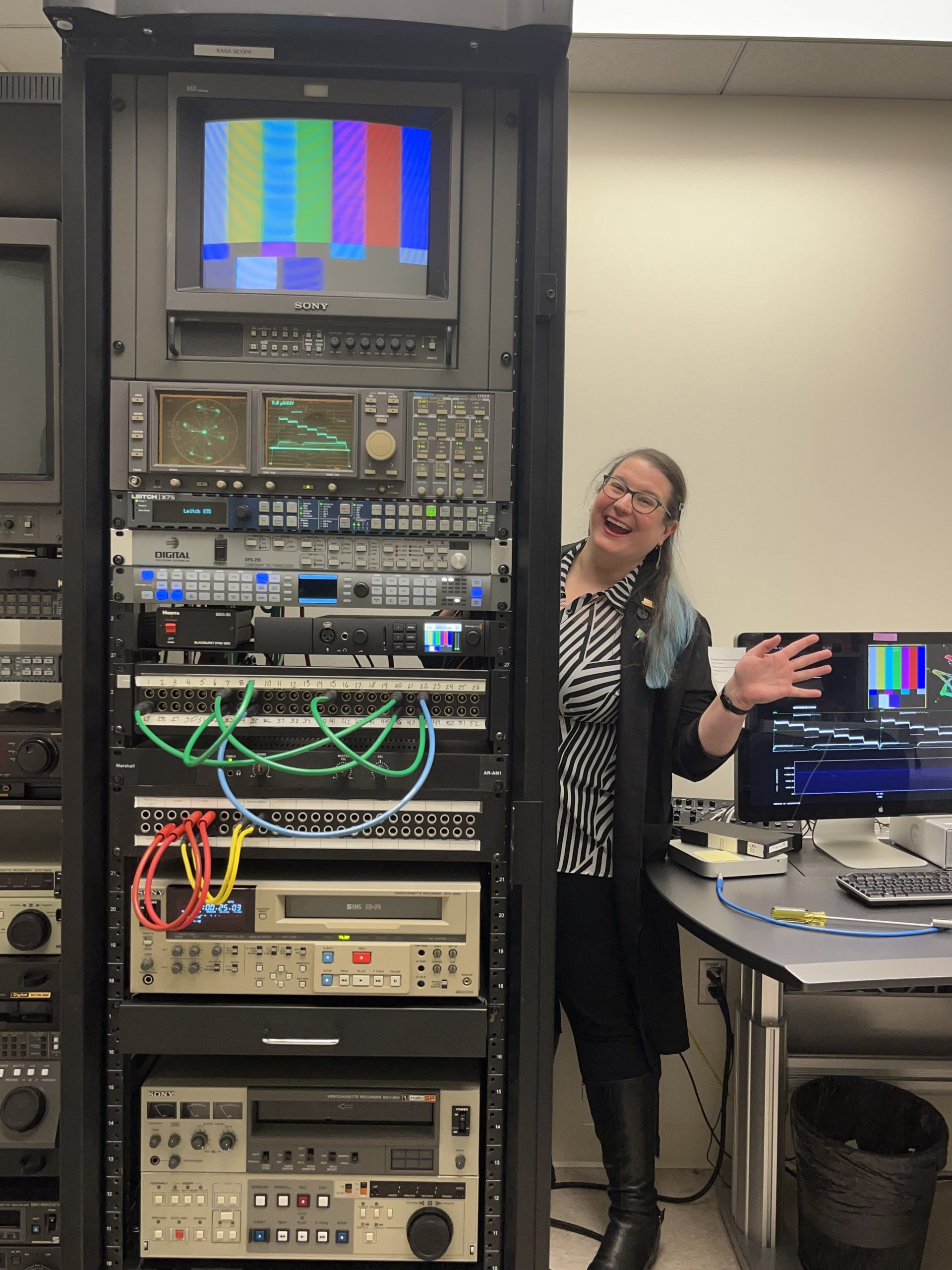 NMAAHC Video Archives Technician, Emily Nabasny. Photo courtesy of NMAAHC Media Conservation and Digitization Specialist, CK Ming.
Walter Forsberg: Hi Emily! Lovely to meet up with you. Can you start by letting us know where you are on the Smithsonian campus, today?
Emily Nabasny: Hi Walter! I am in the NMAAHC Video Digitization Lab at the Capital Gallery building, where [NMAAHC Media Archivist and Conservator] Blake McDowell and I have been working on rewiring this lab’s equipment and getting it fully back up-and-running. It hasn’t really been in use since before the COVID pandemic. Today, I’m digitizing VHS tapes from the Pearl Bowser Collection. I regularly work here, in the video lab, and next door in the film prep space where we undertake some of the film inspection work that we also do across the Mall at the museum.
WF: It seems as though NMAAHC has multiple media preservation spaces to perform work at. Is that a rarity at the Smithsonian?
EN: It is a rarity. It’s amazing to work at a place that’s so well-funded and well-equipped for this specialized labor. The media team is very privileged to have work spaces at three locations to do our preservation work. Our department has garnered a lot of positive attention for its digitization and conservation work with collections through the museum’s Center for African American Media Arts, and the Great Migration Home Movie Project. We must thank NMAAHC Head of Cataloging and Digitization Laura Coyle and the Robert F. Smith Fund for their immense budgetary support.
WF: Can you speak about how you first got interested in film and audiovisual media?
EN: For me it started very young. I grew up watching classic movies—like Hitchcock films, Universal Monsters, Vincent Price, and Turner Classic Movies—so I was exposed early on to a lot of film history. But my interest in the tangible archiving side of things really came from my grandfather Dennis L. Crow, who worked as a professional photographer. We had a lot of family slide shows and home movie projections—not only of family vacations, but also material my grandfather shot on his international work trips. They were exciting to experience as a kid, and I was fascinated by the technology. Being able to hold slides up to the light to see the images, watching the film projector spin the reels—that kind of thing.
 Emily Nabasny’s grandfather, Dennis L. Crow, shooting in New York City.
WF: Did you get involved in shooting film, as well?
EN: I did a lot of still film photography, which my mother is also proficient at, and shot some VHS home movies. I would play around with recording, but I was more interested in the technical side of things. Watching tapes after they were shot and adjusting the settings. I was the kid in the house who would sit in front of the old CRT television set with the knobs on the front, altering the saturation, contrast, and color balances to the extremes.
I ended up majoring in Film Studies in undergrad at the University of Pittsburgh, where I learned how film reels became lost in old trunks, abandoned houses, and filled-in old swimming pools, then were ultimately rediscovered and preserved. To me, that ‘media archaeology’ side of things is extraordinary and exciting.
WF: You ultimately enrolled in the NYU Moving Image Archiving and Preservation (MIAP) graduate program. I remember advising you on a project about the defunct Kodak New York City corporate archives.
EN: That’s right! When I was getting closer to figuring out what I wanted to do after college, my fascination and love of film and history—along with my penchant for organization—led some people to mention library science, which lead me to the NYU MIAP program. That’s how I found out about media archiving. And I do remember those Kodak archive boxes. Hundreds of copies of scientific publications and information about film chemicals. That was a great collection inventory project.
WF: There always seems to be someone in each family with the genealogical-interest gene. Are you that person for the Nabasnys?
EN: Oh yeah, definitely. I currently have about eight boxes of family photos in my apartment that I’ve been scanning. Our family has a collection of thousands of photos. I’ve digitized all of our home movies and, several years ago, I surprised everyone by editing some holiday clips together. Because I’m an archivist, everything is receiving detailed metadata. [Laughs]
WF: Of all the Smithsonian staff I can think of, you’re the person I know who has worked for the most museums. Has it been a decade since you started? Of course, I owe it to our Unbound blog readership to request that you run down the list for us.
EN: Almost a decade, but I’ve been here closer to eight years. It feels unusual that I’ve worked at five different Smithsonian units. I started my Smithsonian journey in 2015 at the Hirshhorn Museum and Sculpture Garden (HMSG) where I was brought in to digitize and migrate artworks recorded on Betacam videotape, and to work with [Variable Media Conservator] Briana Feston-Brunet to set up workflows and processes for time-based media conservation and to build out their media lab. I was there for two years and worked on documenting and ingesting born-digital media artworks into the DAMS. During that time (and in 2021), I worked with [Senior Conservator] Dana Moffett at the National Museum of African Art (NMAfA) on their time-based media art collection, creating collections policies and ingesting digital assets into the DAMS. A lot of the public is unaware of NMAfA. It’s small compared to many of its counterparts, but it hosts an incredible collection.
My third stop on the Smithsonian tour was the Center for Folklife and Cultural Heritage (CFCH) Ralph Rinzler Archive to undertake an enormous item-level inventory of video documentation of past Folklife Festivals. Most people know the Folklife Center from its annual festival hosted on the National Mall and from Folkways Records, which are both admittedly awesome, but fewer people know that Folklife has an amazing collection of materials documenting international cultural heritage from work they do.
WF: Folklife Media Archivist Dave Walker shared a 2002 highlight video from the Silk Road-themed festival for our recent, AVMPI presents: A Zoom with a View streamcast. Definitely great stuff at CFCH.
EN: Absolutely. It was eye-opening to learn more about their vast collections, and I ended up inventorying about 9,000 videotapes. Unfortunately, the scope of my project did not allow me time to watch any of the tapes, but I would love to. They have real variety and unique gems in their collections. My fourth location before coming to NMAAHC was at your own Smithsonian Institution Archives (SIA). I worked with [Digitization Manager] Kira Sobers on cataloging the media collection elements of the Smithsonian World television program. Smithsonian World was a 1980s co-production with the PBS affiliate in Washington, WETA-TV.
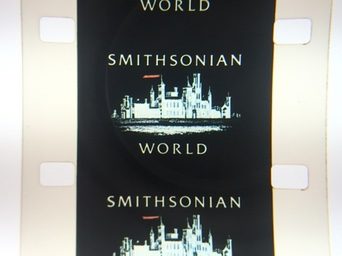 Title credit from the 1980s PBS series, Smithsonian World.
WF: Ahem, I think you mean the “groundbreaking, six-season, Emmy Award-winning series, Smithsonian World.” [Laughs]
EN: [Laughs] Yes, that’s the one! I think SIA was given much of the collection by a former producer and the AV collection materials had never been fully cataloged, so SIA was never certain of what they had in terms of content. It’s mainly 16mm film, with a few reels of 35mm, ¼” audiotape, and most of the finished programs on one-inch videotape. The program was shot on 16mm, so there are production outtakes and original episode segment reels that were later combined on film to make the episodes. My project started with working on rehousing film and cataloging the AV materials for seasons 1 and 2. When COVID hit in 2020, we had to reconfigure my work to center on researching the series and describing episode content because I had to work from home. When that rehousing project eventually continues, they will be able to use my content information to organize film reels within the seasons, and to assist researchers.
The series is from the 1980s, so watching episodes was like being in a time machine. Some of the most fun things I watched were a ‘fashion’-themed episode narrated by James Earl Jones, a segment where a wandering minstrel attempts communication with animals through music, and an episode about developing and constructing the Hubble telescope. That was particularly fascinating—hearing their hopes for the project and watching, given what we know now about how that ended up…I could talk about this show for hours. Incredible interviews and footage with Smithsonian scientists, researchers, staff, and a whole spectrum of other innovators.
 Emily Nabasny inspects film elements from 1980s PBS series, Smithsonian World, inside the laboratory at Smithsonian Institution Archives. Photo courtesy of Emily Nabasny.
WF: Tell me more about your current role as Video Archives Technician at NMAAHC.
EN: After the Smithsonian World project, I moved to work with the six-person ‘Dream Team’ at NMAAHC. NMAAHC has four full-time media archiving staff members and two contractors, including myself, all working to catalog, preserve, conserve, and share the audiovisual collections. I assist with film rehousing and digitization projects, though my current main project is working with a video collection the museum acquired from author, director, producer, archivist, and founder of African Diaspora Images, Pearl Bowser. Pearl’s video collection is comprised of her own documentary work, as well as copies of ‘race films’ by Oscar Micheaux, films by African American filmmakers, documentaries about African American history, and recordings of local television station broadcasts. I have started by researching and digitizing her VHS collection, and then I will move to her U-matic format video collection. Other team members are working on digitizing and cataloging her audiocassettes.
WF: What’s been the most eye-opening part of your career to this point?
EN: When I was in school, I would have *never* expected to work in an art museum. It simply wasn’t part of my career vision. But, I was open to working with different types of media materials, and working on media-based artworks at HMSG and NMAfA was a constant learning experience because it is so different from archival materials. There are many aspects one must consider when working with media formats, and even more considerations when working with art and artists. When you’re pulling a media artwork piece out of storage for exhibition, there’s always the question: Does it still work? And, if it doesn’t work: What are we allowed to undertake as an intervention to get it working? The technological obsolescence aspect of whether or not a museum is able to exhibit an older media art piece was a fun challenge. It was thrilling to be part of those decisions in time-based media art conservation. I remember working with Briana at the Hirshhorn on the artwork At Hand by Ann Hamilton, whose audio files were stored on an outdated SATA hard drive, and we went on a wild chase trying to find the right combination of cables and adapters to get the files off the drive. At NMAfA, I was part of a conservation meeting with Sue Williamson about her work Can’t Remember, Can’t Forget, which is an interactive artwork that was originally exhibited on a computer from the 1990s. We talked with Sue about what was integral to the exhibition and meaning of her artwork, both technologically and aesthetically. ‘What is the art?’ is a fascinating question to consider when looking at media art, because its often more than viewers think.
WF: Do you have any career advice to folks interested in working in audiovisual preservation?
EN: I echo Pam Wintle’s comment in your last blog to be curious and remain open to new experiences. I’ve worked several jobs that I would have never thought I would, but I learned a lot and had great experiences. Being open to the new and unexpected is a big part of life and you never know where a different job or new collection might take you. After working at five different Smithsonian units, I can say each was different than I had expected. Every archive, every collection is unique. There will be institutional things you have to adapt to, collection elements to learn and consider, and constantly new technology to learn. There’s certainly no shortage of collections and incredible projects at the Smithsonian!
In honor of Women’s History Month, we’re celebrating women’s stories in our second AVMPI Presents program. Join us for a screening of audiovisual materials from across the Smithsonian that represent both the spectrum of American women’s history and the diversity of our film and video collections.
Join us to hear more about Emily’s work, the Pearl Bowser Collection, and more!
Ascending Pikes Peak in a Locomobile
Two men set off to ascend a mountain located in Colorado called Pikes Peak. Their transportation was a vehicle called the Locomobile, and this trade catalog traces their journey on an August day over a century ago.
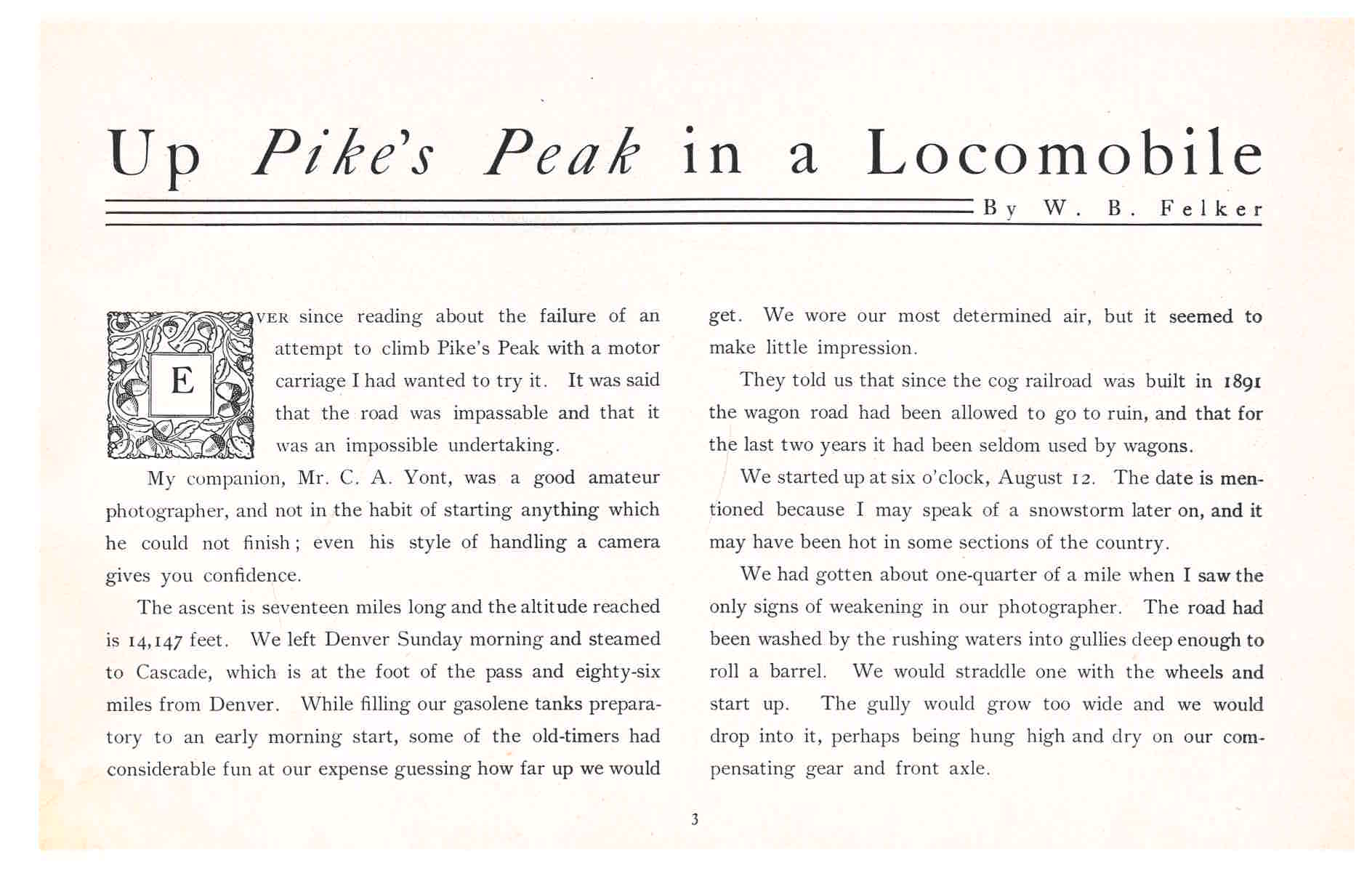
The trade catalog is titled Up Pike’s Peak and Elsewhere in a Locomobile (1901) by Locomobile Co. of America. It begins with a descriptive account of the journey, written by W. B. Felker, titled, “Up Pike’s Peak in a Locomobile.” Mr. Felker’s companion for the trip was Mr. C. A. Yont, an amateur photographer. Their goal was to drive a Locomobile to the summit of Pikes Peak at an altitude of over 14,000 feet.
 Locomobile Co. of America, New York, NY. Up Pike’s Peak and Elsewhere in a Locomobile (1901), front cover.
Before we follow their journey, let’s learn a little about the vehicle they used. It was a steam vehicle called a Locomobile. Several testimonials written by satisfied customers are shared at the end of this catalog. A common theme found throughout these testimonials is the vehicle’s ability to handle hills, long stretches, and poor road conditions.
One testimonial, dated December 15, 1900, was written by Dr. W. B. French of Washington, D.C. According to that testimonial shared on page 22, Dr. French had ridden 5,880 miles in the Locomobile since February 21, 1899, averaging about 580 miles per month. The doctor commented, “This mileage includes many country runs adjacent to this city, over some of the most villainous roads that were ever made, but the ’Loco’ will go even over such roads if it is given steam and some little experience in handling.”
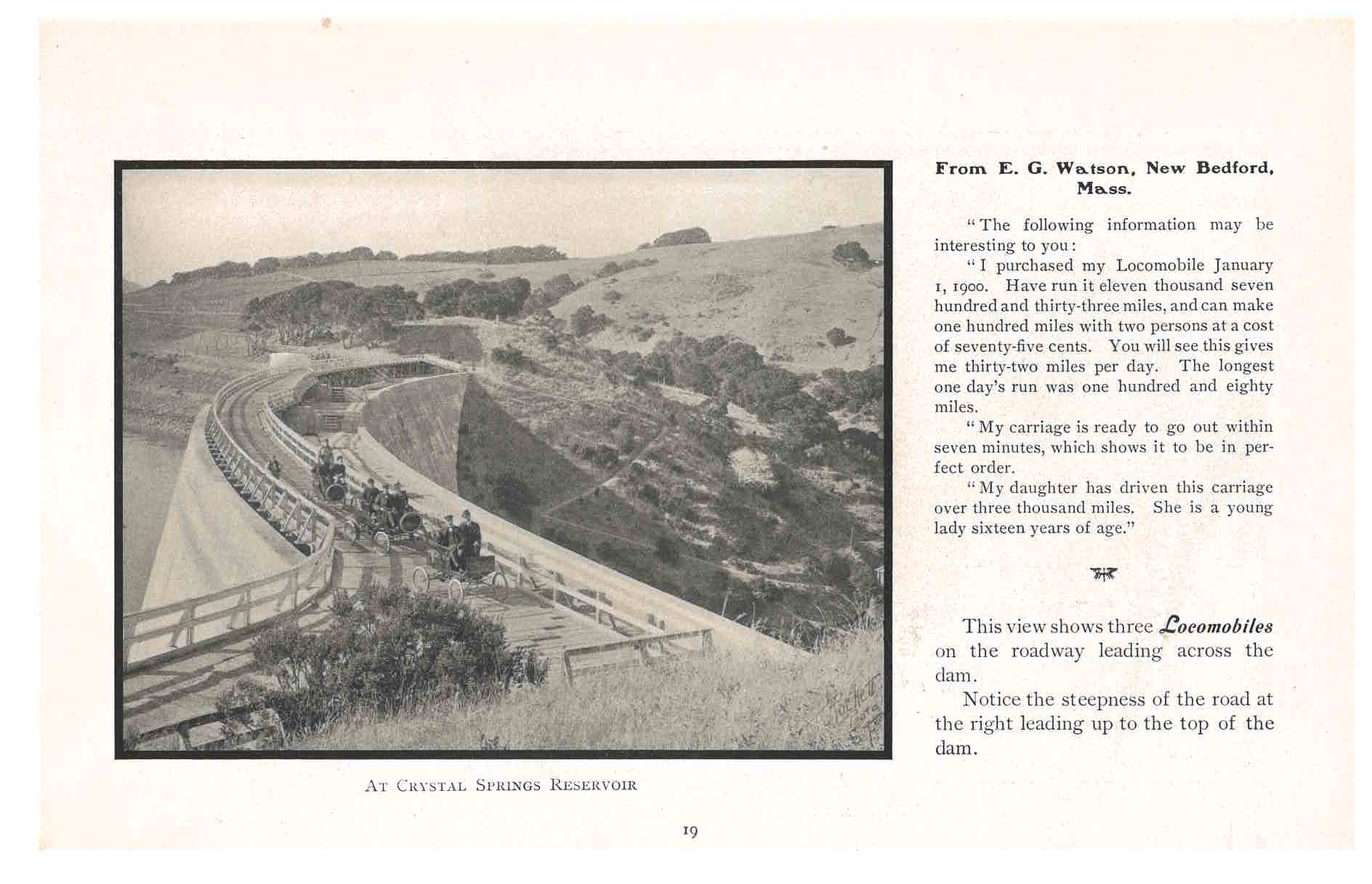
Throughout these testimonial pages, there are also images of Locomobiles in various locations. The image shown below illustrates three Locomobiles on the road leading across the dam at Crystal Springs Reservoir in California. Its caption in the catalog points out “the steepness of the road at the right leading up to the top of the dam.”
 Locomobile Co. of America, New York, NY. Up Pike’s Peak and Elsewhere in a Locomobile (1901), page 19, three Locomobiles at Crystal Springs Reservoir.
Now let’s delve deeper into the journey of Mr. Felker and Mr. Yont as they ascended Pikes Peak in a Locomobile. Their preparation began on a Sunday, as they traveled 86 miles from Denver to Cascade where they filled their tanks to prepare for the following day’s adventure. Mr. Felker remarked that “some of the old-timers had considerable fun at our expense guessing how far up” they would go. They were also told that the wagon road had not been used much by wagons in the past two years and had gone “to ruin” since the cog railroad was built in 1891.
 Locomobile Co. of America, New York, NY. Up Pike’s Peak and Elsewhere in a Locomobile (1901), page 3, beginning of account titled “Up Pike’s Peak in a Locomobile” by W. B. Felker.
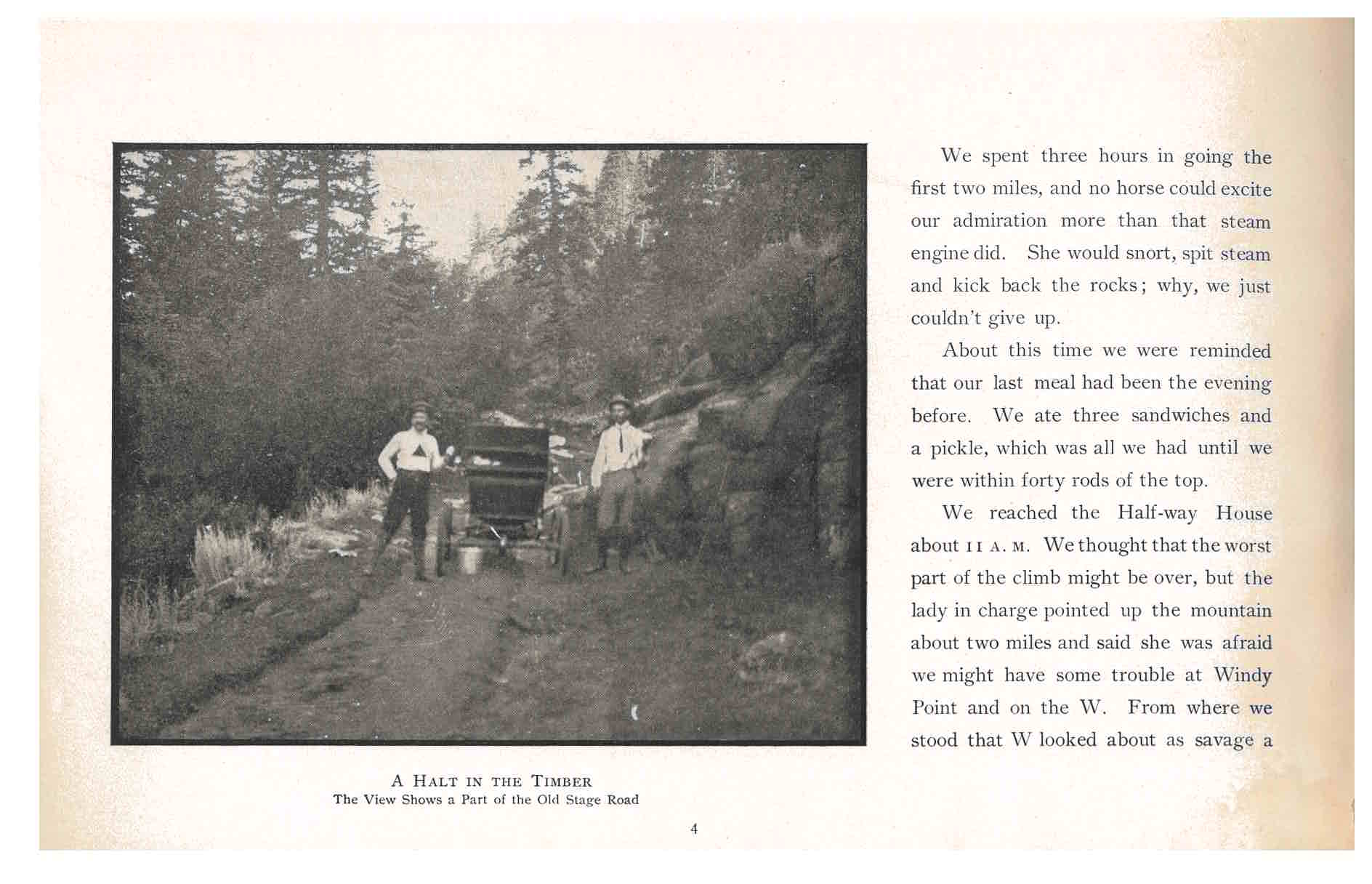 Locomobile Co. of America, New York, NY. Up Pike’s Peak and Elsewhere in a Locomobile (1901), page 4, the two men on a portion of the “Old Stage Road” with the Locomobile.
Their ascent to the summit of Pikes Peak began at 6:00 am on August 12. After the first quarter of a mile, they reached a spot where the “road had been washed by the rushing waters into gullies deep enough to roll a barrel.” Straddling the gullies with their wheels, they continued on. However, they discovered that as a gully became wider, they “would drop into it.” It took three hours to ascend the first two miles. By that time, they decided to stop for a meal consisting of three sandwiches and a pickle. They reached the “Half-way House” at about 11:00 am and thought the worst was behind them.
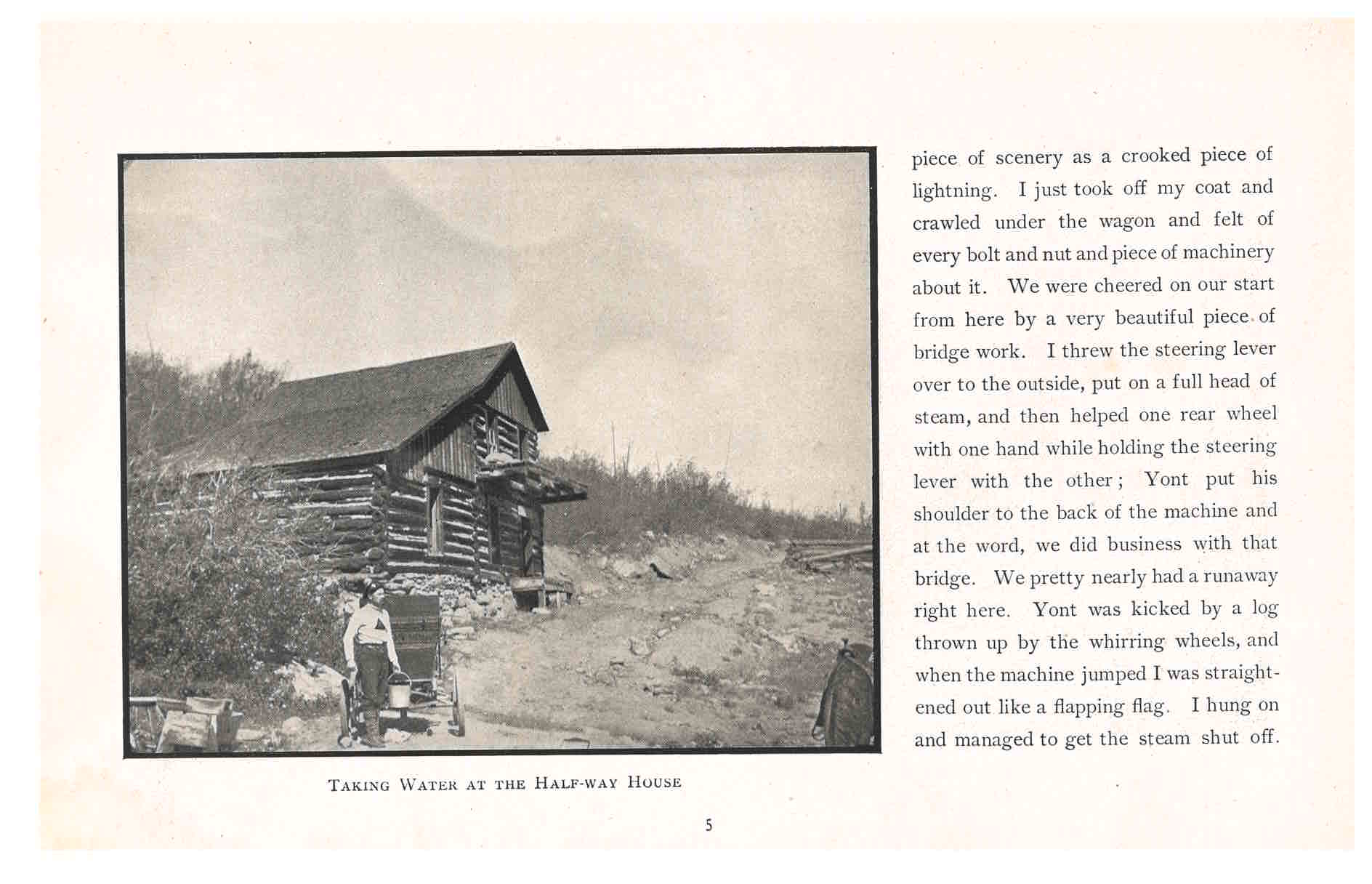 Locomobile Co. of America, New York, NY. Up Pike’s Peak and Elsewhere in a Locomobile (1901), page 5, rest stop at the Half-way House.
But the lady in charge informed them they “might have some trouble at Windy Point and on the W.” Mr. Felker writes, “From where we stood that W looked about as savage a piece of scenery as a crooked piece of lightning.” That led to checking all the machinery of their vehicle, including every bolt and nut, before continuing their journey.
Soon after setting off, they reached a bridge where they “pretty nearly had a runaway…” Mr. Felker writes, “Yont was kicked by a log thrown up by the whirring wheels, and when the machine jumped I was straightened out like a flapping flag.” He continues by remarking that he had “seen some rather bogus bridges, but that beat me.”
As they continued along, they had the opportunity to marvel at the “Grand View,” illustrated below, which from his description appears to be exactly that. And another landmark was “Windy Point” for which Mr. Felker writes, “One knows when they get there.”
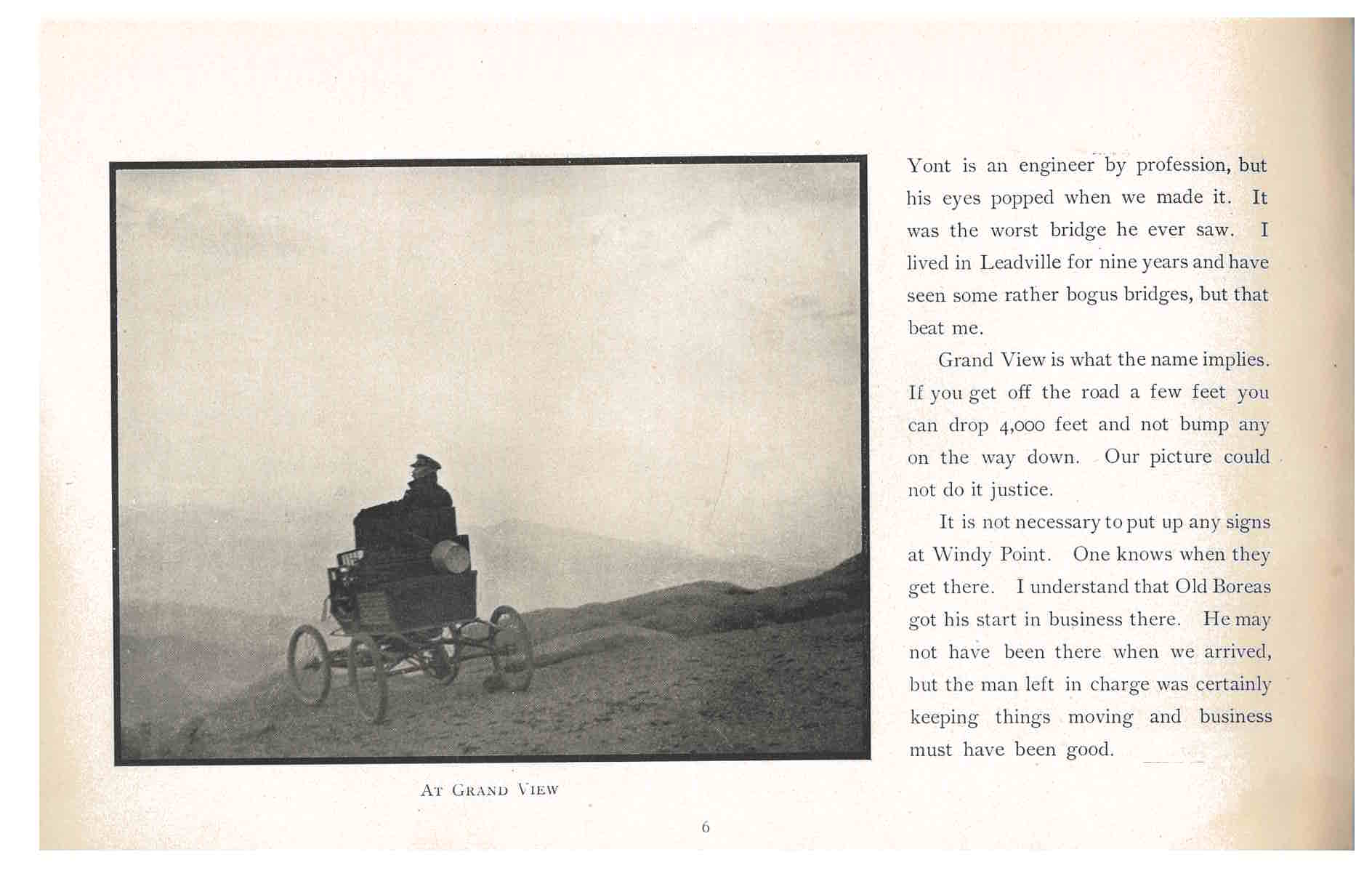 Locomobile Co. of America, New York, NY. Up Pike’s Peak and Elsewhere in a Locomobile (1901), page 6, a stop at “Grand View.”
The lady at the “Half-way House” had warned them of the “W” but it turned out to not be as “formidable” as they had feared. For an idea of how the “W” looks, Mr. Felker suggests turning a letter “W” sideways. Though he cautions that it does not convey how a person actually feels while “on one of the points of the W about 13,000 feet up in the air.”
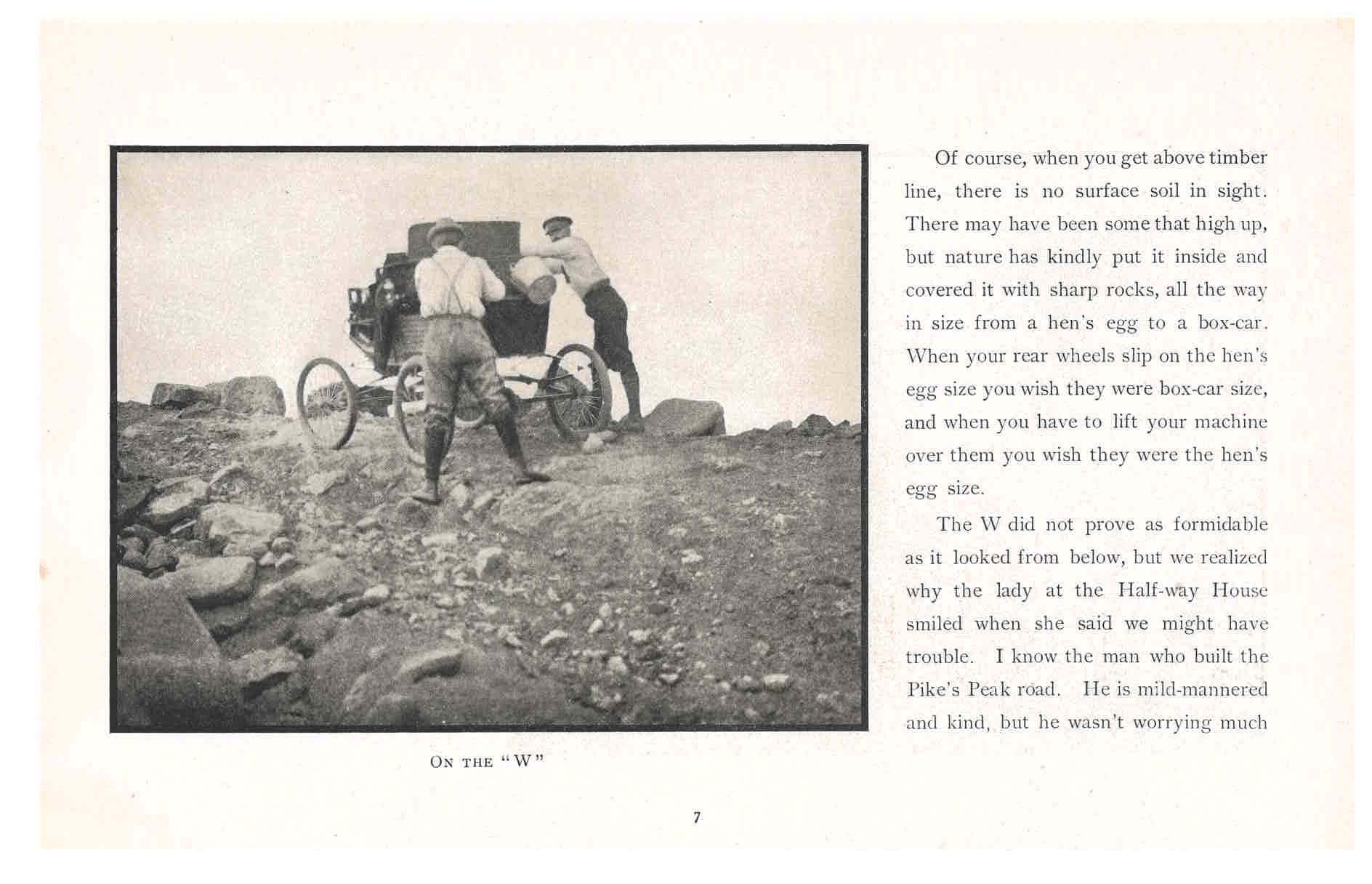 Locomobile Co. of America, New York, NY. Up Pike’s Peak and Elsewhere in a Locomobile (1901), page 7, tending to the Locomobile on the “W.”
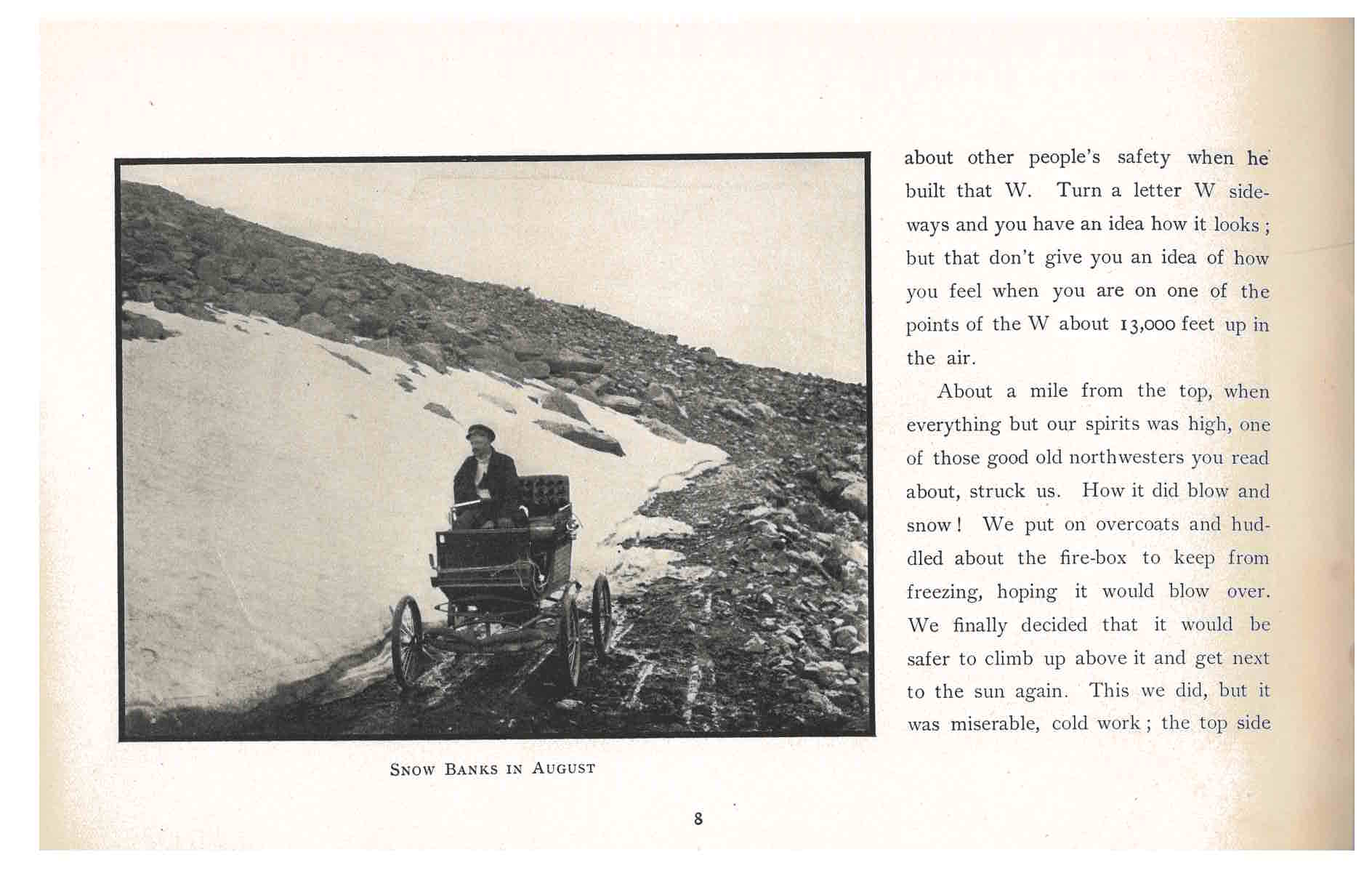 Locomobile Co. of America, New York, NY. Up Pike’s Peak and Elsewhere in a Locomobile (1901), page 8, snowbanks in August.
And then on that August day, about a mile from the summit, they encountered a snowstorm. After passing the storm, they realized they were hungry and also struggling with the air and high altitude. A horseback rider came along and offered to go ahead and find food for them, and with that assistance, they reached the summit. At the top, they paused for photos, food, and coffee.
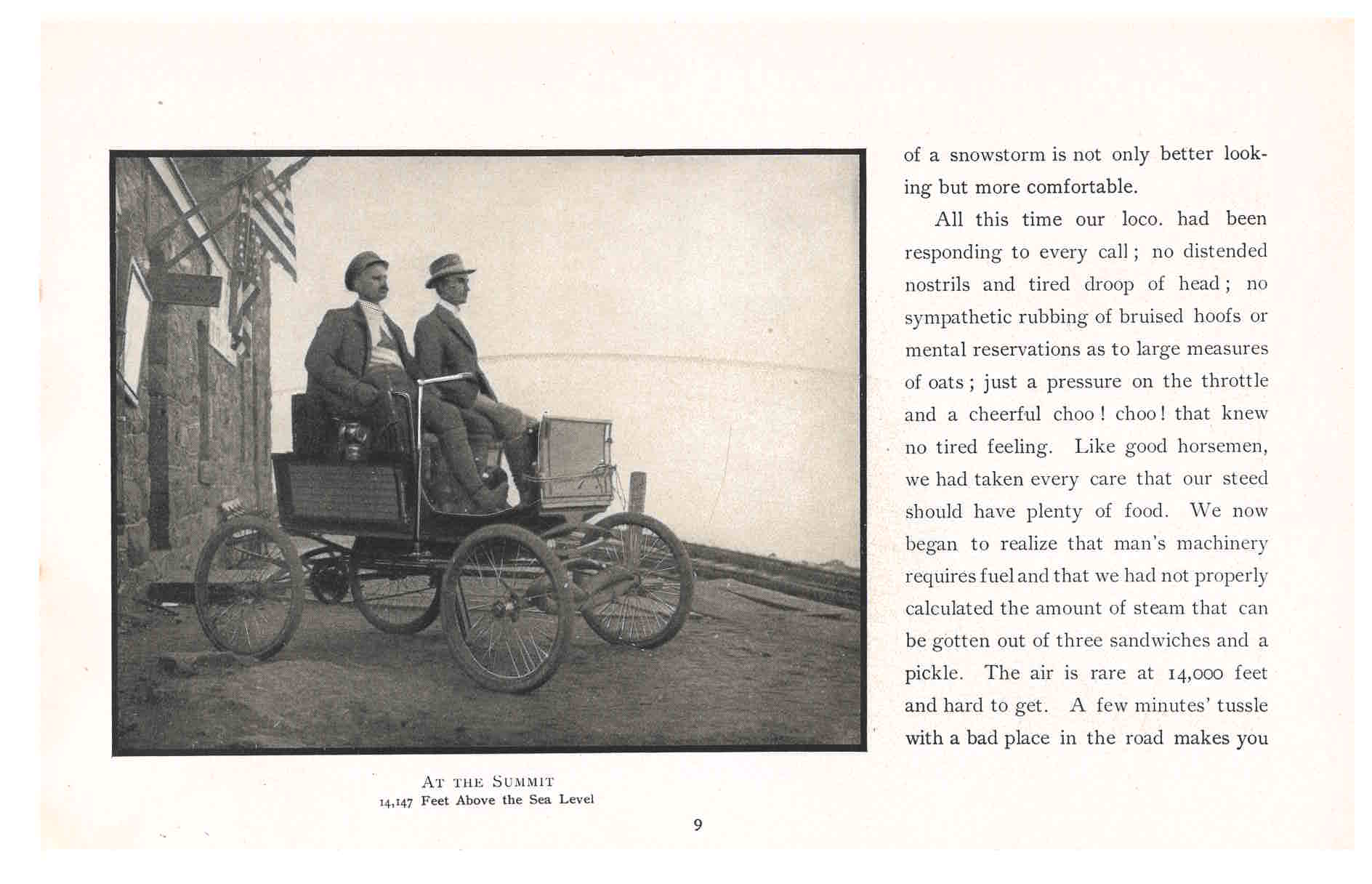 Locomobile Co. of America, New York, NY. Up Pike’s Peak and Elsewhere in a Locomobile (1901), page 9, at the summit of Pike’s Peak on the Locomobile.
Their return trip back down turned out to be “perhaps more dangerous, but not such hard work.” Due to their tiredness and impatience to get to the bottom before dark, they took more chances. After passing the “Half-way House,” they continued their journey with the assistance of their “side-lights” as they made their way through the darkness. They discovered more bumps on the road than they had on the way up, and Mr. Felker wrote that their brake was so hot they “could smell the burning leather, and the metal parts could not be touched with the hand.”
According to Mr. Felker’s account, by 9:30 pm they reached Cascade and headed to bed as they “were too tired to stand around and brag much.” The next morning, the two men departed Cascade, traveled through Ute Pass to Manitou, ate breakfast in Colorado Springs, and reached Denver at 4:00.
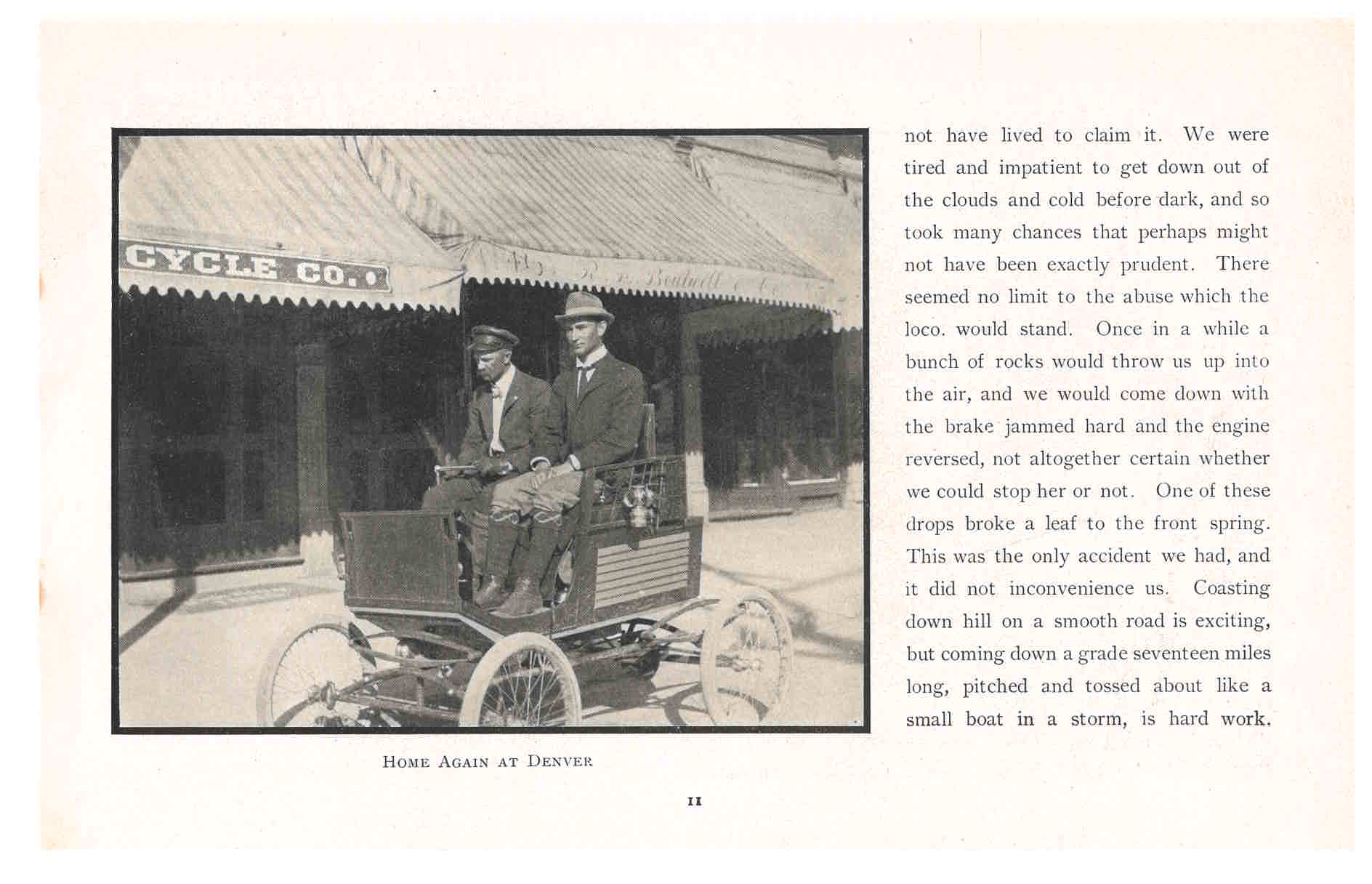 Locomobile Co. of America, New York, NY. Up Pike’s Peak and Elsewhere in a Locomobile (1901), page 11, home in Denver.
Up Pike’s Peak and Elsewhere in a Locomobile (1901) and other Locomobile Co. of America trade catalogs are located in the Trade Literature Collection at the National Museum of American History Library.
Introducing the #FunnList
This Black History Month, we’re excited to introduce the #FunnList: a spotlight on Black women in science from Smithsonian history.
The Funn List builds off the Smithsonian Funk List, the brainchild and namesake of Vicki Funk (1947-2019). Now maintained by American Women’s History Initiative Digital Curator Liz Harmon, the Funk List is an ever-expanding data set documenting over five hundred Smithsonian women in science, past and present.
The vast majority of women on the Funk List are white. Ellis L. Yochelson and Mary Jarrett’s 1985 retrospective, 75 Years in the Natural History Building, crystallizes this disparity: “At the present time [in 1985], though other minority groups are represented, there are no American blacks on the scientific staff.” An understatement follows on the next page: “The historical record is not one to be particularly proud of.”
Despite institutional racism, Black women have fought to forge careers in the sciences at the Smithsonian since at least the mid-twentieth century. The #FunnList campaign from Smithsonian Institution Archives honors the unique stories of these scientists—starting with its namesake, Annette Jones Funn.
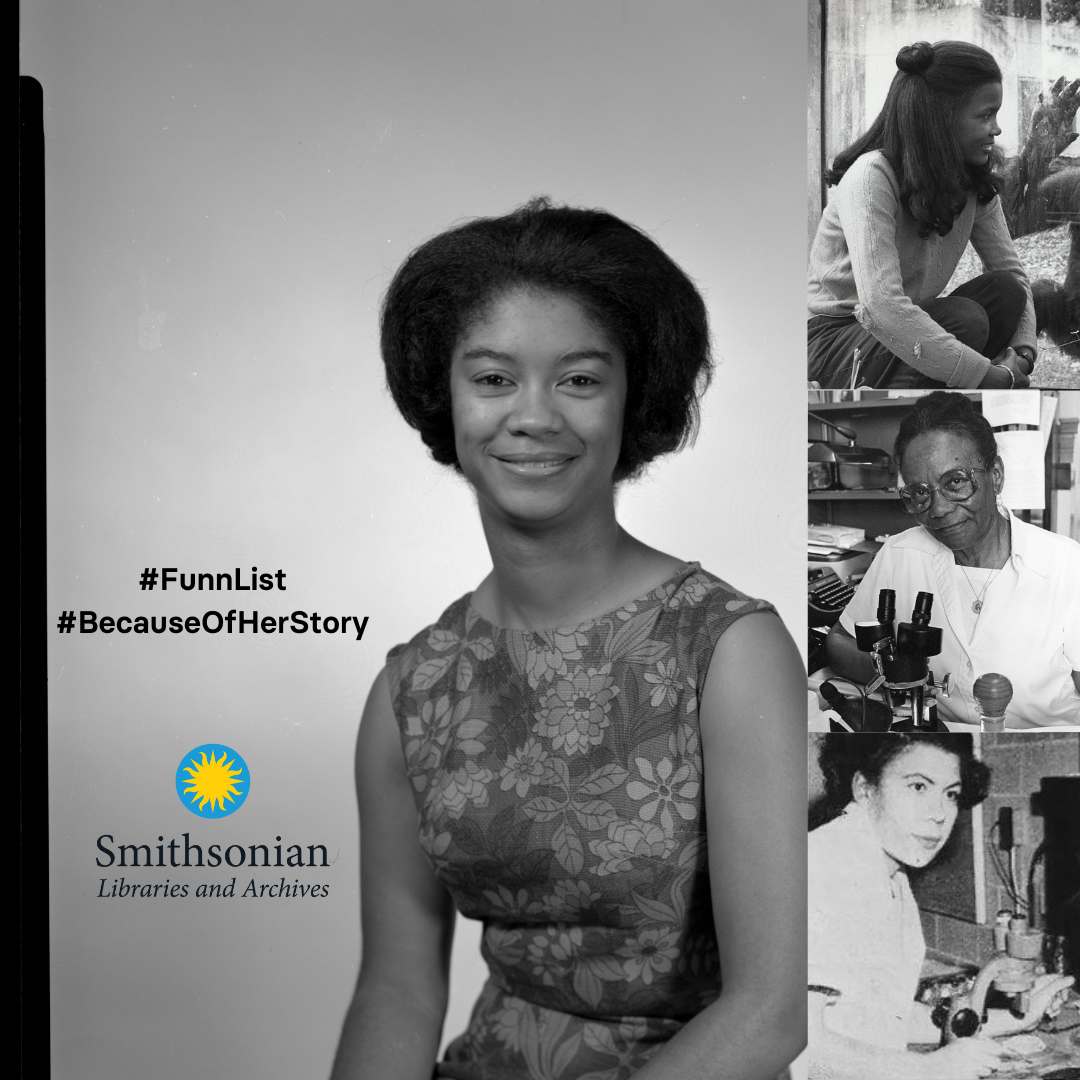 A #FunnList collage featuring, clockwise, from left: Annette Jones Funn; Lisa Stevens; Sophie Lutterlough; Margaret Collins.
The Funn in the #FunnList
The Funn List is named after Annette Jones Funn (1942-2016), a microbiologist with the Smithsonian Oceanographic Sorting Center (SOSC) and U.S. Food and Drug Administration.
Funn spent the years 1966 and 1967 as a technician with the Smithsonian Oceanographic Sorting Center. Founded a few years earlier, SOSC was responsible for cataloging, preserving, and distributing marine specimens for research worldwide.
The Oceanographic Sorting Center was headquartered south of the National Mall, in Washington, DC’s Navy Yard area. Funn’s work, however, took her even farther afield.
In September 1967, Funn joined an expedition of the Southeastern Pacific Biological Oceanographic Program (SEPBOP). The Anton Bruun’s Cruise 18B set sail from Callao, Peru, traveling through the Galapagos to Guayaquil, Ecuador. Along the way, Funn collected invertebrates and algae for SOSC, and preserved specimens gathered from midwater trawls.
Funn would go on to a decades-long career at the U.S. Food and Drug Administration, where she melded her microbiology expertise with a focus on public health. As part of her work in the FDA’s Office of Consumer Affairs, Funn served as a public health advisor for the Health and Human Services Secretary’s Health Promotion Initiative.
Funn’s community advocacy extended well beyond her professional duties. As an undergraduate at Virginia State University, she was appointed by Martin Luther King, Jr. to lead a “platoon” in a civil rights march held near the college. Later, she would hold leadership roles in a veritable bevy of local and national Black and women’s organizations: the National Council of Negro Women, the League of Women Voters, and the NAACP, to name a few.
Funn List Spotlights
Annette J. Funn | Margaret Collins | Margaret Santiago | Sophie Lutterlough | Lisa Stevens
 Sophie Lutterlough at a Microscope, 1983. Smithsonian Institution Archives.
Further Reading:
“Concerned Black Women honors Annette Funn” by Tamara Ward, Southern Maryland News
Inspiring African American Women of Calvert County by Friends of Calvert Library
Join us for “Music HerStory: Women, Zines, and Punk”
February 28th, 7 pm ET
Register via Zoom
Zines are celebrations of self-expression. These unique documents often combine first-person narratives and frank opinion pieces with interviews, reviews, and musings on art, music, and culture. Popular today, zine use was propelled by the riot grrrl movement in the early 1990s. They connected like-minded readers and musicians through writing about women’s issues, perspectives, and experiences. Zines continue to promote community-building and creativity, especially among young women.
In this virtual panel discussion, we’ll explore the history of zines as a grassroots medium, the impact of the riot grrl movement on modern zine creators, and the role libraries and archives play in preserving this material.
Featuring:
- Allison Wolfe, co-creator of Girl Germs, Bratmobile, and Riot Grrrl
- Molly Neuman, co-creator of Girl Germs, Bratmobile, and Riot Grrrl
- Osa Atoe, creator of Shotgun Seamstress
- Michele Casto, librarian, People’s Archive, DC Public Library
Moderated by Meredith Holmgren, curator of Music HerStory: Women and Music of Social Change
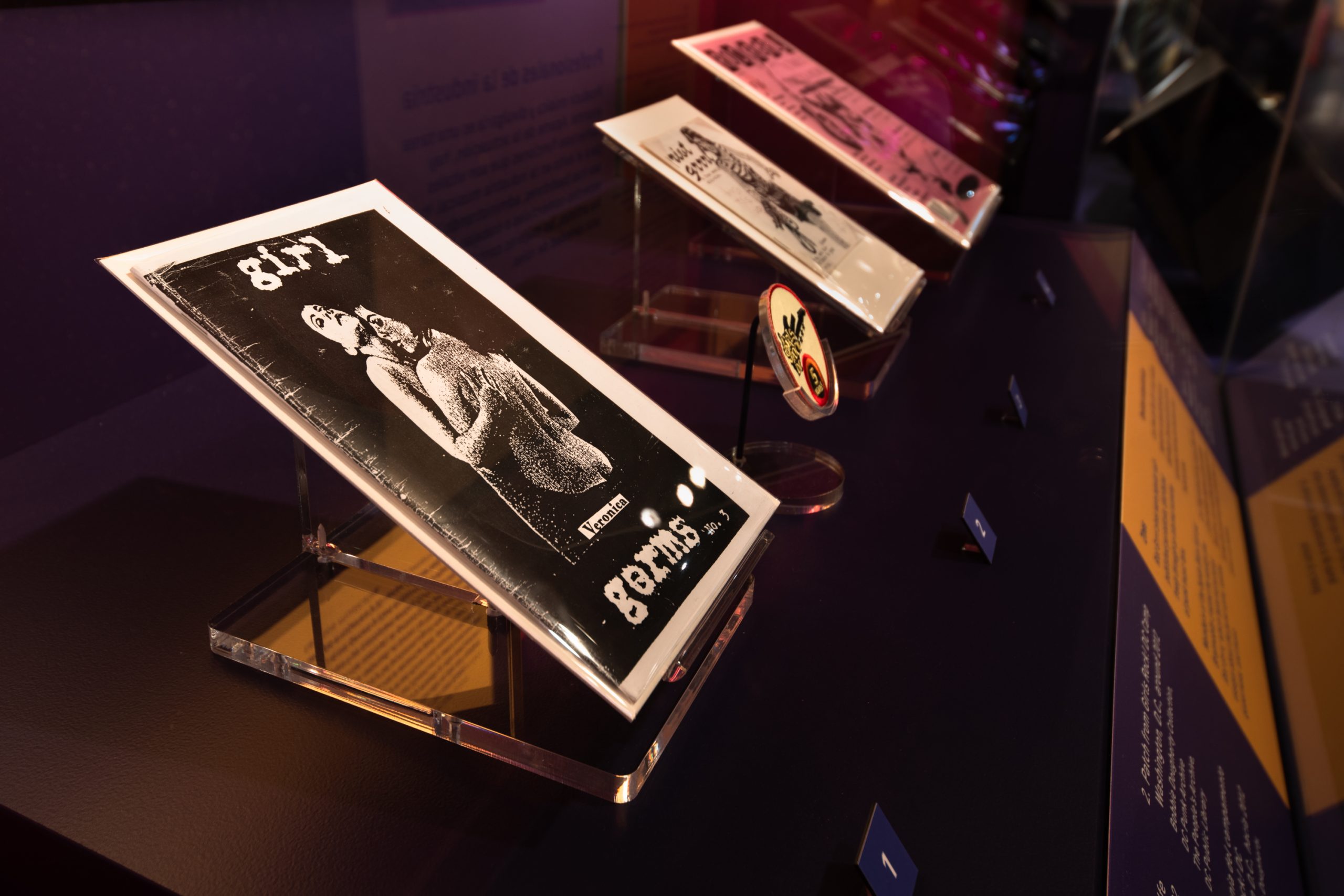 Girl Germs and Riot Grrl zines, on display in Music HerStory: Women and Music of Social Change. Photo by Carolyn Thome, Smithsonian Exhibitions.
This program is part of the exhibition Music HerStory: Women and Music of Social Change, organized by Smithsonian Libraries and Archives and the Smithsonian Center for Folklife and Cultural Heritage. The exhibition, which is now on view in the National Museum of American History, received support from the Smithsonian American Women’s History Initiative.
Related Content:
- Music HerStory: Zine Workshops, March 4th. Details coming soon!
- Bernice Johnson Reagon mini-comic created for Music HerStory: Women and Music of Social Change.
California Rare Books School Comes to Smithsonian Libraries and Archives
Interested in exploring books and archives dating back to the 13th century? Join our summer rare book school!
The Smithsonian Libraries and Archives, in collaboration with UCLA’s California Rare Book School (CalRBS), is excited to present seven (7), week-long, intensive rare book courses at the Smithsonian from August 14-18, 2023. Participants will benefit from an expert faculty and the wealth of special collections of rare books, manuscripts, and archival materials. All attendees will receive in-depth instruction over five consecutive days in specialized topics with authorities in their fields.
Courses and Instructors Include:
- The Power of Display: Books as Transformative Tools in Exhibitions (Jennifer Cohlman Bracchi and Vanessa Haight Smith)
- The Social and Material Lives of Comic Art, or, How Comics Get Around (Charles Hatfield)
- Introduction to Audiovisual Preservation (Siobhan Hagan and Walter Forsberg)
- Data Born in Literature: 600 Years of Special Collections Serving the Planet (Martin Kalfatovic)
- The Nature of Science in Manuscript and Print (Lilla Vekerdy and Leslie Overstreet)
- Introduction to Western Codicology (Ilya Dines)
- Artist Books at the Smithsonian (Brad Freeman)
Select a course above to learn more! From medieval Western manuscripts to comic art, there is something for everyone.
CalRBS was founded in 2005 as a non-degree education program dedicated to providing the knowledge and skills required by collectors and professionals working in libraries, archives, museums, and rare book communities. Read more about CalRBS.
Researching Russia Leather
Smithsonian Libraries and Archives’ new exhibition, “Nature of the Book“, explores the use of natural materials in books from the hand-press era, from the mid-1400s through the mid-1800s. One of the materials the exhibition examines is leather, which was commonly used for book coverings.
One of the leather-bound books we highlight is Mark Catesby’s magnum opus, The Natural History of Carolina, Florida and the Bahama Islands, published between 1729 and 1747. This lavishly illustrated two-volume set is the only known contemporaneous account of the flora and fauna of the American colonies.
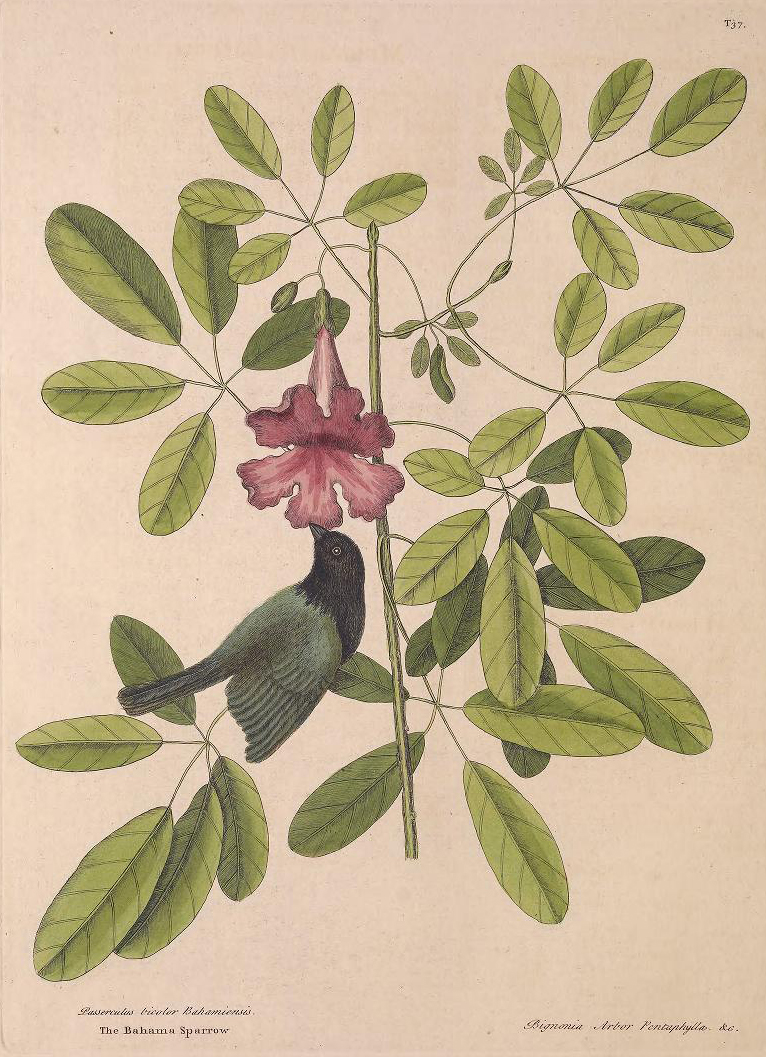 Plate 37, “The Bahama Sparrow”. The Natural History of Carolina, Florida and the Bahama Islands (1729-1747).
Mark Catesby traveled to the American colonies in 1712 with his sister. During his stay he collected botanical seeds and specimens, returning home to England in 1719. He spent the next twenty years producing The Natural History of Carolina, Florida and the Bahama Islands. He sold the book via subscription, releasing it in eleven parts over nineteen years. He gave explicit instructions to wait for all of the parts to be complete before binding the parts in two volumes. Few owners were patient enough to wait for the Appendix before binding.
The original owner of the copy in the exhibition was Cromwell Mortimer, Secretary of the Royal Society. During the Hand Press era (1450-1850) books were printed but left unbound so that the purchaser could customize the binding, including covering materials and decorative endpapers. Cromwell Mortimer likely chose to have the volume bound in one of the most luxurious materials of the time, Russia leather, known as Yufte in Russia.
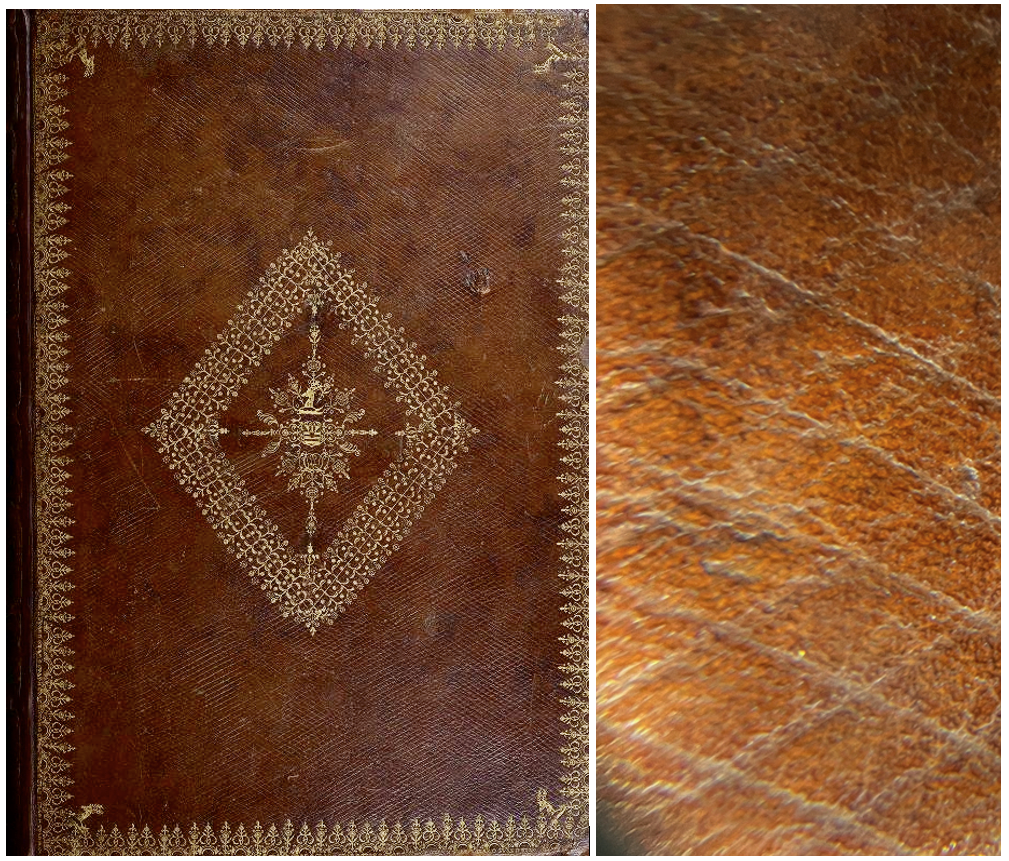 The cover of The Natural History of Carolina, Florida and the Bahama Islands with a close-up of the diamond shaped pattern
As the name suggests, this leather was imported from Russia via the Baltic Trade Routes. The leather has unique characteristics: a diamond shaped pattern, a reddish-brown color, and the aroma of birch oil. Russia leather is vegetable-tanned in the same manner as other leathers with some key differences.
Traditional vegetable tanning is the process of taking an animal hide, cleaning it thoroughly, soaking it in tannins (from tree bark, wood, galls, fruit, or other plant matter), drying it, and processing it to keep it flexible. In the case of Russia leather, willow bark is the traditional tannin used as it is found abundantly throughout the country. The other differences are in the processing of the leather. Birch oil, with its distinctive odor, was added at the end of the tanning process to keep the leather flexible. The diamond shaped pattern of the leather was originally imparted with sticks and later via a specially created grooved cylinder that was weighted and rolled across the leather in two different directions to create the pattern.
It can be difficult to distinguish Russia leather from diced leather. Additionally, the birch oil odor dissipates over time. However, we have several helpful clues that aid us in identifying the leather used on this binding. The first is the original 1955 catalog of the sale of the Ornithological Library of Dr. Evan Morton Evans. Our copy was purchased in that sale and is described on page 31 as being bound in “full old russia.”
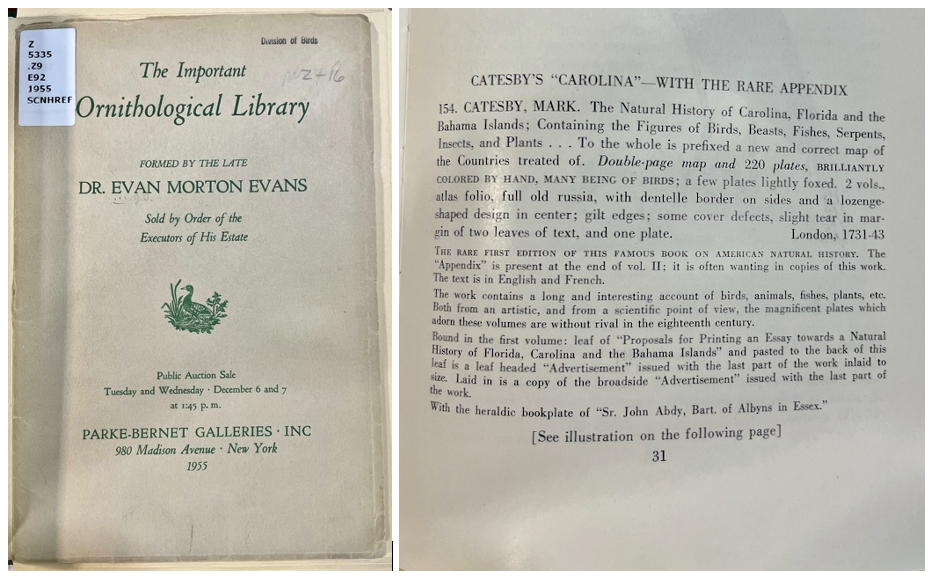 The catalog including the sale of Cromwell Mortimer’s Catesby.
The second clue comes from the pictures and descriptions of Russia leather that were found in the Metta Catherina shipwreck, discovered in 1973. The ship set sail from Saint Petersburg to Genoa in 1786 with a cargo that included rolls of Russia leather when it sank off the coast of Devonshire. The rolls of Russia leather from the Metta Catharina remained preserved for over two hundred years. Some of the leather is now in research collections where the curators of the exhibition were able to examine a piece of it in person.
 Russia leather from the Metta Catharina shipwreck at the Leather Conservation Centre, Northampton, England.
The third avenue we explored was the source species of the hide. Each species has a unique pore structure that is revealed when the leather is viewed under magnification. In the case of the Catesby binding the species appears to be calf. Peptide Mass Fingerprinting (PMF) is another option for identifying the species of origin of leather. While the accuracy rate is very high a sample of the leather is required for this testing, so we opted for the non-invasive pore structure method. Russia leather could be made from a variety of species including calf, reindeer, goat.
The story of Russia leather continues to be a source of fascination today. While the process was not a secret, re-creating Russia leather proved difficult. Tanneries in England, France and Germany attempted to re-create the leather, but the results were not as durable as the imported Russia leather. In the early 20th century this leather became one of the symbols of the exiled Russian population after the 1917 Revolution, particularly in Paris. One of Coco Channel’s early perfumes, Cuir de Russie, evokes the scent of Russia leather. After the revolution, the technique was thought lost until 2016 when the Parisian luxury leather goods manufacturer, Hermès, partnered with a British tannery to successfully recreated Russia leather.
A Convenient Filing System for Late 19th Century Courthouses
As a new year begins, the idea of sorting or reorganizing files might be running through our minds. Without the use of computers, how were important records filed or accessed in the late 19th Century? This trade catalog provides a few hints, especially for workplaces such as courthouses and clerk’s offices.
The trade catalog is titled Wolfe’s Patent Roller Shelving, and Wundt’s Patent File Receptacles (circa 1888) by Pauly Jail Building & Mfg. Co. It includes illustrations and descriptions of these two filing devices along with testimonials from offices and courthouses who used the systems.
The two systems could be installed separately or combined to create a combination case. The front cover, below, shows a combination case of Wolfe’s Patent Roller Shelving and Wundt’s Patent File Receptacles installed at the Clerk’s Office of the Des Moines County Court House in Burlington, Iowa.
 Pauly Jail Building & Mfg. Co., St. Louis, MO. Wolfe’s Patent Roller Shelving, and Wundt’s Patent File Receptacles (circa 1888), front cover/unnumbered page [1], combination case of Wolfe’s Patent Roller Shelving and Wundt’s Patent File Receptacles in the Clerk’s Office in Des Moines County Court House, Burlington, Iowa.Printed on the last page of the catalog is an extract from an article in the Ohio State Journal dated July 14, 1887. It provides some background information on the development of Wolfe’s Patent Roller Shelving. From this extract, we learn that Mr. M. P. Wolfe was the patentee and developed the idea of the Roller Shelving while he was a recorder at the Montgomery County, Indiana Courthouse.
As described in the extract, the courthouse was being furnished “with bookcases, consisting of flat shelves, for the books to lie on.” Mr. Wolfe suggested the idea of rollers replacing the shelves. From his experience, this would make it easier to retrieve and re-shelve the large volumes. Following that suggestion, he experimented with his idea, especially in regard to friction. This led to the development of Wolfe’s Patent Roller Shelving.
Though the article mentions Mr. Wolfe as the patentee and developer of the idea, it also mentions Mr. Wundt as the “manufacturer and proprietor” of the system. A testimonial on the same page, dated July 3, 1888, by the County Commissioners of Barry County, MO, mentions File Receptacles patented by C. L. Wundt and Patent Roller Shelving patented by M. P. Wolfe.
 Pauly Jail Building & Mfg. Co., St. Louis, MO. Wolfe’s Patent Roller Shelving, and Wundt’s Patent File Receptacles (circa 1888), unnumbered page [4], testimonials from satisfied customers and extract of an article from Ohio State Journal dated July 14, 1887.Let’s explore these systems in a bit more detail. Wolfe’s Patent Roller Shelving, illustrated below (top left, “No. 5”) was intended for shelving large volumes of record books. The volumes were shelved flat, and rollers aided in gently and carefully “rolling” the books onto and off the shelves. This was meant to lessen wear and tear on the books and extend the life of their binding.
The casing for the roller shelves was constructed of flat and upright iron bars, cross bars, iron braces on the back to provide stability, and a cornice and base. This created tiers for the storage of books lying flat. The ends of the case were open for ventilation purposes and to allow access to air and light. Galvanized iron at the top of the rack, meant to keep away dust, completed the casing.
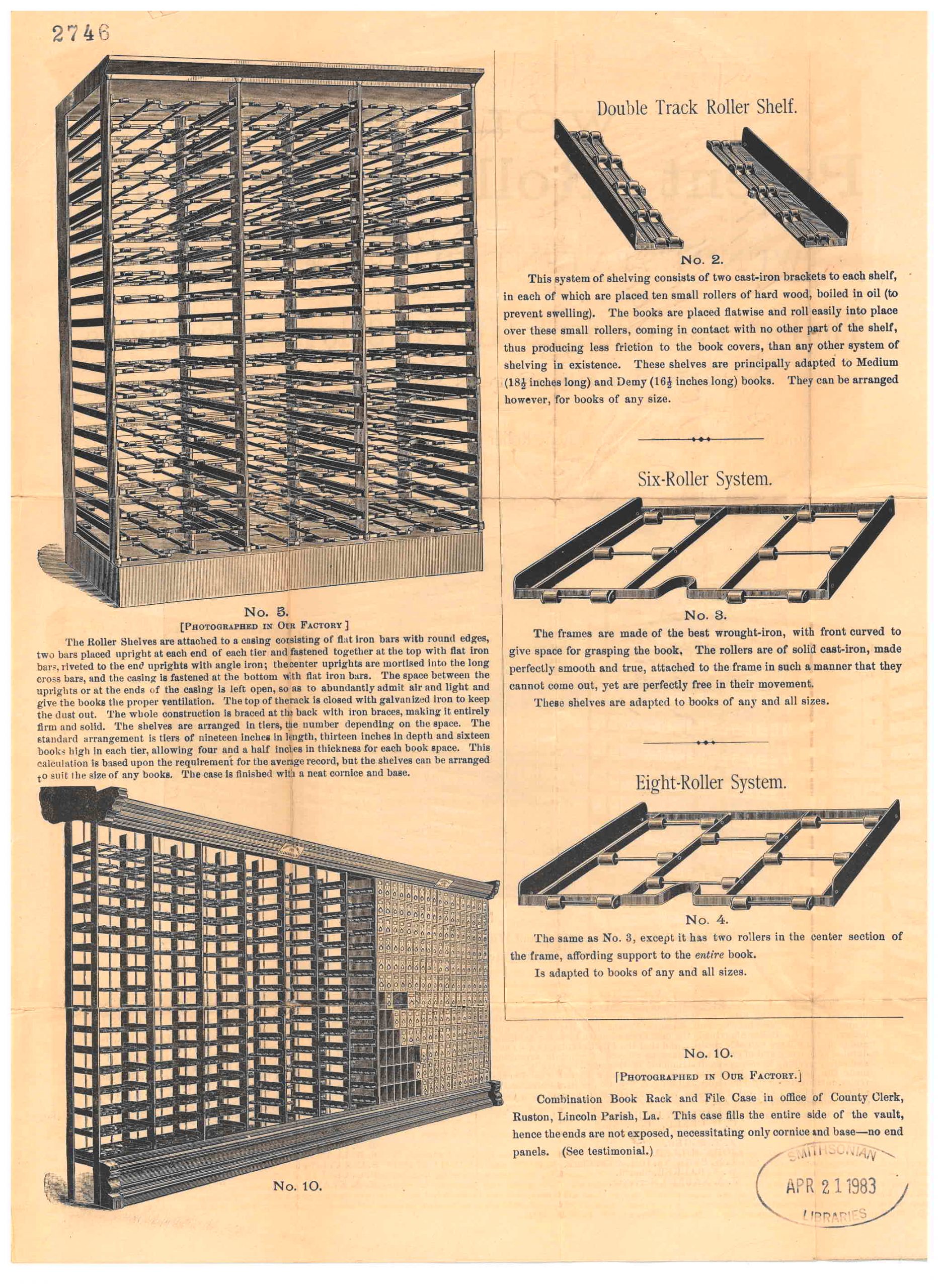 Pauly Jail Building & Mfg. Co., St. Louis, MO. Wolfe’s Patent Roller Shelving, and Wundt’s Patent File Receptacles (circa 1888), unnumbered page [2], various illustrations of Wolfe’s Patent Roller Shelving and Wundt’s Patent File Receptacles, including a combination case and details of the roller shelf system.The standard arrangement consisted of tiers measuring 19 inches long, 13 inches deep, and 16 books high with space for a thickness of 4.5 inches for each book. However, it was possible to create shelving for other size books as well. The number of tiers depended on how much space was available in the room where the case was installed. There were also choices for the number of rollers on the shelving. Details of a double-track system, six-roller system, and eight-roller system are shown in the illustration above.
Now let’s explore Wundt’s Patent File Receptacles, shown below (top right and bottom right). A testimonial, dated May 19, 1888, written by staff of the courthouse in Vernon, Texas, describes, the File Receptacles as being useful for “arranging and safely keeping case papers, instruments of title, etc.” It consisted of many small, individual file boxes in a large case.
The case for the File Receptacles consisted “of galvanized iron with wrought iron bars placed at regular distances.” To hold the weight of the materials stored in the File Receptacles, iron bars were positioned both upright and across. The size of the case depended on the number of file boxes.
The individual file boxes were made of “I. C. tin” and each box measured 4.5 inches wide, 6 inches high, and 10 inches deep. For an extra cost, other sizes were available. Each box came with a card label to place on the front of the box for noting the contents of the box.
The case was available with or without ornamentation. The illustration below shows a case with ornamentation on the top right of the page while a case without ornamentation is shown on the bottom right of the page.
 Pauly Jail Building & Mfg. Co., St. Louis, MO. Wolfe’s Patent Roller Shelving, and Wundt’s Patent File Receptacles (circa 1888), unnumbered page [3], Roller Shelving Car, Wundt’s Patent File Receptacles case with ornamentation, book rack with double track system and eight-roller system, and Wundt’s Patent File Receptacles case without ornamentation.Another useful device illustrated in this catalog is the Roller Shelving Car (above, top left). This was handy when transporting a large number of volumes around an office but there was one important detail. It required a track to run on, as shown in the illustration. The measurements of the car could be custom-made to hold a desired number of books, as many as 70 or even more.
Several testimonials are shared in this catalog. Many are written by staff of courthouses and clerk’s offices. They comment on the amount of space saved when installing these devices, the convenience of handling items stored in these systems, and the ability to decrease wear and tear as books were retrieved and re-shelved.
J. W. Williams from the Clerk’s Office of the District Court in Lincoln Parish, Louisiana wrote on July 17, 1888: “The Roller Shelving is splendid! No Clerk’s office should be without it. The File Cases are very convenient and come fully up to my expectation, but the Roller Shelving is the one thing that cannot be dispensed with, nor substituted by anything else in the Clerk’s office.”
According to another testimonial, Wolfe’s Patent Roller Shelving was installed for 150 books in Bedford County Court in Liberty, Virginia. On June 18, 1887, Clerk R. S. Quarles shared praise by writing, “They are a great convenience and preserve the books from wear. I think the expense will be saved in a few years in the saving of rebinding books, etc.”
The File Cases were written about by staff from Houghton County, Michigan on June 25, 1887. They shared that “…the File Cases fill the bill in all particulars, and will enable us to preserve and protect our books and valuable legal papers in much better shape than we could by any other method.”
Wolfe’s Patent Roller Shelving, and Wundt’s Patent File Receptacles (circa 1888) by Pauly Jail Building & Mfg. Co. is located in the Trade Literature Collection at the National Museum of American History Library.
Join us for “AVMPI Presents A Zoom With a View”
Every recording saved is a story rediscovered.
The Smithsonian Libraries and Archives recently launched the Audiovisual Media Preservation Initiative (AVMPI) to describe, preserve, and provide access to audiovisual collections across the Smithsonian. In this online program, we’ll introduce AVMPI, meet the media experts behind it, and preview some of the video material they’re working on.
- Walter Forsberg, Curator of Recorded Media, Smithsonian Libraries and Archives
- Leigh Gialanella, Digital Archivist, National Museum of American History – Archives Center
- Blake McDowell, Media Archivist and Conservator, National Museum of African American History and Culture
- Kira Sobers, Media Digitization Manager, Smithsonian Libraries and Archives
- Dave Walker, Audiovisual Archivist, Smithsonian Center for Folklife and Cultural Heritage
We are committed to providing access services so all participants can fully engage in these events. Optional real-time captioning will be provided. If you need other access services, please email SLA-RSVP@si.edu. Advanced notice is appreciated. This program will also be recorded and made available following the event.
Summer 2023 Internships Opportunities with Smithsonian Libraries and Archives
We’re excited to announce a new round of internships for Summer 2023. These opportunities provide hands-on experience in a range of subject areas and are open to both undergraduate and graduate students. Each unique project offers a chance to explore current topics in archives, libraries, and information science and learn from experienced Smithsonian Libraries and Archives staff.
These internships include a variety of on-site and remote options, part-time and full-time. All include a stipend. The application deadline is February 13th, 2023.
Programs include:
- Education: For students interested in museum education or similar fields, this intern will assist in expanding our resource-lending kit, Traveling Trunks.
- Professional Development: For a current MSLIS student or recent grad, experience with collections management in our John Wesley Powell Library of Anthropology.
- Summer Scholars: Two projects for undergraduates or grad students, including opportunities to work with art and artists’ files and other ephemera collections.
Learn more about academic appointments and related policies on our Internship and Fellowship page. Curious about the work of past interns? Read more about their experiences.
A Few of Our Most Popular Posts From 2022
It’s been a busy year! Indulge us as we take a trip down memory lane and highlight our top blog posts of 2022.
In no particular order, here are five of our most-read posts of the year:
An Interview with Director Tamar Evangelestia-Dougherty, Smithsonian Libraries and Archives by Liz O’Brien
We’re not the only ones who’ve enjoyed getting to know our new director, Tamar Evangelestia-Dougherty, this year. Readers also appreciated this interview with Tamar by Public Affairs Manager Liz O’Brien where we learned where Tamar got her start in libraries and who she finds inspiring.
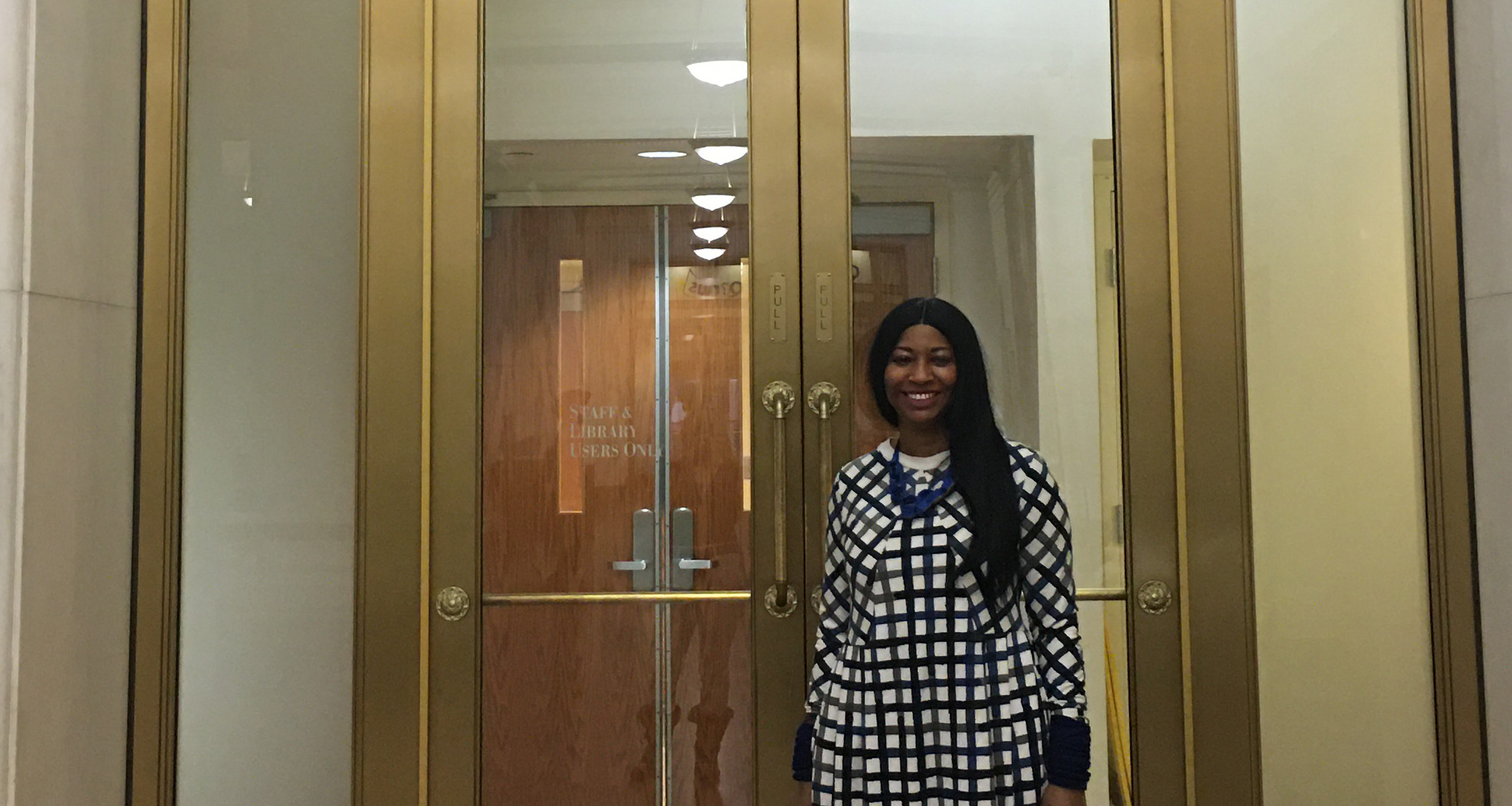 Director Tamar Evangelestia-Dougherty stands outside the doors of Smithsonian Libraries and Archives offices.
Gilded Age Girls: Exploring the Travel Diaries of Sarah and Eleanor Hewitt by Jennifer Bracchi
Sarah and Eleanor Hewitt were remarkable women who left an extraordinary legacy with the Cooper Hewitt, Smithsonian Design Museum. This past March, to coincide with the exhibition Sarah and Eleanor Hewitt: Designing a Modern Museum, we launched a transcription project that offered an intimate look at the lives of the Hewitt sisters.
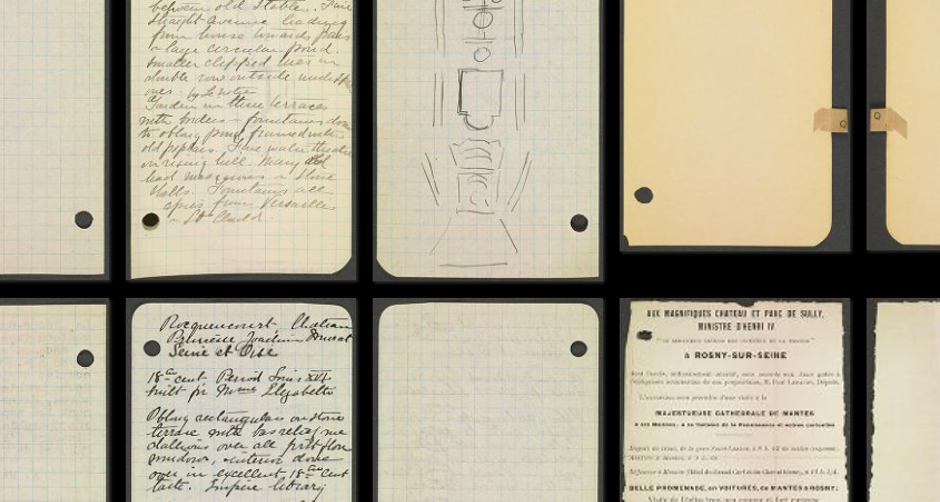
Digital Jigsaw Puzzles: National Library Week 2022 by Erin Rushing
Every now and then we fall apart. Or at least our images do. And audiences seem to get a kick out of putting them back together! Since 2020, we’ve created digital jigsaw puzzles based on images from our collections and they continue to be popular on our blog. This batch offered during National Library Week focused on materials available in the Biodiversity Heritage Library.
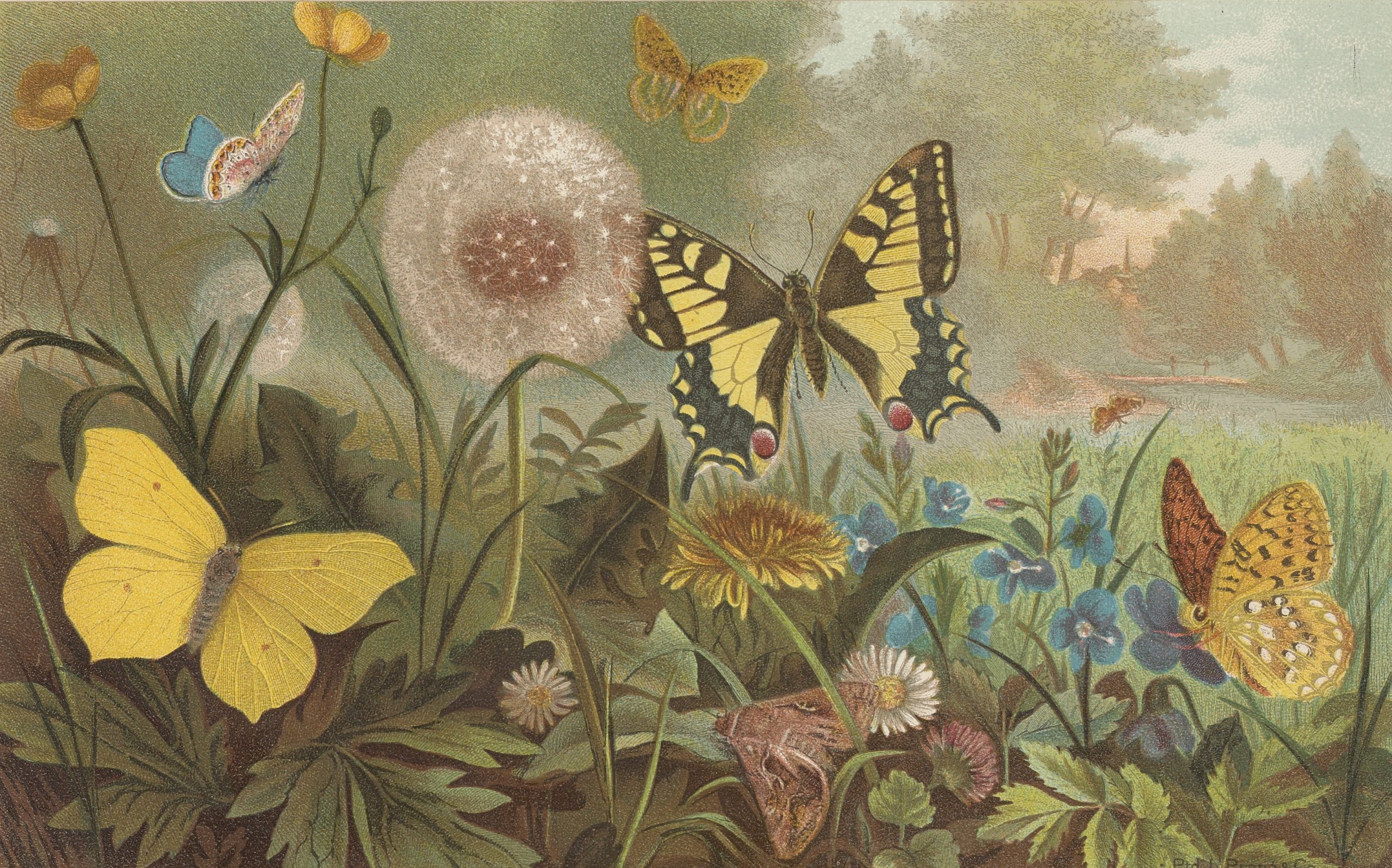
Smithsonian Libraries and Archives & Wikidata: Using Linked Open Data to Connect Smithsonian Information by Jackie Shieh
Our staff have made great strides in harnessing the power of linked open data to share Smithsonian resources. In the first post in a series about Smithsonian Libraries and Archives and Wikidata, Descriptive Data Management Librarian Jackie Shieh describes some of the opportunities and challenges.
 Data graph showing network of organizations that are part of the Smithsonian or its constituent parts,
Mid-19th Century Reaction to a Laundry Invention by Alexia MacClain
Testimonials can be a powerful marketing tool. Even when you never say how your product works! Readers were intrigued to learn about the Twelvetree’s Washing Pamphlet (ca 1850) in our National Museum of American History Library, which lacked instructions, details, or illustrations of the miracle cleaning product it advertised.
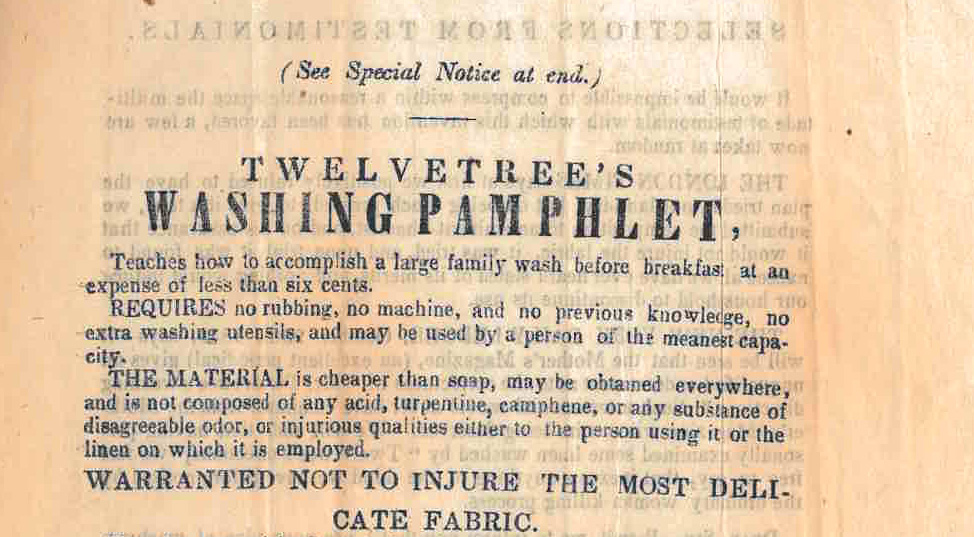
A Christmas Carol Imagined by Arion Press and Ida Applebroog
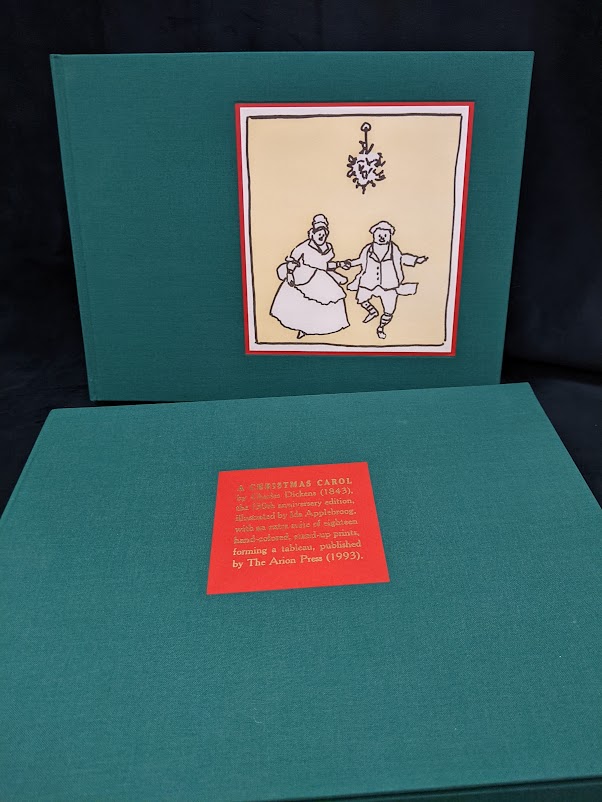 The book, with an illustration by Ida Applebroog, and the slipcase. A Christmas Carol by Charles Dickens, Artwork by Ida Applebroog. San Francisco: Arion Press, 1993. Gift of Ronnyjane Goldsmith.
It is nearly impossible to go through a holiday season and not view some rendition of Charles Dickens’ A Christmas Carol, whether it be in writing, on the stage, or on your television. There have been countless interpretations, each with their own altercations. However, the core message of generosity, empathy, and repentance often remains the same, no matter the method A Christmas Carol is produced.
The American Art and Portrait Gallery Library (AAPG Library) received the 1993 Arion Press edition of A Christmas Carol in Dr. Ronnyjane Goldsmith’s donation of Arion Press books from her collection. Published on the occasion of the 150th anniversary of A Christmas Carol, the Arion Press edition sought to pay homage to the classic through the art of Ida Applebroog. While Arion Press has often selected artists who have not had much experience with book arts, Applebroog is a multi-media artist who is well known for her series of artists’ books, particularly those with the subtitle “A Performance.” These books showcase her signature style of cartoon-like characters, often in dramatic scenes exploring larger social issues, framed by curtains as if they are actors on a stage. The AAPG Library holds several of Applebroog’s artists’ books in its artists’ books collection.
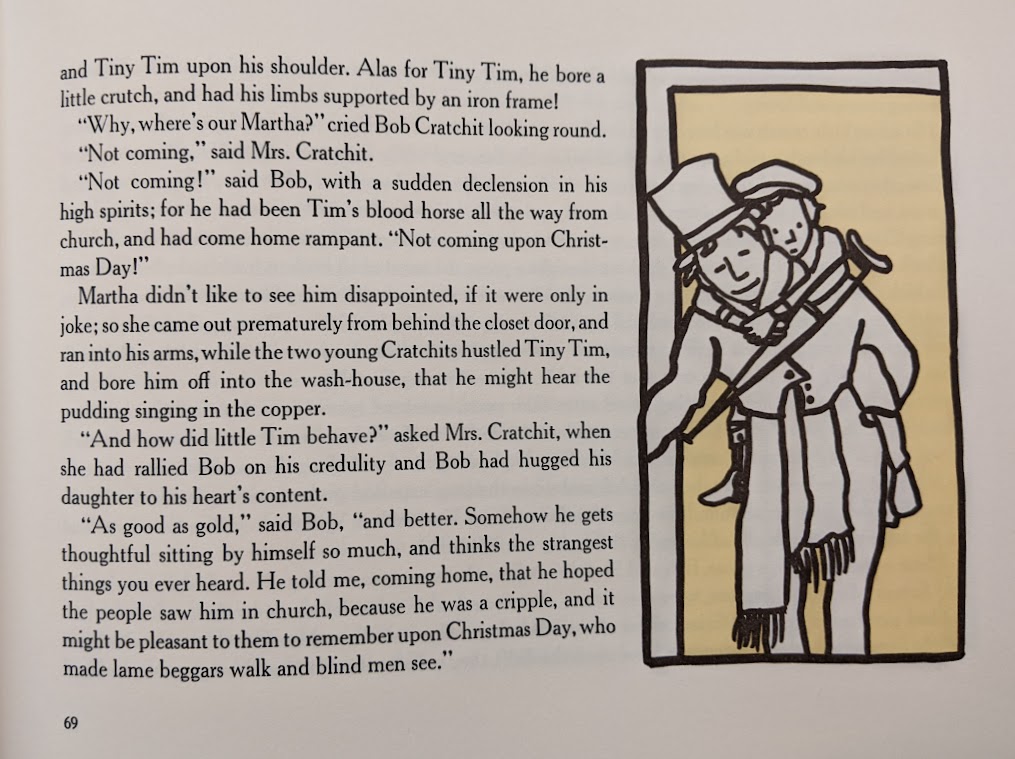 Ida Applebroog’s illustration of Tiny Tim and Bob Cratchit next to text of A Christmas Carol.
Applebroog’s simple but bold style is a stark contrast with earlier, more detailed, illustrations of Christmas Carol. However, Applebroog spent a great deal of time preparing her illustrations. According to the Arion Press prospectus for this book (also included in the donation!), the artist not only studied the illustrations of many different editions of the book at the New York Public Library, she also viewed Dickens’ original handwritten manuscript held at the Morgan Library. From this research, Applebroog found images that she felt best captured the story and recreated them in her own style: thick outlines, cartoonish characters, and framed like comic panels. Applebroog’s versions of iconic scenes, such Tiny Tim on the shoulders of his father or the haunting image of the door knocker with the face of Jacob Marley, are instantly recognizable without immediate context.
 Mounted, standing prints of scenes from A Christmas Carol, in front of prints of a stage with curtains.
The limited edition includes an extra suite of 18 hand-painted prints of Applebroog’s illustrations, of which only 25 sets were made. In addition to the book’s illustrations, the set has 3 prints that create a backdrop with curtains, and all are printed on thick board and can stand upright. The reader can set the stage in any way they want, allowing them their chance to create their own interpretation. The inclusion of the backdrop with curtains not only ties directly with Applebroog’s “Performance” book illustrations, it also serves as an homage to the theatrical history of A Christmas Carol as well. While this collaboration of Dickens and Applebroog might seem unlikely at first, it isn’t difficult to see their similar interest in discussing the good and bad of mankind through their art.
For this edition, the fine press book has a festive green cloth binding with a matching slipcase. Applebroog created fifty drawings overall, including large illustrations, small vignettes, and initial letters. The text was handset and printed in black, green, and red inks. Applebroog’s illustrations were printed in brown and yellow inks from photopolymer plates. The AAPG Library has edition number 16 out of 200.
Beyond the many books on and by Ida Applebroog in the AAPG Library, the Archives of American Art has many materials pertaining to Applebroog, including an interview. The Smithsonian American Art Museum has a silkscreen print by Applebroog in their collection, which serves as another great example of her work.
Through the Loupe: A Staff Profile of Pamela Wintle, Living Legend/Film Archivist
The first in a series of ongoing blog posts from Smithsonian Libraries and Archives’ Audiovisual Media Preservation Initiative, spotlighting the labor of Smithsonian media collections staff.
With millions of exceptional world-class collections across 21 museums and research units, it’s easy to overlook the most amazing part of the Smithsonian Institution—namely, the brilliant and dedicated staff and employees who make it all happen. Our new pan-institutional Audiovisual Media Preservation Initiative (AVMPI) is a project with a long history of development, and one could justifiably argue that it all began back in 1976 when Pam Wintle became the first dedicated motion picture film archivist at the Institution. A true living legend, Wintle worked in the field of film preservation in Washington, D.C. since 1969 (!) and as a Film Archivist at the Smithsonian’s Human Studies Film Archive (HSFA) for 46 years (!!). While she is currently enjoying a well-deserved retirement which began this year, we couldn’t help but pull Pam back into the fold to speak about her career and her impactful work at the Institution.
Walter Forsberg: How did you first get interested in working with film collections?
Pam Wintle: My professional life has been universally magical. As a twelve-, maybe thirteen-, year old growing up in North Syracuse we went on a class field trip to George Eastman House and Museum in Rochester. I remember looking at the equipment and the photographs and being completely enchanted by them.
As I stood inside the house at a railing, looking down into Eastman’s atrium, I thought to myself: ‘I would love to live in a house like this.’ Afterwards, our class took another field trip to Albany, and I went to my first museum ever—the New York State Museum. Looking at dioramas and exhibits, again I thought: ‘Gee, I would love to work in a museum.’ I simply didn’t know these things existed. The same goes for the field of anthropology, which I didn’t know existed until I was in college. I sometimes thought I wanted to be a missionary in order to know other cultures. Putting these memories all together this morning, I had the realization that: I did it! Sure, I didn’t live at George Eastman House but, fast-forward to working at the Smithsonian as a new employee in the 1970s, and I went to a conference hosted by Kodak at the George Eastman House. As I stood in Eastman’s atrium and looked up I could almost see my twelve-year old self wishfully looking down. And, now I’m working in a museum, with cultures and collections from all over the world.’ I did it! It’s been a truly magical career.
WF: Your first job working with film was at the American Film Institute (AFI) in Washington, D.C., in an era when the AFI funded preservation activities?
PW: The AFI had an active preservation program in Washington, under Sam Kula and David Shepard. The emphasis was on 35mm nitrate feature films, hence Sam’s coining of the ‘nitrate won’t wait’ slogan. I believe I started there in 1969. I had just graduated from Ithaca College and moved to DC because I had a friend here. I saw an ad for an AFI position in the paper, and I initially interviewed with the office manager but never got a ‘call back,’ as they say. Being in the AFI offices I knew: ‘this is where I want to work.’ The walls were covered in big black and white enlarged movie stills. Growing up, my moviegoing experience consisted of Saturday matinees at the Hollywood Theatre in Mattydale, New York—which still exists. I also loved watching movies on TV, and when I saw my first foreign film in college—The Servant with Dirk Bogarde—I was totally blown away. Again, I had no idea these things existed! I just kept getting more and more sucked into the world of film, and its transformative ability to make me see things differently. It could open your mind and expand your world, and I just kept getting drawn more and more into it.
WF: So, you eventually succeeded in getting a job there?
PW: When David Shepard’s secretarial position became available and he found out that my favorite film was Bambi, that was it! He said, ‘I want her.’ David was incredible and working for him was like getting a master’s degree in film. Anything I wanted to learn, he was there ready to help me. Eventually, as most AFI activities moved to California, the preservation program and the theatre were the only things left in D.C. The preservation program offices relocated from the Kennedy Center to the Library of Congress, where the AFI collection was housed.
WF: When did you leave the AFI working with David Shepard?
PW: I guess I left the AFI around 1974, as the funding for its preservation program started to diminish. David had left prior and started working for Blackhawk Films (in Davenport, Iowa) overseeing a PBS series called Lowell Thomas Remembers—which revisited footage from Fox Movietone News collection, making a half-hour highlights TV program. I think they made programs for every year from 1916 to sometime in the 1960s. David knew I wasn’t fully-employed and asked if I would go out to Iowa and be his assistant, handling a lot of nitrate film as part of producing this TV program. That was about a five-month gig, and a wonderful experience. I edited a couple of those programs that were broadcast on PBS.
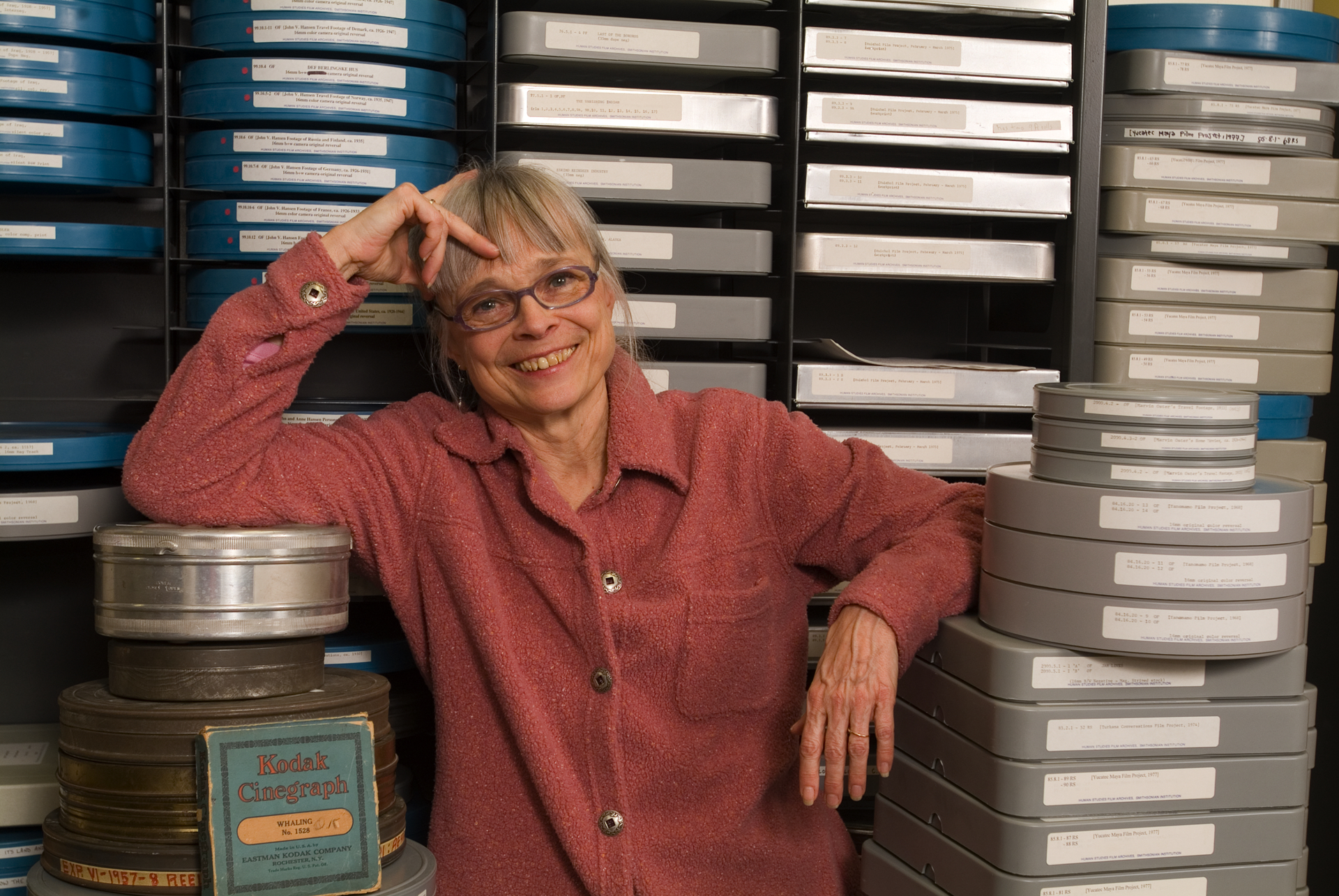 Pam Wintle amid the Human Studies Film Archives collections of more than 32,000 rolls of motion picture film (total footage, still t.b.d.!). Photo by Don Hurlbert.
WF: I’ve heard that you also worked as a film projectionist?
PW: Well, just as a casual one for the lunchtime screenings I ran while at AFI. But I did serve as projectionist on occasion for several dignitaries. My AFI colleague met dancer Rudolf Nureyev at a reception when he was in town. Knowing that Nureyev loved film, she asked: “What film have you never seen, that we could screen for you?” He said, “Intolerance”(D.W. Griffith, 1916). So, we held a private screening for Rudolf Nureyev with (AFI film preservationist) Bob Gitt’s 16mm copy. Bob trusted me well-enough to project his personal print that had been autographed by the film’s star, Miriam Cooper. I got to meet Nureyev, who was bigger to me than any movie star, and he even handed me a rose! I said to him, “I’m so pleased to be able to project this film for you, and I know D.W. Griffith would be equally pleased.” [Laughs] That inspired an enormous smile on his face, and my projection was flawless!
At the Smithsonian, I projected several films for the Dalai Lama, but I didn’t get to meet him. This was during the E. Richard Sorensen National Anthropological Film Center days of the late-1970s, and the Dalai Lama was coming to the Smithsonian. Secretary Ripley met with him, and we screened several film compilations of Tibetan footage that I edited.
WF: You also worked at the historic Circle Theatre, correct?
PW: Yes, I did for several years, which was on Pennsylvania Avenue between 21st and 22nd Street. It was the oldest continuously-run movie theater in Washington until it was torn down, maybe 20 years ago. I sold tickets two nights a week, and it paid my grocery bills. That job really gave me an appreciation for soundtracks and sound design because I was only able to hear the films from the ticket booth, not see them. When I eventually began my position at the Smithsonian’s National Anthropological Film Center, my sensitivity and awareness about the synchrony of sound and image were something that became central to the job.
WF: How did you come to start working at the Smithsonian in 1976?
PW: I first met ethnographic filmmaker John Marshall while attending something called the Summer Film Institute, held at Hampshire College and run by the University Film Study Association out of Boston. One night John, his ethnographic filmmaking colleague Timothy Asch, and I, were sitting on a balcony in Washington having drinks. The two of them were in town for an event and they started telling me about this new organization at the Smithsonian that was going to be created called, the National Anthropological Film Center [now the Human Studies Film Archive (HSFA)]. It sounded like a dream come true and exactly what I wanted to be doing. John said, ‘Well, let me write you a letter of recommendation,’ and I said, ‘OK.’ I still don’t know who he was describing in that glowing letter, [laughs] but the new Film Center’s director E. Richard Sorensen contacted me for an interview and that was it. I recall that they were interested in my AFI background as an archivist who had preservation experience. I think that was their missing piece that was needed. Rather than a filmmaker they really envisioned hiring somebody, who would look after the archival side of things that the filmmakers couldn’t or wouldn’t do.
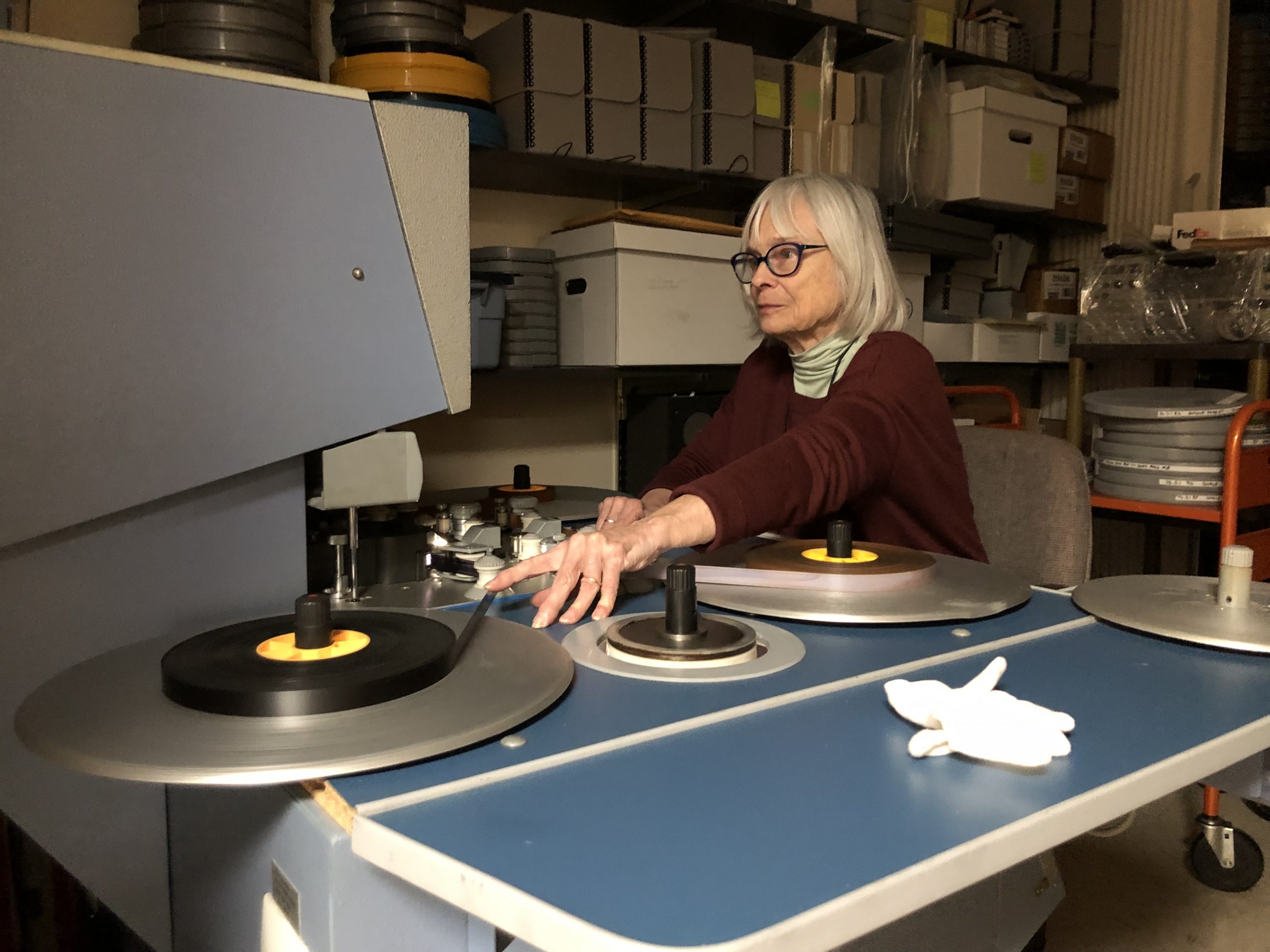 Film Archivist Pam Wintle synchronizing picture and sound rolls on the Human Studies Film Archive Steenbeck flatbed. Photo courtesy of HSFA’s Media Archivist, Daisy Njoku.
WF: Your tenure at HSFA was so profound, but can you enumerate a few of your career highlights?
PW: Are you familiar with Henry Wilhelm? He’s an imaging conservation researcher who wrote a book on color film photography—it’s like the Bible, on the subject. Well, Henry credits us at HSFA as one of two archives in the world having the first cold storage facility for motion picture film. I can’t remember if ours predates the cold vaults at the Library Congress, but true ‘cold storage’ of (then, around 40 °F) is essential in extending the life of motion picture film. Now, we have a second, more recent sub-zero vault at the Museum Support Center in Suitland, and I consider those film storage facilities to be the second-proudest crowning achievement of my Smithsonian career.
WF: And the proudest one?
PW: That would be working to have the John Marshall Ju/’hoansi (Bushman) film and video collection (1950-2000), documenting the Ju/’hoansi people of Kalahari Desert in northeastern Namibia, inscribed on the UNESCO Memory of the World Registry. I say that not because I did it alone, but because I was very much the driving force. We were only the third audiovisual collection be added to the Registry. It was an enormous, difficult, and laborious effort, but something really international and not just American-centric. This is a collection for the world, and the UNESCO’s interest in highlighting indigenous communities made the work to have the collection added to the Registry extremely gratifying. Karma Foley, and Jake Homiak, Daisy Njoku, and Richard Kurin were all Smithsonian collaborators that were also really invested in this effort.
WF: In the course of your career, you’ve mentored so many professionals now working in the audiovisual preservation field. Many of them have since become directors of their own institutional archives. Do you have any words of advice to young folks out there who are interested in getting started ‘in the biz’?
PW: Be curious, and be open because one never knows the shape of possibilities. And a good mentor is priceless. I had them as my good fortune and I love mentoring in return. I’d like to think I’ve been a decent one, at least! [Laughs]
A Dash Through the Snow on a Sleigh
Imagine riding through a landscape blanketed in snow. Whether it’s a family outing, a trip to deliver goods, or simply a pleasure ride, this early 20th Century sleigh catalog includes a few possibilities.
The trade catalog is titled Catalogue No. 43 (1906-1907) by Sturtevant-Larrabee Co. Tucked inside its front pages is an accompanying Price List of Cutters and Sleighs, in effect July 1, 1907.
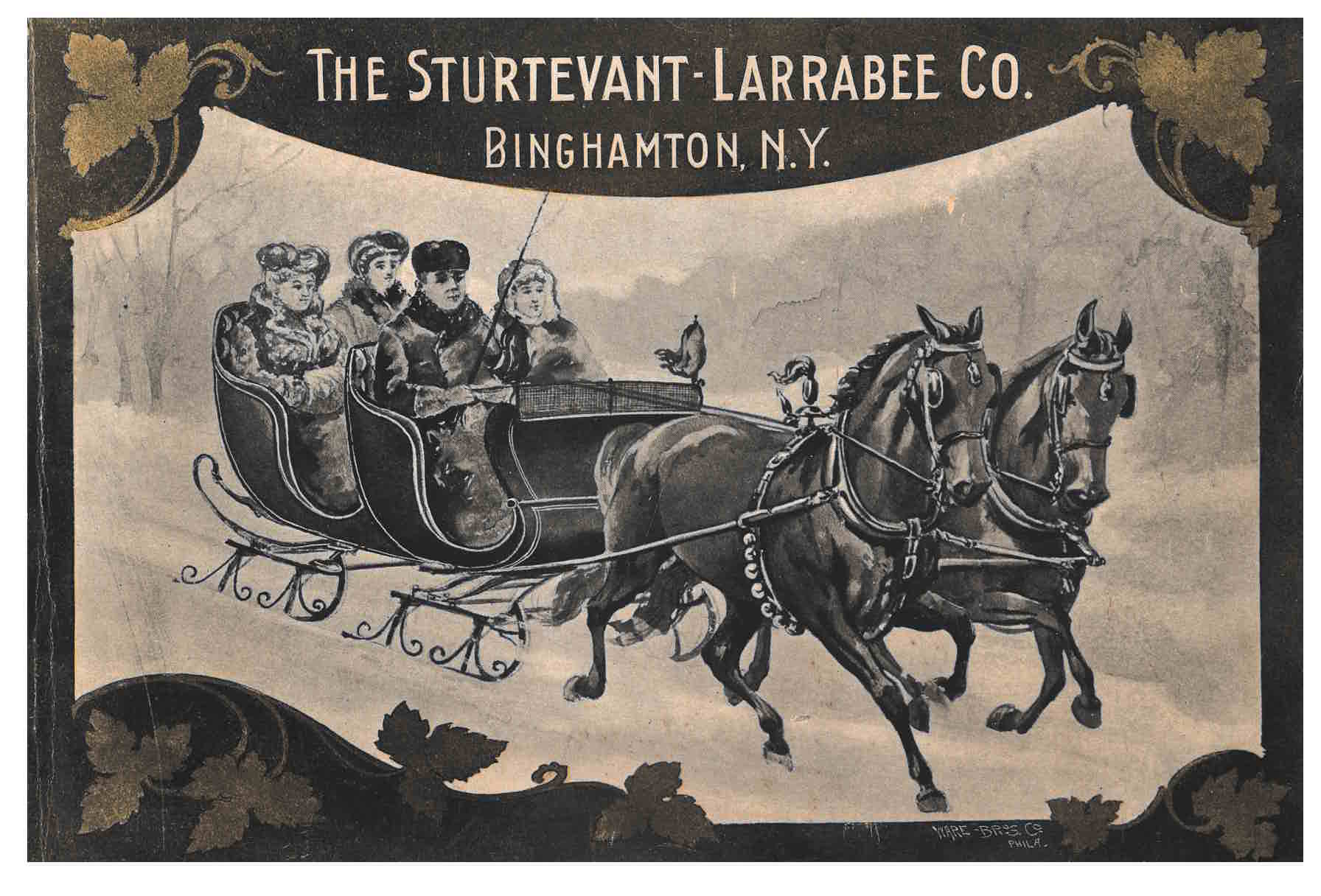 Sturtevant-Larrabee Co., Binghamton, NY. Catalogue No. 43 (1906-1907), front cover.
Almost every page of this 76-page catalog illustrates a specific sleigh. Only a few pages are devoted to parts or general construction. Each sleigh is assigned a number. Along with that number, some are labeled with the type of sleigh, such as “Family Sleigh” or “Delivery Sleigh.”
 Sturtevant-Larrabee Co., Binghamton, NY. Catalogue No. 43 (1906-1907), title page.
Each illustration includes a description providing measurements and primarily focusing on trim and paint. In addition, one page at the back of the catalog shares general information on construction and materials of the sleighs. The sleighs were manufactured with “first-class, thoroughly-seasoned lumber” and, except for delivery sleighs, included spring backs and cushions stuffed with curled hair. Sleighs were trimmed with all-wool green or blue cloth, whipcord, or velour plush. Silk or mohair plush were also available.
The general information page also describes how each sleigh was painted. The method was to use one coat of primer, four or five coats of filler, two coats of a selected color, and one or two coats of rubbing varnish. Finally, it was “elaborately striped and finished with high-grade finishing varnish.”
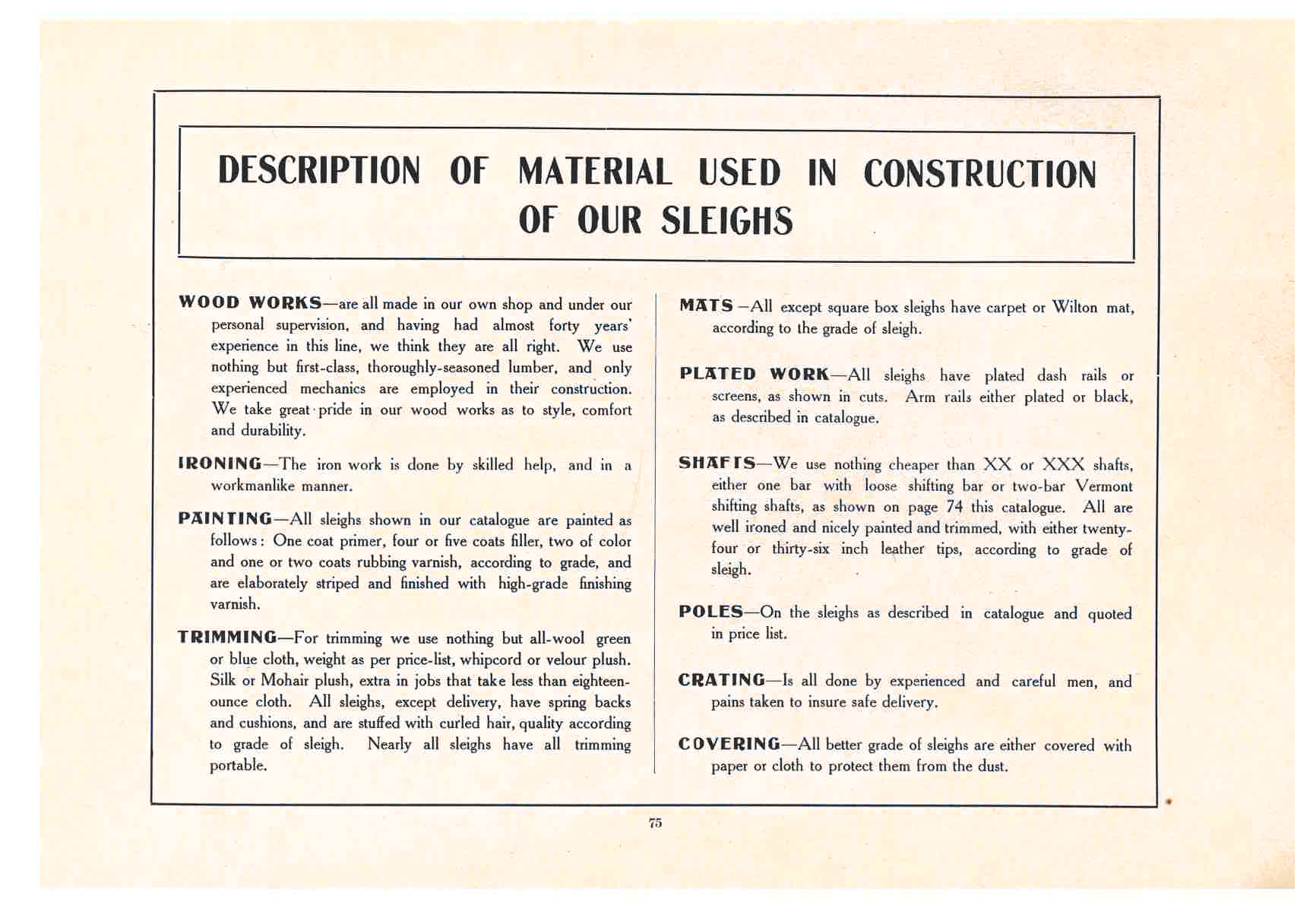 Sturtevant-Larrabee Co., Binghamton, NY. Catalogue No. 43 (1906-1907), page 75, general description of material used to construct the sleighs.
There were a variety of sleighs for customers to select. Some were designed for one or two people while others seated several people in multiple rows. There were also sleighs with a specific purpose, such as delivering goods, or sleighs intended for children.
An example of a children’s sleigh is the No. 41 Children’s Pony Sleigh. Shown below, it included only one seat row. It was trimmed with cloth, whipcord, or plush and included a velvet mat. Designed to be pulled by a medium-sized pony, the sleigh was painted in “Brewster green or fancy colors, two shades” with black moldings and green or carmine gear.
 Sturtevant-Larrabee Co., Binghamton, NY. Catalogue No. 43 (1906-1907), page 19, No. 41 Children’s Pony Sleigh.
Another type of sleigh was the family sleigh. The one pictured below is the No. 9 ½ New Family Sleigh. Trimmed with cloth or whipcord, it accommodated several people in two rows of seats. Its body was painted dark green while there was a choice of color for the gear, either green or carmine.
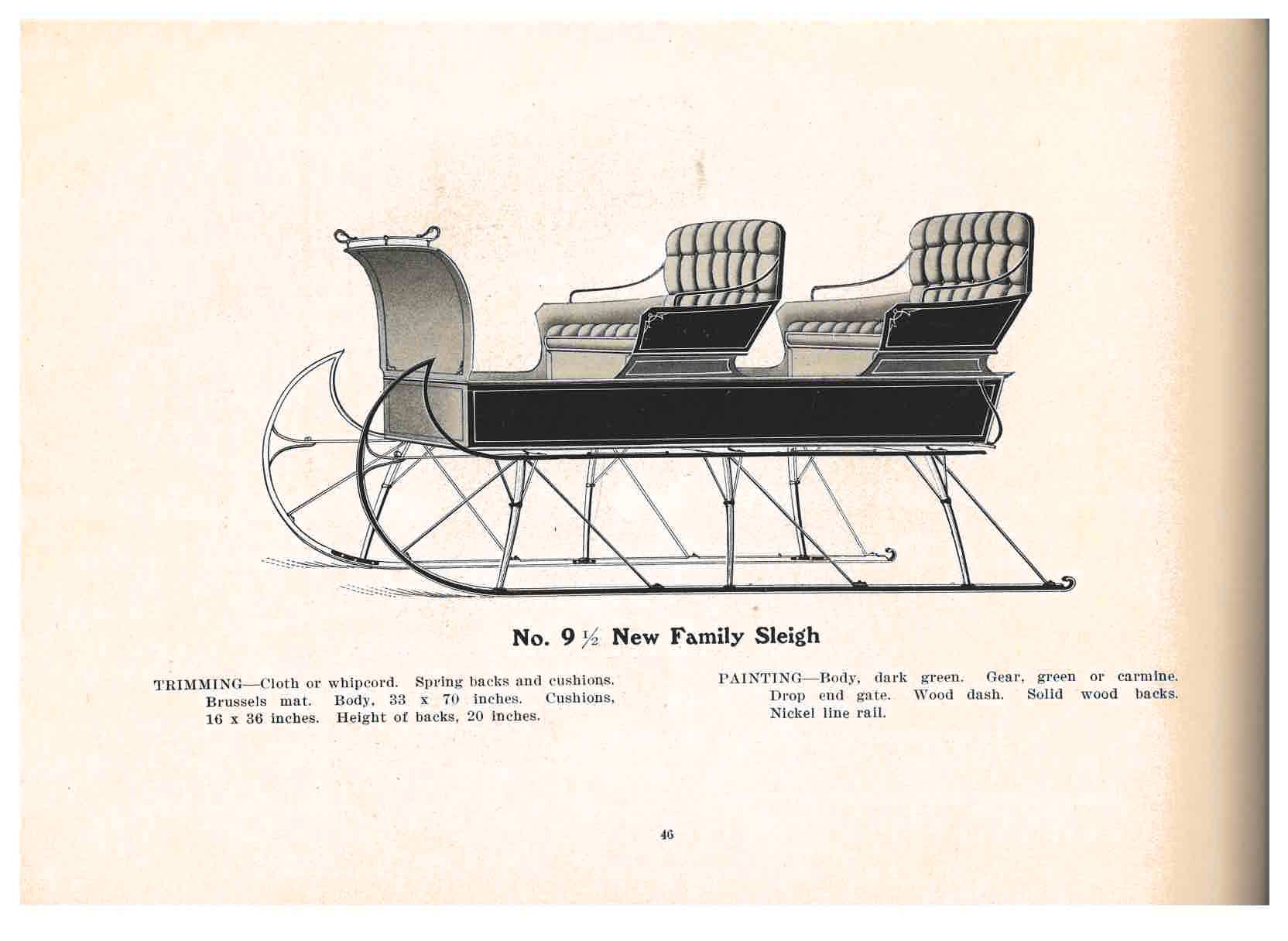 Sturtevant-Larrabee Co., Binghamton, NY. Catalogue No. 43 (1906-1907), page 46, No. 9 ½ New Family Sleigh.
A large group might have selected the No. 19 Sleigh, as it accommodated passengers in three rows of seats. The body was painted black while the gear was available in carmine or dark green. It was trimmed with all-wool cloth or corduroy.
 Sturtevant-Larrabee Co., Binghamton, NY. Catalogue No. 43 (1906-1907), page 55, No. 19 Sleigh.
Some sleighs were fitted with tops. Perhaps this came in handy when snow was falling or simply to retain a bit of warmth in the wind. A top, consisting of 26-oz. rubber, is visible on the No. 20 Sleigh, illustrated below.
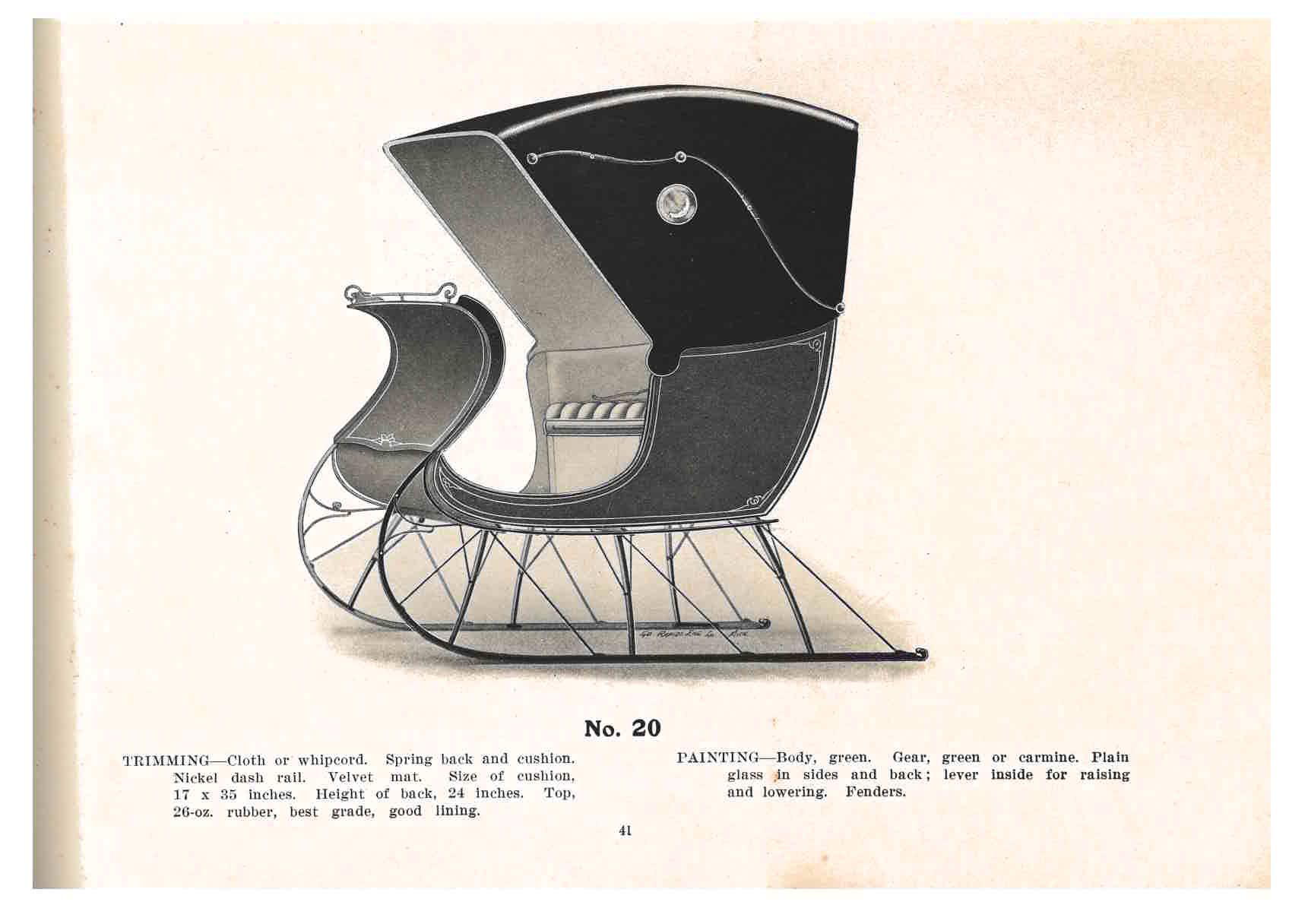 Sturtevant-Larrabee Co., Binghamton, NY. Catalogue No. 43 (1906-1907), page 41, No. 20 Sleigh with top.
Besides pleasure sleighs, some sleighs were used for delivery purposes, such as the No. 12 Delivery Sleigh. Storage space was provided in the back behind the seat. It also included a drop tail gate. The body of the sleigh, painted olive brown, measured 35 ½ x 8 feet 4 inches and the “distance back of seat” measured 67 inches. It appears to include quite a bit of space to store packages, so perhaps it was used to deliver presents!
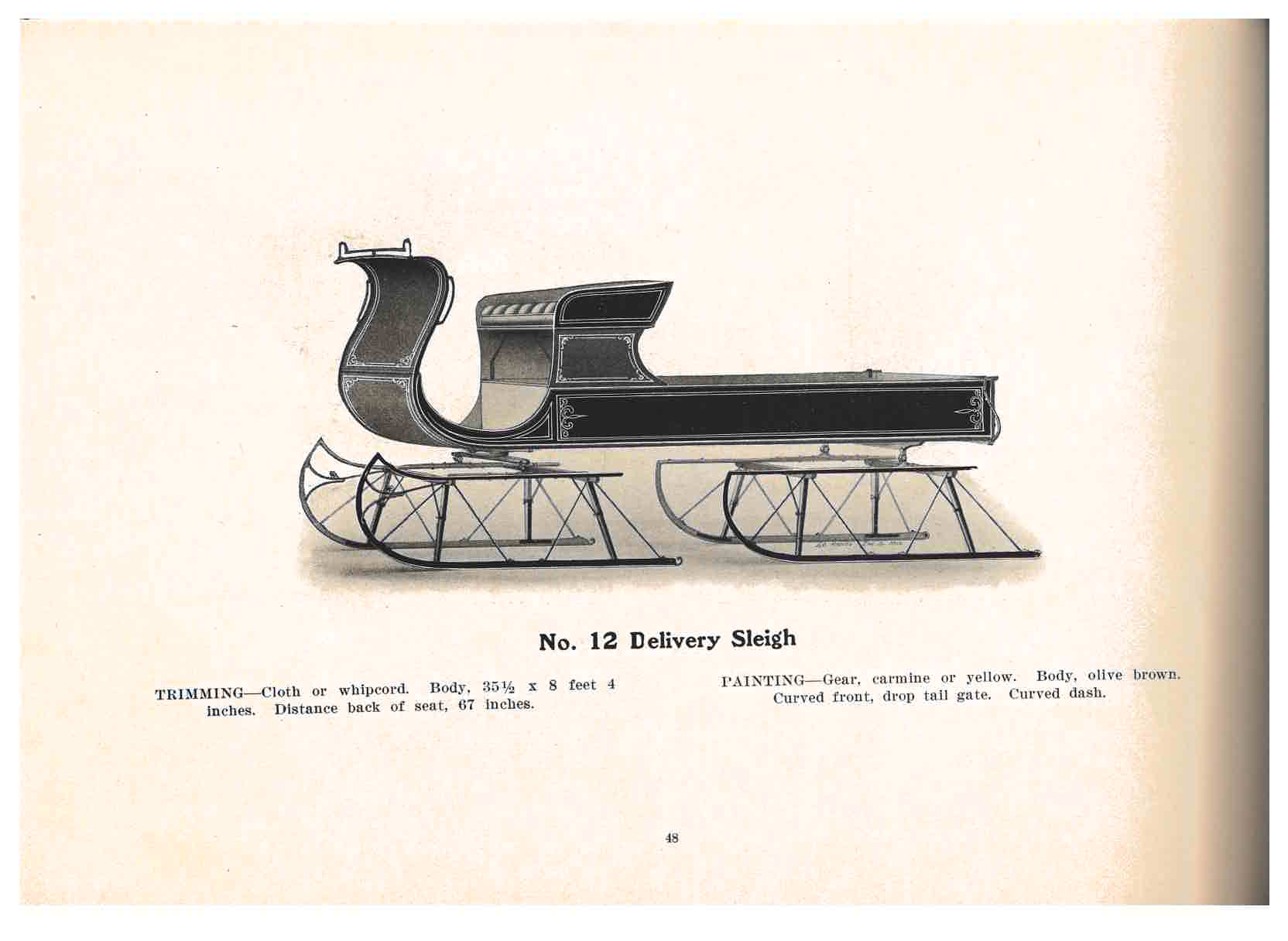 Sturtevant-Larrabee Co., Binghamton, NY. Catalogue No. 43 (1906-1907), page 48, No. 12 Delivery Sleigh.
Throughout this catalog, every so often the description mentions a “new design for 1906.” One of these new designs, the No. 79 sleigh, is illustrated below. With its two rows of seats, it accommodated several people for a pleasant ride through the snow. Painted in two shades of either green or red with black molding and green or carmine gear, it also incorporated some decorative elements, such as the plumes on the front.
 Sturtevant-Larrabee Co., Binghamton, NY. Catalogue No. 43 (1906-1907), page 62, Sleigh No. 79 New Design for 1906.
Catalogue No. 43 (1906-1907) by Sturtevant-Larrabee Co. is located in the Trade Literature Collection at the National Museum of American History Library.
Digital Jigsaw Puzzles: Holiday 2022 Edition
We’re celebrating new publications, exciting exhibitions, and the festive holiday season with another round of digital jigsaw puzzles. This collection of images highlights a few winter favorites as well as recent Smithsonian Libraries and Archives projects.
Play them right here on our blog or use the links to play full screen. Each puzzle is set to be 100 pieces but they are customizable to any skill set. Click the grid icon in the center to adjust the number of pieces.
Miss our previous puzzles? Find them here.
Plate 38, The natural history of Carolina, Florida, and the Bahama Islands (1771).
Just a few weeks ago, we opened our newest exhibition Nature of the Book. It explores the natural elements that help make some of our rarest books. One of the highlights is Mark Catesby’s The natural history of Carolina, Florida, and the Bahama Islands. A seminal work documenting species native to North America, Catesby’s book also provides excellent evidence of papermaking, book illustration, and bookbinding. “The Red Bird”, aka cardinal provides a festive pop of color.
Play online: https://jigex.com/NAEqn
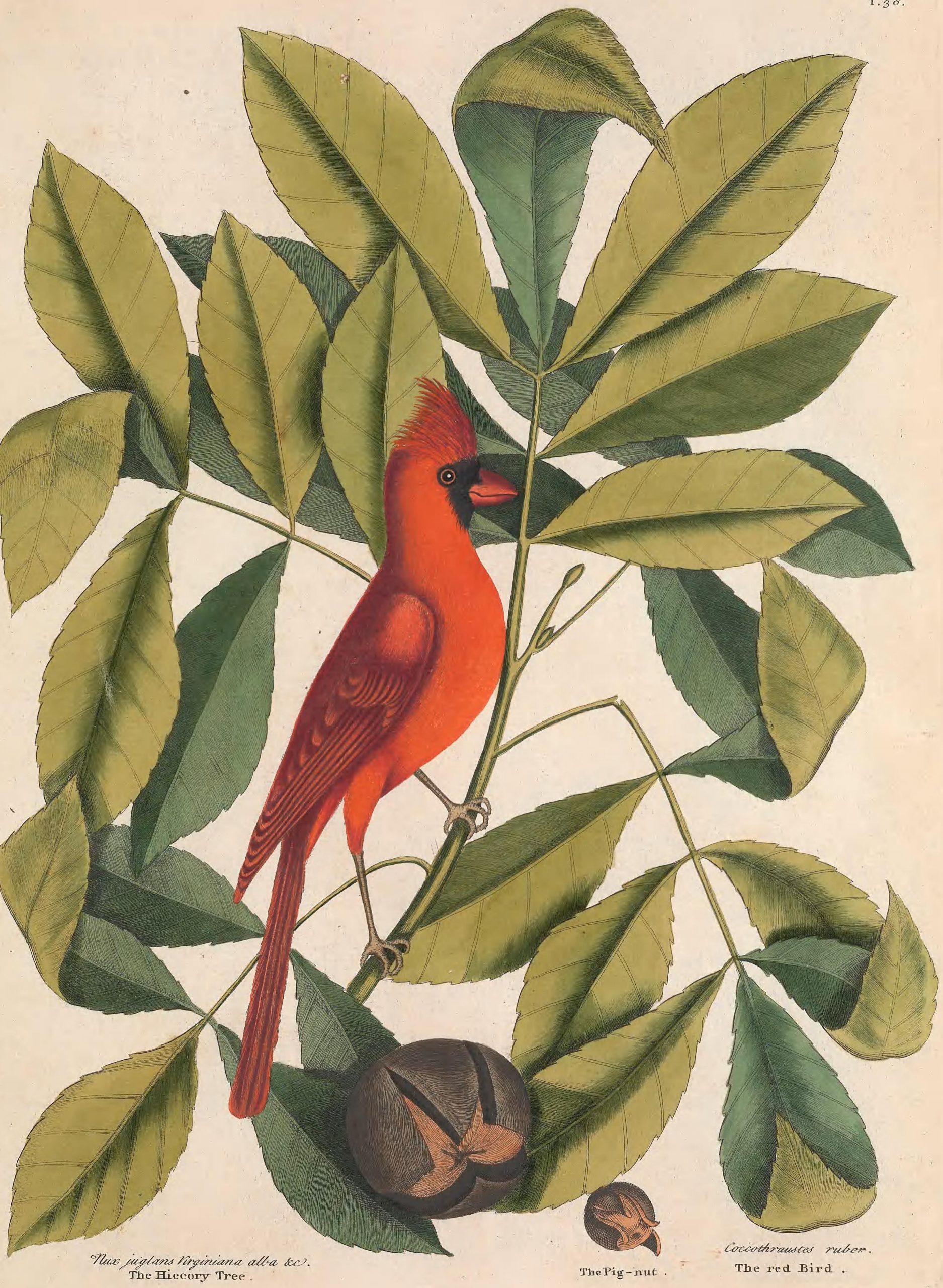 Plate 38, The natural history of Carolina, Florida, and the Bahama Islands (1771).
Jigsaw Puzzle
Front cover, Sleigh Season 1903-04 (1903).
Sleigh bells ring and we are listening! The cover of this trade catalog from Jackson Sleigh Co. of Jackson, Michigan instantly transports us to a snowy scene in the early 20th century. Each month on our blog, Alexia MacClain highlights vintage pieces from our Trade Literature Collection in the National Museum of American History Library.
Play online: https://jigex.com/bVqeM
 Front cover, Sleigh Season 1903-04 (1903).
Jigsaw Puzzle
“American Holly”, Plate 266, North American Wild Flowers (1925).
In October, we announced our newest publication, Wild Flowers of North America: The Botanical Illustrations by Mary Vaux Walcott with Prestel Publishing. This gorgeous book would make a great gift for an art or nature lover on your list (hint hint!). But you can also explore the illustrations online via the Biodiversity Heritage Library, including these seasonally appropriate holly branches.
Play online: https://jigex.com/QM4ux
 “American Holly”, Plate 266, North American Wild Flowers (1925).
Jigsaw Puzzle
Seven-foot Gingerbread Model of the Smithsonian Institution Building (December 1980).
We think the Smithsonian Institution Building, aka The Castle, is pretty sweet any time of year but particularly when it’s made of gingerbread. In this photo from our Smithsonian Institution Archives, Alice Donaldson, Patricia Mudrick, and David Mudrick add icing to their creation – a 7 foot gingerbread model of our beloved building. The photo was taken in December of 1980 by Jeffrey Wayne Tinsley, a long-time photographer at the Smithsonian.
Play online: https://jigex.com/SKZpB
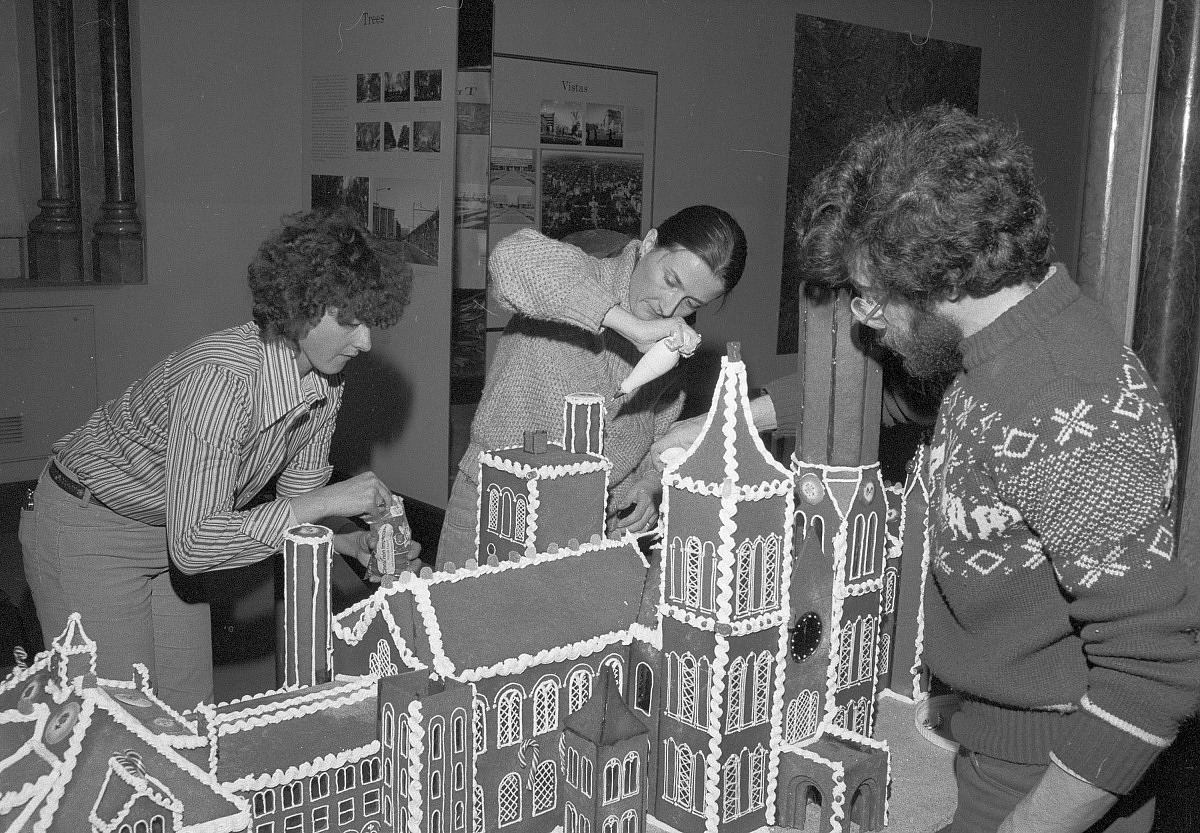 Seven-foot Gingerbread Model of the Smithsonian Institution Building, 80-19953-28. Smithsonian Institution Archives Record Unit 371 Box 3 Folder January 1981.
Jigsaw Puzzle
“Des Rubans”, Gazette du bon ton (1913).
Some elegant gift-wrapping inspiration, courtesy of Gazette du Bon Ton (“Journal of Good Taste”). This French magazine was published in the early 20th century, founded by Lucien Vogel and distributed by Conde Nast. Its annual subscription rate was 100 francs a year, a high sum even then. The magazine featured top couture and art and was printed using the labor-intensive hand-stenciling technique of pochoir. Find digitized copies in our Digital Library.
Play online: https://jigex.com/m3USR
 “Des Rubans”, Gazette du bon ton (1913).
Jigsaw Puzzle
