
Libraries' Blog


Packing for a Vacation in 1907
Imagine it is the early 20th Century and you are packing for summer vacation. What did your luggage look like? Did you pack your clothes in a trunk? What were your options? Today we are familiar with rolling luggage on wheels, but trunks and suitcases over a hundred years ago looked quite different.
Catalogue No. 101 (1907) by Herr, Thomas & Co. provides a peek into the past, specifically the year 1907. Flipping through this trade catalog, we will learn about the types of luggage available in that time period. A few other items illustrated in this catalog might also have made a vacation fun and memorable.
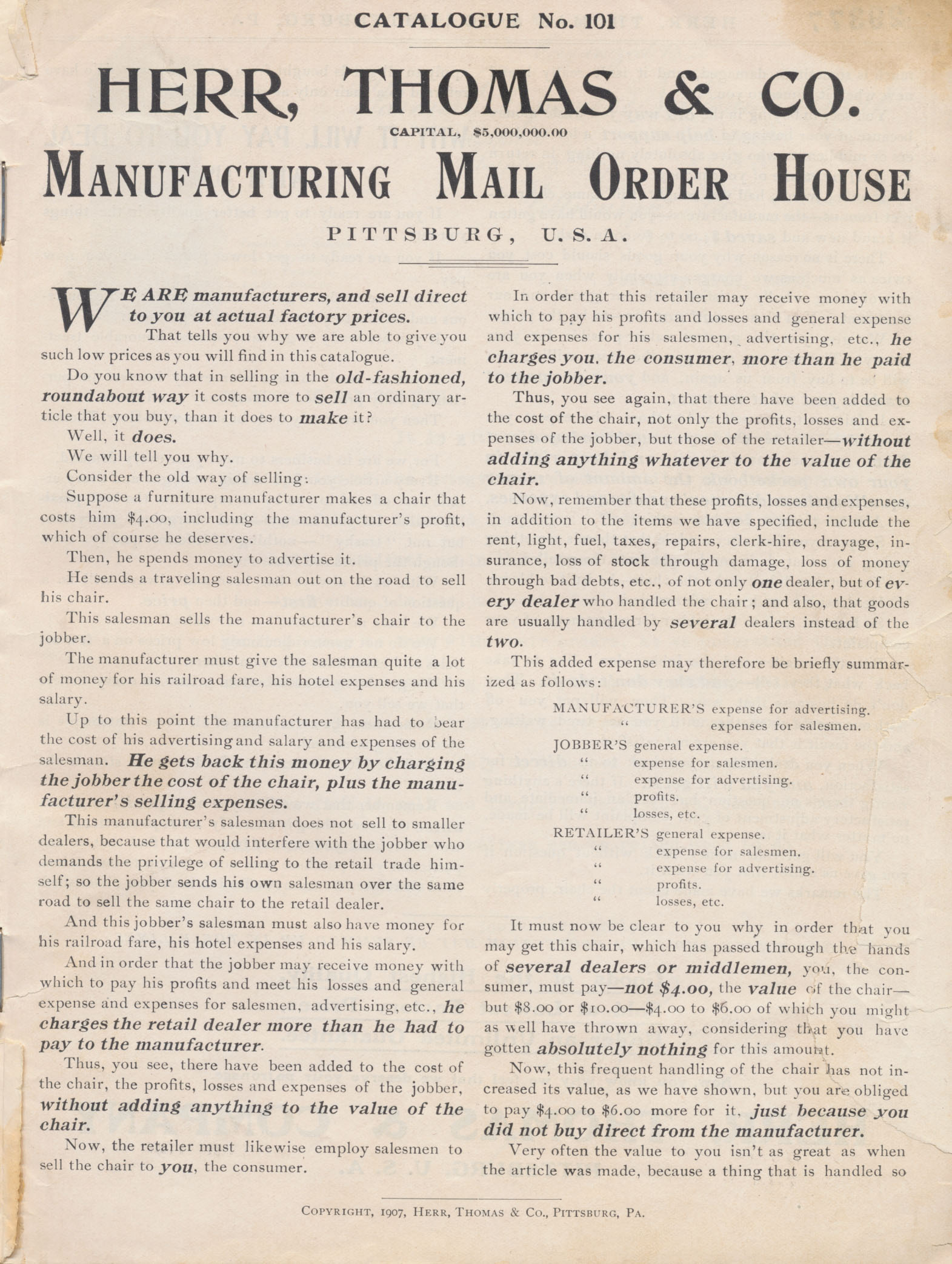 Herr, Thomas & Co., Pittsburg, PA. Catalogue No. 101 (1907), front cover [page 1], explanation of benefits of buying direct from the company.Packing is not always easy. What do you bring and what do you leave behind? Do you really need that extra sweater? Maybe it would be easier if you just brought your entire dresser along. That might not be quite possible, but in 1907 there was a piece of luggage called the Dresser Trunk (below, top left). It was described as “embodying the latest ideas of travel comfort” and “combining the uses of both a trunk and dresser.” The Dresser Trunk was composed of three-ply veneer bass wood, covered with canvas, painted, varnished, lined with cloth, and the frame was reinforced with hard wood strips. It also had hand riveted wrought iron clamps, corners, hinges, and fastenings.
A convenient feature was its ability to open on the side. Instead of lifting everything on top to get to something on the bottom, the drawers made it possible to go directly to the location of a specific item without interfering with the contents of the rest of the trunk. In other words, the Dresser Trunk functioned just like a dresser with drawers. There were three drawers, one large and two of medium size. The large drawer included two compartments. There were also other compartments beneath the large drawer and in the lid. Wondering where that mirror was located? Inside the lid was a French bevel mirror. A Yale lock safely secured belongings inside the trunk. The Dresser Trunk measured 32 inches long, 21 inches wide, and 21 inches high with the lid closed or 42 inches high with the lid raised.
 Herr, Thomas & Co., Pittsburg, PA. Catalogue No. 101 (1907), page 74, Dresser Trunk, Suit Case, Leather Suit Case, Cabinet Bag, Trunk, Steamer Trunk, Hand Bag or Satchel.
Maybe bringing a Dresser Trunk is not quite what you had in mind for a vacation. In that case, Herr, Thomas & Co. also offered other trunks, such as the Steamer Trunk (above, middle right). Its interior was composed of a tray divided into a large and small compartment with four additional large compartments beneath the tray. It also provided security by using a Yale lock.
Other options included a simple suitcase, such as the ones shown above (middle left). The Suit Case advertised for $2.85 in this 1907 catalog included a cloth-lined interior, leather handle, and lock. A Hand Bag or Satchel (above, bottom right) and Cabinet Bag (above, bottom left) are also illustrated in the luggage section of this catalog.
Besides clothing, what other items might you have packed for a vacation in 1907? Perhaps, a tourist brought along the Premo Folding Film Camera (below, middle left). According to Catalogue No. 101 (1907), this particular camera is described as “a very compact outfit that is especially adapted to tourists use” because once it was folded, it was small enough to fit in a pocket. It had a capacity of 12 exposures and was capable of producing photos measuring 3 ¾ x 4 ¼ inches.
 Herr, Thomas & Co., Pittsburg, PA. Catalogue No. 101 (1907), page 73, Shaving Set, Shaving Mug and Brush, Premo Folding Film Camera, Cyclone Magazine Camera, Lady’s Opera Glasses, Folding Opera Glasses, Field Glasses.
Perhaps an opera might have found its way onto a 1907 vacation itinerary. Opera glasses such as the Lady’s Opera Glasses shown above (middle left) might have come in handy. It was fast and easy for theatre-goers to adjust the lenses to various distances while viewing the performance. To keep the opera glasses safe during transit, it came with a black leather satin lined case.
Some might have preferred the Folding Opera Glasses, also shown above (bottom left). Fitted with achromatic lenses, these opera glasses folded into a steel case measuring 4 x 3 x 5/8 inches. For safekeeping, its small size made it easy to fit into a pocket or wrist bag.
Perhaps, a theatre-goer might have stored these Folding Opera Glasses in a bag such as the Lady’s Wrist Bag (below, top left). Herr, Thomas & Co. also sold other items including a hand bag, wallets, lady’s pocket book, and lady’s chatelaine bag, as illustrated below.
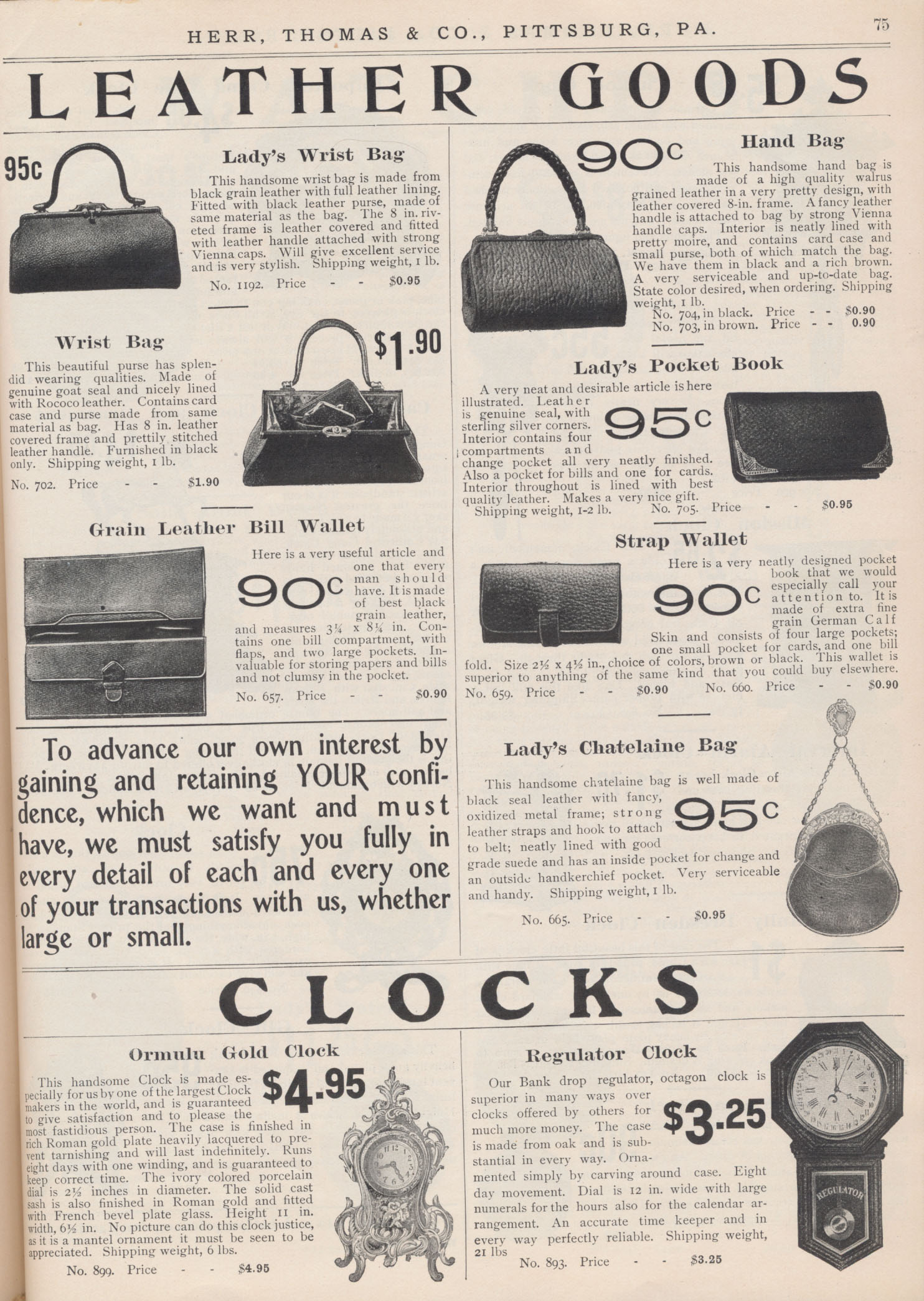 Herr, Thomas & Co., Pittsburg, PA. Catalogue No. 101 (1907), page 75, Lady’s Wrist Bag, Wrist Bag, Grain Leather Bill Wallet, Hand Bag, Lady’s Pocket Book, Strap Wallet, Lady’s Chatelaine Bag, Ormulu Gold Clock, Regulator Clock.
Catalogue No. 101 (1907) by Herr, Thomas & Co. is located in the Trade Literature Collection at the National Museum of American History Library.
Assessing File Format Risk for Born-Digital Preservation Planning
This post originally appeared on the Smithsonian Institution Archives’ blog. Melissa Anderson’s internship was part of the Smithsonian Libraries and Archives’ 50th Anniversary Internship program, with funding provided by the Secretary of the Smithsonian and the Smithsonian National Board.
When I entered the MLIS program at the University of Alabama School of Library and Information Studies in 2018 and became interested in digital libraries, I was surprised to learn that the information we create and store digitally is just as, and in some cases even more, fragile than unstable media or paper. Physical damage, deterioration of digital storage media, and the technological complexity and dependency of electronic records make them uniquely vulnerable to loss, corruption, and alteration. As keepers of records with historical, cultural, and legal value, archival repositories have a responsibility to identify at-risk digital objects and take preemptive action to preserve them in a format that is accessible to the broadest possible public for the longest possible time. As a Smithsonian Libraries and Archives 50th Anniversary intern in born-digital collections, I’m learning how to do just that.
At present, more than half of the Smithsonian Institution Archives’ annual accessions contain born-digital materials, most of which are acquired in mixed collections alongside print and analog media. To document and serve the Institution, the Archives collects documents, spreadsheets, images, audiovisual (AV) material, email, databases, designs, data sets, software, websites, and social media content. These electronic records span more than 40 years and are stored in a variety of media formats, some of which require urgent preservation to avoid information loss.
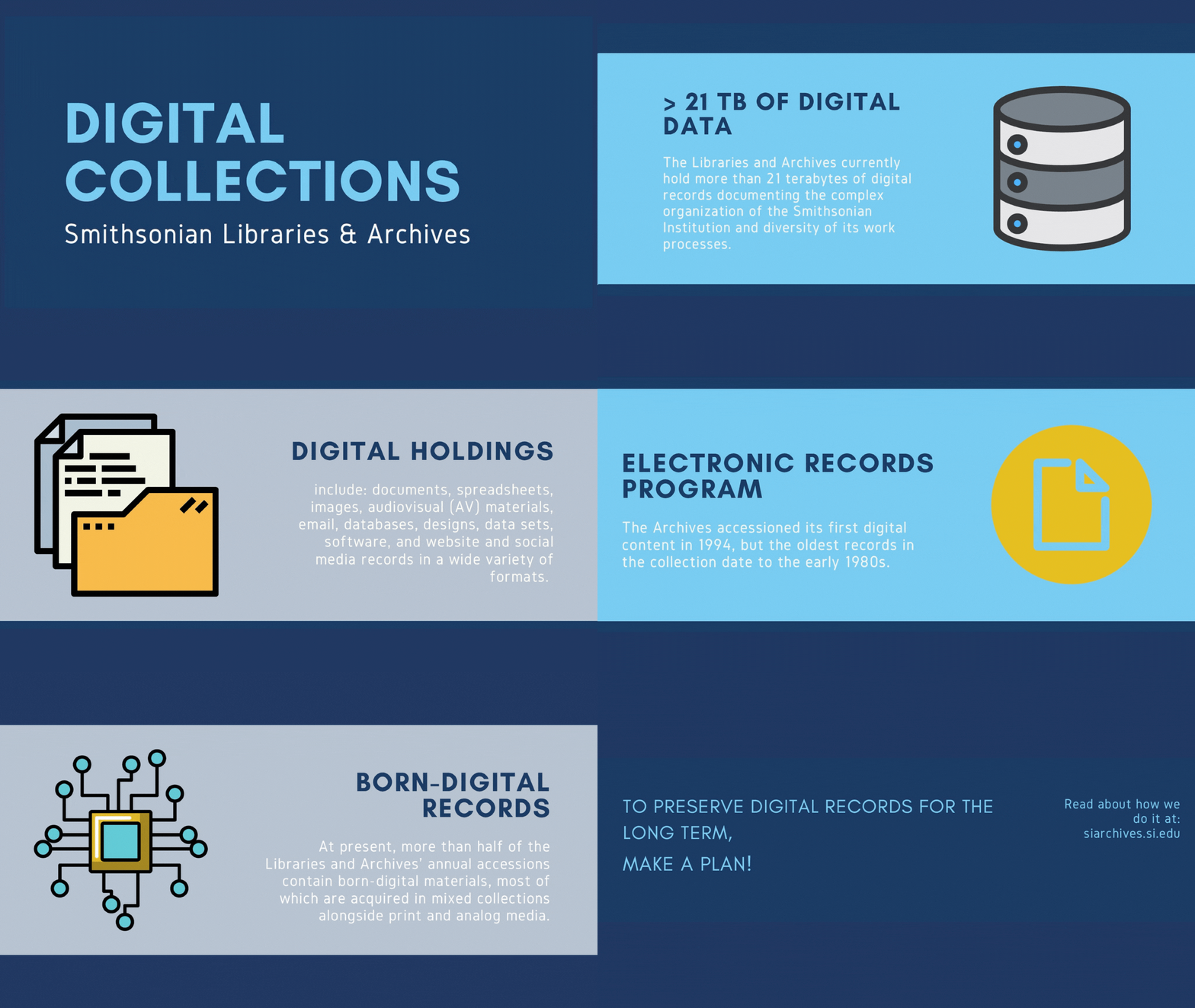 Gif slideshow of Digital Collections information.
The Archives’ employs a multi-pronged born-digital preservation strategy that follows professional standards and best practices including the OAIS Reference Model and trustworthy digital repositories. The three prongs are: bit-level preservation, migration of at-risk files to stable preservation formats, and emulation for access to records locked in obsolete formats. The first strategy creates an exact copy of a file’s content information and data structure and is applied to all digital objects on accession. Having two (or more) identical copies of every file and storing them in different locations mitigates the risk of loss due to media, system, or human failure and disasters like fire and flooding, but possession does not automatically equal access. Our ability to even open and view a file during processing depends on hardware and software that can read and render it.
Obsolescence affects both the machines and the software we use to create, store, and access digital files. Advancements in power, speed, efficiency, and cost lead to rapid obsolescence of computer hardware. The introduction and adoption of new hardware also leads to new and improved software, which eventually makes older software and the file formats it supported obsolete as well. The wide use of proprietary file formats has created a situation in which only the program that created the file—or, even more specifically, a particular version of that program—can be used to open that file.
Sometimes only the information (i.e written text) contained in a file is important, but often we need to preserve the appearance and function of files as well to ensure that evidential and use value is maintained. Take, for example, a newsletter created using Adobe InDesign 1.0 (circa 1999) and selected for a digital exhibition commemorating the Smithsonian’s 175th anniversary. If we’re only able to render the text of that document but not the images, layout, colors, or fonts, we would have only a part of the newsletter the original user experienced. This is where our second and third prongs—migration and emulation—come into play.
Migration involves moving a file from an at-risk or obsolescent format to a format digital archivists agree is more stable. Despite dependence on hardware and software, migration is an effective way to preserve digital objects and make them accessible, so long as it’s done promptly and as needed to keep up with technology. But it requires archivists to verify fixity, which assures that a copied or converted file hasn’t been altered from the original. Digital files can be changed or corrupted accidentally during preservation events, through human error, or maliciously by actors who wish to alter or destroy records. Checksums enable archvists to validate the authenticity of records, which is essential for maintaining public confidence in the trustworthiness of repositories. If the hash of a copied file matches the hash of the original, archivists can be confident the record has been reproduced exactly.
When files can’t be migrated, emulation provides another mode of preservation and access. This method uses programming to emulate the appearance and function of obsolescent computing technologies—one can, for instance, turn a Raspberry Pi into an original Nintendo gaming system. But the kind of emulation needed to preserve both the information content and appearance of digital records is much more complicated and expensive. A well-known and early use of emulation was undertaken at Emory University’s Rose Library. In 2009, when I was a third-year doctoral student in American Studies there, my digital humanties friends were all excited about a digital archives technology that convincingly replicated Salman Rushdie’s Power Macintosh 5400. Emory’s case study became an early model for successful digital preservation, but their innovation was supported by a resource-rich institution that invests heavily in its archives and special collections libraries.
Ten years later, when I entered library school, I understood why my Emory classmates had been so excited; migration and emulation enable us to preserve and provide access to electronic records at scale.Today, we’re challenged to develop preservation policies and workflows that include strategic risk assessment. The Archives’ digital preservation team is performing a detailed risk analysis of the born digital holdings in our collections.This process starts at ingestion by identifying and validating the format type of each file using DROID and JHOVE, as well the PRONOM technical registry. Digital archivist Lynda Schmitz Fuhrig or another team member reviews this and other administrative metadata. All the administrative information about the born digital content in an accession is gathered in the Archives’ DArcInfo (Digital Archive Information System) database.
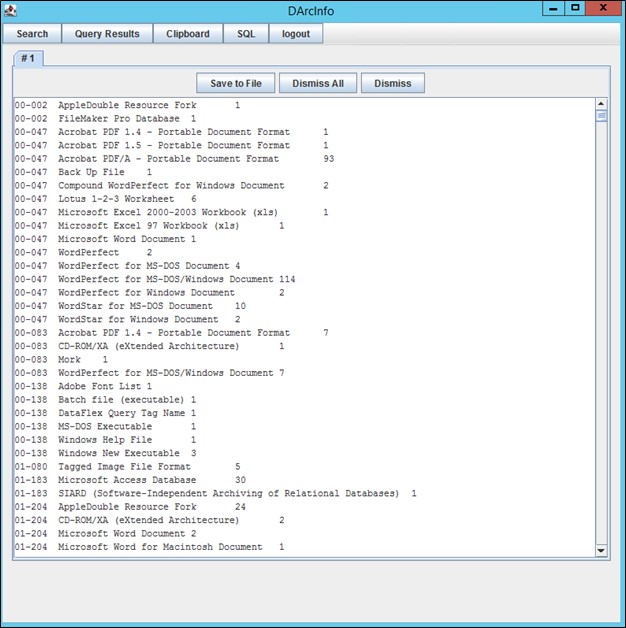 Screenshot of DArcInfo query results showing format type and count by accession for born-digital holdings.
By querying this database, we can determine and document our preservation backlog (how many assets we hold that do not yet have a preservation master file), giving us the scope of our to-do list. We can also inventory the format status of our digital holdings (including format type and version) and assess storage media (type, stability, and condition). We intend to use this information to identify the range of formats and how many files in each format we hold by accession. From there, we will draft a plan for targeting the most valuable and at-risk digital objects in our collections so that we can preserve them in accessible formats before they’re lost.
Exploring Bias and Library of Congress Subject Headings
I am currently wrapping up my first year as an MLS student at Emporia State University, with a concentration in archives. A sense of curiosity, a love of learning, and a passion for research led me to libraries and archives as a career. I am drawn to the idea of working for universal access to information and knowledge, and I intend to work to disrupt systems of oppression in our institutions. In Spring of 2021, I took a required course in my program that introduces students to basic concepts in cataloging and classification. While I had already chosen a concentration that fills most of my elective credits, I wanted to learn more about cataloging. The cataloging project, part of the Smithsonian Libraries and Archives’ 50th Anniversary Internship program, was the perfect opportunity to further develop my knowledge of descriptive work, while incorporating ethics of social justice.
For this project, I had the pleasure of working with Heidy Berthoud, Head of Resource Description, and Amanda Landis, Library Technician. We started with materials relating to ideas of diversity, equity, accessibility, and inclusion (DEAI) within Smithsonian Libraries and Archives library collections and examined the Library of Congress Subject Headings (LCSH) being used for those materials in library catalogs. We then considered where there were gaps in the assigned headings which did not fully convey the meaning of these works, or where subject headings being used were inappropriate or outdated. We would then draft proposals for new subject headings, with the goal of improving accuracy and inclusivity within LCSH.
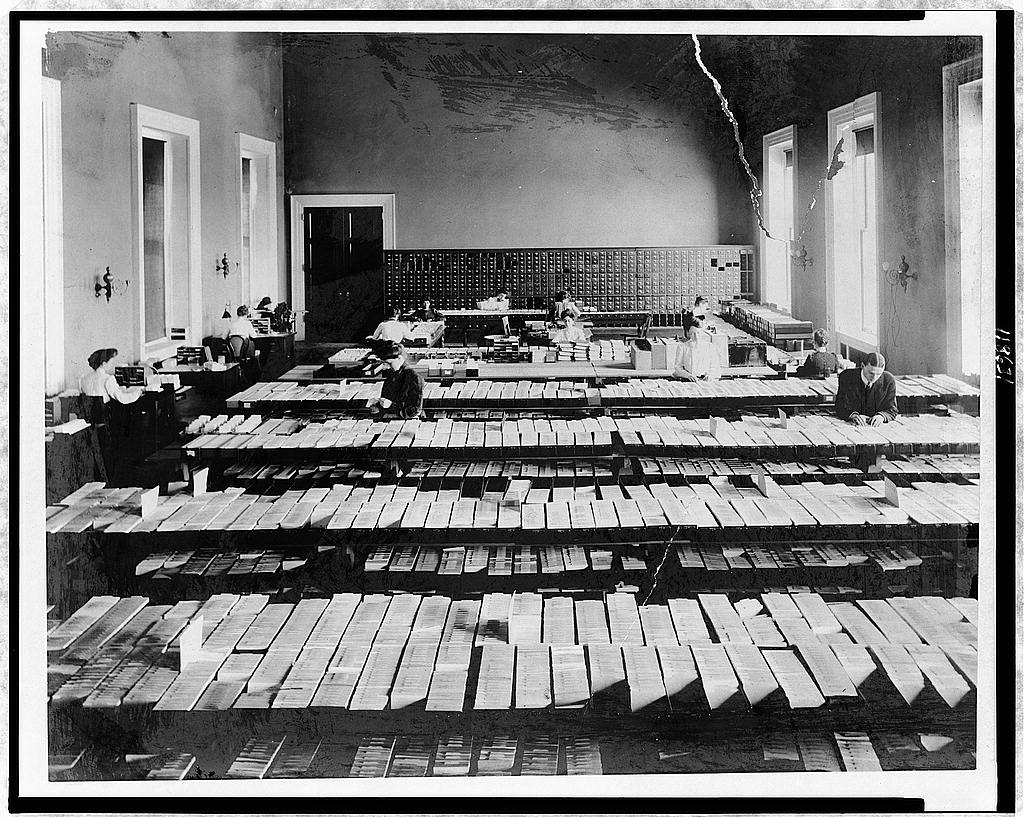 People working in Card Division, Library of Congress, Washington, D.C. [Between 1900 and 1920] [Photograph]. Library of Congress.As intern for this project, I conducted research needed to justify proposals and provided an additional critical eye as we searched for issues. I took particular interest in issues of gender and sexuality within LCSH, performing research to determine the relationships between terms as the hierarchy of LCSH exists at present. This led me to discover that a common sexual orientation, pansexuality, is currently absent from LCSH. I performed the research to draft a proposal for pansexuality as a new heading. I also performed research to support a change in the heading “sexual minority culture,” hoping to update it to “queer culture” (this heading exists in addition to “gay culture” and “lesbian culture”).
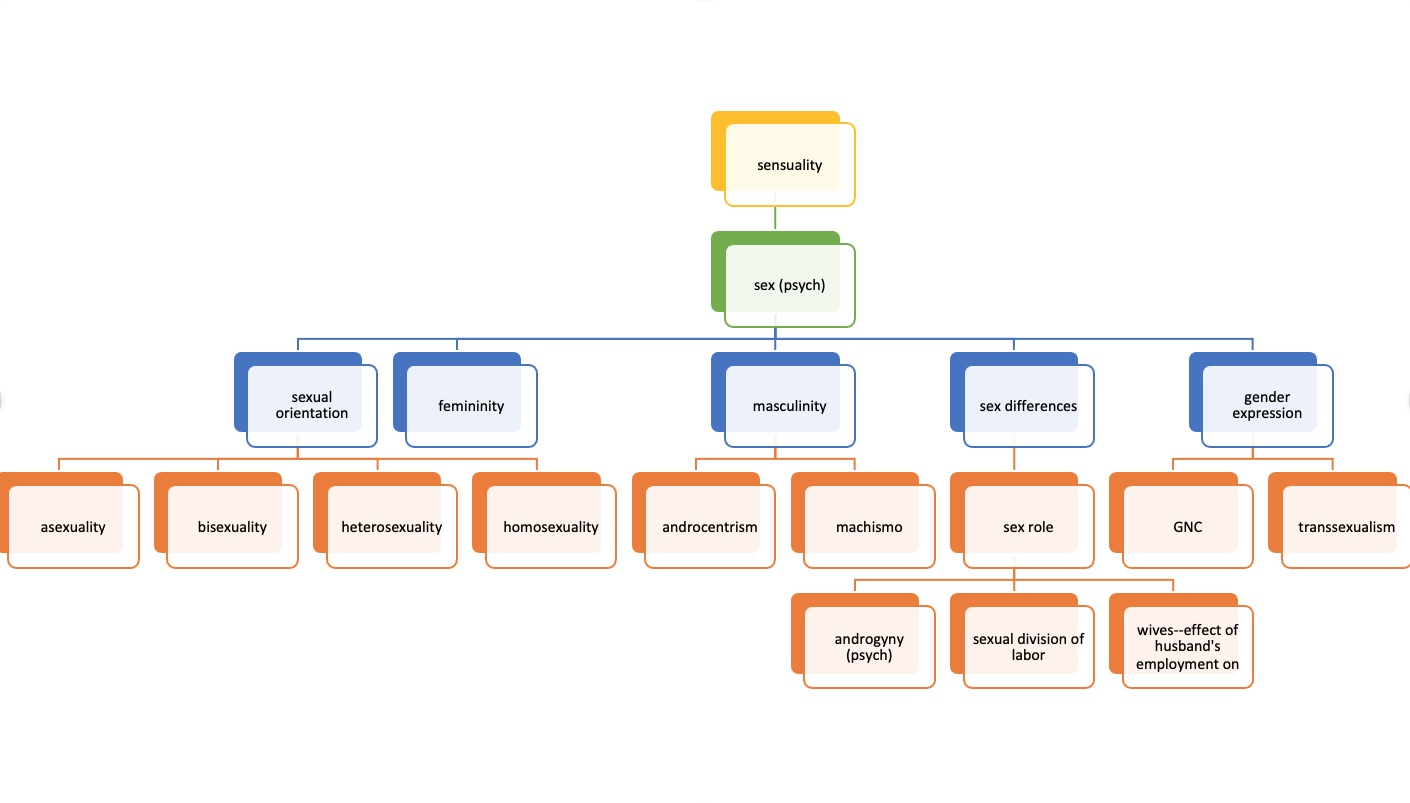 Mapping sexuality terms as present in LCSH [screenshot]. River Freemont.Through this project, I learned a lot about the process and politics of proposing headings. There are an extensive number of complicated rules for constructing proposals, but it is also important to be mindful of how LC prefers things to be done, even if they are not requirements. Consistency within LCSH is a common factor in rejections, as well as the impact a change would have on the larger system. It can take over two months to receive a ruling on your proposal. Heidy even arranged for us to attend an editorial meeting of the LC Policy, Training, and Cooperative Programs Division (PTCP), where decisions are made about new headings or revisions to headings.
It is important to consider that headings are approved based on works being cataloged, not anticipation of some future need for a heading. So, an important part of writing proposals is to provide literary warrant – justifications for headings that consist of published works where the term is being used – which shows the PTCP that experts in the field agree that your heading is the preferred term. Something this brought up for me is the validity of lived experience. How can we privilege the voices of those whose lives are affected by the language used to describe them? Potential solutions to this issue that I found were choosing sources that interviewed subjects or contained personal anecdotes, as well as considering the positionality of the author or the publication.
There are issues with access to this process. In order to perform this work, we really need to have access to tools such as RDA Toolkit, OCLC Connexion, Classification Web, or Cataloger’s Desktop. These are costly tools that not everyone wishing to do this work will have access to through their institution. There is an overrepresentation of university, research, and national libraries, as well as vendors, in the decision-making process. Conversely, there is a lack of representation from Historically Black Colleges and Universities (HBCUs), public and school libraries, and international libraries. During our work on this project, Heidy was able to consult a colleague with insider knowledge, but not everyone will have that kind of connection.
Heidy also introduced me to Cataloging Lab, a project started by Violet Fox. It is a website “designed so that people who are familiar with LCSH and experienced with the…proposal process can assist those who want to do the research to make changes”. I was inspired by this project because it is increasing access to the process, facilitating collaboration, and sharing knowledge in order to make positive changes in a difficult system. Anyone can join and post their proposals, receive knowledgeable input, and assist others with research.
I found the iterative nature of the process was a challenge with this project. It was necessary to keep in mind that we might not see immediate results from our efforts, but we are contributing to change, and others can come along and build off our work. Another significant challenge was overcoming my inclination toward introversion, and developing confidence in myself as a professional. It certainly paid off in the end, however, as the connections I made were my favorite part of this experience.
I particularly enjoyed attending Smithsonian Library and Archives meetings, such as the National Museum of Natural History’s Collections Task Force. I loved learning about different projects underway at the Smithsonian and learning about what librarians do for the Smithsonian community. Heidy facilitated a lot of conversations with different folks around the Smithsonian, some librarians, some not. These conversations helped to inspire me, give me direction for my education and future career, and increase my confidence as an emerging professional. I loved being a part of the Smithsonian community. The people I met were so kind and welcoming, and I especially enjoyed working with Heidy and Amanda.
River Freemont’s internship was part of the Smithsonian Libraries and Archives’ 50th Anniversary Internship program, with funding provided by the Secretary of the Smithsonian and the Smithsonian National Board.
Stewards of the Hungerford Deed
When the Smithsonian Institution was founded “for the increase and diffusion of knowledge,” it was difficult to know how impactful this mission would still be 175 years on. To this day, the Smithsonian Libraries and Archives strives to further this goal, sharing our knowledge to make discoveries and expand our understanding together with you, our community of supporters. The Hungerford Deed, which quickly became a treasure of our collections, exemplifies this work, as does the special opportunity to become a close supporter of the Smithsonian Libraries and Archives by joining the Stewards of the Hungerford Deed. Read on to learn about how the Hungerford Deed illuminates the Smithsonian’s founding, and the impact you can make as a Steward.
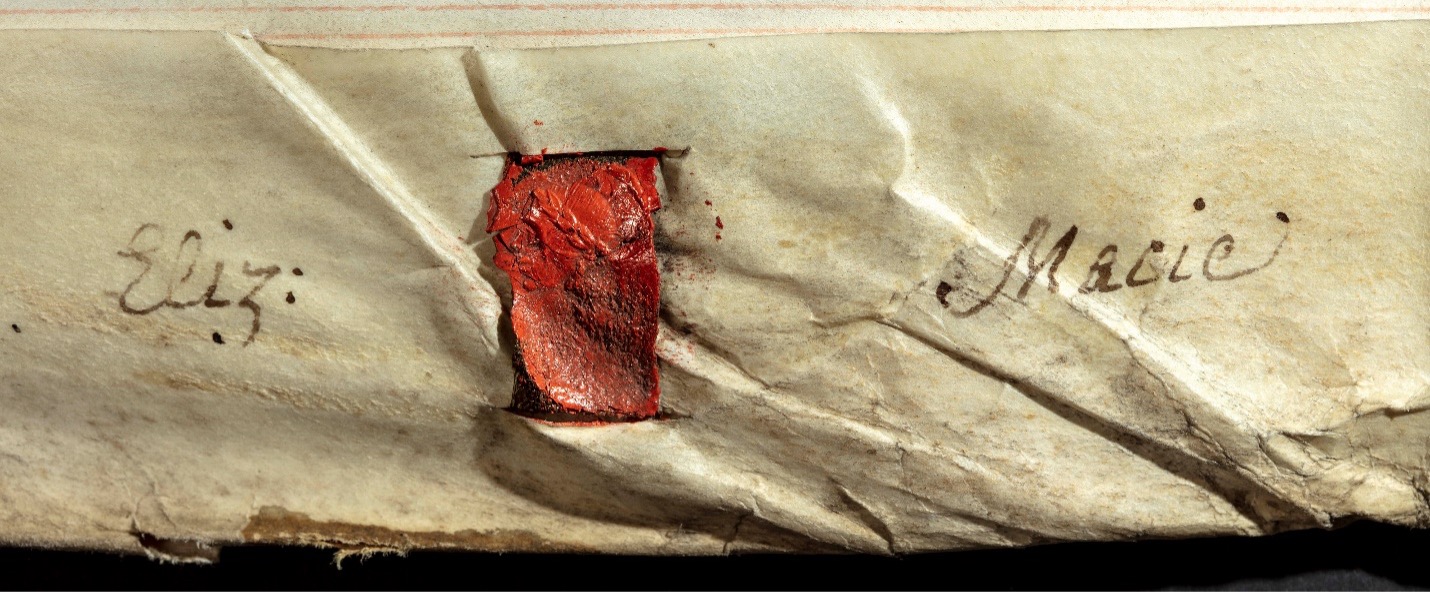 The signature of Elizabeth Macie, James Smithson’s mother, on the Hungerford Deed, 1787, Smithsonian Institution Archives, Acc. 19-150.
The Deed is a 1787 property contract divvying up inherited lands between James Smithson’s mother and aunt. The insights shared by the Deed go beyond the legal decisions, illustrating a dramatic battle between the sisters and offering context via the family dynamics that shaped Smithson into the founding donor of the Smithsonian Institution. Like many archival discoveries, the Deed is an unpublished work that required ample preservation when it was anonymously donated to the Smithsonian in 2019. Preservation included carefully unfolding, stabilizing, and humidifying each parchment page so viewers can examine the pages, as interested parties might have three centuries ago. This process reveals and protects the original knowledge present in the Deed, contributing this knowledge to the collections that the Libraries and Archives safeguards as a resource for future generations.
 The Hungerford Deed opened for the first time. Smithsonian Institution Archives.
Sharing knowledge often leads to exciting discoveries in collaboration with other scholars and curious minds. The Libraries and Archives is excited to facilitate this exchange through a virtual exhibition launching on August 10, offering a deeper dive into the Deed. Visitors near and far will be able to virtually turn the pages of the Deed and explore for themselves, with highlights of interesting facts and context right on the page to enhance their understanding. The Deed offers a wellspring of new information pertaining to the history of women’s property rights, the British legal system, and Smithson’s genealogy, and we are excited to make this knowledge available to evolve understanding alongside researchers.
 The first page of the Hungerford Deed, 1787, Smithsonian Institution Archives, Acc. 19-150.
Our preservation, research, and outreach in connection to the Deed exemplifies just a few of the ways the Smithsonian Libraries and Archives protects and shares our collections. With scientific and cultural treasures ranging from oral histories to artists’ books, the Libraries and Archives is a resource where knowledge can be tested and expanded. Stewards of the Hungerford Deed champion this impact, ensuring this knowledge will continue to be safe and accessible. This special group will be celebrated in connection with the Deed and beyond, as the impact of these gifts reverberates through our crucial work.
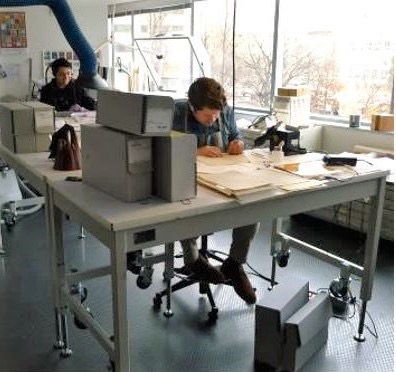 The Archives conservation lab, where staff are working to preserve more of our treasures
You are invited to join our community of supporters, championing accessible educational resources, diverse collections, and critical preservation. Stewards are recognized beginning with a gift of $75, and benefits at a variety of giving levels include honoring Stewards on the virtual exhibition illuminating the Deed, a certificate recognizing your gift, and an exclusive invitation to view the Deed in person with fellow Stewards in the future. We are pleased to recognize donors with giving levels inspired by the real people behind the Hungerford Deed. Join their legacy today as a Steward in one of the following categories:
- Steward – $75 and more
- Keate Steward – $175 and more
- Walker Steward – $575 and more
- Macie Steward – $1,175 and more
- Smithson Steward – $5,175 and more
- Hungerford Steward – $10,175 and more
The Hungerford Deed illuminates the context for James Smithson’s commitment to knowledge, and the Smithsonian Libraries and Archives looks forward to re-committing and investing in this mission together with you.
Learn more about becoming a Steward of the Hungerford Deed!
P.S. Interested in learning more about the Deed and the upcoming virtual exhibition? Join us during our virtual program with conservator William Bennett on August 12! Attendees will take a closer look at the Deed and learn more about the significance of the discoveries it holds.
Vintage Furniture Finds from the Early 20th Century
Before online outlets and a certain Swedish superstore, imagine decorating and furnishing a new home in the early 20th Century. What did your furniture look like? What curtains or window hangings did you choose? How did you communicate with your neighbors? The Trade Literature Collection at the National Museum of American History Library includes a few catalogs related to these very things.
One catalog is titled Spring & Summer Catalog (1915) by John Wanamaker. In previous blog posts, we learned about library pieces like armchairs and sofa beds as well as dining room furniture and tableware. Now, let’s explore a few more items from this catalog.
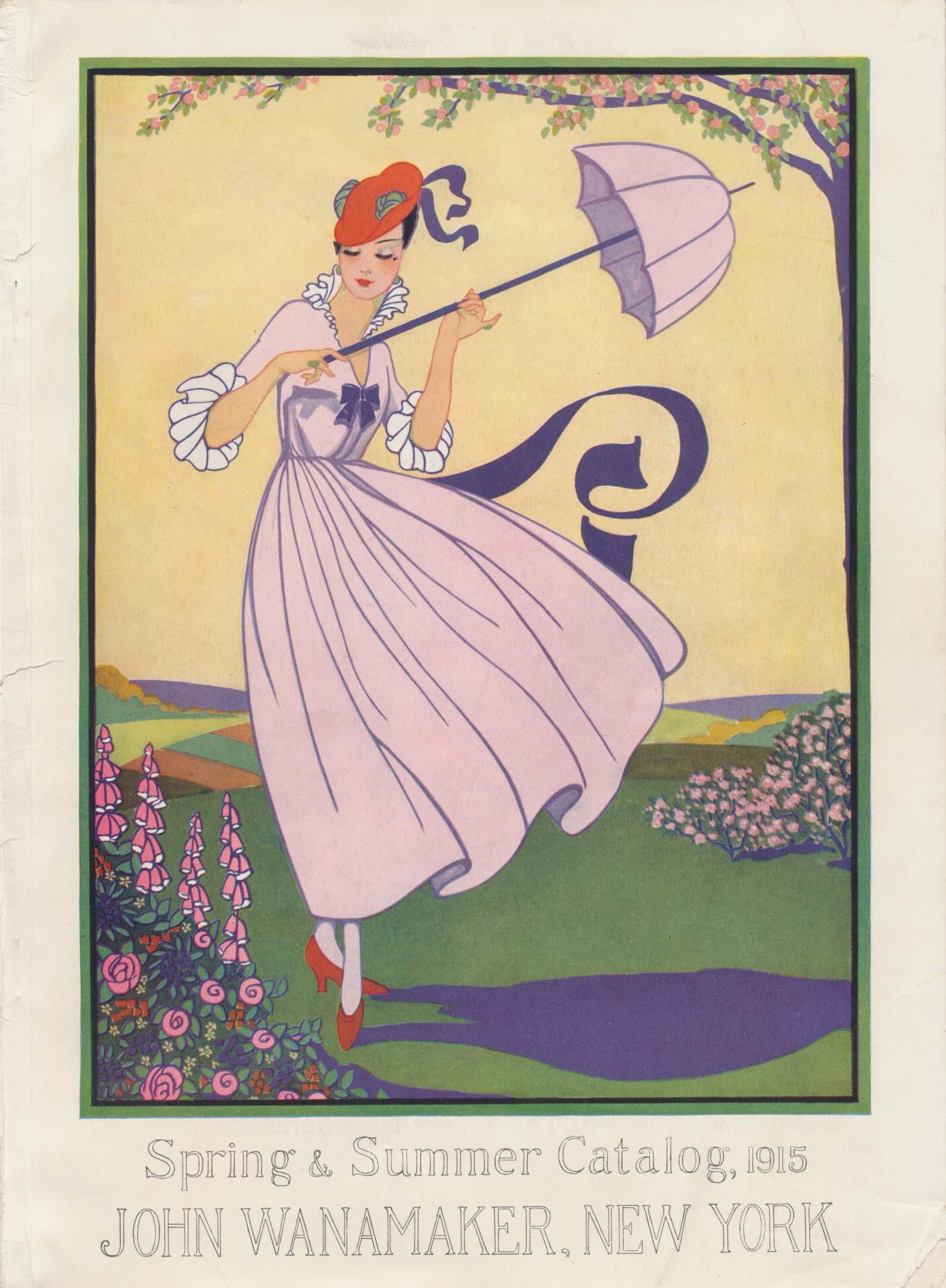 John Wanamaker, New York, NY. Spring & Summer Catalog (1915), front cover.
Several pages focus on bedroom furniture such as these Bedroom Suites manufactured from solid mahogany. The Bedroom Suite shown below included several pieces of furniture, but each piece was priced individually. This included bedframes (top and bottom, middle), dresser with glass (top right), chiffonier with glass (top, second from left), and dressing table (top, left). The dressing table came with a triplicate mirror, but those preparing for a special occasion might have preferred a tall or full-length mirror, such as the Cheval Glass (bottom right). Another piece in the suite was the Table Desk (bottom, middle). Perhaps it was used for corresponding with family and friends via letters. The top of the desk included small compartments to store stationery and supplies.
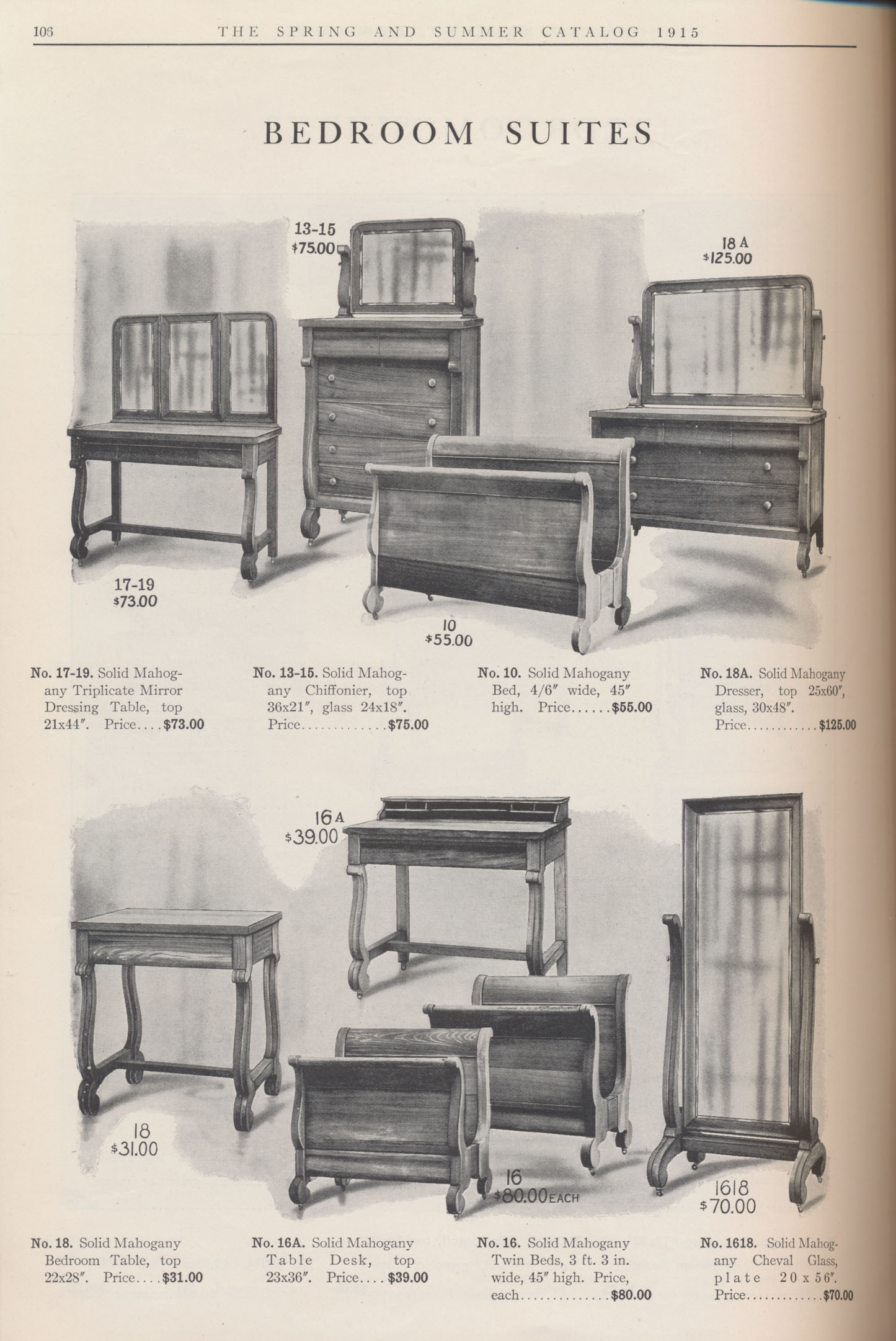 John Wanamaker, New York, NY. Spring & Summer Catalog (1915), page 106, Bedroom Suites (Dressing Table, Chiffonier, Bed, Dresser, Bedroom Table, Table Desk, Twin Beds, Cheval Glass).
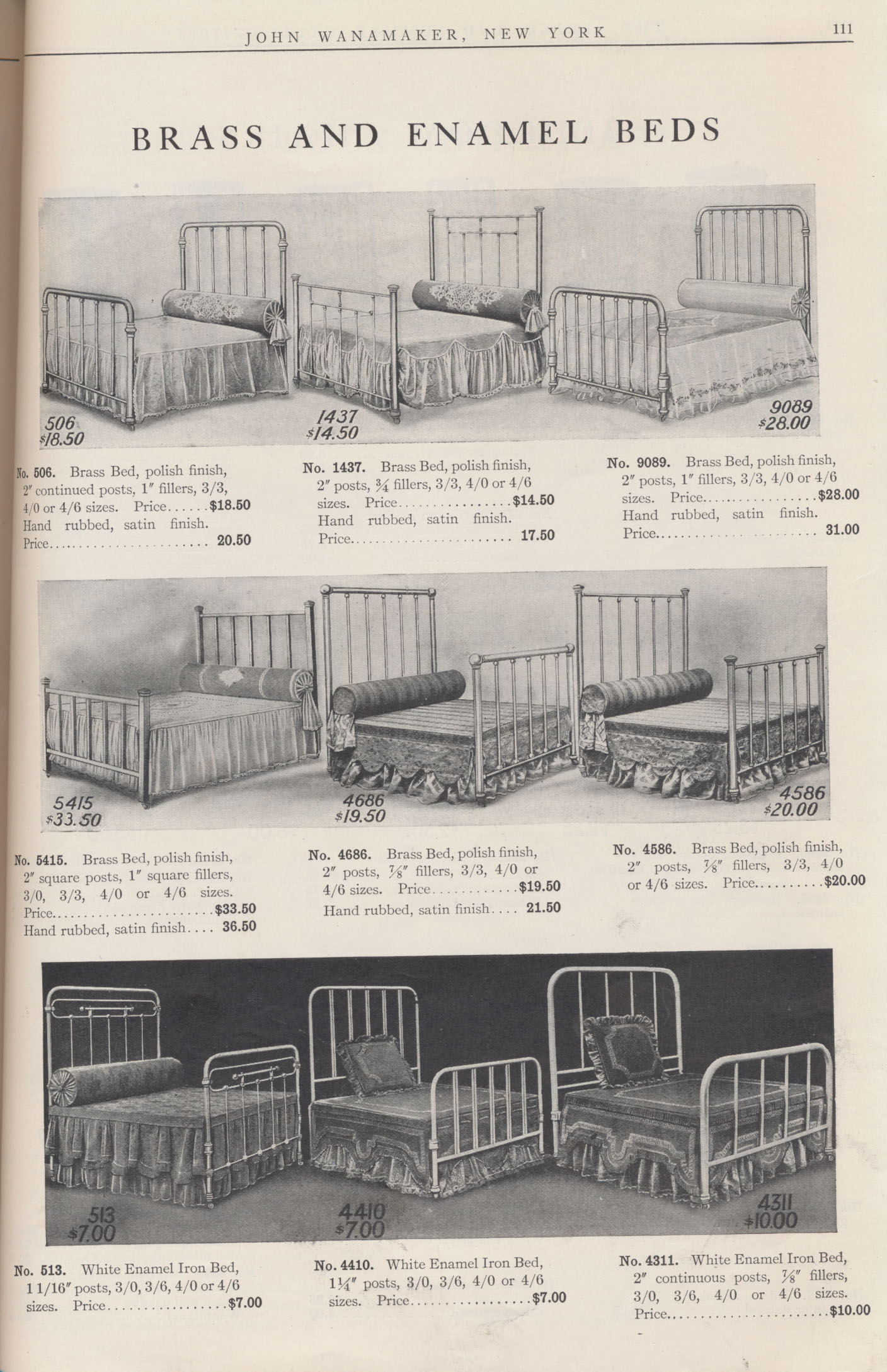 John Wanamaker, New York, NY. Spring & Summer Catalog (1915), page 111, Brass and Enamel Beds.
Other choices included brass and enamel beds. The brass beds, shown above (top and middle rows), were available with a polished finish and most also had the option of a hand rubbed, satin finish. White Enamel Iron Beds are also illustrated above on the bottom row.
As for mattresses, one option was the Kurly-Kotton Elastic Felt Mattress (below, top middle). No space age foam or fancy fillings here – this elastic felt mattress was filled with cotton sheets laid by hand. The Single Border Spring (below, middle right) had 63 spirals and was compatible with wooden beds.
 John Wanamaker, New York, NY. Spring & Summer Catalog (1915), page 119, Mattresses and Springs.
John Wanamaker also sold draperies and window hangings. Someone setting up their new home in 1915 could chose these Irish Point Curtains (below, bottom left). Measuring 47 inches wide and 3 yards long, these had a plain net center and decorative border. Other window hangings incorporated floral decorations, such as No. 4 Fine Soft Voile (below, top right). Described as having a “graceful floral pattern,” it was available in pink, blue, and yellow.
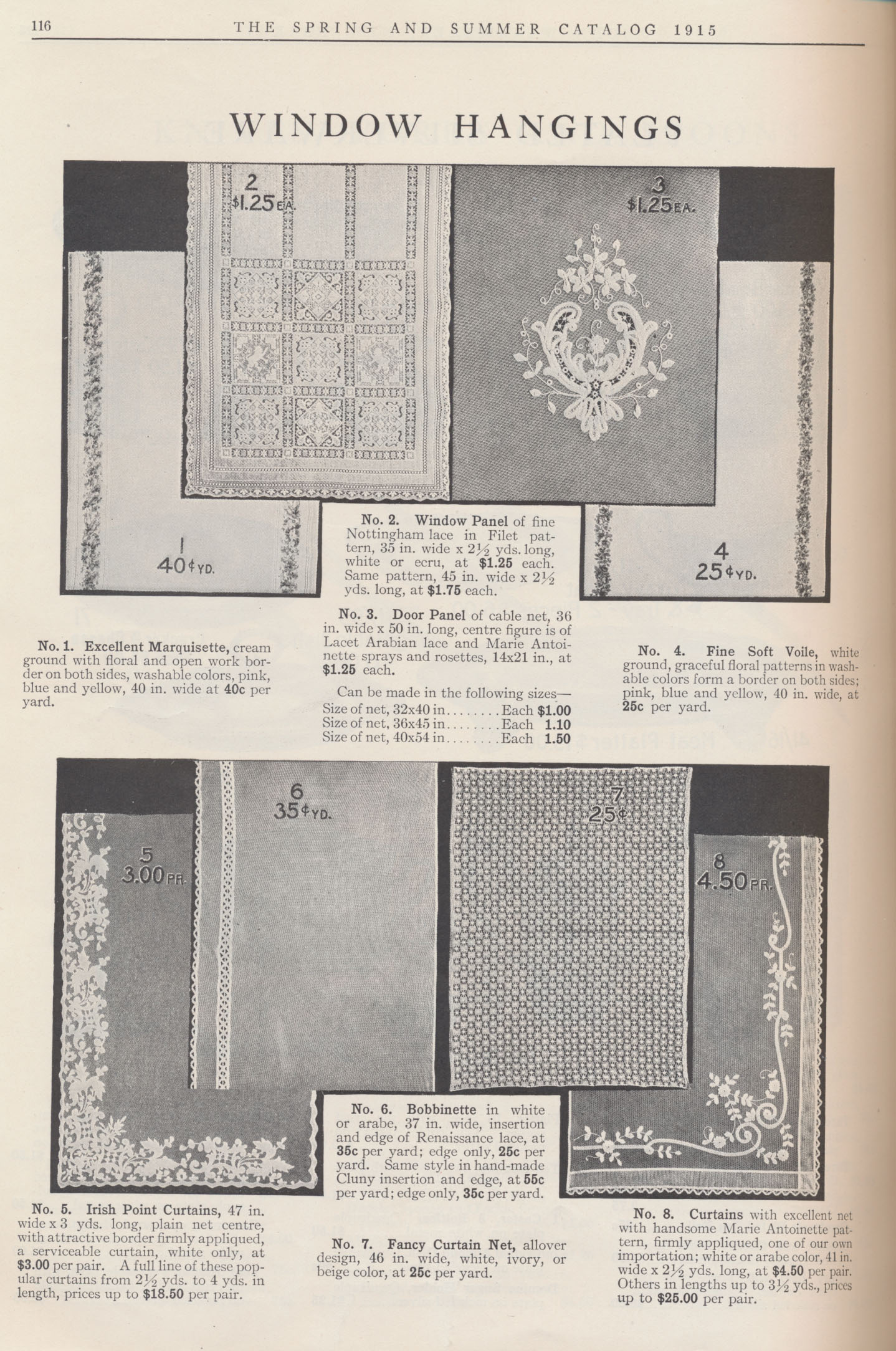 John Wanamaker, New York, NY. Spring & Summer Catalog (1915), page 116, Window Hangings.
Just as curtains add a decorative touch to a room, so do rugs. The All Wool Art Rug (below, bottom left) was reversible and described as having “plain or all-over effects.” The particular one illustrated below includes shades of blue, but according to its description it was also available in “special colorings.”
Another option was the colorful Log Cabin Rag Rug shown below (bottom right). Besides plain colors, it was also available in “hit-and-miss effects with plain band borders.”
Cotton Bath Rugs were sold in a variety of colors and patterns. Though the catalog does not give specific details, one bath rug is shown below (middle) in shades of blue.
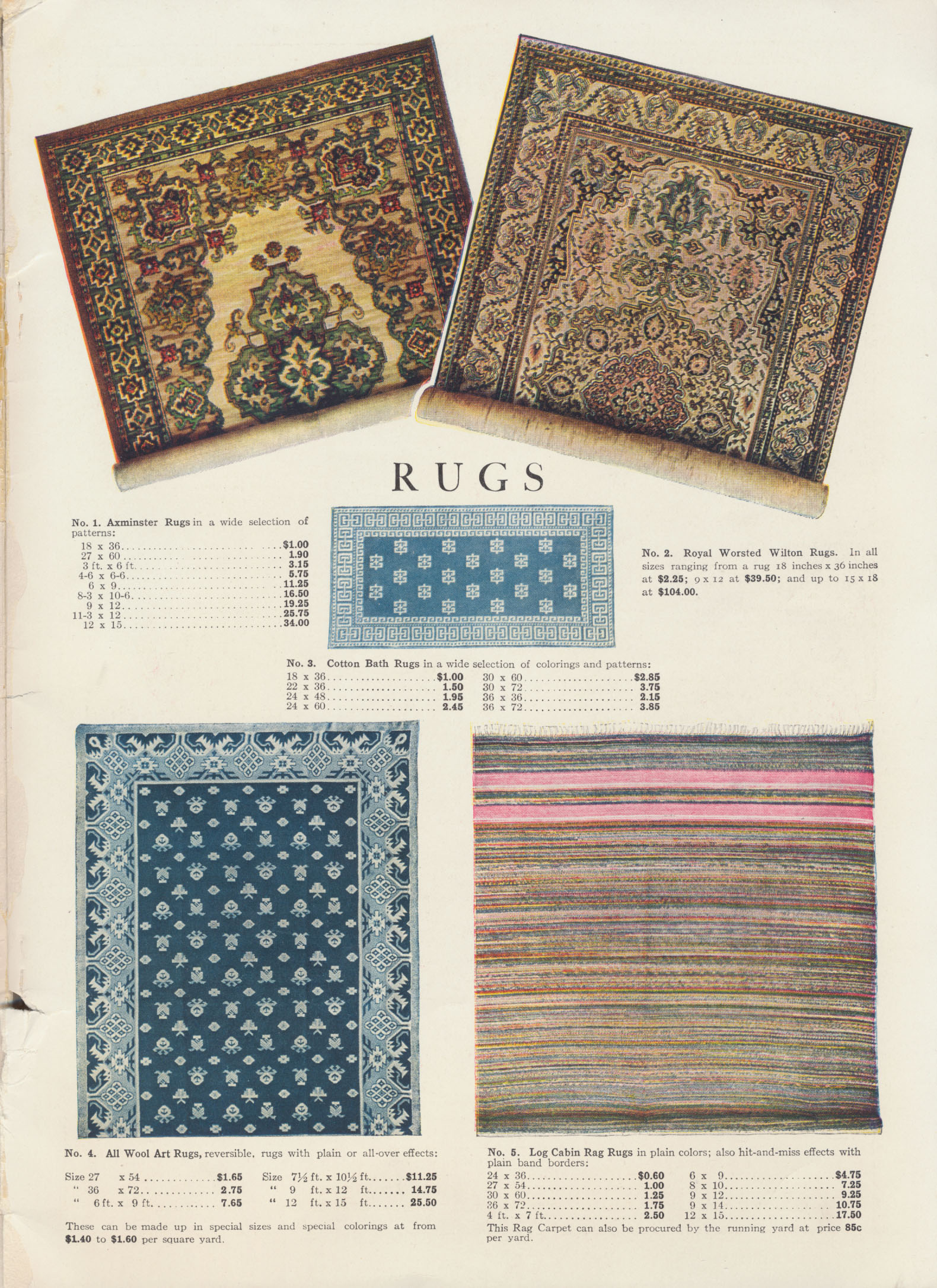 John Wanamaker, New York, NY. Spring & Summer Catalog (1915), inside back cover, Rugs.
Now let’s travel a few years further back in time to 1907. This trade catalog is titled Catalogue No. 101 (1907) by Herr, Thomas & Co. The company sold a variety of household items via mail order. In previous blog posts, we highlighted writing supplies and related furniture as well as lawn and porch furniture and even groceries. Now let’s explore a few items in the “Laundry Furnishings” and “Household Necessities” sections.
Herr, Thomas & Co., Pittsburg, PA. Catalogue No. 101 (1907), front cover [page 1], explanation of benefits of buying direct from the company.What did a clothes washer look like in the early 20th Century? Perhaps a family in 1907 bought the Washer pictured below (bottom left, shown in the closed position). The interior of its tub was heavily corrugated or ribbed which, according to the catalog, made the machine capable of “producing the same action on clothes being washed as rubbing them by hand on a wash board.” To prevent fingers or clothing from getting caught, a malleable iron cage guard covered the gearing, but it was possible to open the guard to clean the gears. The catalog also mentions that this machine was capable of washing something as small as a napkin or as large as a horse blanket.
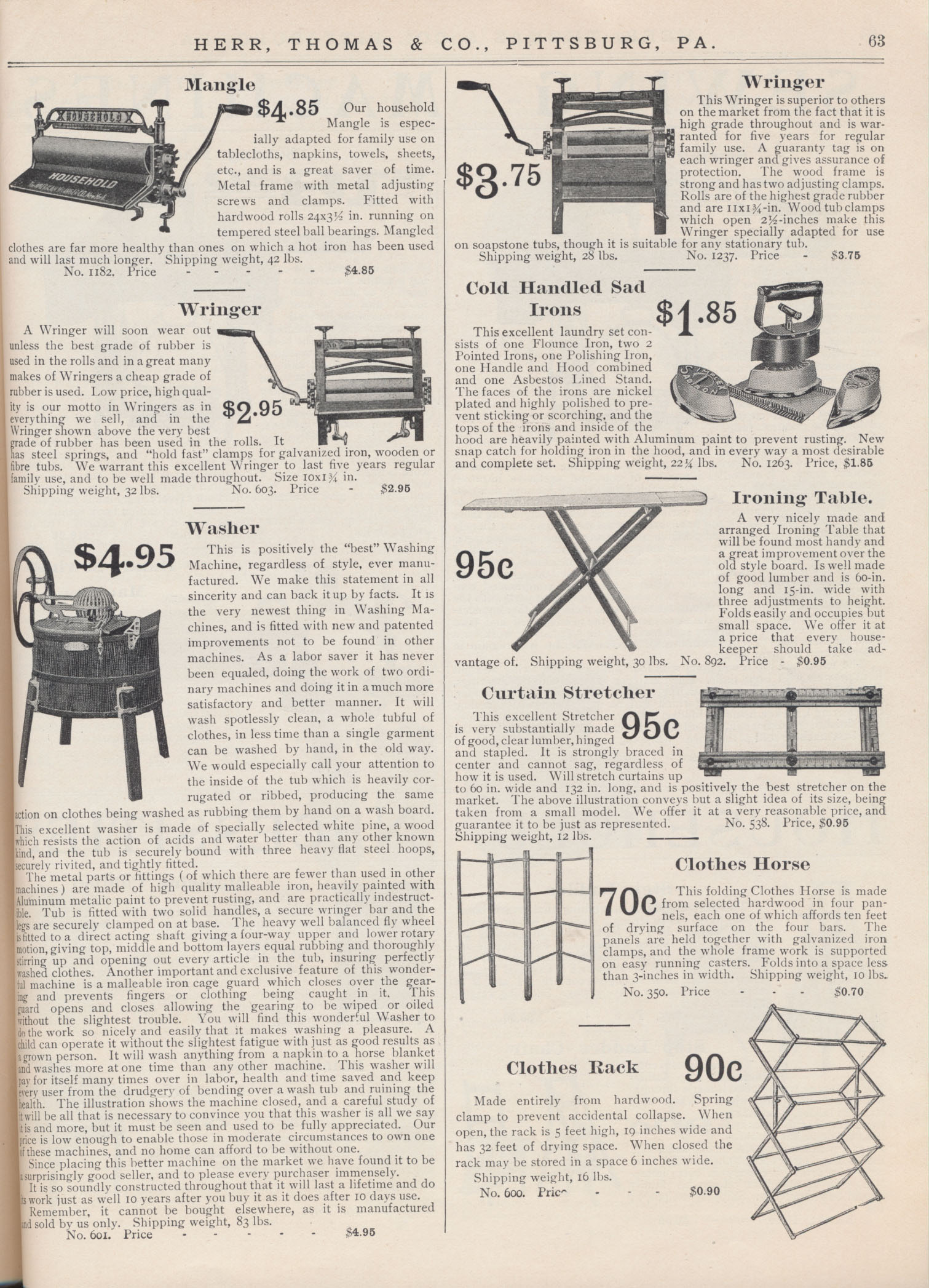 Herr, Thomas & Co., Pittsburg, PA. Catalogue No. 101 (1907), page 63, Mangle, Wringers, Washer, Cold Handled Sad Irons, Ironing Table, Curtain Stretcher, Clothes Horse, Clothes Rack.
How did you communicate with family and friends in 1907? Perhaps a Biaphone was installed in the home, as illustrated below (bottom right). The Biaphone provided a means of communication between two rooms or two nearby buildings by using the same wiring as the electric bell or annunciator. It required wire 500 feet in length with a Biaphone installed at each end of the line. Maybe it was helpful for quick conversations between family members in separate rooms of a house or even with the next-door neighbor.
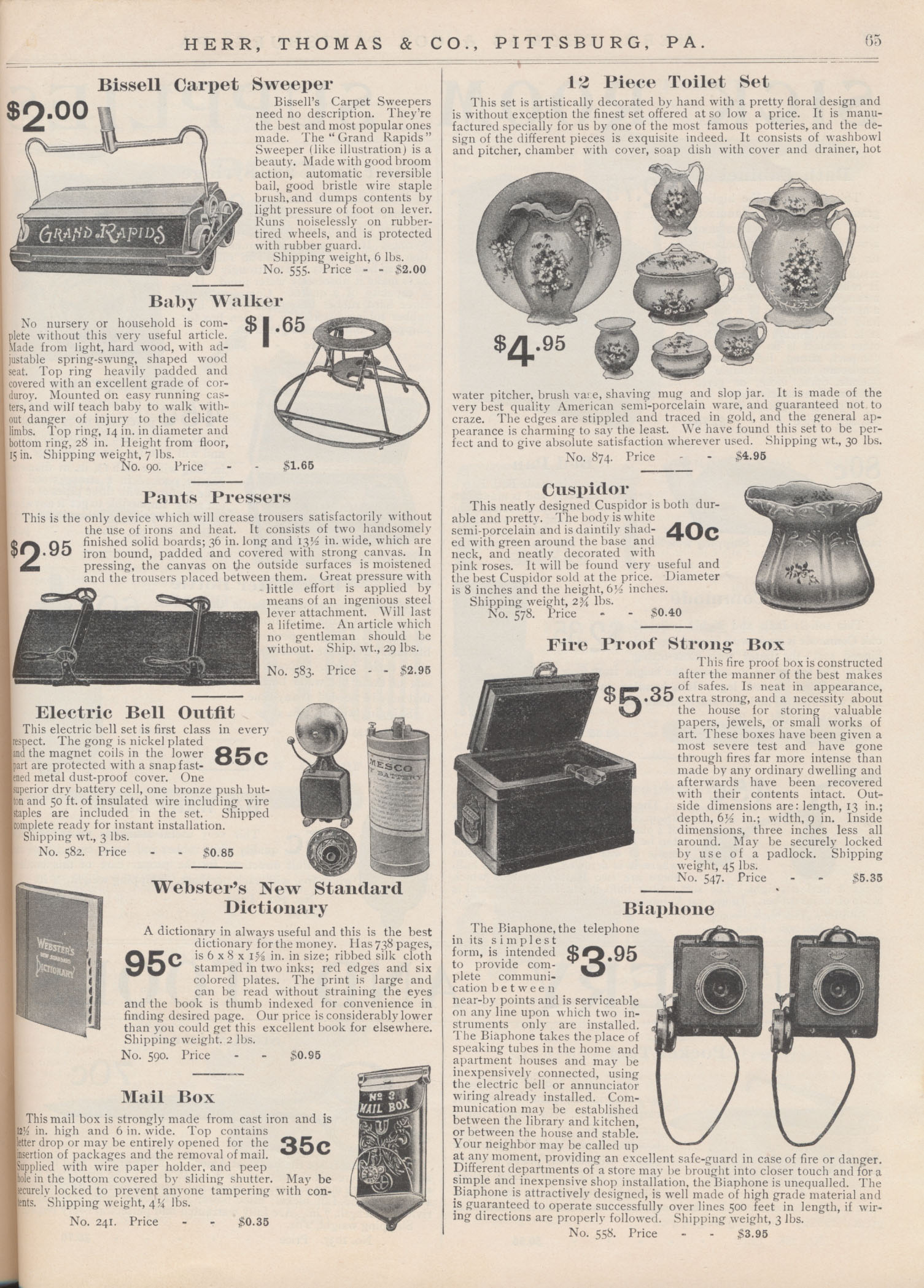 Herr, Thomas & Co., Pittsburg, PA. Catalogue No. 101 (1907), page 65, Bissell Carpet Sweeper, Baby Walker, Pants Pressers, Electric Bell Outfit, Webster’s New Standard Dictionary, Mail Box, 12 Piece Toilet Set, Cuspidor, Fire Proof Strong Box, Biaphone.
Another form of communion is letter writing. For that, a mailbox, such as the one shown above (bottom left), might have been handy. This Mail Box, manufactured of cast iron, was capable of being securely locked. It featured a letter drop, or slot, to deposit thin envelopes along with the ability to fully open the top to deposit thicker envelopes and remove mail. It also featured a wire paper holder and “peep hole in the bottom covered by sliding shutter.”
Many other household necessities are illustrated in this section of the catalog such as a Pants Presser, for creasing pants without using an iron and heat, and the Fire Proof Strong Box, to securely lock and store important and valuable papers and belongings.
Spring & Summer Catalog (1915) by John Wanamaker and Catalogue No. 101 (1907) by Herr, Thomas & Co. are located in the Trade Literature Collection at the National Museum of American History Library.
Identifying Article Metadata in “The Avicultural Magazine”
This blog post was written by Taylor Smith, the 2019 Kathryn Turner Diversity and Technology Intern in the Smithsonian Libraries’ Web Services Department. At the time of her internship, Taylor was an undergraduate Computer Science student at Bowie State University. Her work in the summer of 2019 consisted of developing and coding a method for identifying article metadata in The Avicultural Magazine, a leading journal for the keeping of non-domesticated birds in captivity.
As a biology major with an interest in computer science, I had a curiosity for wildlife and a newfound love for coding. I kept the two in mind when searching for internships, and luckily for me, I was led to the Kathryn Turner Diversity in Technology Internship for the summer of 2019. When I saw that the internship would focus on working with zoo articles relating to botany and wildlife, I knew this was perfect for me.
I had never held an internship before, let alone one that involves coding (which I had started learning that year). I had no idea what to expect when coming into this internship, but I learned a lot more than I could have imagined. Throughout this internship, I learned what metadata was and why it was so important. I learned why having digitized articles available online was so crucial. I also learned that making information accessible took a lot more work than anyone would think.
In my first week, I was introduced to the Biodiversity Heritage Library (BHL), an online digital library designed to make biodiversity literature available to the public. In this library, I was specifically working with The Avicultural Magazine. This was a journal created by the Avicultural Society in 1894 with the purpose of spreading information, advice, and updates on non-domesticated birds. The volumes are digitized by Smithsonian Libraries and Archives and processed through optical character recognition (OCR) for the convenience of zookeepers and other zoo curators. The only problem with this is that it takes scrolling through endless pages of articles to find the specific item you’re looking for. My job was to create code that finds metadata for these articles to make them much more accessible and citable.
Below is an example of a page with the beginning of an article.
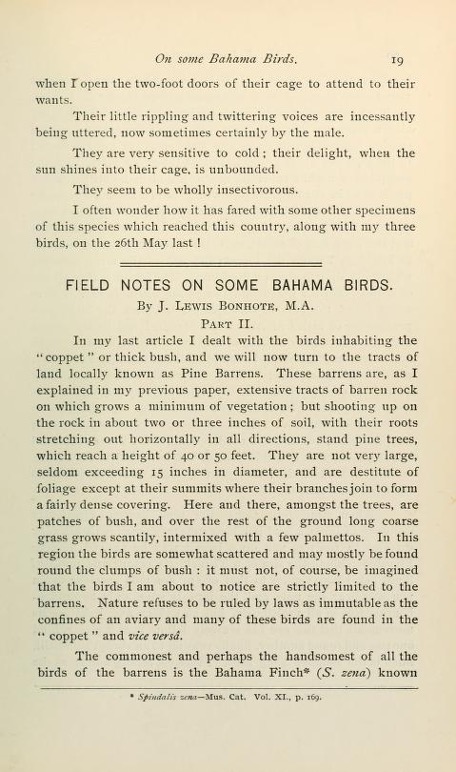 J. Lewis Bonhote, “Field Notes on Some Bahama Birds”, The Avicultural Magazine, volume 9, number 1 (November 1902): 19.
At first, I had to write code that would open up the directory of all the articles, open up one file at a time, and look for titles, page numbers, authors, etc. I set to work, but it was not long before we found that Penn State University and the National University of Singapore actually had a project named ParsCit that went through the files and searched for said data. The results are placed into an XML file, which was helpful to the process but not exactly as we needed.
My job then became loading and parsing the XML files using C++. The task was initially daunting: I had no idea what OCR was, what parsing meant, or what an XML file was. But with the help of Joel Richard, my supervisor and head of Web Services, it came a little more smoothly than I expected.
Joel really helped me take the next step in applying myself and taught me about regular expressions, parsing, XML files, and helped me with any trip-ups I had along the way. He also helped re-run the OCR for better material to work with, as well as pre-process the XML files so the data was more consistent and easier to work with.
After receiving the XML files I had to parse them. Parsing is essentially going through the tags of an XML file and picking out specific types of information. The process was not as simple as finding parts of the text marked as “author” or “title”, or even tags marked as such, but rather required me to take a look at the patterns occurring in the file. So, in my case, if I wanted the title, I would most often go to a <sectionHeader> tag since that’s where the Penn State code placed the titles it caught.
I checked the places I knew most of the titles were held (some were not caught at all and were in the middle of body text, which we couldn’t catch) and then looked for uppercase letters since all the titles were capitalized. Then, I checked if there was a “By” in either the <sectionHeader> tag or in the following <bodyText>tag. If nothing was found, then it wasn’t deemed an article. For authors, if there was an article found, then the “By” search would lead to an author every time. The next picture is an example of the OCR from one of the articles. You can see in this particular one the title is in the section header tag, but the author is in the body text tag.
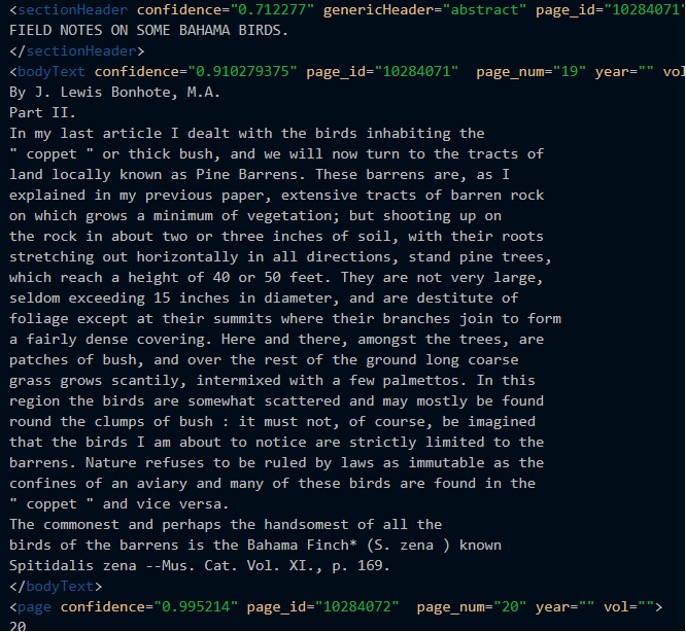 Example of OCR for J. Lewis Bonhote, “Field Notes on Some Bahama Birds”, The Avicultural Magazine, volume 9, number 1 (November 1902): 19.
For Page Numbers and Page IDs at BHL, I looked into the attribute of a tag. In the screenshot, you can see page_id and page_num which are attributes of <bodyText>. I pulled the information from those tags and stored them as is.
Since the OCR is imperfect, sometimes the “B” in “By” was interpreted as maybe an “E” or maybe the “V” in “Vol” was found as a “Y”. I did some very specific checking so that for as many cases as possible, as long as the very specific conditions were met, the information was found. We used regular expressions which looked for certain arrangements of these similar characters to determine the author, volume, date, and similar data.
After finding and storing the data, much of the remaining work was cleaning up what I had. That meant taking off any extra spaces, periods, capitalizing the first character of each word, and making the rest lowercase, or maybe refining the results even more. This was to make it easier for the humans who correct the results afterward. The code is effective, but not perfect. When the human cleanup was complete, the articles were imported into the Biodiversity Heritage Library.
While interning, I was able to go on many tours including the Smithsonian Libraries Research Annex collections, the Joseph F. Cullman Library 3rd Library of Natural History, and behind the scenes of the National Zoological Park. From viewing James Smithson’s books at the Cullman to watching the process of restoring aged and delicate books in the Book Conservation Lab to learning about mole rats, each tour showed a different but equally fascinating aspect of the libraries, as well as their involvement with the Zoo. I thoroughly enjoyed seeing the older objects, as it was very cool to see things that have held importance for such a long time and how times have changed.
The Zoo tour was led by branch librarian and supervisor Stephen Cox. Both Stephen and Jackie Chapman, Head of the Digital Library and Digitization, were extremely helpful, generous, and informative throughout the internship. They even helped me and intern Katerina Ozment create a poster to present at the Association of Zoos and Aquariums symposium! Katerina’s internship was focused on manually collecting and analyzing metadata from a related journal, the Animal Keepers’ Forum.
Kathryn Turner, the sponsor of my internship, is an inspiring woman I had the privilege to meet and share my story with her. It was motivating to see another woman with a very similar background to mine rise up in the STEM world and conquer it. I’m so grateful that I had the opportunity to intern and learn at the Smithsonian Libraries (now Smithsonian Libraries and Archives) that summer. I not only was able to expand my knowledge in my field but was also able to meet very intriguing people and see how things work behind the scenes.
Editor’s Note: Since the writing of this post, the National University of Singapore has developed and released a neural net version of their ParseCit software. This greatly improves the potential effectiveness of future computer-based automatic identification of articles building upon Taylor’s groundwork.
How Yellowstone Was Saved by a Teddy Roosevelt Dinner Party and a Fake Photo in a Gun Magazine
A chill rain drizzled over guests arriving at Bamie Roosevelt’s midtown brownstone near the corner of Madison Avenue and East 62nd Street in December 1887. There weren’t many of them, but all had two things in common: they were New York’s most influential and rich social elite, and they all loved hunting big game. All were hand-picked by the hostess’s brother, Theodore Roosevelt, to facilitate his newfound interest in the conservation of the American West. That small gathering became the first domino in a long line that ended in the protection of Yellowstone, the first environmental advocacy group in the US, and the creation of the American National Parks system.
Teddy was in the nadir of his career. His 3rd place finish in the New York City Mayoral race foretold doom in the realm of politics. His North Dakota ranch was devastated by winter storms (later known as The Big Die-Up) and on the verge of collapse. His latest book on his Western adventures, Hunting Trips of a Ranchman, received a middling review in the popular sportsmen’s magazine, Forest and Stream, which praised his prose but harped on “the author’s limited experience” (Forest and Stream v.24, pg. 451). T.R. was evidently so incensed at the aspersions on his Western manliness that he showed up at the Forest and Stream editorial offices in New York to demand to speak to whoever wrote the article. That very visit led to Roosevelt’s midtown dinner party.
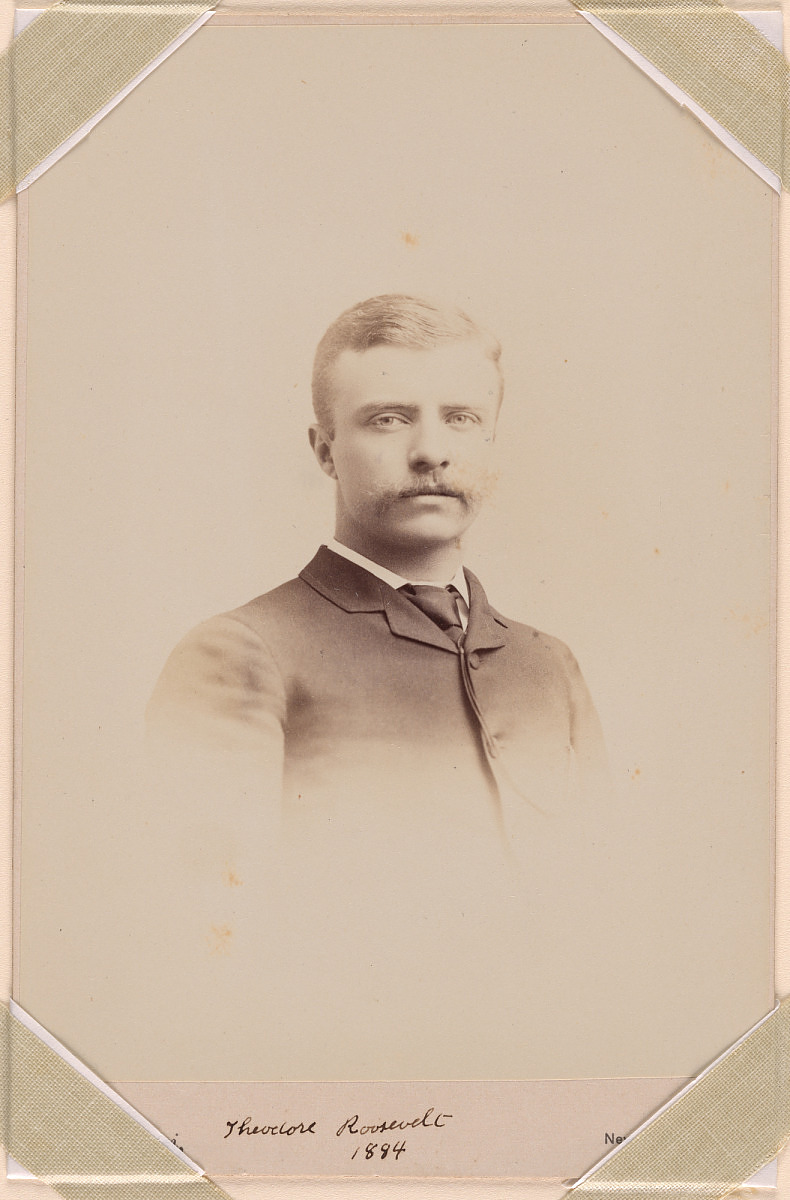 Photograph of Theodore Roosevelt by Julius Ludovici, 1884. Object number NPG.81.125. Courtesy of National Portrait Gallery, Smithsonian Institution.
The evening may have gone something like this: first, he plied his guests with the rich bounty of his table and cellar with many toasts and courses. Roosevelt’s glass was unlikely to contain much alcohol (there was even a later court case about his abstention from drunkenness), but his hard-drinking younger brother Elliott and others may have partaken in the bon-vivant cocktails popular at the time. Then during the game course traditional to late 19th century gatherings, the conversation is adeptly steered by Teddy to their subject of common interest: hunting. Over yet another toast, Roosevelt proposes the formation of club named for America’s two most legendary hunters and committed to their shared values: fair chase, preservation of game, and “manly sport with the rifle.” Thus was formed the Boone and Crockett Club.
It could have ended there, with a private club whose members were required to have killed a large North American animal according to their own rules of engagement. But this group would grow in fame because of one of its founding members: George Bird Grinnell. At the time of this gathering, Grinnell stood out among the invited guests for his anonymity. He wasn’t a millionaire like Rutherford Stuyvesant or John Jay Pierrepont, or a famous man of the West like Albert Bierstadt or Bronson Rumsey, or an influential socialite like J. Coleman Drayton or Archibald Rogers. George Bird Grinnell was just a scientist, interested in joining expeditions to the West as a naturalist and studying the Native peoples of that region. He did have two qualities that drew Roosevelt to him, though: he loved Yellowstone and he edited a sportsmens’ magazine called Forest and Stream. Yes, Grinnell was the very person who published the backhanded review of Roosevelt’s book. Their confrontation led to a friendship that hatched the plan to gather the powerful crew of socialites and advocates for the West.
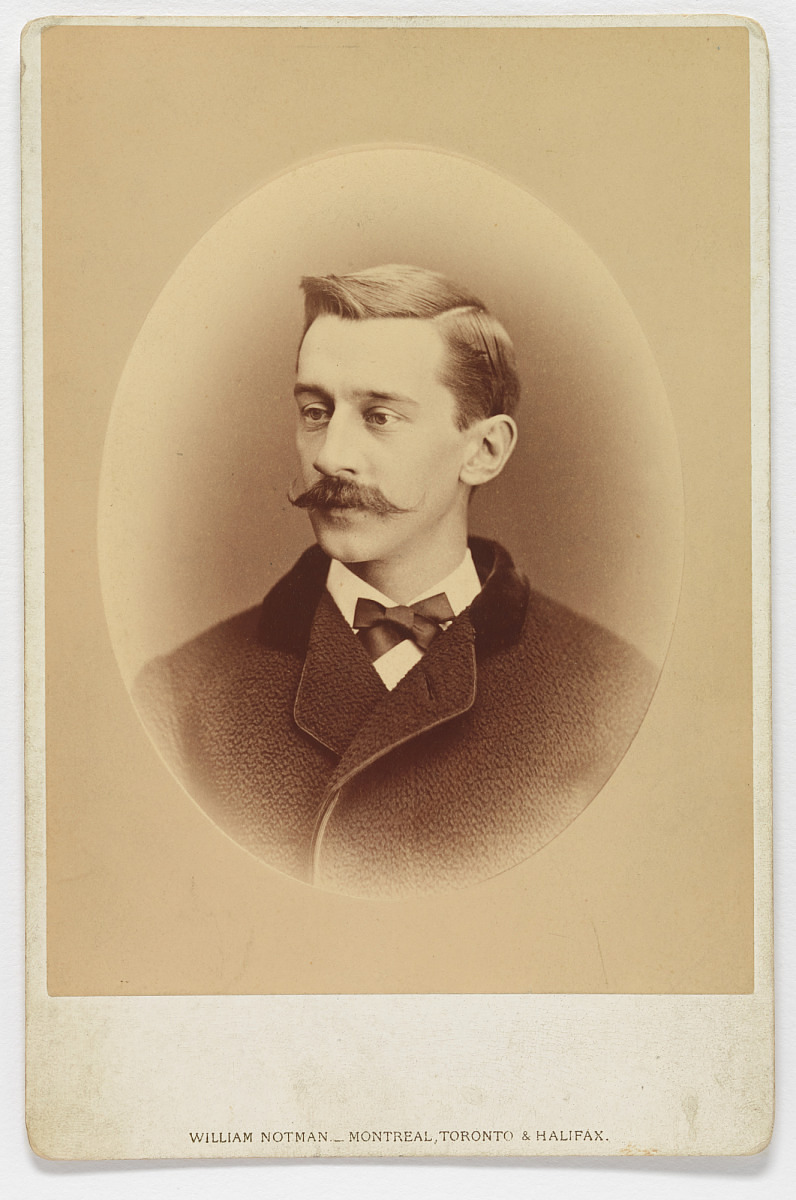 Photograph of George Bird Grinnell by William Notman. Object number NPG.77.184. Courtesy of National Portrait Gallery, Smithsonian Institution. Grinnell went on many expeditions to the American West and fell in love with its natural beauty.
The Smithsonian Libraries and Archives holds an extensive run of Forest and Stream, beginning with the first volume in 1873. While our physical copies are located in the Smithsonian Libraries Research Annex location, readers can find digitized versions of Volumes 1- 95 online in the Biodiversity Heritage Library. Part of the Smithsonian Libraries and Archives’ work during the pandemic has been improving metadata in the Biodiversity Heritage Library, helping titles like Forest and Stream become more accessible to the world. Grinnell became editor-in-chief of the publication in 1881, using it as a tool to raise awareness of conservation issues, especially of his beloved Yellowstone, which he visited in 1875 as part of the Ludlow Expedition.
But in 1888, Yellowstone was in big trouble. Even though the area had achieved National Park status (the first in the US) in 1872, the designation was toothless. Poachers ran rampant, railroad companies eyed its majestic passages as thruways for their locomotives, and the Army had set up a fort to make war on the Native people of Yellowstone and deny them rightful access to their land. So Grinnell and the Boone and Crockett Club began a petition to Congress, published in the pages of Forest and Stream among its coverage of hunting trips, fishing tips, and shooting competitions. First a column of names, then page after page of supporters, many cajoled into participation by the Boone and Crockett Club’s socially influential measures, like Roosevelt and his chums, as evidenced by the frequent appearance of high-level New York socialites on these lists, many of whom included acquaintances of the likes of Stuyvesant and Drayton.
 “Yellowstone Park Petition”, Forest and Stream, Volume 30 (April 30, 1888): 246.
But all that effort didn’t move Congress to act, despite year after year of attempts. That all changed on May 5, 1894, when Forest and Stream published an account of the capture of an infamous poacher, Edgar Howell. He had previously eluded apprehension because the U.S. Cavalry, who was tasked with patrolling the park, had to catch a perpetrator in the act of poaching in order to pursue and arrest them. Unbelievably, the Army only had a single patrolman for the entirety of Yellowstone. This patrolman happened to be near Howell during a shooting and got the drop on the poacher and was able to call for help on the new-fangled telephone. The story was covered in full by the lone correspondent to as yet overwinter in Yellowstone: Emerson Howe. But it wasn’t Howe’s breathless reporting of the killing of dozens of buffalo that spurred national outrage; it was the images of Howell’s animal victims left lying in piles on the plain, titled by Grinnell as “The Butcher’s Work.”
 “’Forest and Stream’s’ Yellowstone Park Game Exploration”, Forest and Stream, Volume 42 (May 5, 1894): 377.
Except they weren’t pictures of the bison that Howell had killed. These pictures were used in an Annual Report of the Smithsonian Institution from seven years earlier. Grinnell was apparently sent the original photographs by William T. Hornaday, whose collection of living animals formed the basis of the Smithsonian’s National Zoological Park. No record has yet been found illuminating how or why the decision to fake the photographs was made. Of important note, Grinnell’s trickery wasn’t necessary to convict Howell, who confessed and never amended his ways.
 After L. A. Huffman, “A Dead Bull” and “Buffalo Skinners at Work.” From William T. Hornaday, “The Extermination of the American Bison, with a Sketch of Its Discovery and Life History,” Annual Report of the Smithsonian Institution for the Year Ending June 30, 1887, part 2 (1889): pl. IX.
The ruse was effective though: only days later Congress passed the Act to Protect the Birds and Animals in Yellowstone National Park, and to Punish Crimes in Said Park. Known as the Lacey Act of 1894, the law finally outlined a punishment for poaching on public lands. The first person convicted under the Act was none other than Edgar Howell.
Roosevelt went on to strengthen the protections of public lands, campaigning on conservation for the Vice Presidency in 1900 and later as President, establishing the National Parks system that currently protects not just Yellowstone, but 85 million total acres of American lands. T.R. continued to have a close relationship with Forest and Stream, contributing articles heralding conservation reforms and hosting organizational meetings at his home in Oyster Bay.
Further Reading:
Alan C. Braddock, “Poaching Pictures: Yellowstone, Buffalo, and the Art of Wildlife Conservation,” American Art, 23:3 (2009): 36-59.Supporting Access to Zoological Literature: Article Definition in the Biodiversity Heritage Library
This post was written by Katerina Ozment, part of the Smithsonian Libraries’ 50th Anniversary 2019 Intern Class, funded by the Secretary of the Smithsonian and the Smithsonian National Board. At that time she was an undergraduate at the University of Oklahoma, majoring in History and Biology. Katerina is now a graduate student at the University of Tennessee, College of Communication and Information, School of Information Sciences. The internship program is now the Smithsonian Libraries and Archives’ 50th Anniversary program.
For zookeepers to most effectively care for their animals, they need access to zoological research, as well as a way to communicate with other zookeepers. One way for zookeepers to do this is through participation in professional organizations such as the American Association of Zoo Keepers (AAZK) and its publication, Animal Keepers’ Forum (AKF). AKF contains current research, husbandry techniques, animal enrichment activities, conservation news, and other topics.
Due to AKF’s role in facilitating this kind of communication, Smithsonian Libraries (now Smithsonian Libraries and Archives) requested permission from AAZK to digitize the Libraries’ copies of AKF and make them available through the Biodiversity Heritage Library (BHL). BHL is an open access digital library for biodiversity works. Smithsonian Libraries and Archives is one of the only BHL member libraries that supports an active zoo and therefore has a unique commitment to providing for this user community in BHL.
Although the publication was already available online, searching for specific articles remained difficult. This is because AKF was uploaded as whole issues as opposed to individual articles. It was uploaded this way because the metadata (data about the work) associated with the Libraries’ record applies to each issue, not each article. Descriptive metadata includes information such as the title, volume, issue number, or date of a work. This metadata ensures that BHL is searchable and that specific works can be located.
However, researchers are used to having article-level metadata and often search for a specific article or article topics. Currently, if a researcher searched for a specific article author in the name field, it would not bring up the articles written by that author for AKF. Similarly, if an article’s title was searched for in the title field, it would not be found. Without article-level metadata, such as article titles or article authors, these resources are much harder to find. It is possible to do a full text search and find articles by title or author that way; however, the OCR (optical character recognition) the full text search relies on is not corrected. If there are mistakes in the OCR, the search terms won’t be found. This is especially true when an article has graphic design elements, or text overlaid on a picture, as both contribute to poor OCR.
Despite this, it is sometimes possible to search for an article’s title or author(s) using the full text of the issue, which is made available via OCR (Optical Character Recognition). However, the OCR that the full text search relies on frequently contains mistakes and cannot be manually corrected at this scale. If there are mistakes in the OCR, the search terms won’t be found. This is especially true when an article has graphic design elements, or text overlaid on a picture, as both contribute to poor OCR.
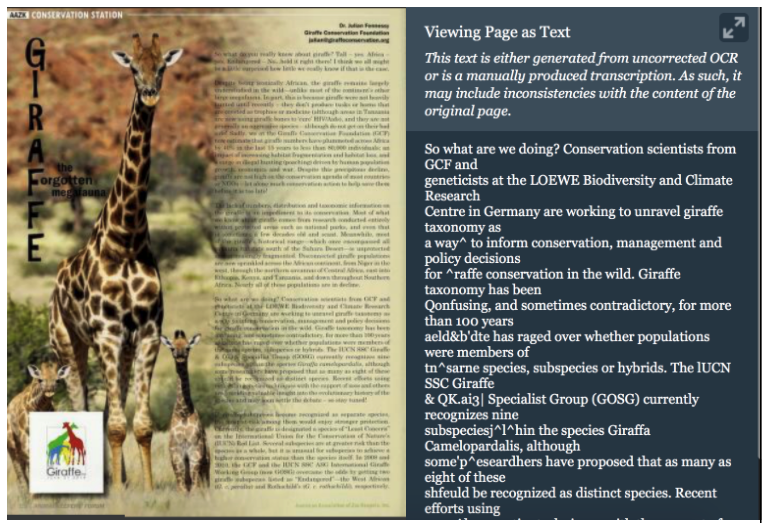 This article, “Giraffe: Forgotten Megafauna”, left, has both an acrostic title and is overlaid on a photo. As a result, the OCR, right, did not pick up the title, and the OCR text of the article has a number of errors.
To address this, I worked to add article-level metadata and access to issues of AFK. This is possible due to the recently added batch upload tool for BHL. The batch upload tool allows the metadata for an entire set of articles to be added to BHL at once, following a template.
Because AKF is more of a newsletter or magazine than a formal journal, determining what counted as an article was not always obvious. For each AKF issue, I needed to determine what should be defined as an article (for the purposes of this project) and then add the relevant metadata (including author, title, page numbers, etc) to the template. Letters from the editor, interviews, and news summaries were some parts of AKF that caused the most questions. I often consulted with my supervisors, Jacqueline Chapman (Head, Digital Library & Digitization) and Stephen Cox (Branch Librarian for the Smithsonian’s National Zoo and Conservation Biology Institute), to determine what should be defined as an article and what shouldn’t. In the end, focusing on what was most important to animal care research was a key aspect of this definition. The articles I added to BHL included research done by zookeepers, interviews with conservationists, and columns summarizing zoo-related news. However, there are still many parts of AKF that I did not articlize, but could be added later. These include the letter from the editor, “About the Cover,” or AAZK chapter news.
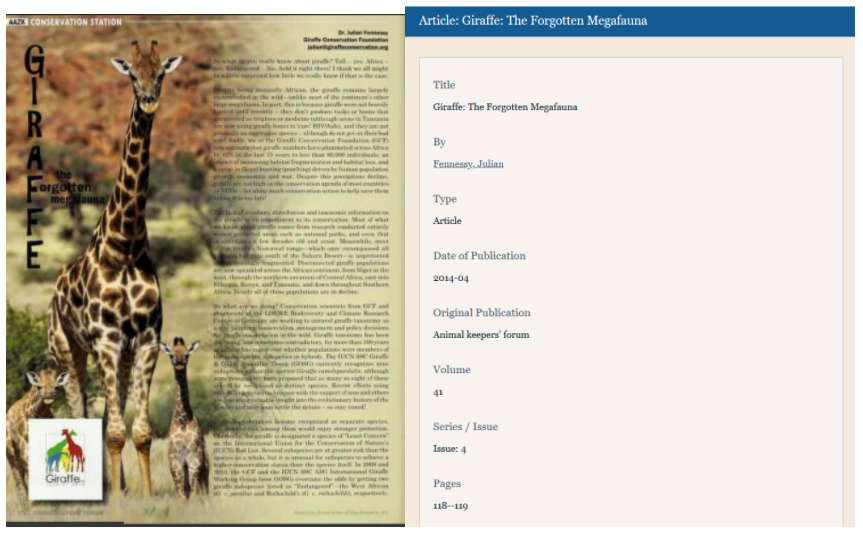 The same article, “Giraffe: Forgotten Megafauna”, left, now with article metadata manually applied, right. The title is now searchable within BHL and for other services that use BHL’s data, despite the complicated layout and underlying uncorrected OCR.
Aside from defining articles, another challenge was ensuring consistency for author names across issues. If an author uses a nickname in one article and their full name in another, or if their name has changed over time, only one version of the name should be recorded as the author. This is necessary so that each individual only receives one BHL “creator ID” and so that searching their name will bring up all their work, regardless of the name variation used. This required that the preferred version of the name be used on all articles.
For this part of the process, I needed to learn about Name Authority work, an aspect of library science focused on solving this problem. Name Authorities establish IDs for individual authors, such as those provided by the Library of Congress, VIAF, and ORCID. VIAF (Virtual International Authority File) is a compilation of name authority records from libraries across the world, including the Library of Congress. An ORCID is an ID that the individual author creates for themselves. Its use is increasingly common among researchers across many fields and helps ensure that an author’s works are all connected even if the author changes their name. In each case, the name associated with the BHL “creator ID” should be the one used in one of these Name Authorities.
I was able to find and associate these IDs with their authors in AKF using a tool called OpenRefine. Earlier, in July 2019, I attended a Data Carpentries workshop at the Smithsonian. In addition to receiving an introduction to several data management and manipulation tools, including Python and SQL, I also learned how to use OpenRefine. I was able to use this tool to more easily determine if there was an author ID associated with any of the AKF authors. OpenRefine allows the user to upload a list of authors and use the reconcile tool to find possible matches in either ORCID or VIAF. From there, I could determine if the ID was the author from AKF, or someone else with the same name. While these IDs were very useful for determining preferred names, there were occasional mistakes. In one instance, the VIAF record for the author included works by two different people with the same name. I submitted a correction to VIAF, with the help of Lesley Parilla (former Cataloging and Bibliographic Librarian).
I was able to complete AKF issues from 2010-2016 during my internship. I also worked to document the process I used and decisions my team made, ensuring a future intern or staff member will be able to take up the project from where I left off.
AKF is very varied in how the articles are formatted, how the authors’ names are listed, and how accurate the OCR is; therefore, a manual process worked best for this project. It is also possible to create article-level metadata by writing a script to collect the necessary information, if the title is consistent in layout. I worked with Taylor Smith (Summer 2019 Kathryn Turner Diversity and Technology Internship) and her supervisor, Joel Richard (Head, Web Services & IT), who created metadata for the journal Avicultural Magazine in this way. We were able to share the results of both of our projects as a poster, Supporting Access to Zoological Literature: Article Definition in the Biodiversity Heritage Library, at the Association of Zoos & Aquarium’s (AZA) conference in September 2019.
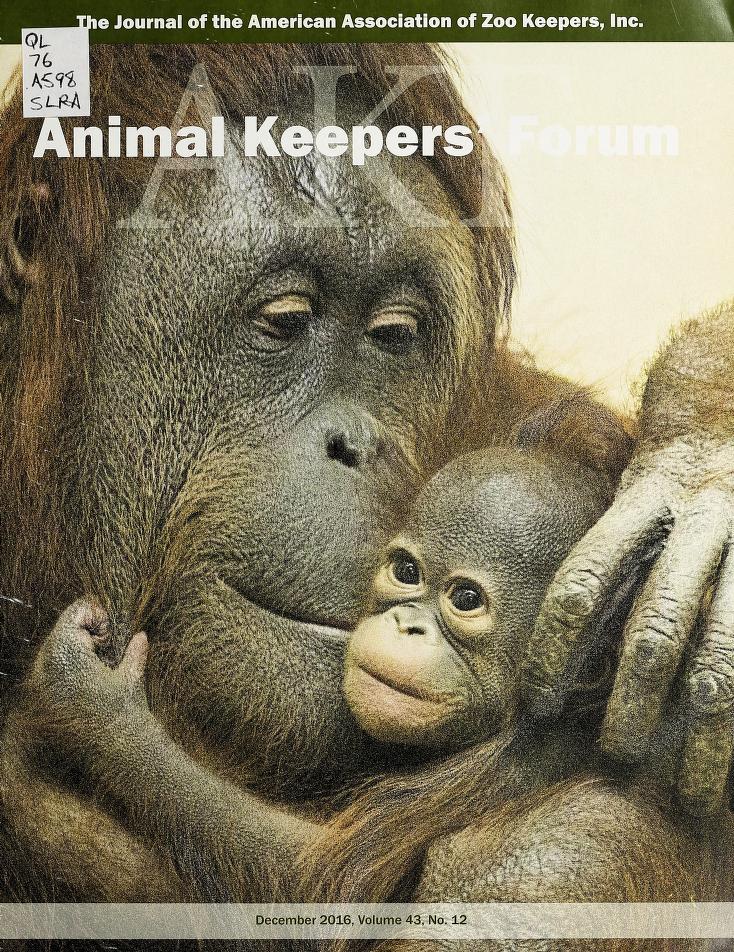 Cover, Animal Keeper’s Forum, V. 43: No. 12 (2016).
Whereas my work on AKF in BHL was focused on providing article-level access to one title, my other project allowed me to take a broader view of zoological literature. I was able to help Stephen with his work on a bibliography for the AZA’s Orangutan Species Survival Plan (SSP). An SSP is a holistic approach developed by conservationists to help support captive breeding programs for endangered species. Stephen functions as a curator of relevant peer-reviewed literature for several SSPs, maintaining comprehensive bibliographies. This specific SSP bibliography serves as a resource for zookeepers caring for orangutans and contains citations for articles and books about a variety of husbandry topics. I located each listed source online and added it to Zotero, a reference management tool, ensuring the accuracy and completeness of each citation. This tool will be shared amongst primate keepers around the world.
As I worked on my two projects, both focused on how the Libraries and Archives supports zookeepers, I was able to appreciate the many ways in which librarians and zookeepers work together. I have spent a lot of time in zoos and libraries; however, I was unaware of how connected the two are.
Over the course of the summer of 2019, I learned so much about how libraries work, the different careers within a library, and how libraries provide resources for their users. I was constantly amazed to see the careful thought and work that goes into tools that I had always taken for granted as a library user. Aside from my projects, I’ve been able to talk to so many people who work here and each one has given me more insight into what it means to work in a library and the variety of types of librarians. I know that everything I’ve learned will be invaluable as I pursue my career in the library and information sciences.
A Late 19th Century Camping Experience
Do you remember summer camp as a child? Perhaps you went on a camping trip with your family or maybe you camped out in your own backyard. The Trade Literature Collection located at the Smithsonian Libraries and Archives holds a variety of catalogs. Some illustrate camping equipment. Have you ever wondered what it was like to camp over a century ago? This trade catalog might give us an idea.
The trade catalog is titled Awnings and Tents, Signs and Banners (1882) by Murray & Baker. Just as the title suggests, it includes tents, and as we will learn later, one style even had an awning. It also illustrates camping stoves and camp furniture as well as hammocks for that late afternoon nap.
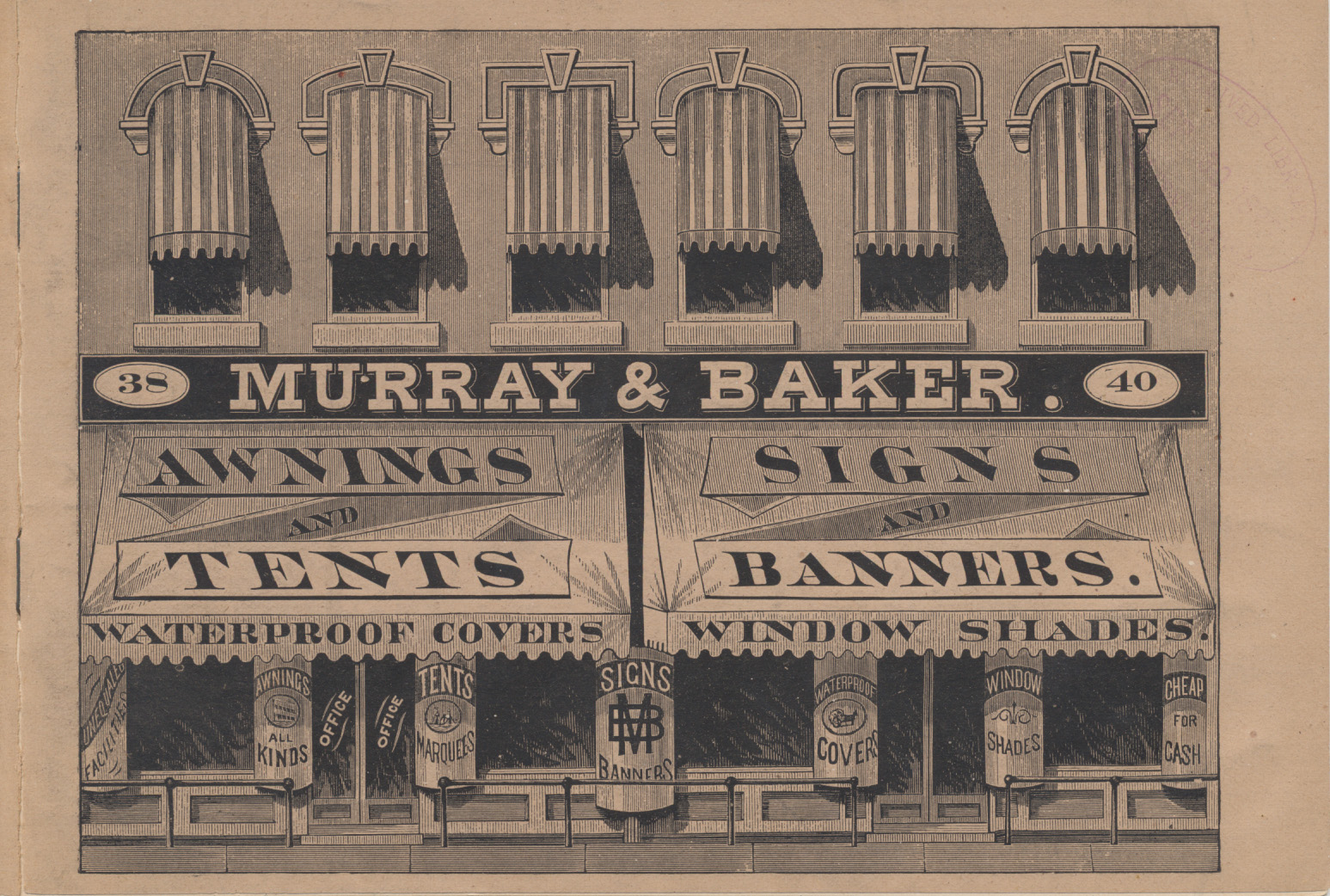 Murray & Baker, Chicago, IL. Awnings and Tents, Signs and Banners (1882), front cover.
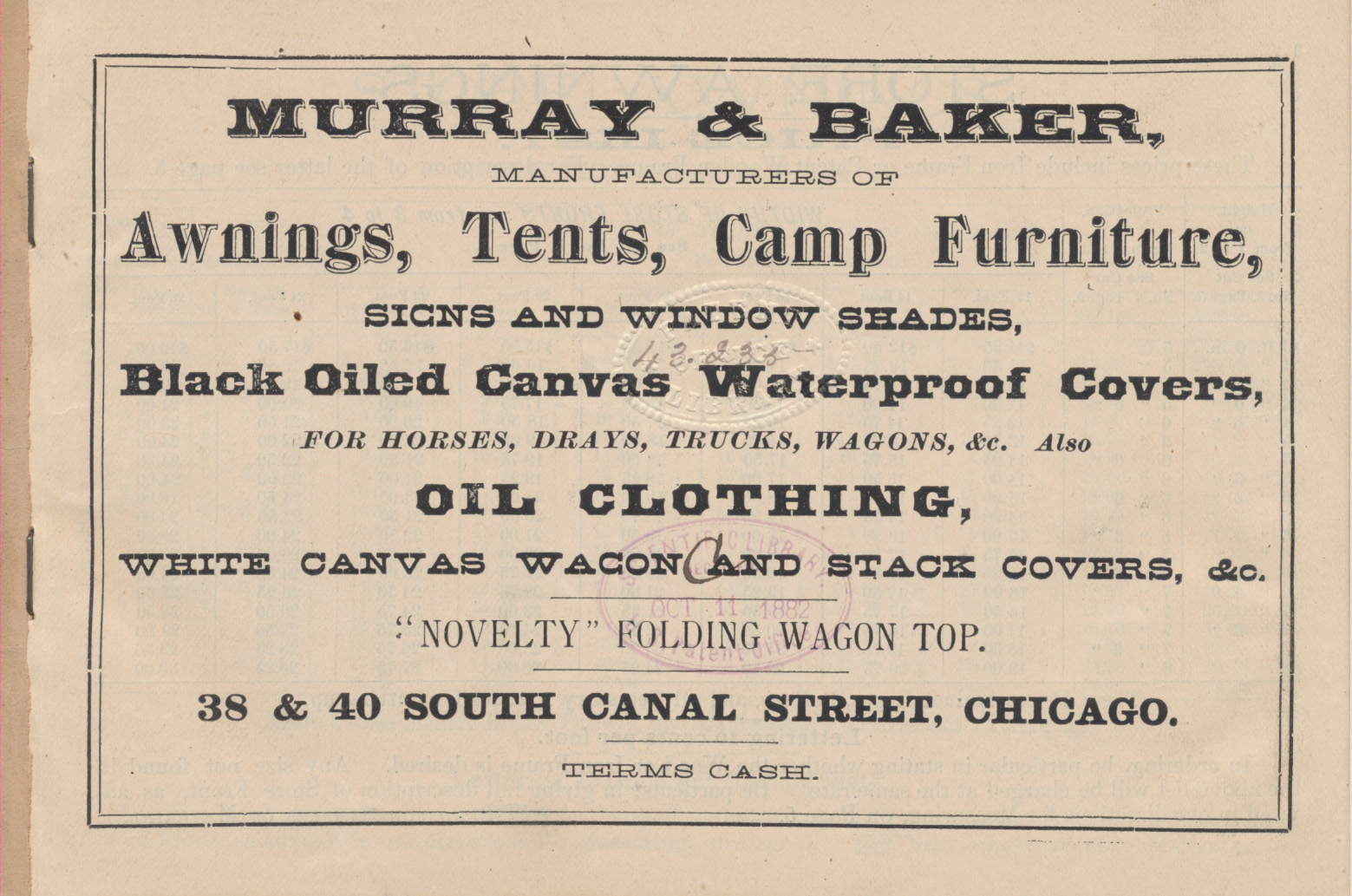 Murray & Baker, Chicago, IL. Awnings and Tents, Signs and Banners (1882), title page.
The Round Tent, illustrated below, varied between 8 to 11 feet in height and 10 to 16 feet in diameter. It was available in two designs. One design included a wall measuring two feet three inches in height before sloping inward to create a point at the very top. The other design did not include the wall. As shown below, ventilators were located near the point of these tents. This was likely a convenient and welcome feature as it provided air circulation. The Round Tent with a wall is pictured below, bottom right, while the Round Tent without a wall is pictured to its left.
The portable nature of this tent made it easy to pack for a camping trip. The center pole of the tent conveniently folded into two pieces and then all the poles and stakes were rolled inside the folded tent.
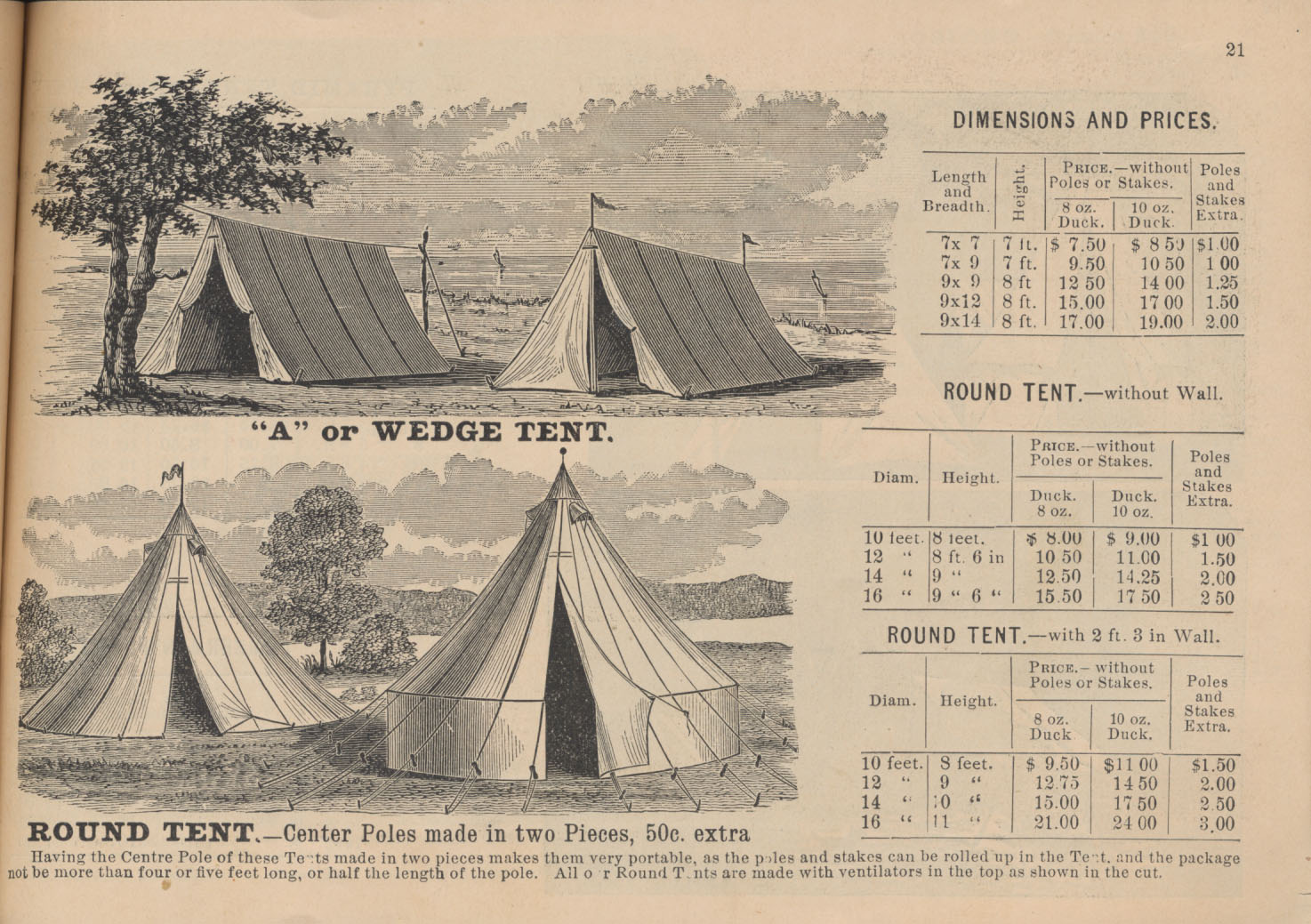 Murray & Baker, Chicago, IL. Awnings and Tents, Signs and Banners (1882), page 21, “A” or Wedge Tent, Round Tent without a wall, and Round Tent with a wall.
Those who wanted their own space might have preferred the Family Tent, illustrated below (bottom left). The common room was described as a Dining Room and located in the center of the tent. Two or four bedrooms surrounded the dining room. The bedrooms were separated by sheeting, six feet in height, attached by rings onto cords that stretched from the center poles to the sides of the tent. This tent also had a wall measuring 6 feet in height before sloping inward to create a peak at the top.
The Family Tent provided a handy built-in feature for the comfort of its occupants. It had an awning that was created by simply lifting one wall of the tent and supporting it with poles. As illustrated below, the addition of the awning created both air circulation and shade.
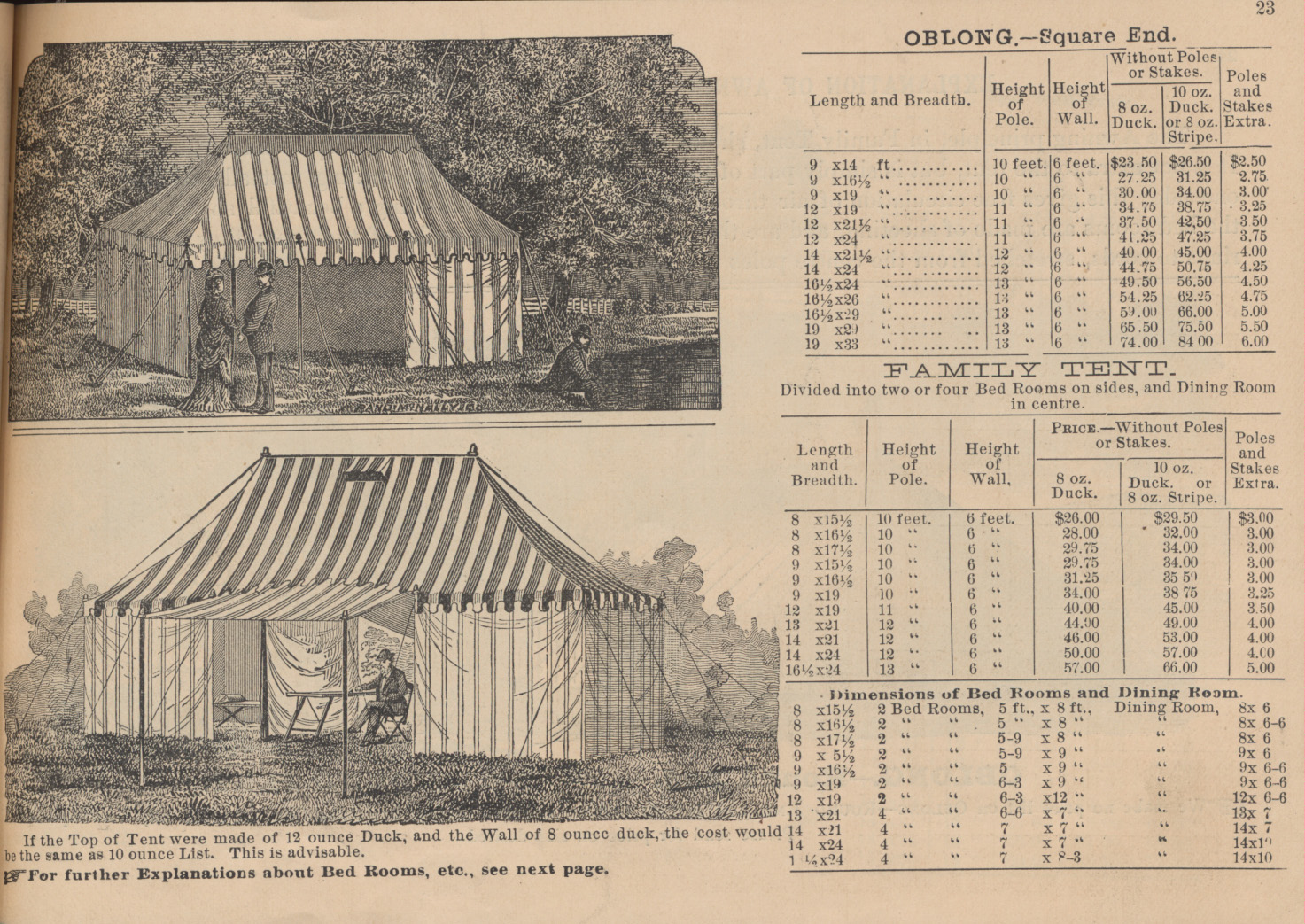 Murray & Baker, Chicago, IL. Awnings and Tents, Signs and Banners (1882), page 23, Oblong Tent with Square End and Family Tent.
In a previous blog post, we highlighted camp furniture such as folding tables, chairs, beds, and the combination trunk/cupboard/table. Now let’s take a look at camp stoves. The “Adams & Westlake Oil Stove” is pictured below and included several options. It was available with one, two, or three burners, as a double stove, or even an oven for baking. Besides cooking, it also provided warmth on chilly nights by using “Armour’s Improved Flue Heater Attachment.”
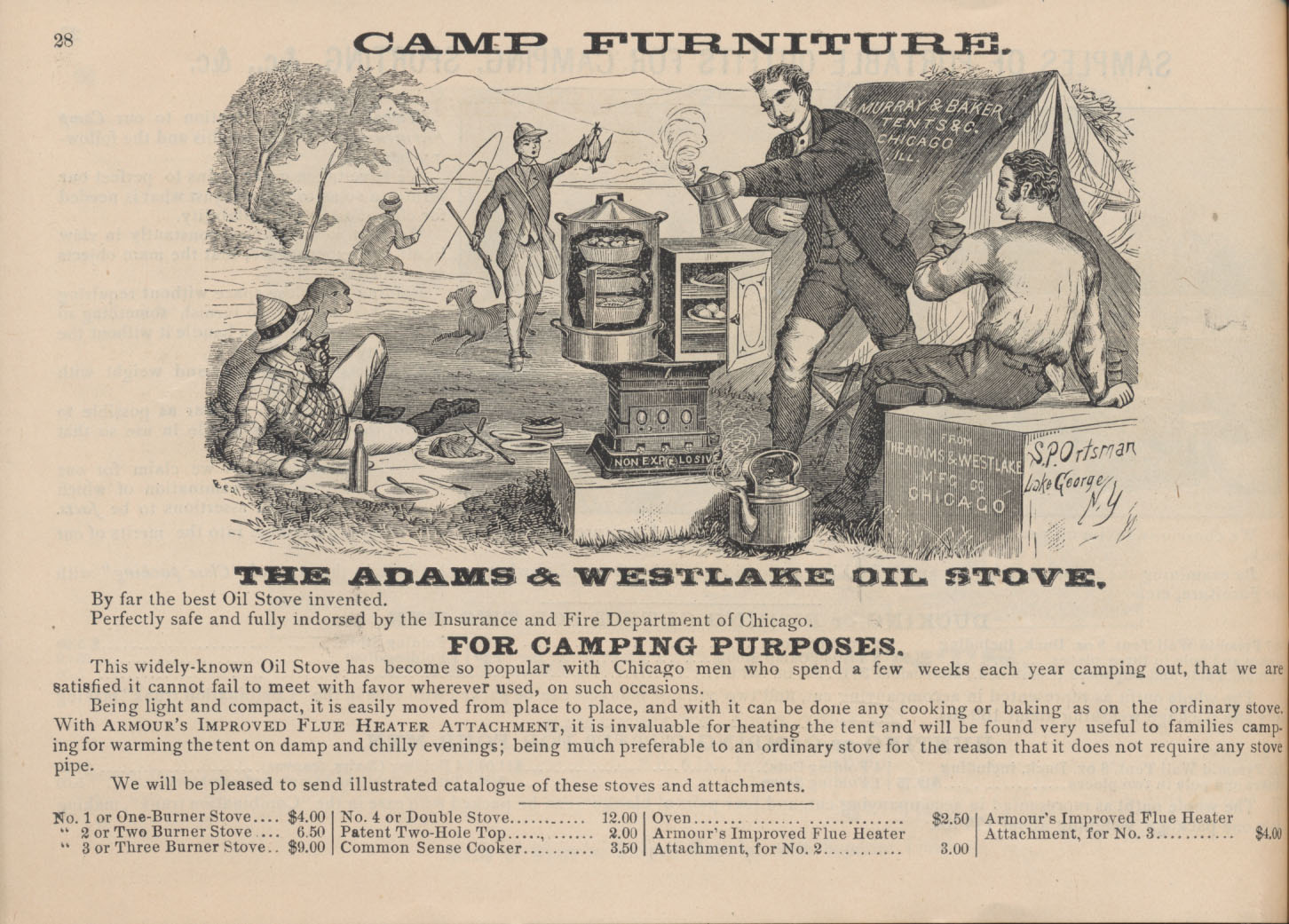 Murray & Baker, Chicago, IL. Awnings and Tents, Signs and Banners (1882), page 28, “Adams and Westlake Oil Stove.”
Though the “Adams & Westlake Oil Stove” was described as “light and compact” and “easily moved from place to place,” another camp stove might have appealed to some campers due to its ability to be used as a packing crate. The camp stove, pictured below (top), doubled both as a stove and a packing crate. This stove was constructed without a bottom and relied on the ground to form its bottom. With no actual bottom, the stove was easily converted into a packing crate by simply turning it upside down. Then the stove pipe and cooking utensils were safely stored inside.
 Murray & Baker, Chicago, IL. Awnings and Tents, Signs and Banners (1882), page 29, Camp Stoves and Folding Stove.
When it came time for an afternoon nap, these hammocks, shown below, might have looked inviting. Imagine a peaceful afternoon spent resting or reading a book outdoors in the fresh air. The Rubber Air Pillows and Waterproof Camp Blankets mentioned on the same page might have been useful as well.
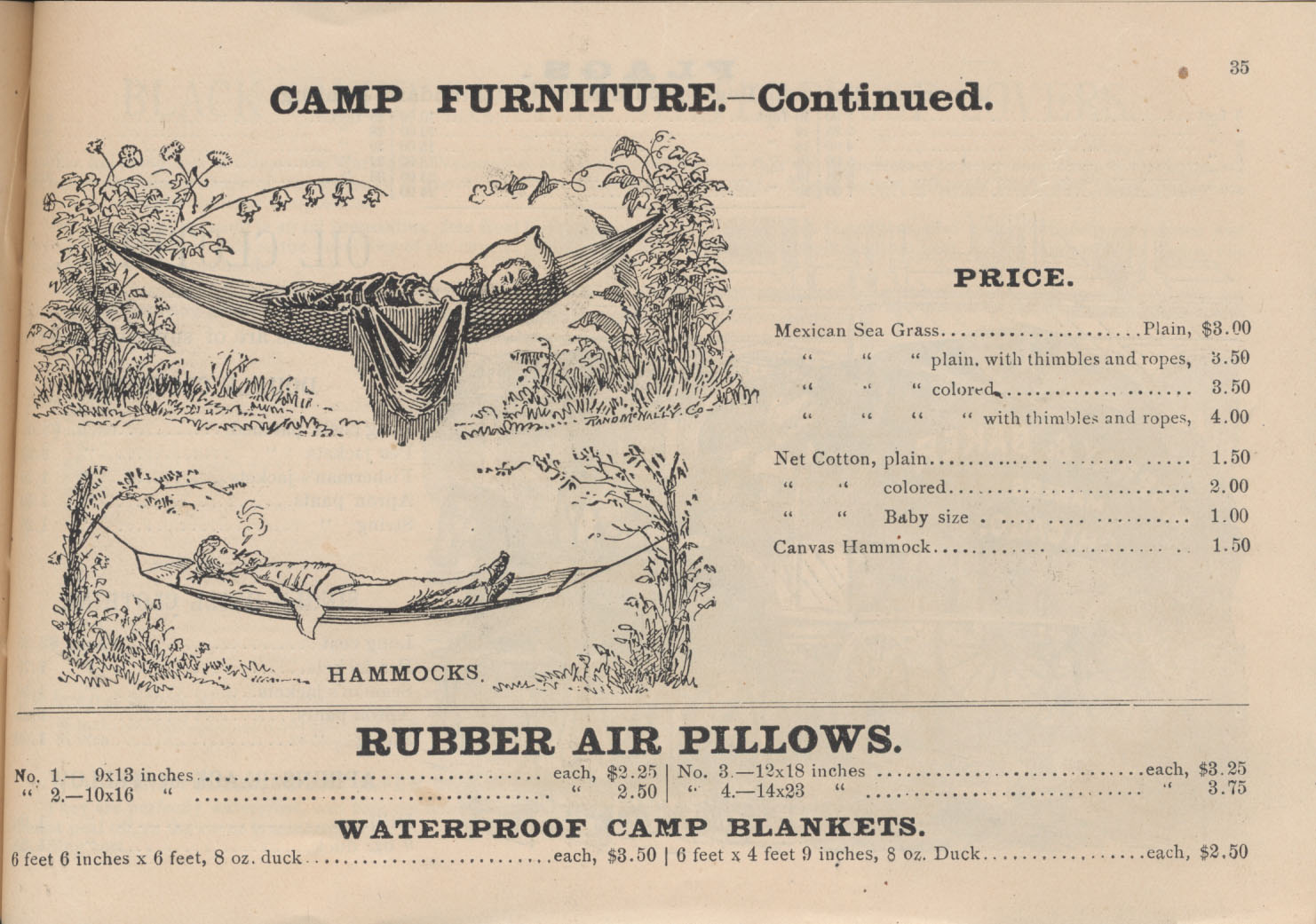 Murray & Baker, Chicago, IL. Awnings and Tents, Signs and Banners (1882), page 35, Hammocks, Rubber Air Pillows, and Waterproof Camp Blankets.
Awnings and Tents, Signs and Banners (1882) by Murray & Baker is located in the Trade Literature Collection at the National Museum of American History Library. Murray & Baker sold more than just camping equipment. Among other items, they also provided awnings, buggy tops, wagon umbrellas, and waterproof wagon and horse covers as described in a previous blog post.
Falling for Field Books
Being an avid reader, every once in a while an item comes across my desk for digitization with such an intriguing story that I can’t help but get sucked into it. That’s what happened when I first saw one of James Eike’s field books. Now I know what you are thinking, “how does one get sucked into a field book?” Often times, field books are filled with lists of specimens or observations from the field, and those created by James Eike, an avid bird watcher and citizen scientist, are no exception. However, among the almost daily counts of birds observed by Eike are glimpses into his personal life, where, according to him, just about every day was glorious.
 List of items Claire and Susan Eike received for Christmas in 1958. Record Unit 7342 – James W. Eike Papers, 1927, 1950-1983, Box 1, Folder 5, Smithsonian Institution Archives, Neg. No. SIA2012-0088.
James Eike was born in Woodbridge, Virginia on September 29, 1911 to Carl and Sarah Eike. Shortly after starting at Georgetown University in 1928, he began recording his observations about the wildlife he saw around northern Virginia, especially birds and snakes. Unlike the lists of bird counts found in his later field books, Eike’s first few journals are more narrative in form. By 1930, he was keeping lists of the numbers and types of birds seen, as well as the date and location where he saw them. Eike graduated from Georgetown in 1932 and started working for the U.S. Public Health Service in 1934.
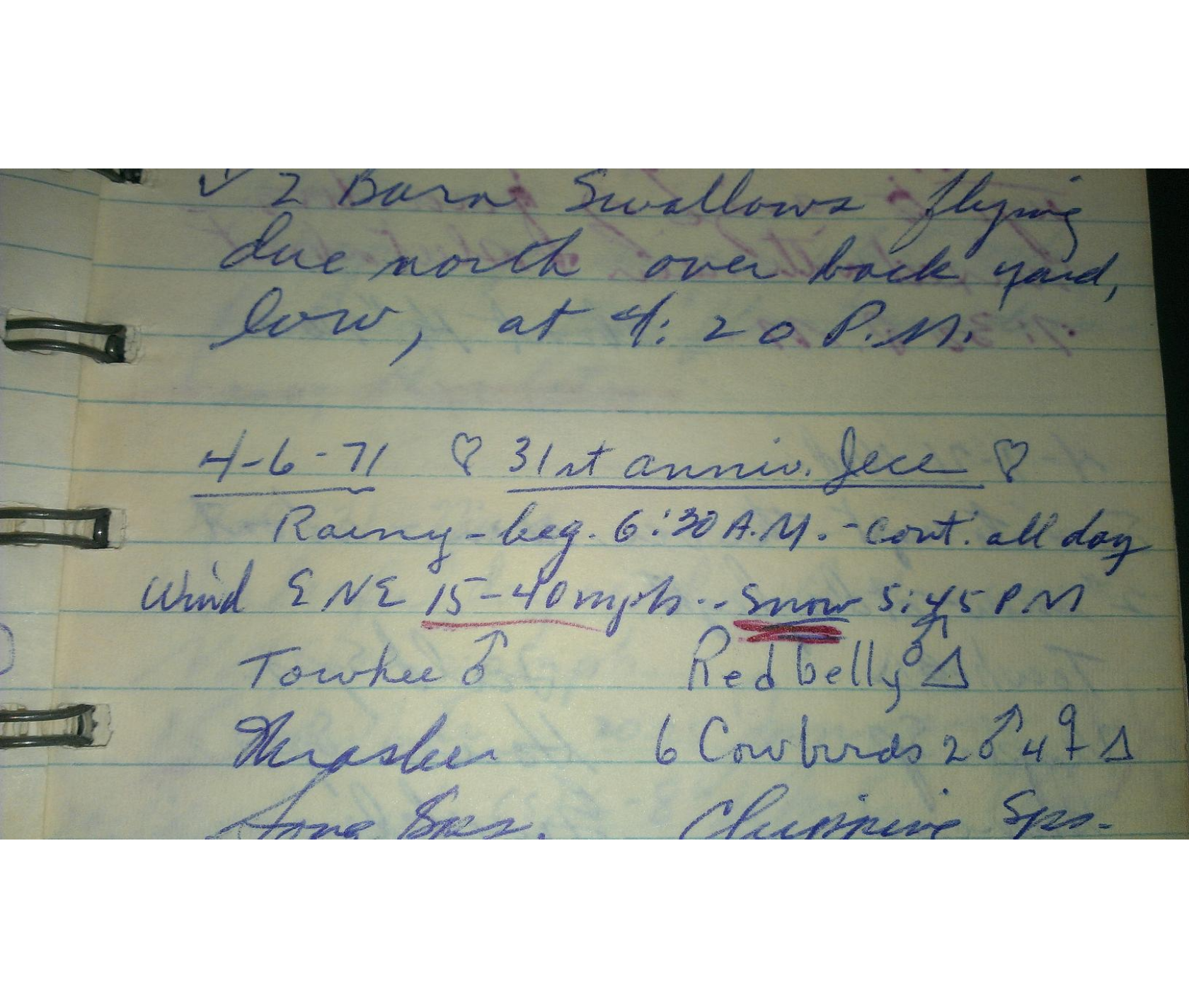 James Eike’s field book entry for April 6, 1971; his 31st Anniversary. Record Unit 7342 – James W. Eike Papers, 1927, 1950-1983, Box 1, Folder 8, Smithsonian Institution Archives.
On April 6, 1940, James Eike married the love of his life, Claire. Their daughter, Susan, was born almost six years later on January 31, 1946. At that point, spotting and counting birds seemed to become somewhat of a family affair for the Eikes. Occasionally, James Eike would take his young daughter with him when he went to the nearby woods to count the birds, and on the weekends, sometimes the whole family would go together. Additionally, one page of Eike’s field book from “3-20-57 to 7-20-57” includes a list of birds that Claire saw while on a trip to Michigan in July while her husband stayed in Virginia. Claire and Susan also became members of the Virginia Society of Ornithology (VSO), a group which James Eike had actively participated in since 1933.
Sept. 8, 1951 – Sat: To woods with Susan 10:30-12:30. Wonderful weather… Sept. 9, 1951 – Sun: Another wonderful day – brisk in morning. To woods with Claire and Susan, 11:00-12:30. Saw and/or heard Swifts, Hummingbird…
In addition to the lists of birds, Eike’s entries and field books started to include notes about his personal life. Starting in 1957, in the back of just about every field book that spanned Christmas, he would record the list of gifts he, Claire, and Susan received that year. He also included little notes about their birthdays and his anniversary at the top of his entries for those days. Eike would even make notations about trips the family was taking, and after Susan left for college, his entries about her return home and departure back to school usually include a happy and sad face, respectively.
4-6-67 Thurs: 3 real gold ones [goldfinches] greeted me first thing – on my 27th anniv. with you, dear.
On February 8, 1983, James Eike died of cancer. Starting on January 21, 1983, Susan and Claire took over recording the daily bird counts for James, and even after his death, Claire continued to record the counts in the field book that James had started. She even noted their 43rd wedding anniversary on April 6, 1983. In her last entry in the book, Claire writes “My dearly beloved – I’ll keep trying to get a good list. I am feeding our birds well. I miss you.”
 Note from James Eike to his wife, Claire, and daughter, Susan, dated February 9, 1961. Record Unit 7342 – James W. Eike Papers, 1927, 1950-1983, Box 1, Folder 5, Smithsonian Institution Archives.
In 1984, the VSO created the James Eike Service Award in honor of the time and dedication James put into the society. The first recipient of the award was Claire Eike, in honor of her late husband. Eike’s love of both birds and family make his field books a joy to explore. The personal stories and reflections add to the layers of valuable information captured in his notes, making me fall in love with field books and the insight they can bring about both science and life.
Upcoming Event: Ask a Conservator – Emergency Management
Ask a Conservator: Emergency Management
Wednesday, June 23 at 5 pm ET
Cultural heritage is not renewable. If books, documents, pieces of art, or any other ephemera are destroyed in a fire, for example, they are likely lost forever. Librarians and archivists have a long history of responding to and preparing for the kinds of emergencies and disasters, both natural and human-inflicted, that threaten these important resources for economic development and tourism, as well as knowledge, creativity, and a sense of historically connected identity.
In our next “Ask a Conservator” program on June 23, Nora Lockshin, senior conservator, and Katie Wagner, senior book conservator, will share how they plan for and respond to potential emergency situations that could pose risks to the safety of our precious collections at the Smithsonian and those of our fellow cultural institutions around the country. They’ll also discuss how they are called on to assist with protecting and recovering cultural heritage around the world. And as always, there will be plenty of time for your questions!
Register now to attend this webinar via Zoom. Spaces are limited!
You can also watch this event on Facebook. To access the event, please be sure you are following Smithsonian Libraries and Archives. We recommend having our page open when it starts.
If you’re not able to watch live, don’t worry! This program will be recorded and made available for later viewing on our YouTube channel.
We’re seeking sponsors for this program. Donations will go directly to support preservation at the Smithsonian Libraries and Archives. If you’re interested in learning more about this opportunity, please contact our Advancement team.
A Digitization Journey, a Knowledge Journey: Personal and Professional Insights From My Work on Polynesian Researches
Na au iki a me na au nui o ka ʻike: The little and the large currents of knowledge.
In preparation for Asian American Pacific Islander Heritage Month, I chose to reflect on the intersections of my past and present work in Biodiversity Heritage Library (BHL) collections, with historical connections to my home in Hawaiʻi. Part of my primary duties as a Conservation Technician with the Smithsonian Libraries and Archives is to stabilize objects before and after digitization for BHL. When I joined the team in 2018, I was assigned the task of mending the library’s four volumes of the 1853 edition of William Ellis’ Polynesian Researches During a Residence of Nearly Eight Years in the Society and Sandwich Islands. The idea was to kick off my new job with a project that would inspire me on a personal level, as an introduction to the value of both the digital and physical preservation responsibilities of our institution.
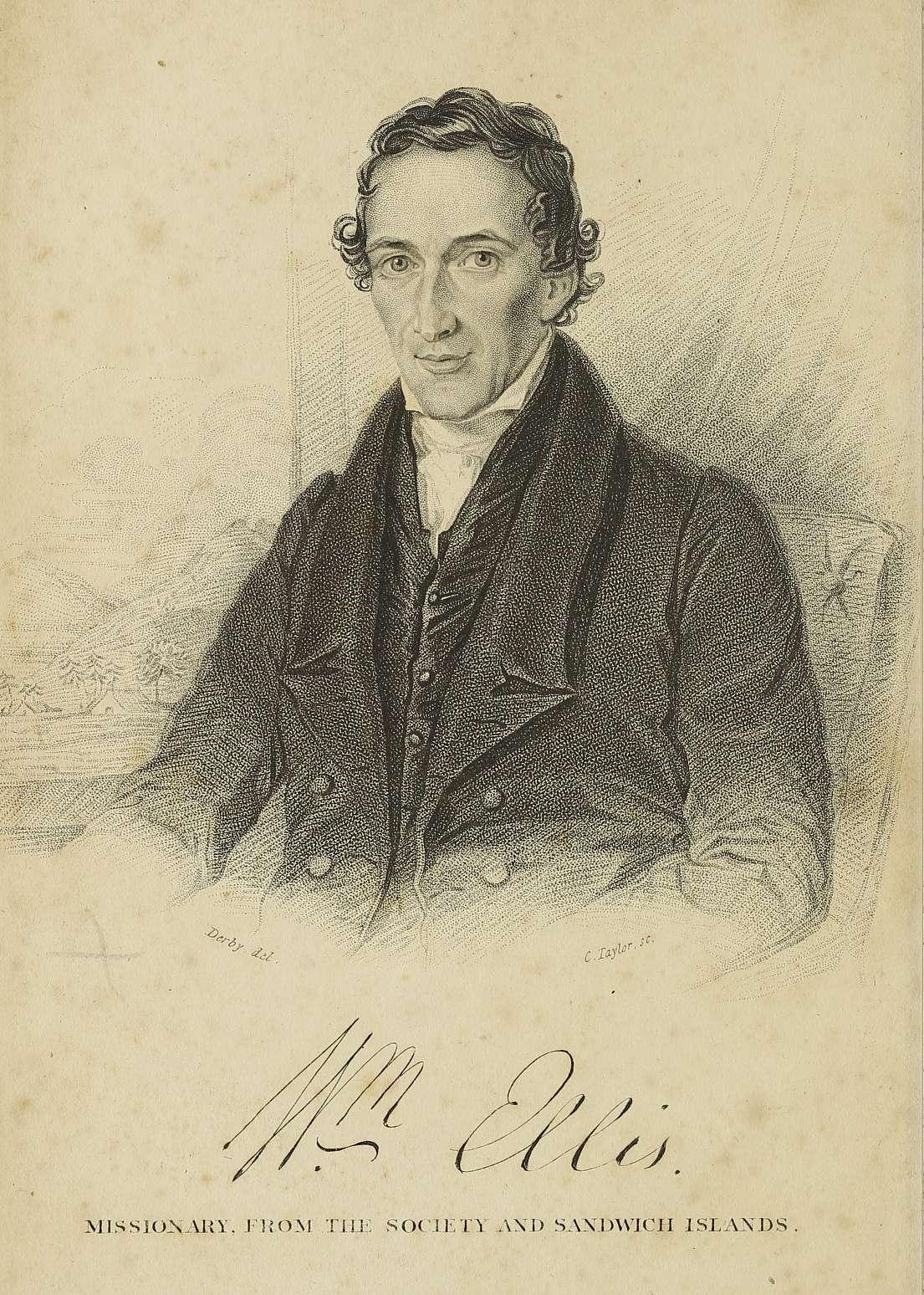 Portrait of William Ellis. Narrative of a tour through Hawaii, or Owhyhee with observations on the natural history of the Sandwich Islands, and remarks on the manners, customs, traditions, history, and language of their inhabitants. Third Edition, 1827. Contributed in BHL from Smithsonian Libraries and Archives.
British-born William Ellis is considered the “godfather of missionary ethnography.” Polynesian Researches vol. 4 chronicles his time spent in Hawaiʻi while serving under the infamous American Board of Commissioners for Foreign Missions. Credited with bringing Christianity, literacy, and western education to Kānaka Māoli (the native Hawaiians), the ABCFM also seeded the islands with the missionary descendants, known as the Committee of Safety, who on 6 July 1887 would hold King Kalākaua at gunpoint to sign a new constitution, effectively granting them control of the government. On 17 January 1893, a group of these same men organized a coup against the last reigning monarch, Queen Liliʻuokalani, using the imposing presence of the U.S. military to overthrow the sovereign Kingdom of Hawaiʻi. Following the overthrow, the provisional government set up by the Committee was recognized as a protectorate without the permission of the U.S. State Department. Finally, on 16 June 1897, in direct violation of previous treaties with the Kingdom of Hawaii, President Mckinley signed a new treaty granting the fraudulent annexation of Hawaiʻi by the United States. On 23 November 1993, the 100 year anniversary of the overthrow, Joint Resolution 103-150 was signed into law by both chambers of congress and President Clinton. The law “acknowledged the historic significance of the illegal overthrow of the Kingdom of Hawaiʻi…” and expressed the U.S. government’s “deep regret.”
 Flag of the Kingdom of Hawaii. Ellis, William. Polynesian researches during a residence of nearly eight years in the Society and Sandwich islands, v.4 (1853). Contributed in BHL from Smithsonian Libraries and Archives.
The legacy and impact of missionary settler colonialism cannot be divorced from the ethnographic literature it produced. Ellis’ work is important not only for the exceedingly detailed account of early post-contact Hawaiʻi, but also because it offers up the faulty colonizer narrative of the great western savior. Preserving volumes like Polynesian Researches provides historical accounts of endemic, and in many cases extinct, plant and animal life to researchers studying biodiversity in the Pacific. It may also complicitly privilege that version of information over the Indigenous sources.
I started my treatments with volume four, specifically because this volume contains early post-contact details of my hometown, Hilo, on Moku o Keawe (The Big Island of Hawaiʻi). My handskills and knowledge of book and paper conservation as a technician are developing exclusively from bench training. The Smithsonian Libraries and Archives’ Preservation Department operates out of two spaces: a larger off-site Book Conservation Lab and a small ”annex” in close proximity to our digitization suite in the National Museum of Natural History. Familiarizing myself with the materials available in our annex space was a challenge in itself. The nature of the repairs in the annex skew more toward improving the durability of an object to withstand the stress of digitization procedures. Treatment materials are limited in variety and custom-toned papers must be made in our larger Book Conservation Lab. In my hasty enthusiasm and novice familiarity with the “house style” and availability of materials, I made plenty of well-intentioned yet questionable aesthetic compromises, but the project was exciting and meaningful never the less.
 An engraving of ka poʻe kānaka heʻe nalu (Indigenous Hawaiians surfing). Ellis, William. Polynesian researches during a residence of nearly eight years in the Society and Sandwich islands, v.4 (1853). Contributed in BHL from Smithsonian Libraries and Archives.
One of the great values of these volumes is the maps and engraved frontispieces. Each volume contains a scene depicting some cultural practice of the nations Ellis visited. In volume four, there is a map of the Hawaiian archipelago and an engraving of ka poʻe kānaka heʻe nalu (Indigenous Hawaiians surfing), which you can learn more about in this previous article by Julia Blakely on the Smithsonian Libraries and Archives’ blog.
 Close-up of a repair made on the frontispiece. Ellis, William. Polynesian researches during a residence of nearly eight years in the Society and Sandwich islands, v.4 (1853). Contributed in BHL from Smithsonian Libraries and Archives.
I began treatment with the frontispiece. The page had several long tears running through the image, as well as losses around the bottom and foredge. Both are common issues for acidic 19th-century paper. I gently re-oriented the edges of either side of the tears using a micro spatula and tweezers. This is to ensure that the fibers of the paper lay as flat and as close to their original direction as possible. I then applied wheat paste to the edges to secure them in place. Thin strips of Japanese paper were torn in the shape of the various tears and adhered to the verso using wheat paste again.
After completing further treatment on the text block and case, the volume was digitized and uploaded to BHL via the Internet Archive. Unfortunately, only volume four was able to be imaged and uploaded before Smithsonian staff began teleworking full time due to the ongoing COVID-19 pandemic.
One of the silver linings of our COVID-induced telework status is that we have been able to cross-train in other skills, switching gears to improving and promoting the Smithsonian’s digital presence to the public. When I signed on to a new telework project—paginating digitized books (i.e. enhancing metadata at the page-level ) from our digitized collections—Polynesian Researches vol. 4 was again my first step.
 Interface in the back-end BHL administrative dashboard which allows staff to add or enhance page-level metadata for digitized books.
I’ve come full circle in the preservation process, from making stabilizing paper repairs, to ensuring the digitized book can be easily navigated by users. The digital object can be used as a surrogate of the physical, preventing further wear and enabling remote access. And I have worked on this item at the page level both physically and digitally, applying care in my conservation treatments and in my metadata enhancements, both crucial to ensuring access to the volume.
In spite, or perhaps because of, the complicated and painful legacy of settler colonialism that endures in Hawaiʻi, working on this set of Ellisʻ Polynesian Researches was a rewarding introduction to my duties at the Smithsonian Libraries and Archives. The task of preserving these early editions both physically and digitally has contributed to my practical understanding of the value of our digitization and conservation departments. I have found it helpful to reconcile my ethical questions about treating these items by looking at their utility for native communities.
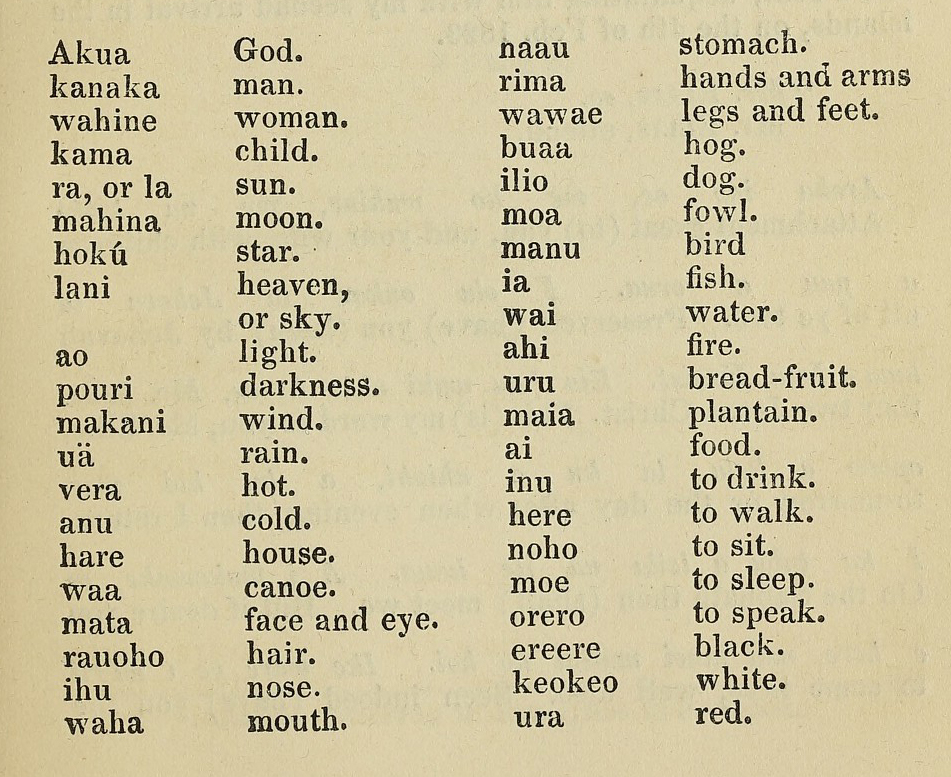 An image from Polynesian Researches showing romanization of common ʻōlelo Hawaiʻi (Hawaiian words). Ellis, William. Polynesian researches during a residence of nearly eight years in the Society and Sandwich islands, v.4 (1853). Contributed in BHL from Smithsonian Libraries and Archives.
When I first moved to D.C., I sought comfort in Hālau Hula o Nohona Hawaiʻi, where I could dance and find fellowship with other members of the Hawaiʻi diaspora. I shared photos of the things I worked on, and in particular an image from Polynesian Researches showing the romanization of common ʻōlelo Hawaiʻi (Hawaiian words). I found it funny, if unsettling, to see how the language sounded to missionary ears so many years ago. One of our alakaʻi (leaders) corrected me and used it as a teaching moment. She discussed with me and the other haumana (students) about the way the language has evolved, and the variation in dialect from island to island and from kupuna to keiki (elders and children). The language I grew up hearing on my island and in my family is not the same as what was spoken on other islands, and in some places is still currently spoken in older generations. My hula sister reminded me that despite my ethical reservations about the work as a whole, there is value to Indigenous communities in using these primary sources.
You can explore the 1853 edition of Polynesian Researches, as well as other editions of the title and other works by William Ellis, in BHL.
ReferencesNational Archives. “The 1897 Petition Against the Annexation of Hawaii.” Archives.gov, 15 August, 2016. https://www.archives.gov/education/lessons/hawaii-petition.
Johnston, Anna. “The Strange Career of William Ellis.” Victorian Studies, vol. 49, no. 3, 2007, pp. 491-501.
Silva, Noenoe K. Aloha Betrayed: Native Hawaiian Resistance to American Colonialism. Durham: Duke University Press, 2004, pages 123-163.
United States, Congress. Public Law 103-150. United States Statutes at Large, Vol. 107 – 103rd Congress, 1st Session, 1993. U.S. Government Publishing Office, https://www.govinfo.gov/content/pkg/STATUTE-107/pdf/STATUTE-107-Pg1510.pdf.
Intriguing Items from the Smithsonian Libraries and Archives’ Adopt-a-Book Program
The Smithsonian Libraries and Archives’ Adopt-a-Book program has brought donors, Smithsonian staff, and treasured collection items together for twelve years. This year our annual event went virtual in a series of Adopt-a-Book Salons. Across four evenings, we were able to showcase 77 items from our collections. We featured selections from the Smithsonian Institution Archives for the first time, giving our attendees a look into our incredible archival materials.
Even though the Salons are over, we still have many intriguing items available for adoption. Each adoption provides essential funding to support the conservation, acquisition, and digitization of our materials while allowing you to create your own Smithsonian legacy. Here you can see some of your options, but there are many more on our website.
Forgive us for stating the obvious, but this item is simply fab. Packaged to look like Fab laundry detergent is Aspen: The Magazine in a Box, Volume 1 Issue 3, December 1966. It is one of six issues owned by the Cooper Hewitt, Smithsonian Design Library and was designed by Andy Warhol and David Dalton. As with all the Aspen volumes, this issue has many components, including a flipbook based on Warhol’s film Kiss and a flexidisc by John Cale of the Velvet Underground. Each issue was intended to be a time capsule, capturing the culture and events of the late 1960s.
 Cover, Aspen: The Magazine in a Box, Volume 1 Issue 3, December 1966.
Ne’Ho Niyo’ Dë:Nö’ = That’s What It Was like
Knowledge of the Seneca Nation is preserved in this compilation of oral histories from sixty-one tribal elders, creating a valuable historical and cultural resource. The grant-funded Seneca Nation Curriculum Development Project gave the Seneca Nation Education Department an opportunity to produce this rare publication that preserves, teaches, and conveys Seneca history from the Seneca perspective. Most of the elders interviewed were born early in the 20th century. Their stories tell the rich tapestry of life as Haudenosaunee people who were deeply impacted by government or parochial boarding schools and language loss. The book was intended for use by teachers and students on and around the nine Seneca reservations.
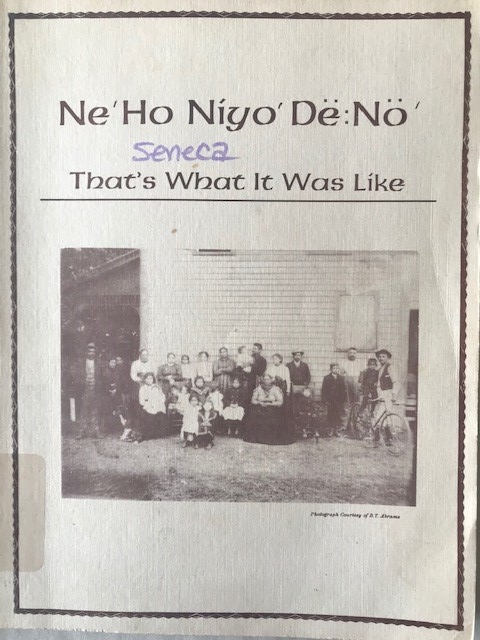 Cover, Ne’Ho Niyo’ Dë:Nö’ = That’s What It Was like (1986).
Russia’s Treasure of Diamonds and Precious Stones
A real gem of a rare book, Russia’s Treasure of Diamonds and Precious Stones is an illustrated catalogue of the Russian crown jewels, published by the Soviet Union’s People’s Commissariat of Finance after the Russian Revolution removed the Tsar and his family from the throne. It is believed to be the only complete record of the Romanov dynasty’s treasures before their dispersal through private sale and a subsequent auction. The work was published as a limited-edition portfolio consisting of 100 photographic plates (often life-sized) and four sections of text, with only a dozen copies currently known in North America.
 Three plates of crown jewels, Russia’s Treasure of Diamonds and Precious Stones (1925).
Who knew slugs could be so beautiful? In 1907, Paul Bartsch, an assistant curator of the Smithsonian’s division of mollusks, set sail aboard the USS Albatross on a collecting trip throughout the Philippines. Sprinkled throughout Bartsch’s field notes about nudibranchs in the Archives collections are detailed watercolor illustrations of the sea slugs by Japanese artist Kumataro Ito.
 Notes and description of specimens collected on the Philippine Expedition of the Steamer Albatross, circa 1908. Smithsonian Institution Archives, Accession 16-213.
Georgia O’Keeffe Correspondence with Joseph Hirshhorn
Apologies in advance, because we’re going to do some serious name dropping as we highlight this item available for adoption from the Archives. Hirshhorn Museum and Sculpture Garden founding donor Joseph Hirshhorn rubbed elbows with some of the greats of the 20th-century art world. In his papers are letters to or from Alexander Calder, Picasso, Chagall, Man Ray, Isamu Noguchi, and Georgia O’Keeffe. The specific correspondence available for adoption reveals the mostly friendly, though sometimes contentious, relationship between O’Keefe and Hirshhorn.
 Letter, dated December 20, 1967, from artist Georgia O’Keefe to Joseph and Olga Hirshhorn. Smithsonian Institution Archives, Record Unit 7449, Box 6, Folder 31.
As we wrap up our series of Adopt-a-Book Salons, we want to celebrate every single donor who has made an impact in the first twelve years of this program. Whether you’ve adopted in the past or are new to Adopt-a-Book, we hope you will join us as we move the program into the future. New elements like adoptable materials from the Smithsonian Institution Archives, behind-the-scenes videos, and digital experiences can be enjoyed by supporters around the world.
Sleuthing Captain America’s Shield
While the Smithsonian is referenced all the time in popular media, nothing goes hand-in-hand with the world’s largest museum complex quite like the world’s largest film franchise: the Marvel Cinematic Universe (MCU). In that fictional world, the Avengers and the Smithsonian have had a somewhat rocky relationship, including a heist by Captain America to steal his old uniform from the National Air and Space Museum. The inclusion of the Smithsonian in the MCU has led to many questions for Smithsonian staff, most prominently, “Why is the Captain America exhibit in the MCU in the National Air and Space Museum and not the National Museum of *American* History?”
 41c Captain America single, National Postal Museum 2007.2025.46. Copyright United States Postal Service. All rights reserved.
But the most recent feature of the Smithsonian in the MCU raised a fabulous question from the public to our Ask A Librarian service. Ask A Librarian is our public-facing email that opens the expertise of Smithsonian librarians to the entire world, answering questions and connecting the public to Smithsonian resources.
This question is from Jason Henderson, a librarian at Langston University in Oklahoma:
I was watching the Disney+ Marvel show The Falcon and the Winter Soldier.
In this show, Captain America’s shield was specifically donated to (a fictional version of) the Smithsonian.
In the narrative, the shield was donated by a private citizen, with the understanding it would be part of the permanent display.
The shield however might technically be considered property of the US government, was removed from the exhibit and was issued as military equipment.
I know this is a fictionalized event, however as a librarian, it made me wonder about the real Smithsonian policy concerning these types of donations.
To answer Jason’s specific question, the handling of collections, including accountability and ownership, are governed by “Smithsonian Directives” (SDs) which outline policy and practice for the entire institution. Specifically, SD-600 covers items in the National Collections, like the shield would be.
SD-600 requires that the Smithsonian establish legal title to any item to be acquired for the collections with accompanying evidence, such as provenance information, permits, export/import licenses, and intellectual property transfer agreements where applicable. Such evidence would prove conclusively that an item wasn’t, for example, already owned by another department of the US government (i.e. S.W.O.R.D. in the case of Falcon and the Winter Soldier) and subject to repossession by that entity.
In the case of Captain America’s Shield, provenance is key. The Shield given to Sam Wilson in Avengers: Endgame was brought back to the standard MCU timeline by Steve Rogers from an alternate universe. Clearly, since federal jurisdiction does not extend throughout the multiverse, this particular Shield was the personal possession of Steve Rogers, who gifted it to Sam Wilson, who gifted it to the Smithsonian.
Now that legal title has been established, there is a question of the consequences of deaccessioning (that is, removing from the collections) the donated Shield. Section 3 of SD 600 sets policy for Deaccessioning and Disposal of Collections items based on the estimated value of the particular object. In Age of Ultron, Ultron purchases about 500 lbs of the fictional metal vibranium for $1,840,561,245 from the supervillian Klaw. While Captain America’s shield would have obvious and intangible historical value and is not made purely of vibranium, one can fairly estimate its scrap value by weight (12 lbs according to Marvel) at $44,173,470. Therefore, specifically, Section 3, Subsection b(2)(c) on policy would apply, saying:
If the estimated value of a single collection item or a group of collection items considered for disposal is …
more than $500,000, the collecting unit must obtain two written, independent appraisals or informed estimates of fair market value and approval of the deaccession and disposal from the Office of the General Counsel, the appropriate Under Secretary or Director – International Art Museums Division, the Secretary, and the Board of Regents.
Policy also states that the Secretary must report on the disposal of items to the Board of Regents, which would be quite an interesting meeting to be a fly on the wall for.
But, in all this policy, there is an important tidbit that shouldn’t be forgotten: there is a REAL Captain America Shield in the Smithsonian, the one wielded by Chris Evans in Captain America: The Winter Soldier. And where is that piece of real world history? Not in the National Air and Space Museum. You guessed it, it’s in the Smithsonian’s National Museum of American History.
 Shield used by Chris Evans as Captain America in Captain America:The Winter Soldier, Smithsonian’s National Museum of American History 2018.0107.01.
Sailing the Great Lakes in 1897
Are you dreaming of summer vacation? Do you eagerly read guidebooks or search online to learn about cities and sites you’ll visit? How did tourists in the late 19th Century plan their vacations? The Trade Literature Collection at the Smithsonian Libraries and Archives may give us an idea. Perhaps someone in 1897 read this promotional booklet in anticipation of that long-awaited trip.
This trade catalog is titled Seven Halcyon Days of Blessed Rest (1897) by Northern Steamship Co. It provides a small glimpse into a tour of the Great Lakes aboard steamships in the Summer of 1897. Previously, we explored accommodations on these ships. Now let’s take a look at how this pocket-sized booklet promoted and encouraged people to take that vacation.
 Northern Steamship Co., Passenger Department, Buffalo, NY. Seven Halcyon Days of Blessed Rest (1897), front cover.
 Northern Steamship Co., Passenger Department, Buffalo, NY. Seven Halcyon Days of Blessed Rest (1897), unnumbered page [1], star-shaped image of a steamship sailing on the water.Just as the title suggests, this booklet emphasizes the rest and relaxation that awaited passengers who boarded these steamships. On the first page, the trip is described as, “A tour of the Great Lakes on the floating palaces of the Northern Steamship Company, ‘North West,’ ‘North Land.'”
 Northern Steamship Co., Passenger Department, Buffalo, NY. Seven Halcyon Days of Blessed Rest (1897), unnumbered pages [2-3], lighthouse and other buildings along a shoreline.The reader is reminded that a tour of the Great Lakes aboard a steamship is different than an ocean voyage. Instead of being surrounded by vast amounts of open water, passengers had the chance to touch or at least see land each and every day. The ships were described as “great pleasure-resorts afloat, with the consequent advantages of delightful motion, lake breezes, and constantly shifting scenes, thrown in.”
 Northern Steamship Co., Passenger Department, Buffalo, NY. Seven Halcyon Days of Blessed Rest (1897), unnumbered pages [10-11], boats sailing on the water.The journey began in Buffalo, New York for those traveling westward or Duluth, Minnesota for those traveling eastward. Roundtrip consisted of seven days, but passengers had the option of disembarking or boarding at any of the stops along the way. These included Cleveland, Ohio and Detroit, Mackinac Island, and Sault Ste. Marie in Michigan.
What might have enticed someone in 1897 to book that vacation? Of course, it might simply have been to enjoy a relaxing week on the water. Other ideas are also offered in this catalog. Newlyweds might have considered a Great Lakes Tour for their honeymoon. Or perhaps someone on a cross-country railway trip might have paused the rail portion to board a steamship and enjoy a bit of fresh air and change of scenery. The trip itself was described as “calming the nerves, and clearing the brain to an extent that will never be realized until it has been experienced.”
 Northern Steamship Co., Passenger Department, Buffalo, NY. Seven Halcyon Days of Blessed Rest (1897), unnumbered pages [12-13], shoreline.
 Northern Steamship Co., Passenger Department, Buffalo, NY. Seven Halcyon Days of Blessed Rest (1897), unnumbered pages [14-15], steamship sailing on the water and a shoreline.Passengers might have chosen to remain onboard to enjoy a roundtrip experience or disembark at various points along the way to explore a city. The schedule for the Season of 1897, shown below, provided arrival and departure times for each stop. The steamship stopped for only a short time before continuing so those who disembarked at stops along the way were required to find overnight accommodations until the ship returned.
 Northern Steamship Co., Passenger Department, Buffalo, NY. Seven Halcyon Days of Blessed Rest (1897), unnumbered page [16], Season of 1897 Schedule for “North West” and “North Land” steamships.To book those overnight accommodations or find activities in various cities, another trade catalog might have come in handy. This catalog is titled Itinerary: Great Lake Tours (1897) by Northern Steamship Co. It provided general information about cities and stops on the route, excursions to additional cities, and railway connections. Though it does not go into extensive detail, it briefly describes the cities and mentions sites to consider visiting as well as hotels.
 Northern Steamship Co., Passenger Department, Buffalo, NY. Itinerary: Great Lake Tours (1897), front cover.
 Northern Steamship Co., Passenger Department, Buffalo, NY. Itinerary: Great Lake Tours (1897), title page and preceding page, steamship (shown on page preceding title page).
One stop on the route was Mackinac Island, Michigan. Illustrated below, Mackinac Island was described as an area “rich in historical interest” with a “dry, crisp, and invigorating” climate. Perhaps visitors enjoyed the “various attractive drives” or spent their time fishing.
 Northern Steamship Co., Passenger Department, Buffalo, NY. Itinerary: Great Lake Tours (1897), page 13, Mackinac Island, Michigan and Lighthouse, Mud Lake.
For those interested in fishing, an excursion to Les Cheneaux, also known as the Snow Islands, might have sounded appealing. Tickets for this excursion were sold in connection with a ticket either to or via Mackinac Island. Just a few hours ride from Mackinac Island via the Arnold Line, the Snow Islands might have provided a relaxing day of fishing and change of scenery. Boats, guides, fishing tackle, and bait were available at various points.
 Northern Steamship Co., Passenger Department, Buffalo, NY. Itinerary: Great Lake Tours (1897), page 21, Club House, St. Clair Flats and information about excursion rates from Detroit, Michigan and Mackinac Island, Michigan.
Seven Halcyon Days of Blessed Rest (1897) and Itinerary: Great Lake Tours (1897) by Northern Steamship Co. are both located in the Trade Literature Collection at the National Museum of American History Library. Interested in learning more about vacations aboard these steamships? Take a look at this post for more on accommodations and other excursions.
Meet the Smithsonian’s First Woman Photographer
This post first appeared on the Smithsonian Institution Archives’ blog.
While Thomas W. Smillie is known as the Smithsonian’s first and chief photographer from 1871 to 1917, it is less known that his first and chief assistant, Miss Louisa Bernie Gallaher, was quite an accomplished photographer herself and is responsible for much of the work produced by the photographic laboratory of the United States National Museum (USNM).
 Portrait of woman believed to be Bernie Gallaher, circa 1880, SIA Acc. 11-006, MAH-2301 (Smithsonian Institution Archives)Gallaher began working at Smithsonian as a clerk in 1878 at the age of twenty, after her relative, Senator James B. Beck of Kentucky, placed her under the care of Thomas Smillie. Upon seeing some photographs she had made from one of her vacations, Smillie recognized her skills as a photographer and asked for her to be transferred to the photographic department where she worked as a photographer from 1890 until her death in 1917.
 Photomicrograph of wood specimen, circa 1890s, by L. Bernie Gallaher, SIA Acc. 11-007, MNH-4701. (Smithsonian Institution Archives)
Gallaher’s work in photomicrography and x-ray reproductions was highly regarded by the scientific community, and Smillie himself said, “I believe her to be the most successful woman photographer in the United States in scientific illustration.” In addition to her work in scientific photography, Gallaher also photographed living models, portraits, and museum objects. Whenever Smillie was away, the responsibility for managing Smithsonian’s growing photographic force was upon her. Smithsonian employees called upon Gallaher’s expertise on the history and art of photography for the development of Smithsonian’s first photography exhibition in 1913, which included a few of her own works.
 Magnified view of nuclear whorl on shell, by L. Bernie Gallaher, Smithsonian Miscellaneous Collections, Vol. 47, Pl. XXIX. (Smithsonian Libraries and Archives)
While much of the work produced by the USNM photo lab prior to 1917 has, in the past, been credited to Thomas W. Smillie, for the simple fact that his is the only name really documented anywhere in our records pertaining to photography at that time, we are discovering a much richer history. We look forward to expanding credit to Louisa Bernie Gallaher for the magnitude of work she created while in the employ of the United States National Museum.
Hidden Biodiversity: Exploring Neotropical Fungus Weevils With the Help of BHL
This post was originally featured on the Biodiversity Heritage Library blog.
 A view of the Panamanian tropical rainforest in Colón Province. Photo by Samanta Orellana.
In the last decades of the 19th century, a monumental publication on the biodiversity of Mexico and Central America began publication—Biologia Centrali-Americana. Published in 215 parts from 1879 to 1915 by the editors Frederick DuCane Godman and Osbert Salvin, the work describes over 50,000 species and is illustrated with over 1,600 lithographic plates depicting over 18,000 species. Remarkable for its time, the title is still vitally important for the study of Neotropical biodiversity today, as it contained virtually all known information at the time about Mexican and Central American flora and fauna.
Biologia Centrali-Americana is a particularly important resource for entomologist Samanta Orellana, a PhD student in evolutionary biology at the Dr. Nico Franz Lab of Arizona State University (ASU) and a research assistant in the ASU Biocollections of the Biodiversity Knowledge Integration Center. Orellana began studying insects and working with entomological collections more than a decade ago, during her undergraduate studies in her home country of Guatemala.
“For many insect groups in Guatemala and the rest of Central America, Biologia Centrali-Americana still represents the only source of information available for the region,” states Orellana.
 Samanta Orellana in the Arizona State University Biocollections. Photo by Kevin Cortés.
Biologia Centrali-Americana is also meaningful to Orellana because it led her to the Biodiversity Heritage Library (BHL). In 2010, whilst identifying Guatemalan insects as part of her undergraduate studies, Orellana started using the “Electronic Biologia Centrali-Americana,” available from the Smithsonian Libraries and Archives, which directed her to BHL. She hasn’t stopped using BHL since.
“BHL is simply wonderful,” lauds Orellana. “I think it is an amazing tool for entomologists all around the world, especially for those of us who work or have worked in collections in developing countries, usually without access to specialized libraries or journals, but with a lot of material to identify.”
 One of the plates of Central American anthribids, included in the chapter written by Karl Jordan in the Biologia Centrali-Americana (Insecta. Coleoptera. v.4, pt.6, 1895-1907). Contributed in BHL from Smithsonian Libraries and Archives.
Orellana specializes in the family Anthribidae (Coleoptera), commonly known as fungus weevils. Her research on these insects began during her studies at the Universidad de Panamá, where she completed an M.Sc. in entomology, and continues through her PhD work, with her dissertation focused on the family’s diversity and evolution. As part of this research, Orellana recently published a catalogue of the Anthribidae species from Panama.
BHL’s collections have been instrumental in enabling Orellana to pursue her work on the family.
“BHL was essential to complete my first published work on Anthribidae, a catalogue of the species from Panama,” shares Orellana. “This group of weevils has been poorly studied in the Neotropics, so identifying specimens is always challenging due to the lack of taxonomic keys. I had to rely mostly on original descriptions available through BHL to identify the specimens I examined, both in Panamanian and American collections. The catalogue ended up with 44 new records for the country, most of them identified thanks to the literature available in BHL.”
 Eugonus robustus Jordan, 1904 (Coleoptera: Anthribidae), from Panama. Photo by Samanta Orellana.
BHL has now become a core part of Orellana’s research process. She uses the Library at least several times a week, reading content online or downloading material via BHL’s custom PDF generator to build her own local collection of Anthribidae literature. Her favorite feature is BHL’s full text search service, which allows her to easily find scientific names or specific localities within sources.
“I use BHL all the time,” affirms Orellana. “I continue using it for my PhD studies to identify collection specimens, as taxonomy is an important component of my research with this group of weevils. I also maintain a website in Spanish about insects of Guatemala and constantly consult BHL to obtain and share information about the diversity of this group in my country.”
When asked what improvements she would like to see in BHL, Orellana replies, “This is a difficult question, because I love BHL so much. There is nothing I can think of that I would change. I can always find what I am looking for with the features already included on the website.”
Orellana’s experience testifies to the importance of open access for scientific research, whether you are a researcher working with limited resources or even if you have the benefit of a large, institutional library. For researchers everywhere, BHL’s collections offer free, easy access to centuries of scientific literature and sources that may otherwise have been inaccessible.
“Even now that I am working at a larger collection, and I have access to specialized literature, there are older works that can only be obtained through BHL,” confirms Orellana.
We are proud to know that BHL is empowering biodiversity research globally. As we face unprecedented biodiversity declines—with more than a million species threatened with extinction—immediate, online access to essential literature is ever-more important, allowing scientists to conduct research more quickly and efficiently and improving our ability to respond to today’s biodiversity crisis. We look forward to continuing to work with our global community of partners to ensure that researchers like Samanta Orellana have the resources they need to study and conserve biodiversity, from the smallest weevil to the largest sequoia and everything in between.
———————
Biodiversidad Oculta: Explorando los Gorgojos Neotropicales con la ayuda de BHL
Una vista del bosque tropical de Panamá en la Provincia de Colón. Fotografía por Samanta Orellana.
En las últimas décadas del siglo XIX, una publicación monumental acerca de la biodiversidad de México y Centroamérica inició su difusión –la Biología Centrali-Americana. Publicada en 215 partes de 1879 a 1915, por los editores Frederick DuCane Godman y Osbert Salvin, el trabajo describe más de 50,000 especies y está ilustrada con más de 1,600 láminas litográficas que contienen más de 18,000 especies. Muy notoria en su tiempo, la obra aún es sumamente importante para el estudio de la biodiversidad neotropical en la actualidad, ya que contiene prácticamente toda la información conocida, hasta el momento, acerca de la flora y fauna de México y Centroamérica.
La Biologia Centrali-Americana es un recurso particularmente importante para la entomóloga Samanta Orellana, estudiante de Doctorado en Biología Evolutiva, en el laboratorio del Dr. Nico Franz, en Arizona State University (ASU) y asistente de investigación en las Colecciones Biológicas del Centro de Integración para el Conocimiento de la Biodiversidad en ASU. Orellana empezó a estudiar insectos y a trabajar en colecciones entomológicas hace más de una década, durante sus estudios de pregrado en su país natal, Guatemala.
“Para muchos grupos de insectos de Guatemala y el resto de Centroamérica, la Biología Centrali-Americana aún representa la única fuente de información disponible en la región”, asegura Orellana.
Samanta Orellana en las Colecciones Biológicas de Arizona State University. Fotografía por Kevin Cortés.
La Biologia Centrali-Americana también es importante para Orellana, ya que la llevó a descubrirBiodiversity Heritage Library (BHL), que en español podría denominarse como “Biblioteca del Patrimonio de Biodiversidad”. En 2010, mientras identificaba insectos de Guatemala, como parte de sus estudios de pregrado, Orellana empezó a utilizar la versión electrónica de la Biología Centrali-Americana,disponible en el sitio de las Bibliotecas y Archivos del Instituto Smithsonian, lo cual la dirigió hacia BHL, y no ha dejado de usarla desde entonces.
“BHL es simplemente maravillosa”, asegura Orellana. “Pienso que es una herramienta increíble para los entomólogos alrededor del mundo, especialmente para aquellos que trabajamos en colecciones de países en vías de desarrollo, usualmente sin acceso a bibliotecas o revistas especializadas, pero con mucho material por identificar”.
Una de las láminas de antríbidos de Centroamérica, incluidas en el capítulo escrito por Karl Jordan en la Biología Centrali-Americana (Insecta. Coleoptera. v.4, pt.6, 1895-1907). Compartido en BHL por las Bibliotecas y Archivos del Instituto Smithsonian.
Orellana se especializa en la familia Anthribidae (Coleoptera), comúnmente conocidos como “gorgojos de los hongos”. Sus investigaciones con estos insectos iniciaron durante sus estudios en la Universidad de Panamá, donde completó su maestría en entomología, y continúan durante su doctorado, con su tesis enfocada en la diversidad y evolución de la familia. Como parte de su investigación, Orellana recientemente publicó un catálogo de las especies de Anthribidae de Panamá.
Las colecciones de literatura de BHL han sido indispensables para permitir que Orellana trabaje con esta familia.
“BHL fue esencial para completar mi primer trabajo publicado acerca de Anthribidae, un catálogo de especies de Panamá”, comparte Orellana. “Este grupo de gorgojos ha sido pobremente estudiado en la región Neotropical, por lo que identificar las especies siempre es un reto debido a la falta de claves taxonómicas. Yo tuve que basarme mayormente en descripciones originales, disponibles en BHL, para identificar las especies que estudié, tanto en colecciones panameñas como norteamericanas. El catálogo finalizó 44 nuevos registros para el país, muchos de los cuales fue posible identificar gracias a la literatura disponible en BHL.”
Eugonus robustus Jordan, 1904 (Coleoptera: Anthribidae), de Panamá. Fotografía por Samanta Orellana.
BHL se ha vuelto una parte esencial en el proceso de investigación de Orellana, ya que utiliza este recurso al menos varias veces por semana, leyendo el contenido en línea o descargando material, por medio del generador de archivos PDF de BHL, para construir su propia colección de literatura de Anthribidae. Su característica favorita de BHL es el servicio de búsqueda de texto, que le permite encontrar nombres científicos y localidades de una manera fácil dentro de los archivos disponibles.
“Uso BHL todo el tiempo”, afirma Orellana. “Durante mis estudios de doctorado, uso BHL constantemente para identificar especímenes de colecciones, ya que la taxonomía es un componente importante de mi investigación con este grupo de gorgojos. Como una actividad adicional, administro un sitio web enfocado en insectos de Guatemala, y consulto BHL constantemente para obtener y compartir información acerca de la diversidad de este grupo en mi país.”
Al consultarle acerca de las mejoras que le gustaría ver en BHL, Orellana responde, “Esta es una pregunta difícil, porque BHL me gusta demasiado. No puedo pensar en nada que me gustaría cambiar. Siempre puedo encontrar lo que estoy buscando con las características ya incluidas en el sitio web”.
Las experiencias de Orellana son un testimonio de la importancia de libre acceso a las investigaciones científicas, así sea para científicos trabajando con recursos limitados, o para aquellos que cuentan con acceso a bibliotecas institucionales. Para investigadores de todas partes, la colección de BHL ofrece acceso gratuito y fácil, a siglos de literatura y recursos científicos que, de otra manera, serían inaccesibles.
“Aún ahora, que me encuentro trabajando en una colección grande y tengo acceso a literatura especializada, existen trabajos muy antiguos a los que puedo acceder únicamente a través de BHL,” confirma Orellana.
Estamos orgullosos de saber que BHL empodera la investigación de biodiversidad a nivel global. Mientras nos enfrentamos a la desaparición sin precedentes de la biodiversidad —con más de un millón de especies amenazadas con la extinción— el acceso inmediato a literatura en línea es más importante que nunca, permitiendo que los científicos conduzcan sus investigaciones de una manera más rápida y eficiente, mejorando la habilidad de responder a la crisis de biodiversidad actual. Esperamos continuar trabajando con nuestra comunidad de socios para asegurar que los investigadores como Samanta Orellana tengan a la mano los recursos que necesitan para estudiar y conservar la biodiversidad, desde el gorgojo más pequeño a la secoya más grande.
New Video Series Highlights Conservation Treatments
Curious about our conservators’ favorite books or trickiest treatments? While they’ve had to step away from the bench during the pandemic, our Preservation Services staff have been hard at work describing some of their remarkable conservation techniques in video form.
In honor of Preservation Week (April 25 – May 1, 2021) we invite you to learn more about the work of our Book Conservation Lab as well as our Adopt-a-Book program through a new video series, “Adopt-a-Book: Preserving Treasures Together”. Embedded below are the first five videos in the series. You can also find them in a playlist on our YouTube channel. Watch as our conservators introduce you to some of the memorable books they’ve worked with and walk you step-by-step through some tough treatments they’ve completed thanks to donor support.
Want to hear more about our Adopt-a-Book program? Tickets are still available for our next virtual event, Adopt-a-Book Salon: From the Vaults on Wednesday on April 28th at 5:30 PM ET.
Adopt-a-Book: Preserving Treasures Together – How it Works
Our Adopt-a-Book Program provides crucial support for the care of our collections. But how does it work? Book Conservation Lab staff Donald Stankavage and Keala Richard created this video to walk you through the process.
Adopt-a-Book: Preserving Treasures Together – Baby Bird-Finder
Watch as Daniel Viltsek, book conservator, shares his process for the preservation of a rare book–from spine repair to leather contouring.
Adopt-a-Book: Preserving Treasures Together – Auctoritates extracte ex Libris phi[losophorum]
Vanessa Smith, book conservator and Head, Preservation Services, describes the delicate work involved in treating a 15th century book of ancient philosophy, Auctoritates extracte ex Libris phi[losophorum].
Adopt-a-Book: Preserving Treasures Together – Le Cheval
Katie Wagner, Senior Book Conservator, highlights the treatment of Le cheval, a rare 19th century equine anatomy book with 16 lithograph plates and movable parts.
Adopt-a-Book: Preserving Treasures Together – Wendingen
Daniel Viltsek shares his process for using raffia to recreate a stab binding on the Dutch design journal Wendingen.
Libraries Then and Now: The Ideas We Share
What products or materials come to mind when you think of libraries? The obvious things might be books and shelving, but to keep a library functioning other items are needed as well. Supplies for circulating and tracking books and identifying ownership of books remain largely behind the scenes but are just as important.
Classified Illustrated Catalog of the Library Department of Library Bureau (1899) by Library Bureau is a trade catalog providing us a glimpse into supplies and equipment that library staff in 1899 might have used to complete their everyday tasks. Though much has changed, we might recognize some basic concepts that still exist.
 Library Bureau, Boston, MA. Classified Illustrated Catalog of the Library Department of Library Bureau (1899), front cover.
 Library Bureau, Boston, MA. Classified Illustrated Catalog of the Library Department of Library Bureau (1899), title page.
Today we use a library borrower’s card to check out a book. Typically, each book has a barcode that assists library staff in circulating and tracking that particular book via an online library system. We might also notice a property stamp inside the book. The property stamp identifies the library that owns the book. What supplies did libraries in 1899 use to circulate and identify their materials?
As highlighted in a previous post, paper-based charging systems were used to circulate books before the availability of computers and online library systems. Both types of systems require borrower’s cards, but paper-based charging systems also require a book card or charging card for each book.
An example of a borrower’s card from 1899 is shown below. The top portion included general information pertaining to the user such as name and address. It also included the Borrower’s Pledge. A version of this pledge might sound familiar to us today. As in the example below, library borrowers pledged to be responsible for all materials charged to them. The bottom portion of the card included ruled lines for noting borrowed books and dates for when each book was borrowed and returned.
 Library Bureau, Boston, MA. Classified Illustrated Catalog of the Library Department of Library Bureau (1899), page 76, Borrower’s Card and Charging Cases.
When a paper-based charging system is used, a charging card, or book card, for each book is also necessary. An example of a charging card from 1899 is shown below. It included ruled lines on both the front and back to record information about the book. The three lines at the top were intended for entering the title and author of the book and its number, what we typically refer to as a call number today. Below that section were more ruled lines or small boxes. Each time the book was checked out and returned, library staff recorded such things as borrowing date and returned date in those small boxes. This provided a history of the book’s circulation.
 Library Bureau, Boston, MA. Classified Illustrated Catalog of the Library Department of Library Bureau (1899), page 75, Slip Trays and Charging Cards.
To record those dates on the cards, library staff might have used the Self-Inking Library Dater illustrated below (middle right) or the Lever Dater also shown below (top left). Both had the ability to stamp dates in tiny spaces on cards. According to this 1899 trade catalog, the Lever Dater was Library Bureau’s “most popular style” at the time. A drawback of the Self-Inking Library Dater might have been that it was not as noiseless as the Lever Stamp.
Dates were just one piece of information for which libraries might have used a stamp. The Self-Inker (below, bottom left) was another handy tool because it was customizable and capable of stamping both dates and words. Due to its design, another feature was its ability to stamp not only cards or single sheets of paper but also books.
 Library Bureau, Boston, MA. Classified Illustrated Catalog of the Library Department of Library Bureau (1899), page 79, Lever Dater, Self-Inking Library Dater, and Self-Inkers.
Just like today, libraries in 1899 needed a way to mark ownership to assist in identifying their books. Today we might notice a property stamp inside a book stating the name of the library that owns it. In 1899, an option for marking ownership was the Perforating Stamp. As shown below, this type of stamp perforated the page by spelling out the name of the library with perforation marks. It was described as an alternative to the embossing stamp and did not increase the thickness of the book.
 Library Bureau, Boston, MA. Classified Illustrated Catalog of the Library Department of Library Bureau (1899), page 82, Perforating Stamp.
Now let’s take a closer look at equipment that might be useful when shelving or browsing the stacks. Every so often, library staff may come across a book that is too large to be safely shelved in its proper location. The book is typically removed and shelved in a more suitable spot based on its size. Judging from supplies offered in this trade catalog, the same thing happened in 1899.
To assist in locating an oversize book in its new location, Library Bureau offered supplies called “Wood Dummies.” These were thin boards measuring 5 x 8 x 1/4 inches and meant to be shelved in the book’s proper, or original, location. A label, such as the one below, was attached to the board to assist users in locating the book’s actual location. The label included bibliographic information and the book’s new location along with the reason for it being moved. This particular label gives several reasons. Besides being “too large for the regular shelves,” other reasons included rarity, cost, being transferred to Reference, or missing.
 Library Bureau, Boston, MA. Classified Illustrated Catalog of the Library Department of Library Bureau (1899), page 86, Buffalo Book Brace and Wood Dummies.
Every library needs step stools for reaching high shelves. These Folding Steps, illustrated below, provided an additional benefit. How many times have we been browsing the stacks and located a book but needed a quick, safe place to set it down to take a closer look at a page? The Folding Steps provided a way to do that. Along with the step stool portion which consisted of two steps, there was also a flat surface at the very top where a book might be set down if needed. These portable steps measured between two feet and three feet in height and were capable of being expanded outward to create the step stool portion or folded inward if only a stool or the flat/table top surface was needed. Both positions are shown below.
 Library Bureau, Boston, MA. Classified Illustrated Catalog of the Library Department of Library Bureau (1899), page 150, Folding Steps and Mimeograph.
As we flip through this trade catalog, we are reminded of how much has changed in libraries over the last century, but it also shows that we continue to share some basic ideas and concepts with our predecessors. Classified Illustrated Catalog of the Library Department of Library Bureau (1899) and other catalogs by Library Bureau are located in the Trade Literature Collection at the National Museum of American History Library.
An Internship in the Time of Coronavirus
This post was contributed by Natalia Addison, 2020 spring intern with the American Art and Portrait Gallery (AA/PG) Library and a recent Master of Science in Information and Library Science graduate from Clarion University.
Working at the prestigious Smithsonian Institution has always been a dream that I’ve held. Thus, obtaining an internship at the American Art and Portrait Gallery Library (AAPG Library) in the spring of 2020 was a manifestation of that dream. Here, I learned how to process and select materials for the Art and Artists File Collection. I learned how to do intensive art research on artists, and learned when, why, and how to add new items to those artist files. I learned preservation practices, analysis techniques, and was able to expand my knowledge about the artists. I was able to use the knowledge I gained through my courses at Clarion University to serve patrons through an unfamiliar integrated library system. It is through this opportunity that I found what I suspected all along to be true: that I want to continue to pursue my dream of becoming an art librarian.
 This is an example of the type of materials Natalia Addison worked with during her internship.
Much of my time at the AAPG Library was spent working with art ephemera. Ephemera, in relation to libraries, is printed material that is not meant to last or to be kept for a long time. For the artists represented in an art library, these pieces of ephemera are important parts of their histories. Artist files hold “private view cards, exhibition announcements, press releases, newspaper clippings, artists’ correspondence, posters and flyers, emails, and other materials.”[i] These items are important as reference pieces as they can contain significant documentation on artists that is not easily found elsewhere especially for artists who may not be well covered in mainstream or standard resources.
As a Library Science Graduate student, learning how ephemera is used, and how to access it, was an important and fascinating aspect of my internship. During ordinary circumstances when the library is open, researchers can come into the library and request files to view and library staff will pull the files for them. Being able to sort through the artist files myself during my internship really helped me understand how and why ephemeral materials are so important. I also learned how to label the artist folders, strategically stamp materials to note the donation they came from, carefully remove all harmful extraneous materials, and place them in protective coverings.
Sorting through the ephemeral materials in the artist files was a dream come true. Being able to see how the artists represented themselves through postcards and exhibition materials was so inspiring. Ephemeral materials allowed me to see how art was displayed by artists or galleries. I was able to see the stories of artists in news clippings and read about how their contemporaries viewed their works. Some files had letters, sometimes from the artist themselves. Artist files allow researchers a glimpse into the mind of the artist, and a deeper connection to the artwork. So much of the work that I did reminded me of my childhood days: saving postcards and tags from garments, making collages, and researching the brands and artists.
 This is an example of the type of materials Natalia Addison worked with during her internship.
The impact of COVID-19 changed the nature of my internship. I was able to continue online and in spite of the changes I learned a great deal. Together with my internship supervisor, Alexandra Reigle, we decided that the best way to continue would be to focus on readings and assignments that related to special collections (particularly artist files), topics specific to art and museum libraries, and reference services. Together we had weekly meetings to discuss the articles and projects to ensure that the internship was still on track. Thanks to my supervisor’s diligence I learned more than I thought possible interning from home.
For one of my assignments I developed my own ephemeral collection. I used items around my home and put them together to showcase why I thought they would be a great addition to an artist file. In this instance I choose a luxury department store as the “Institution.” I used packaging, postcards, flyers and mailers to demonstrate the ephemeral nature of the items. They could be of importance for the history of the company for anniversaries, corporate literature, or future design. Thinking about ephemera from outside an artist perspective was a great lesson on how valuable these items can be. This allowed me to utilize both my life’s passions and areas of expertise: fashion and art literature.
Since working remotely I’ve also attended an online symposium on American Art, and a presentation on trade literature collection at the National Museum of American History Library as part of my internship. COVID-19 has made digitization efforts and issues seem especially pronounced. Patrons of all libraries have had to adapt to researching online and contend with inaccessibility of items that would normally be available. While I’ve been grateful that I was able to continue my internship and feel that I learned a lot in the process, it has not been without its difficulties. One of the best aspects of my internship was getting to be in the AA/PG library. Seeing the volumes of books and magazines in person inspires creativity that simply cannot be matched at home.
My experience as an intern at the AA/PG Library was one of the most important and influential times of my life. This internship granted me the opportunity to see first-hand what it means to be a reference librarian at an art library. I was also able to learn important research habits and interact with some of the finest minds in the art library world. This internship cemented and reinforced my love of art and libraries, and I feel encouraged to continue to pursue my dream of becoming an arts librarian.
[i] Kent C. Boese, “Relics of the Past, or Treasures for Posterity?” Art Documentation: Journal of the Art Libraries Society of North America 25, no. 1 (Spring 2006), 34.
