
Libraries' Blog


National Library Week Virtual Meeting Backgrounds from Smithsonian Libraries and Archives
 Screenshot of Dibner Library of the History of Science and Technology background in use.
A year in to the COVID-19 pandemic and we’re guessing some of you might be missing your libraries. We know we are! To give your next video meeting some book-ish ambience and to celebrate National Library Week, we’ve put together a set of backgrounds that bring you into our spaces and, in some cases, right into the pages of our books.
Below are nine images just waiting to adorn your virtual walls. Some are recent photos of our library locations. Some are vintage views from the collections of Smithsonian Institution Archives. And a few are just favorite book illustrations with a collector’s vibe. Click on the image and save to your computer, then follow the instructions provided by your virtual meeting platform (Zoom, Microsoft Teams, etc.) to upload and use.
Library stacks in the National Museum of Natural History Library, main location.
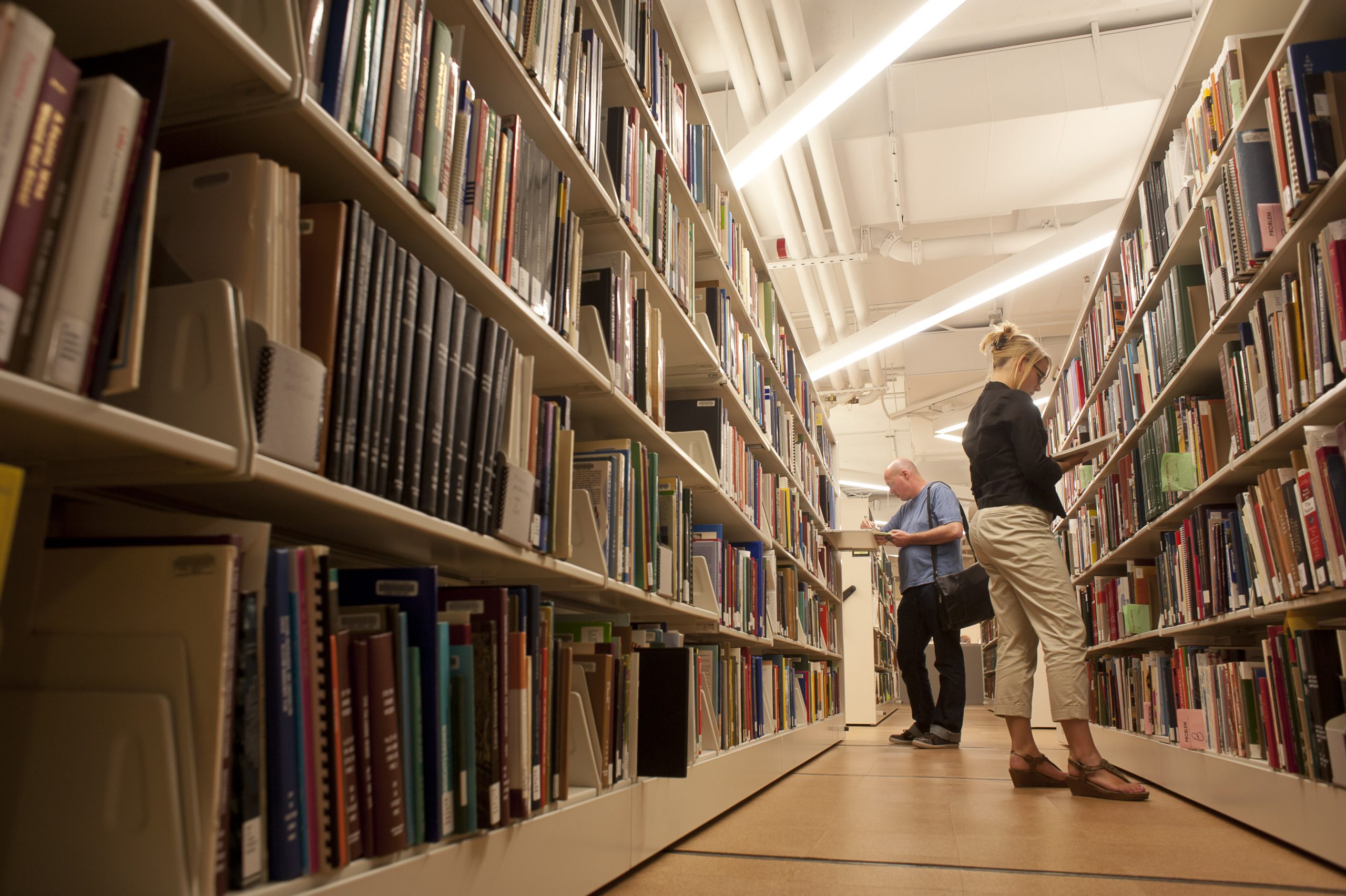 National Museum of Natural History Library, main location. Click to enlarge and download.
Vintage juvenile aviation adventures shelved in the National Air and Space Museum Library‘s rare book room.
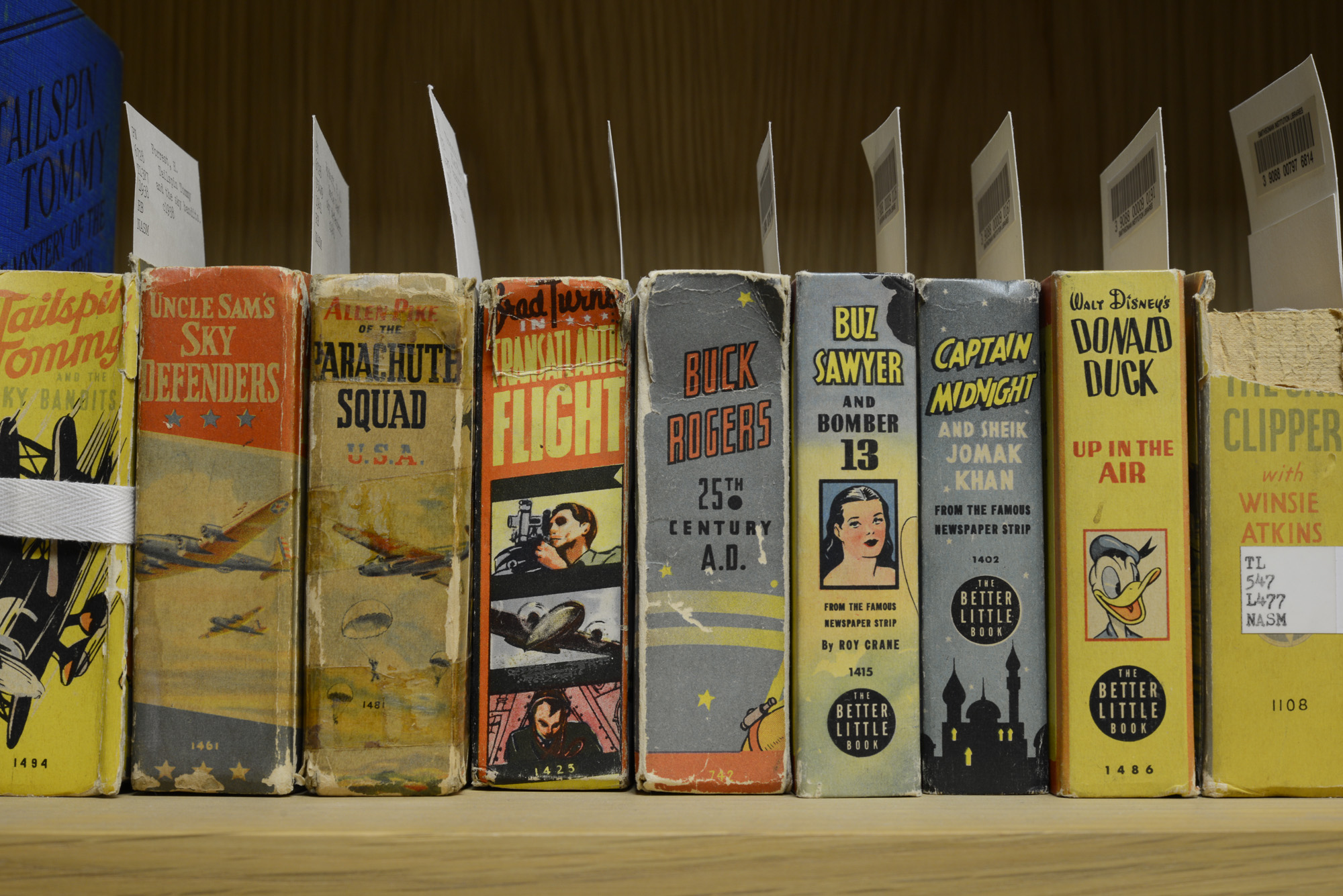 National Air and Space Library. Click to enlarge and download.
Reading room of the Dibner Library of the History of Science and Technology. Photo by Liz O’Brien.
 Dibner Library of the History of Science and Technology. Click to enlarge and download.
Double-page plate, Dell’historia natvrale di Ferrante Imperato napolitano libri XXVIII (1599), detail.
 Double-page plate, Dell’historia natvrale di Ferrante Imperato napolitano libri XXVIII (1599), detail. Click to enlarge and download.
Plate No. 215, Le garde-meuble, v. 1 (1839), detail.
 Plate No. 215, Le garde-meuble, v. 1 (1839), detail. Click to enlarge and download.
“Living Room”, The woman’s book v. I (1894), detail.
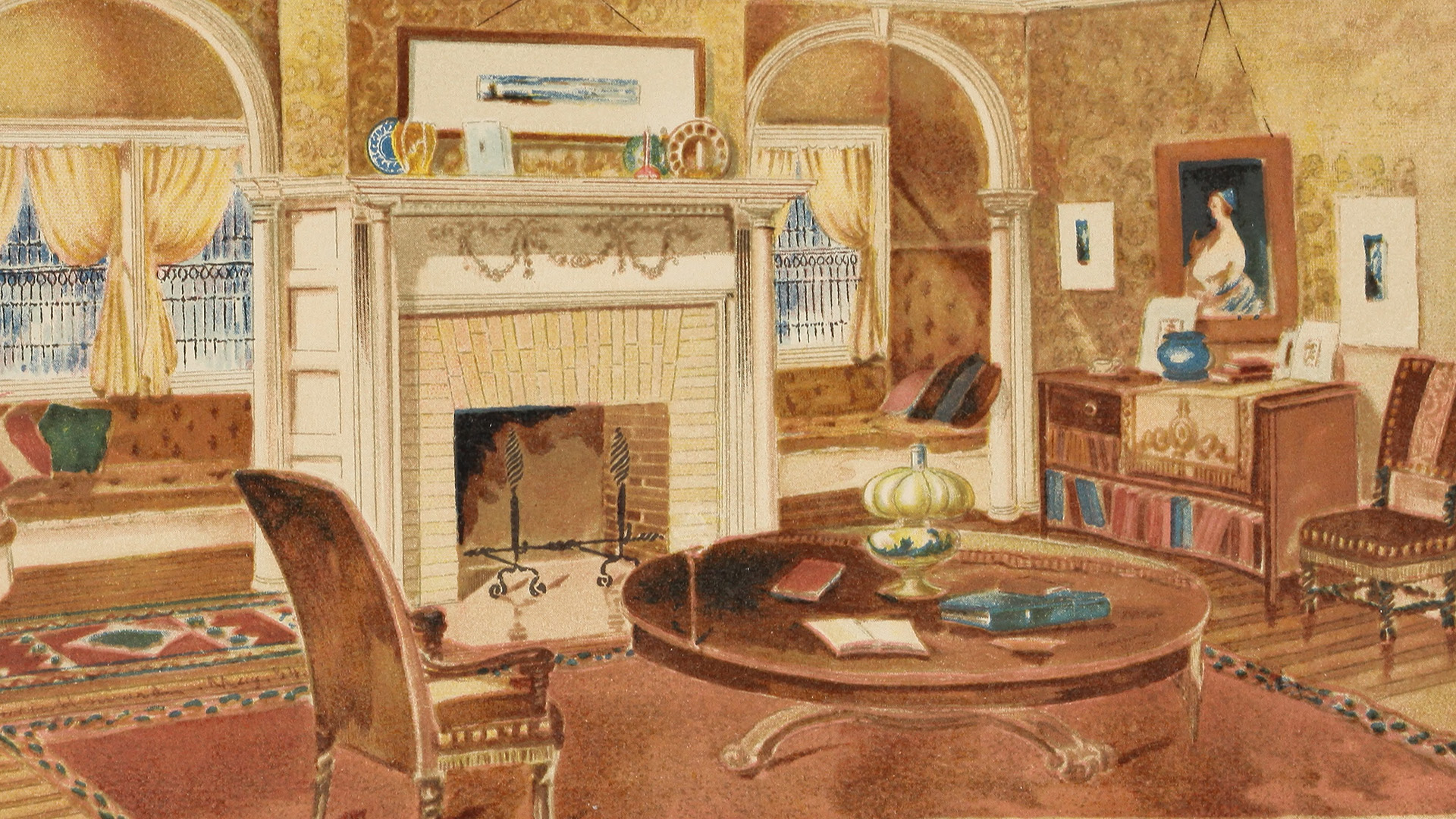 “Living Room”, The woman’s book v. I (1894), detail. Click to enlarge and download.
Library Stacks, Lower Main Hall, Smithsonian Institution Building, or Castle, Smithsonian Institution Archives, Record Unit 95, Image no. SIA_000095_B31_F38_002, detail.
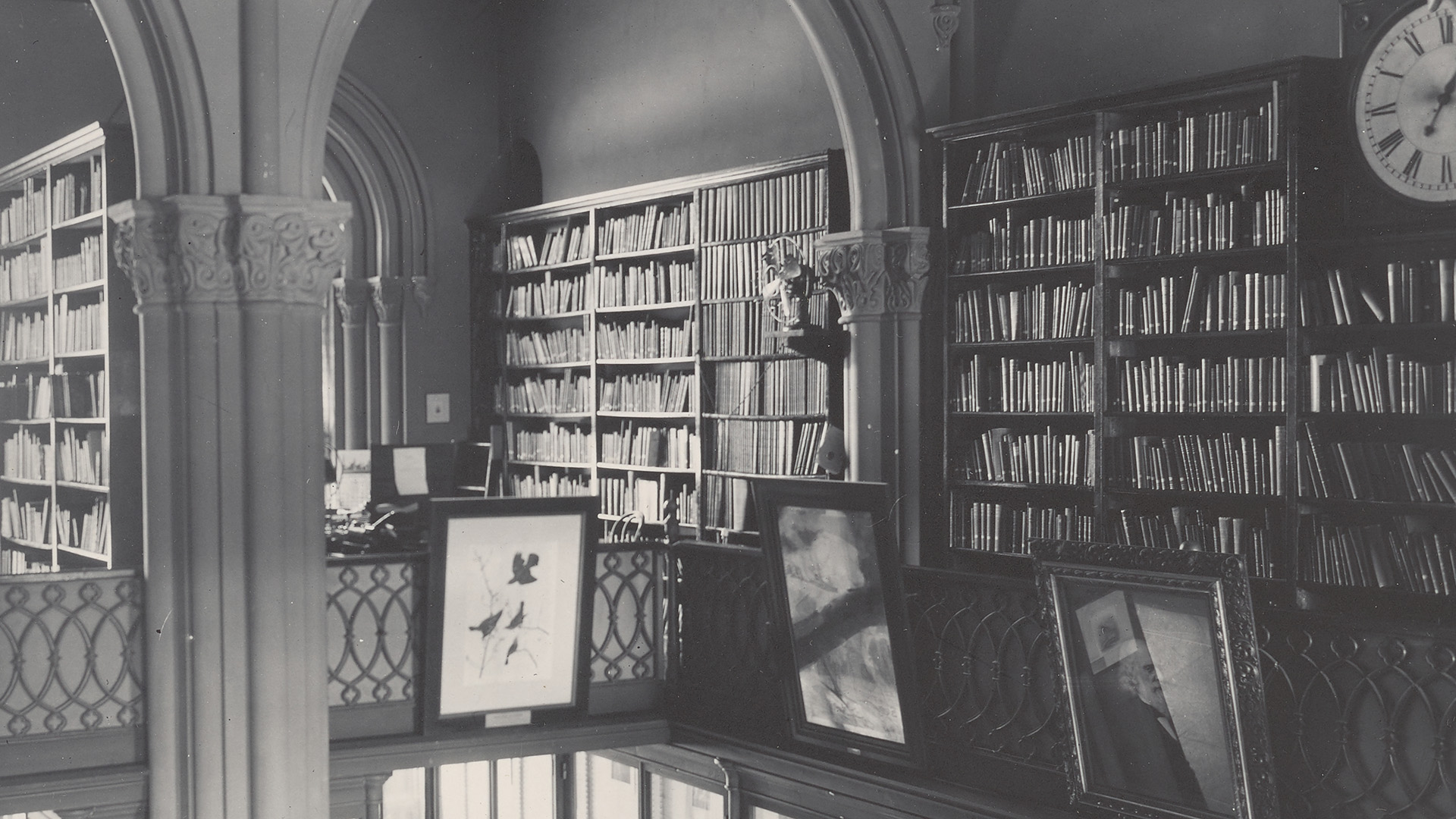 Library Stacks, Lower Main Hall, Smithsonian Institution Building, or Castle, Smithsonian Institution Archives, Record Unit 95, Image no. SIA_000095_B31_F38_002, detail. Click to enlarge and download.
Conference on the Future of the Smithsonian, Smithsonian Library Exhibit, Smithsonian Institution Archives, Record Unit 95, Image no. SIA_000095_B41_F09_035, detail.
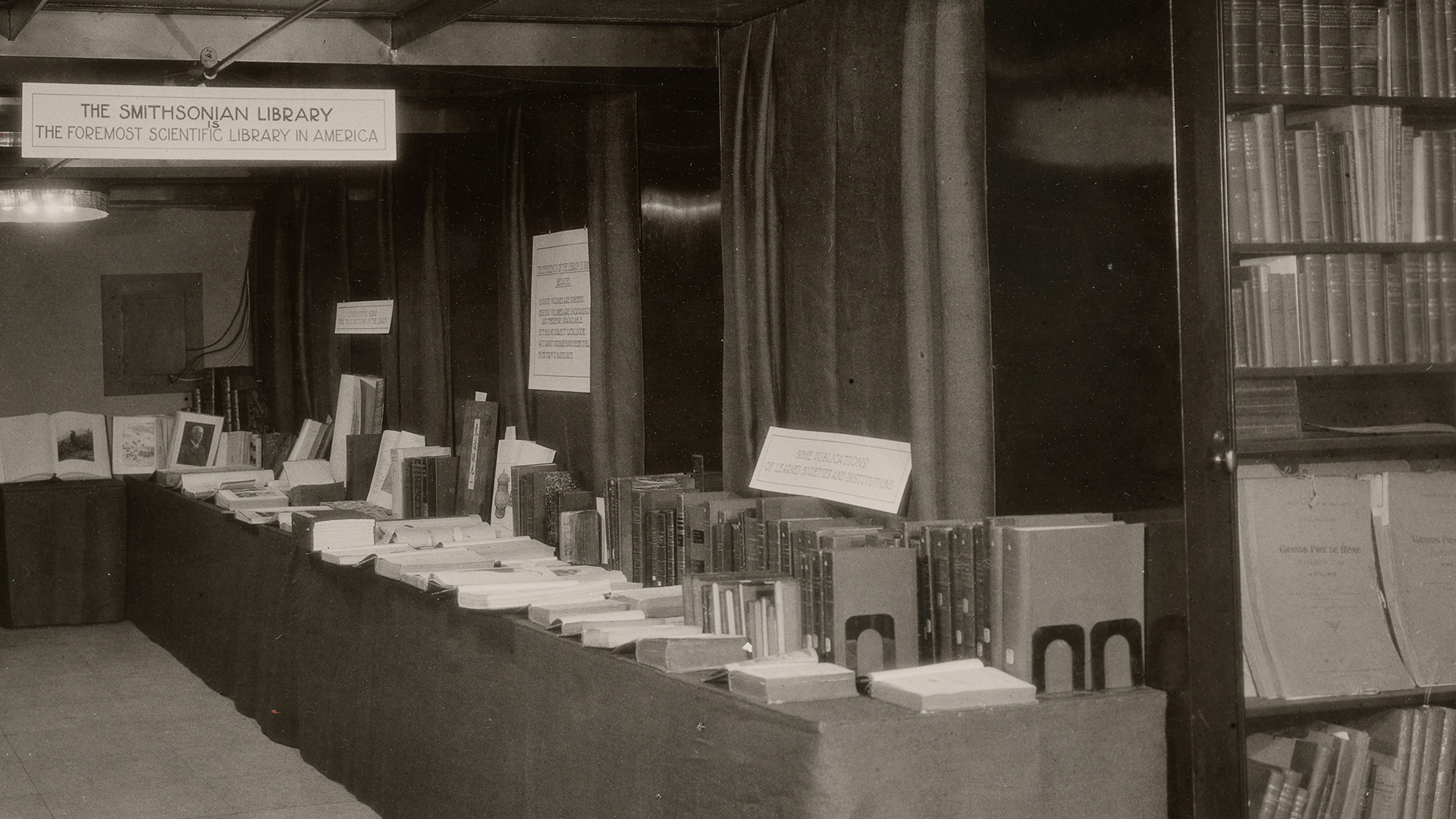 Conference on the Future of the Smithsonian, Smithsonian Library Exhibit, Smithsonian Institution Archives, Record Unit 95, Image no. SIA_000095_B41_F09_035, detail. Click to enlarge and download.
Museum of History and Technology Library, Smithsonian Institution Archives, Record Unit 285, Image no. SIA2010-2160, detail.
 Museum of History and Technology Library, Smithsonian Institution Archives, Record Unit 285, Image no. SIA2010-2160, detail. Click to enlarge and download.
Digital Jigsaw Puzzles – National Library Week Edition
To celebrate National Library Week and the start of spring, we’ve put together another round of digital jigsaw puzzles! We hope these cheerful florals brighten your screens and bring you a few moments of peace, minus the pollen.
Play them right here on our blog or use the links to play full screen. Each puzzle is set at about 100 pieces but they are customizable to any skill set. Click the grid icon in the center to adjust the number of pieces. All of the images are available in our Digital Library, Image Gallery, Biodiversity Heritage Library or Smithsonian Institution Archives Collections. Feel free to explore and make your own!
Miss our previous puzzles? Find them here.
Rear Cover, The Conard and Jones Co. New Floral Guide (1898).
In 1897, Alfred Conard, already an established seedsman, and Antoine Wintzer joined with S. Morris Jones to become Conard & Jones Co. The company focused primarily on the growing and distribution of roses and flowering plants. This brilliantly lithographed rear cover of the firm’s Autumn 1898 catalog highlights “winter flowering bulbs”, many of which are also popular outdoor blooms in spring.
Play online: https://jigex.com/6z14
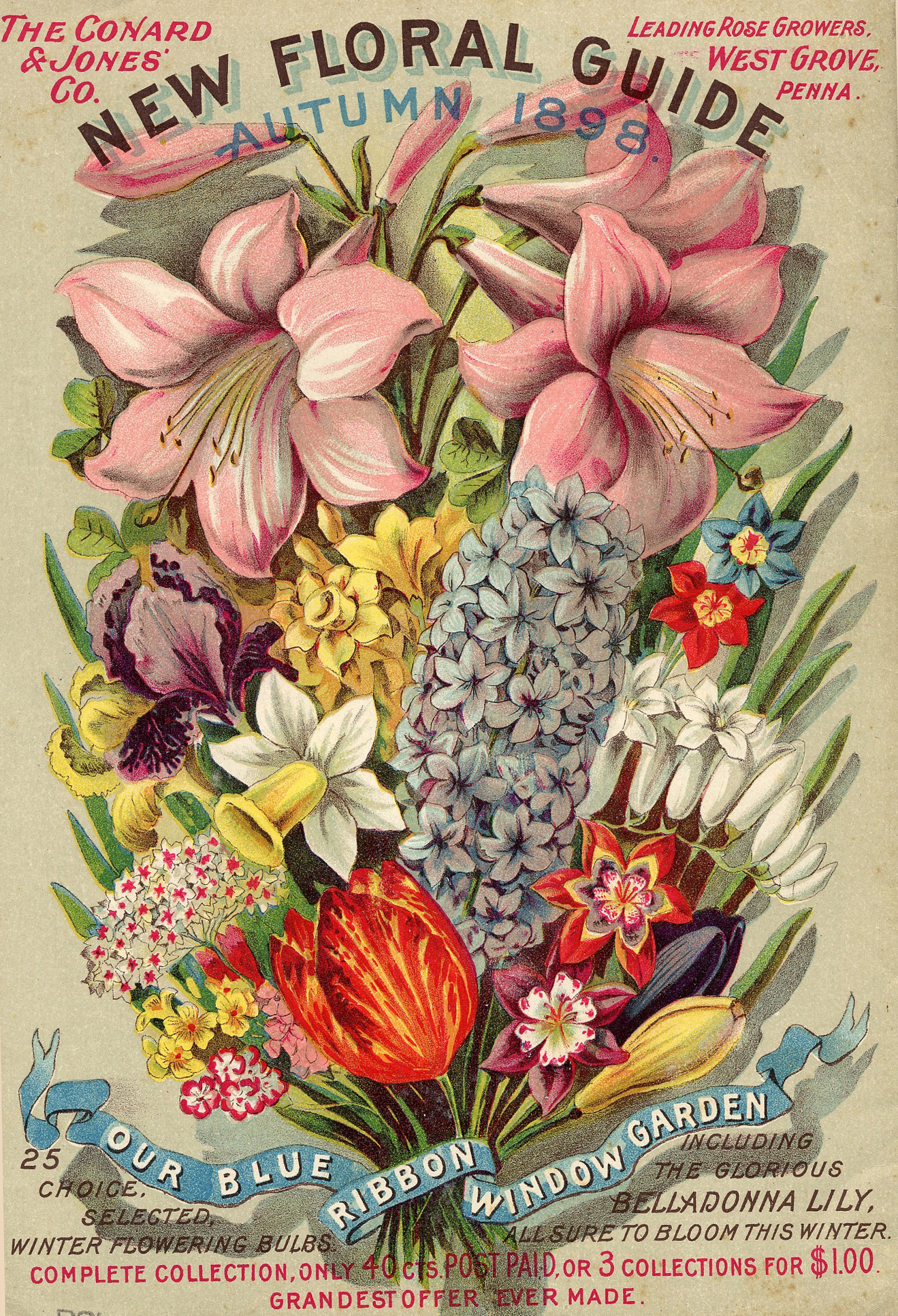 Rear Cover, The Conard and Jones Co. New Floral Guide (1898).
Jigsaw Puzzle
Cerisier Pl 7, Pomologie française : recueil des plus beaux fruits cultivés en France, Volume 2 (1846).
Pomologie française : recueil des plus beaux fruits cultivés en France , published in four volumes in 1846, is a delight for the senses. French botanist Pierre-Antoine Poiteau wrote the text, a study of French fruit plants and their cultivation. The lush illustrations were the work of Poiteau as well as fellow botanist and artist Pierre Jean François Turpin.
Play online: https://jigex.com/5SbS
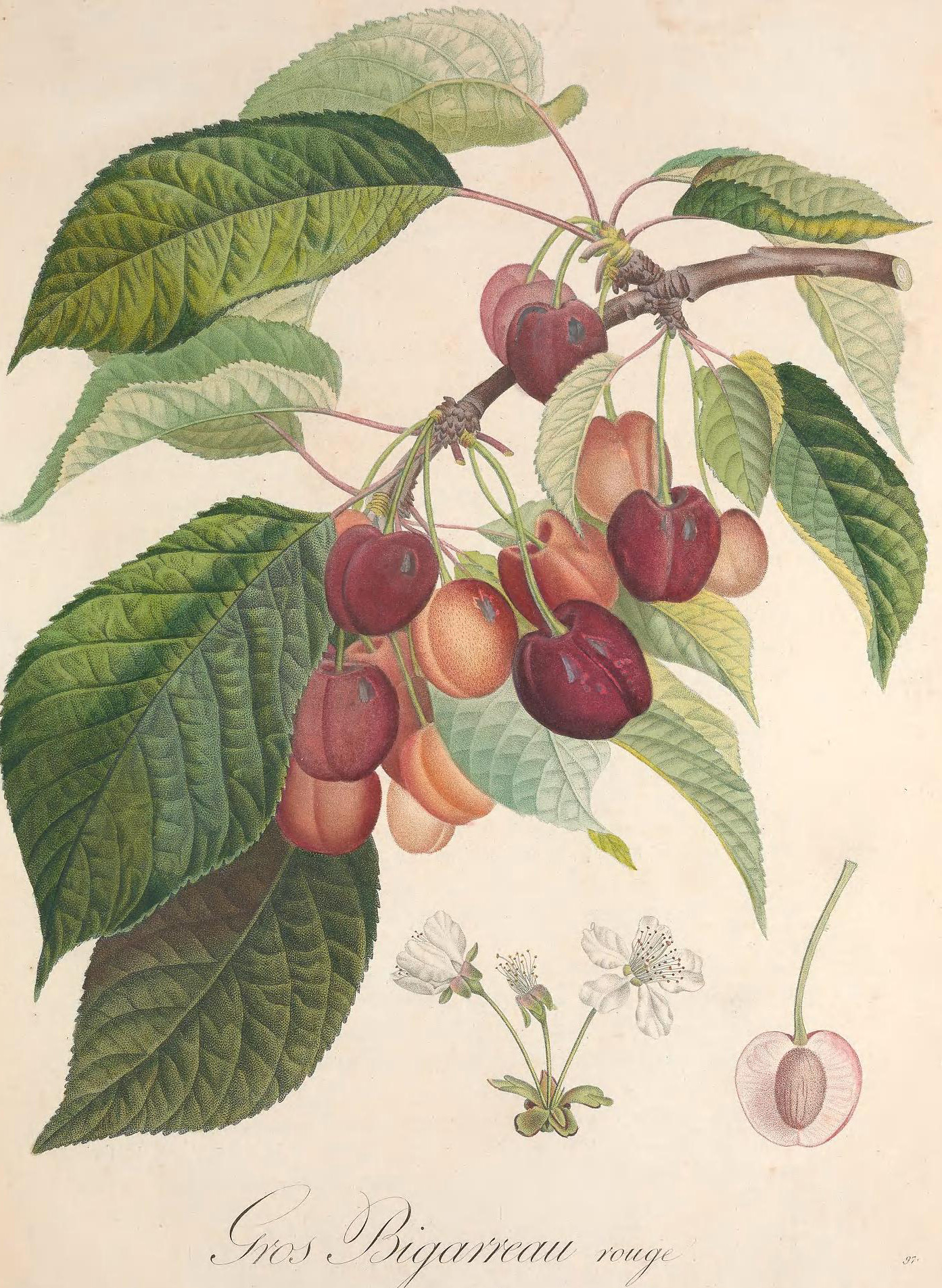 Cerisier Pl 7, Pomologie française : recueil des plus beaux fruits cultivés en France, Volume 2 (1846).
Jigsaw Puzzle
Postcard of the Smithsonian Institution Castle, Smithsonian Institution Archives, Record Unit 95, Image no. SIA2013-07202.
This early 20th century postcard offers a glimpse of the Smithsonian Institution Building, or “Castle”, designed by architect James Renwick, Jr. and completed in 1855. In the foreground is a statue of the first Smithsonian Secretary Joseph Henry, who served as the Institutions’ founding leader from 1846 to 1878. Modern visitors to the National Mall will note that Henry’s statue has since been moved closer to the north entrance of the building.
Play online: https://jigex.com/TRRi
 Postcard of the Smithsonian Institution Castle, Smithsonian Institution Archives, Record Unit 95, Image no. SIA2013-07202.
Jigsaw Puzzle
Women gathering spring herbs, Haru no Fuji [1803].
This book by Katsushika Hokusai was a special New Year’s publication of kyōka poetry (mad verses) collection commissioned by a private kyōka salon. This is one of two color woodblock-printed illustrations that accompany the text, showing three women in delicately colored kimono gathering spring herbs. The seventh day of the Japanese New Year is called nanakusa no sekku or the festival of seven herbs, and traditionally included eating a rice soup or porridge with seven healthy herbs. Learn more about our Japanese illustrated books from the Edo and Meiji periods.
Play online: https://jigex.com/M82d
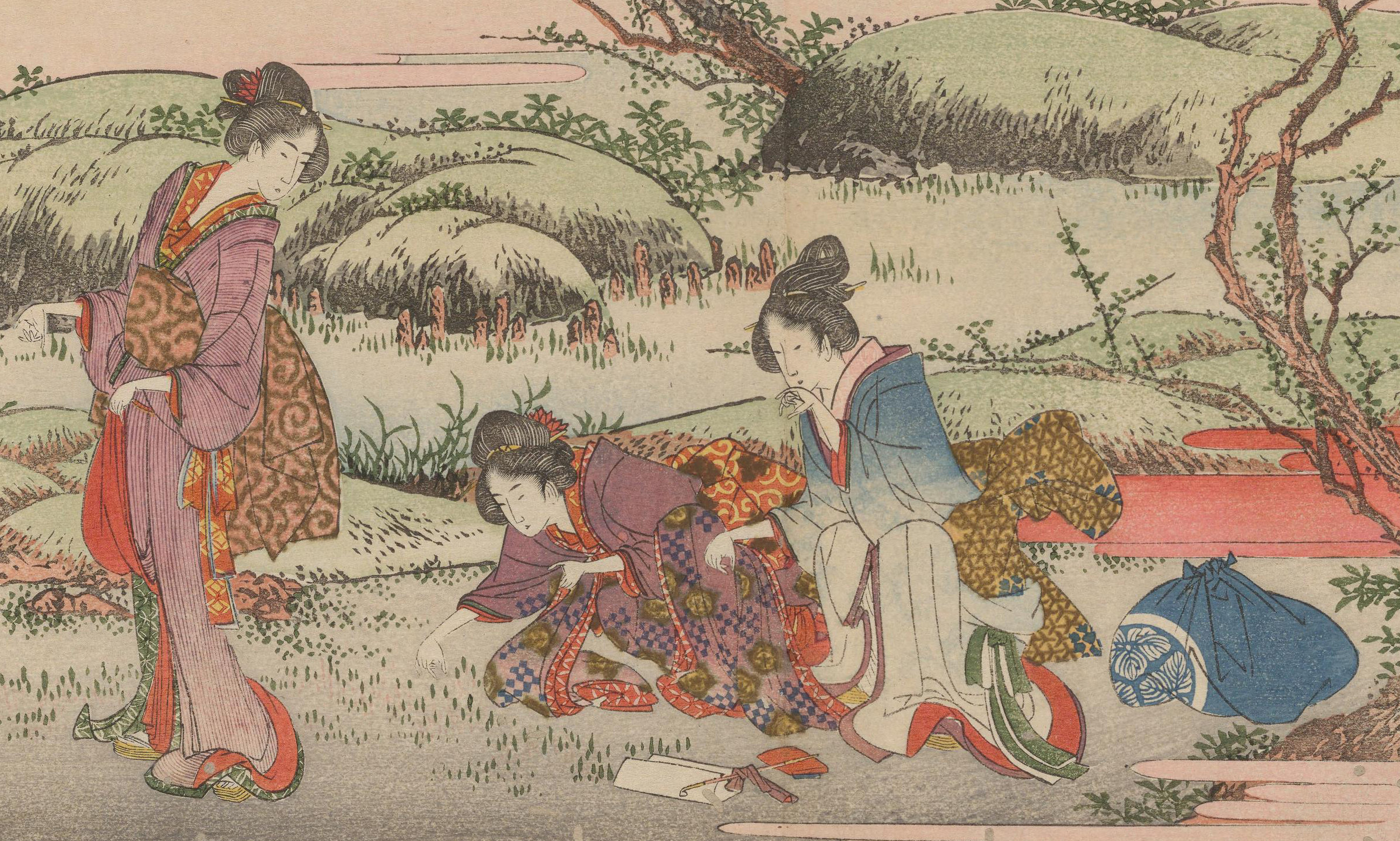 Women gathering spring herbs, Haru no Fuji [1803].Jigsaw Puzzle
Plate VIII, Gazette du bon ton, t. 2 (1913)
Long-time blog readers and social media followers might have noticed that we are big fans of the illustrations in Gazette du Bon Ton. This French art and style journal was published by Lucien Vogel between 1913 and 1925. This plate from August 1913 highlights an afternoon dress by design house Worth. Learn more about Gazette du Bon Ton.
Play online: https://jigex.com/6o8u
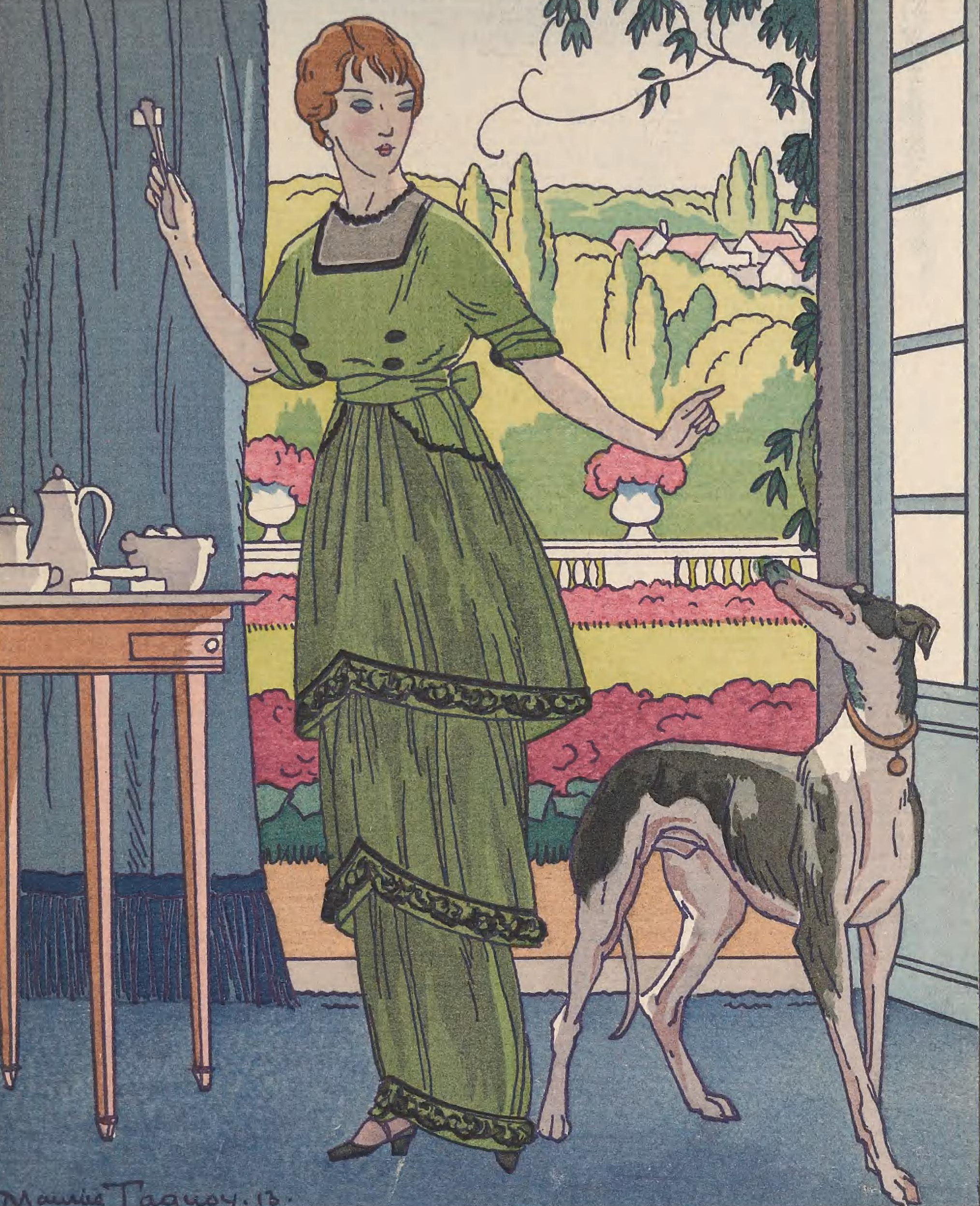 Plate VIII, Gazette du bon ton, t. 2 (1913).
Jigsaw Puzzle
Cover, The Inland Printer, Volume 57 (May 1916).
This fantastical cover image from the May 1916 issue of The Inland Printer is courtesy of illustrator Gordon Ertz. The periodical, a trade journal for the printing industry, is said to be the first to feature different cover art with each issue. The interiors of the issues were just as interesting, as the publication highlighted new advances in graphics, printing and paper making.
Play online: https://jigex.com/rcFQ
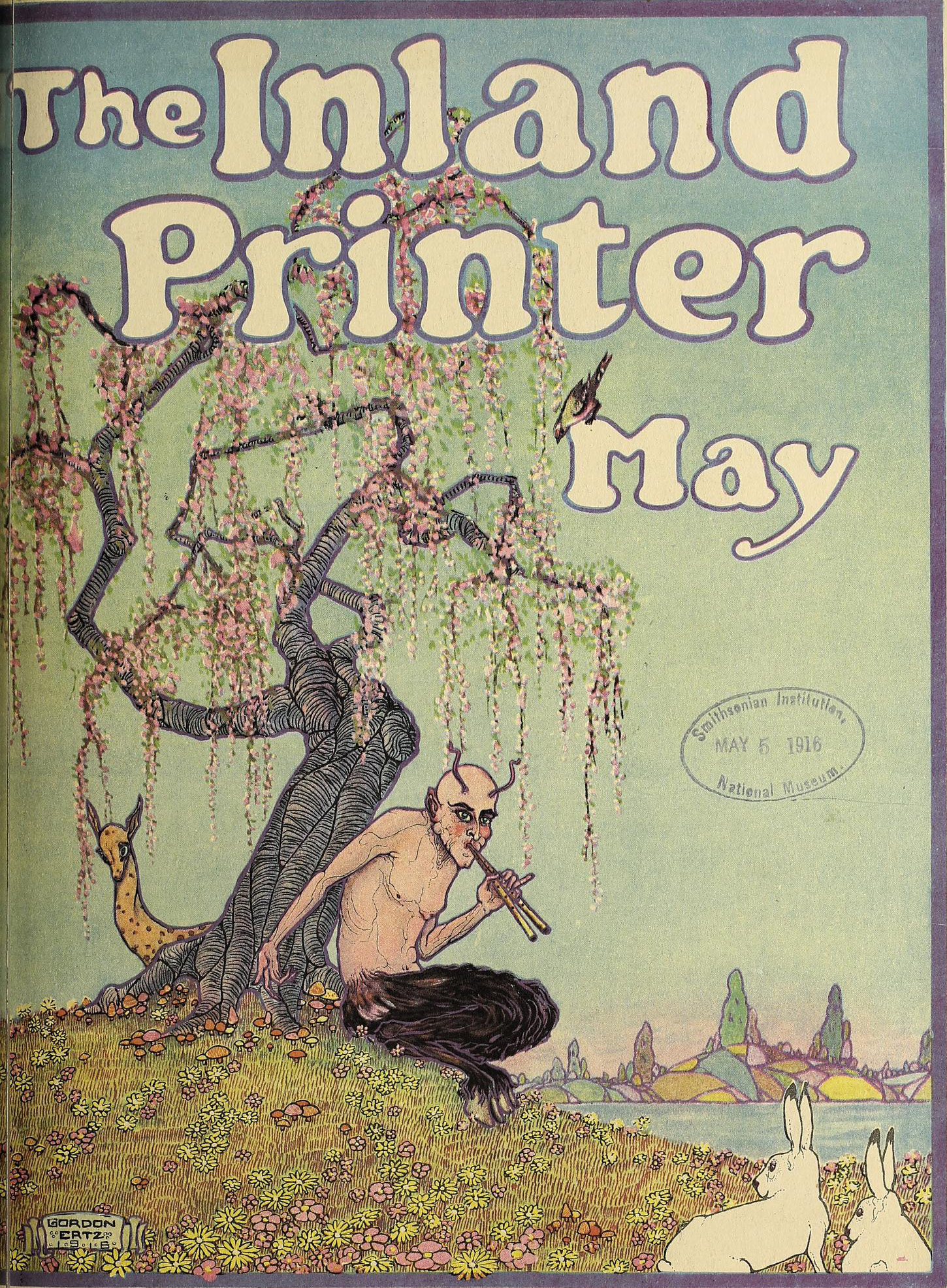 Cover, The Inland Printer, Volume 57 (May 1916).
Jigsaw Puzzle
Plate IV, Papillons (ca. 1925).
Emile-Allain Séguy was a popular French designer throughout the Art Deco and Art Nouveau movements of the 1920s. He designed primarily patterns and textiles and was heavily influenced by the natural world. Papillons is a book of designs based on wing patterns in butterflies commissioned by American textile manufacturer F. Schumacher and Co. Learn more about Séguy on the Biodiversity Heritage Library blog.
Play online: https://jigex.com/1oq6
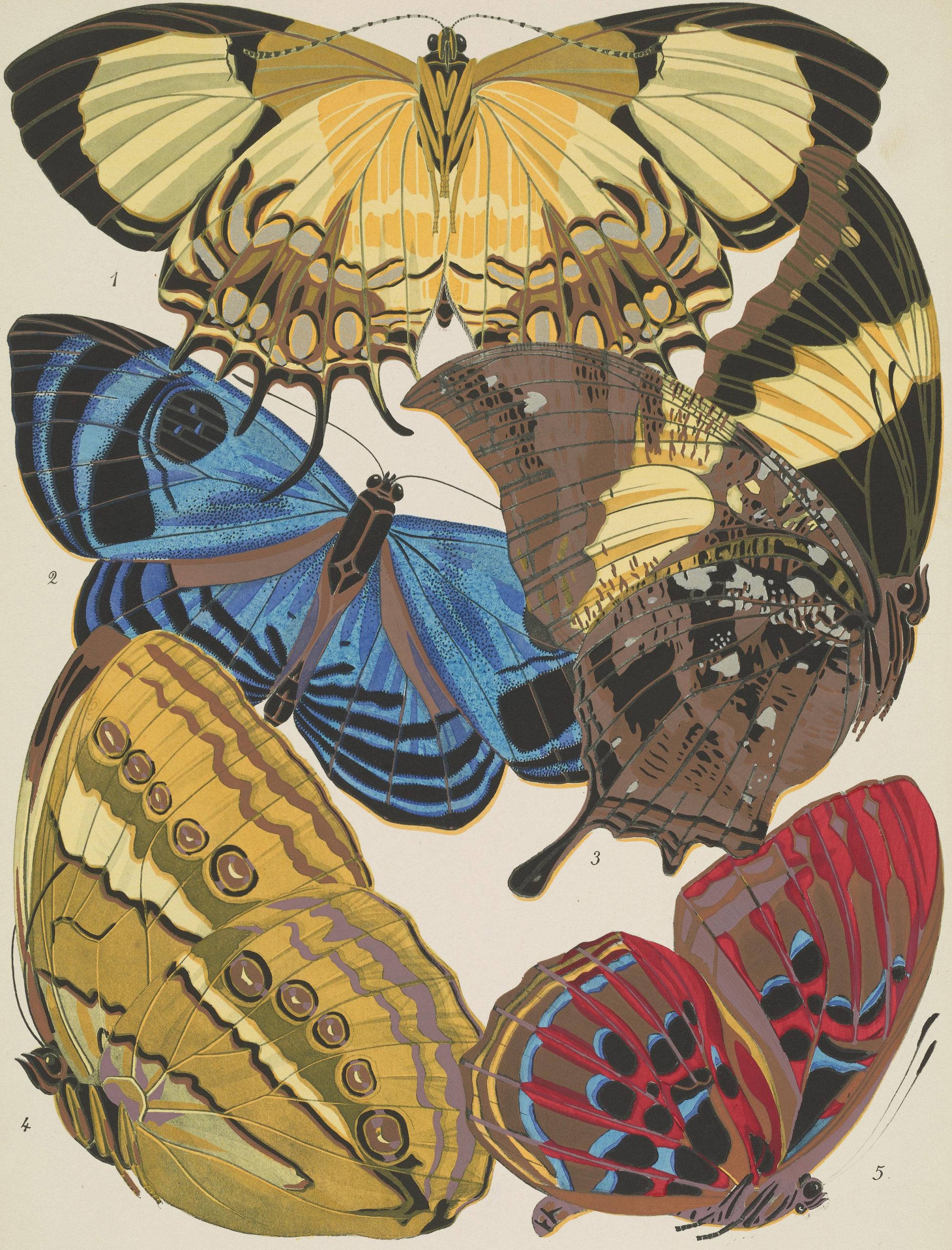 Plate IV, Papillons (ca. 1925).
Jigsaw Puzzle
Celebrating National Library Workers Day
This week (April 4-10, 2021) is National Library Week and Tuesday is set aside to celebrate National Library Workers Day. It’s a wonderful opportunity to highlight the important contributions made by all library staff. In honor of National Library Workers Day, we caught up with a few staff members to hear what they’ve been working on over the past year. Although they’ve been largely offsite during the ongoing pandemic, our staff remain dedicated to providing information to researchers at the Smithsonian and around the world. Learn more about how they’re sharing their expertise, caring for collections, and connecting data in a totally virtual environment.
Sharad J. Shah
Collections Management Librarian
“With over twenty branches in the Smithsonian Libraries and Archives system, numerous challenges involving collections and collections space are bound to arise. Even while the museums and research centers are closed to the public, Smithsonian staff continue to work behind the scenes to ensure the Smithsonian’s treasured collections are safe and secure. Currently, I am working with other units overseeing the management of collections across the Smithsonian’s museums and research and storage facilities. These projects range from transferring library material between branches, to upgrading library storage units, to planning a future home of Smithsonian Libraries and Archives materials (see: Suitland Collections Center Executive Summary). Our goal is to iron out plans, for both diving into and successfully completing, collections and collections space-related projects once we return to normal operations.”
 A rendering of the proposed Master Plan in 40 years, prepared by Bjarke Ingels Group
Nilda Lopez,
Library Technician, Cooper Hewitt Smithsonian Design Library
“Several locations in the Smithsonian Libraries and Archives house special collections called the Art and Artist Files. They are a valuable resource for art historical research on emerging regional and local artists. They hold information on artists, art collectives, and galleries and contain ephemera from flyers, clippings, press releases, brochures, invitations and so much more. As we continue to grow the Art and Artist Files, our intent is to make the information they contain more digitally accessible to the public, and one of these ways is our effort to make our collections discoverable in Wikidata. You might be familiar with Wikipedia, and Wikidata is related—it is a free and open database software that allows anyone to contribute with structural data. Smithsonian Libraries and Archives has several pilot projects with Wikidata, and the Art and Artist project is quickly reconciling data into the larger structure of Wikimedia. This process involves using Open Refine, a tool that “cleans” data, to link Wikidata to details from our files such as artists’ names and life dates. And most importantly, with more than 60,000 names in our files, it involves lots of time! It is our hope that this project will increase the diffusion of knowledge, linking our data in as many places as possible. Other “GLAM” institutions—galleries, libraries, archives and museums–are collaborating on this project and we hope to grow and create a web of data for the future.”
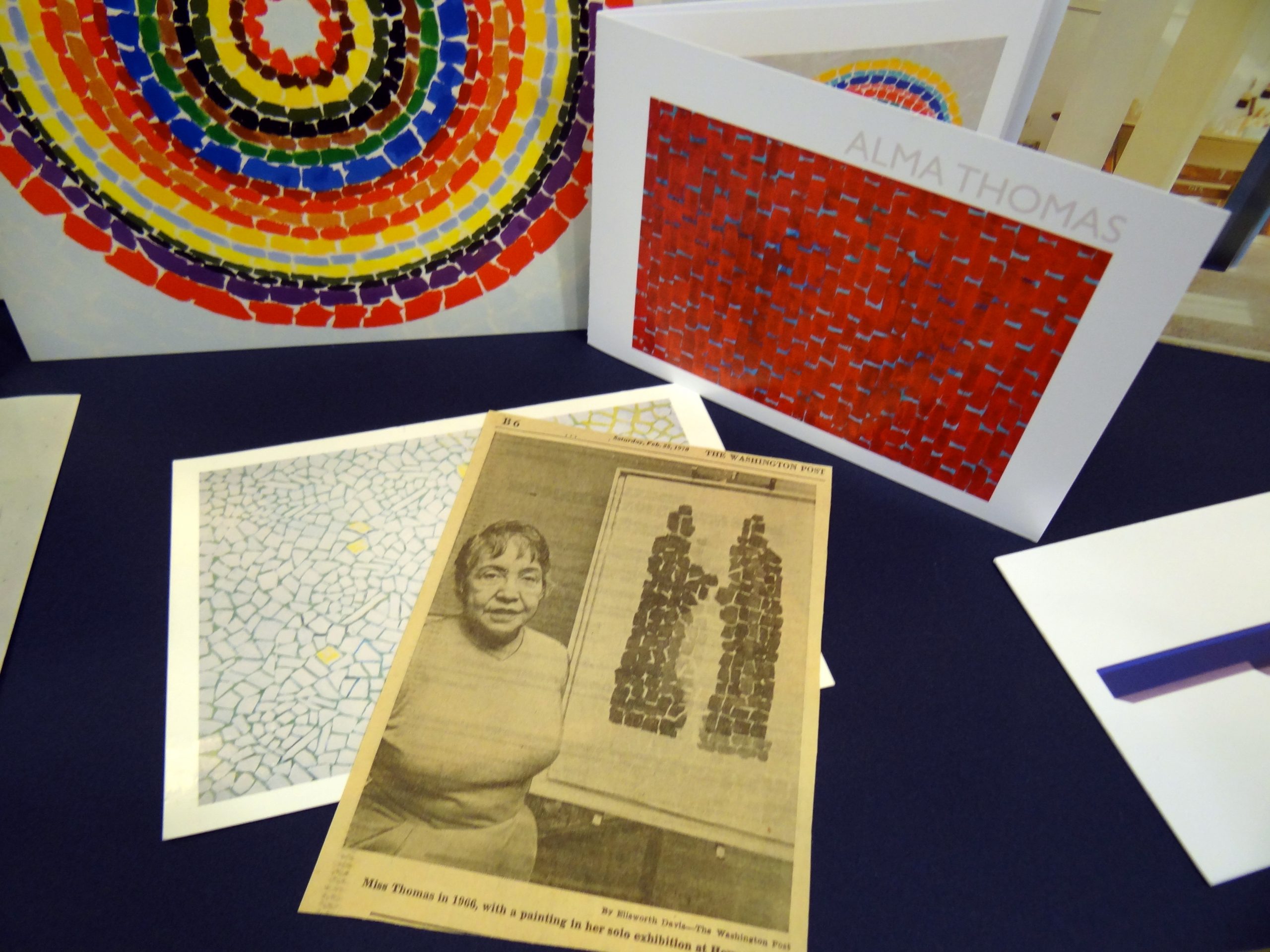 Selection of Art and Artist File material from the file of Alma Thomas.
Preservation Services Department
During a normal work week, you can often find our Preservation Services staff at the bench in our Book Conservation Lab repairing materials. Without access to our physical collections, this team has turned digital to advocate for collections care and help explain their work. They’ve presented webinars, answered questions on Instagram and Twitter and, most recently, developed a video series to describe the conservation treatments made possible through our Adopt-a-Book program, “Adopt-a-Book: Preserving Treasures Together”. Many thanks to Keala Richard, Vanessa Smith, Donald Stankavage, Daniel Viltsek and Katie Wagner for sharing their work and participating in our outreach efforts during the pandemic.
Stephen H. Cox
Branch Librarian, National Zoological Park and Smithsonian Conservation Biology Institute
“Over the past year, I have created and continue to curate and maintain four citation databases on behalf of SI’s COVID-19 task forces: Scholarly Literature, Non-Scholarly Sources, Risk Assessment, and RNA Sequencing. Well over 100,000 scholarly papers, book chapters, books, theses, and reports have been written in the span of 15 months, with thousands more being published every day. Within Scholarly Literature, I have focused research on air monitoring, breather/exhalation valves, face coverings, contact tracing, safety training, surface wipe sampling, and temporal patterns in viral load. Despite the evolving science on the novel coronavirus and its variants, two constants have emerged: the dedication of the Smithsonian’s COVID-19 task force members to the safety of our colleagues and visitors, and the incredible diversity of knowledge that can be created when the world’s scientists have a shared goal.”
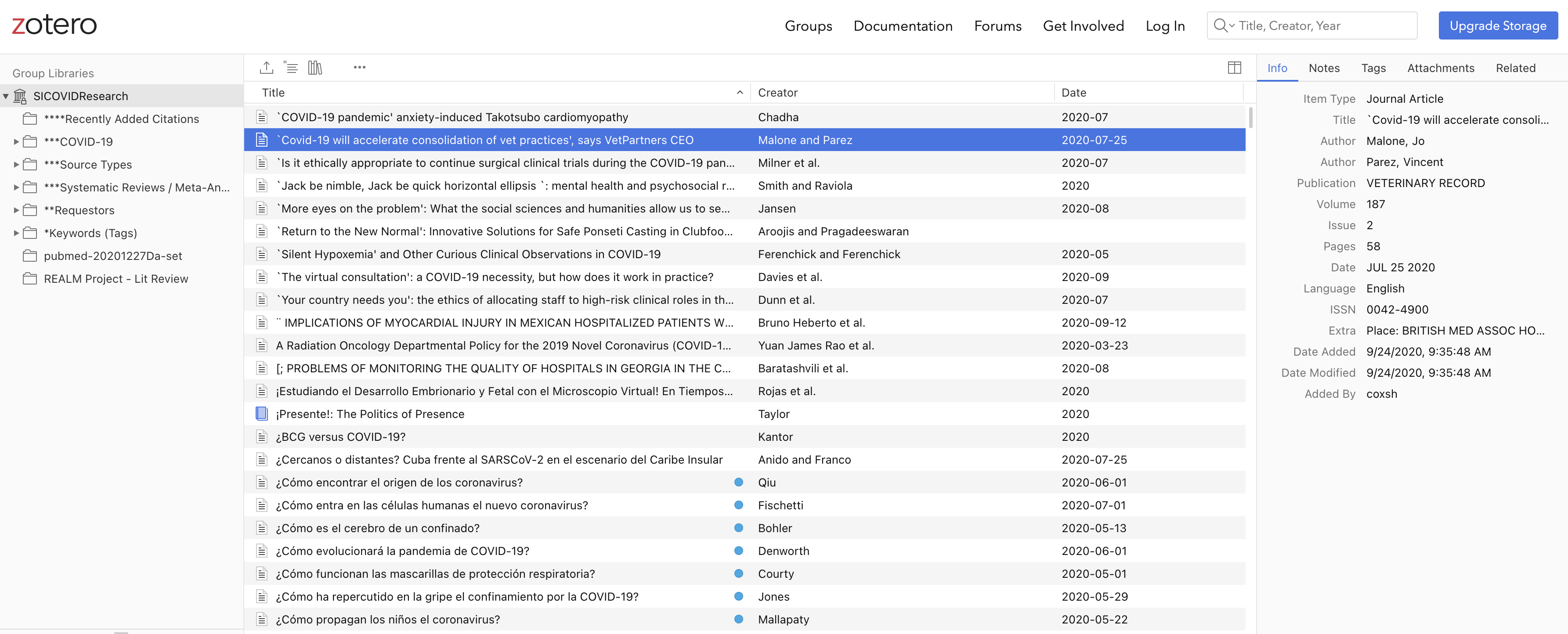 Screenshot of COVID-19 Citation Database in Zotero.
Baasil Wilder
Librarian, Anacostia Community Museum Library and National Postal Museum Library
“A team of Smithsonian Libraries and Archives staff has made great progress improving page-level and image-level metadata for digitized books by re-paginating the materials and uploading images to the Biodiversity Heritage Library’s Flickr photostream while working from home (more details in this previous blog post by Alexia MacClain). The work that I do as a member of this team, is a huge leap from what I focused on as a reference librarian before the pandemic . Though different from my usual tasks, this work is all about providing access to information, which is my goal as a librarian. Doing this work has given me a much greater appreciation of what’s happening behind-the-scenes in our Digital Library and the Biodiversity Heritage Library. I want to highlight one of my completed Flickr albums, from a book entitled Mendelism (1911). Mendelism is about the principles of genetics, such as single-gene traits, and is named after Gregor Johann Mendel (1822-1884). Mendel was born in (today’s) Czech Republic and was a meteorologist, mathematician, biologist, Augustinian friar, and the abbot of St. Thomas’ Abbey. He established the laws that are the foundation of the modern science of genetics. Below are some images from the book that I uploaded to Flickr. I rotated them and tagged them with keywords and taxonomic name tags so that users from all over the world can more easily discover and use the free images in their research.”
 Portrait of Gregor Mendel and Plate VI, Mendelism (1911).
Graceanna Lewis: A naturalist and abolitionist
“To her mind the truths of science seem revealed.”
That’s how Phebe A. Hanaford, author of Daughters of America (c. 1882), described naturalist Graceanna Lewis, one of the first three woman to be accepted into the Academy of Natural Sciences. But Lewis was not only one of the first professionally acknowledged women naturalists; she was also an abolitionist and social reformer who worked for the advancement of science as well as human rights. Researchers can find many publications by and about this intriguing woman in the Smithsonian Libraries and Archives’ Digital Library and the Biodiversity Heritage Library.
Born in 1821, Lewis benefitted from an egalitarian Quaker upbringing, one that encouraged education in daughters as well as sons. Lewis told Hanaford that she learned to love natural history from her mother, Esther Lewis. Esther had been a teacher before marriage and continued to educate her own young children, sending her daughters to nearby Kimberton Boarding School as they grew. There, Graceanna was influenced by Abigail Kimber, a woman botanist who had discovered and identified several species. In 1842, Lewis’ uncle, Dr. Bartholomew Fussell, started a new boarding school for girls, and Lewis came on board as a teacher. She taught astronomy and botany, among other subjects.
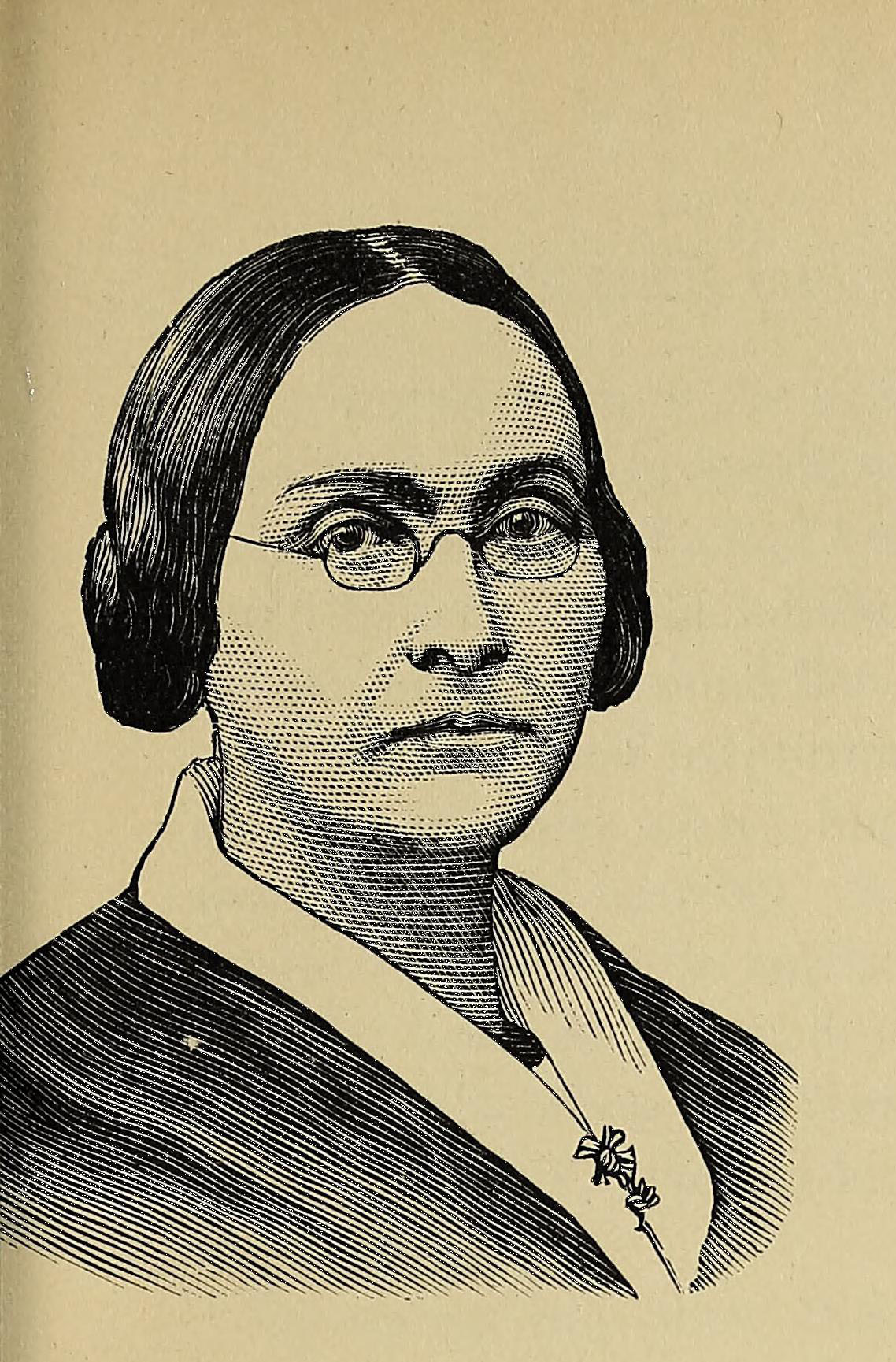 Portrait of Graceanna Lewis, The Underground Rail Road (1872)
From her family, Graceanna Lewis inherited not only an interest in science and education but also a deep concern for social issues. Uncle Bartholomew was an active abolitionist, and the family formed a local auxiliary of the American Anti-Slavery Society. The Lewis sisters, Graceanna, Mariann and Elizabeth, were profiled in William Still’s The Underground Rail Road (1872), which described them as “among the most faithful, devoted, and quietly efficient workers in the Anti-slavery cause”.
One of Graceanna’s earliest publications, written in the 1840s, was “An Appeal to Those Members of the Society of Friends Who Knowing the Principles of the Abolitionists Stand Aloof from the Anti-Slavery Enterprise”. It implored fellow Quakers to join the Anti-Slavery movement. The Lewis farm in Pennsylvania became a frequent and successful point on the Underground Railroad, described in detail by Still. The family helped transport those seeking freedom and provided clothes and supplies.
Eventually, Lewis moved away from the family farm to Philadelphia. She had studied birds and other natural sciences on her own, but this move allowed her to take advantage of the specimen and library collections at the nearby Academy of Natural Sciences, and it propelled her into a network of naturalists. In 1862, she met John Cassin, ornithologist and curator of birds at the Academy. Cassin had written, with George N. Lawrence and the Smithsonian’s own Spencer Baird, The Birds of North America (1860), a work Lewis found particularly inspiring.
Cassin would be an invaluable friend and mentor to Lewis, even naming a bird for her, Icterus graceannae, the White-edged oriole. Lewis also corresponded frequently with Baird for years, seeking advice and asking for copies of Smithsonian publications. In 1870, the year after Cassin’s death, Lewis became one of the first three women admitted as members to the Academy.
 Icterus graceannae, or White-edged Oriole, Ibis. Series 5, Volume 1. No. 1-4. Plate XI.
Lewis had channeled her interested in ornithology into her first scientific publication, Natural History of Birds : lectures on ornithology, in ten parts (1868). It was intended as an inexpensive overview of American birds for a general audience. In it, she also proposed a new classification scheme based on embryology, the characteristics of eggs. Unfortunately, only the first part was published, as funding for the remaining nine was never secured. She continued to research and publish on birds, alongside the leading naturalists of her time. Her articles in The American Naturalist, “The Lyre Bird” (August 1870) and “Symmetrical Figures in Birds’ Feathers” (November 1871) are available in the Biodiversity Heritage Library.
Lewis’ interests and publications grew beyond ornithology, into the classification of natural history and a “tree of life”, which she exhibited at the Centennial Exhibition in 1876. The Development of the Animal Kingdom (1877), available in the Biodiversity Heritage Library, is a twenty-page overview of her theories. It was prepared for the fourth meeting of the Association for the Advancement of Women. The group was formed in 1868 with the goal of presenting practical methods for improving women’s role in society, including education on a variety of subjects. Unsurprisingly, Lewis was active on the group’s Committee on Science.
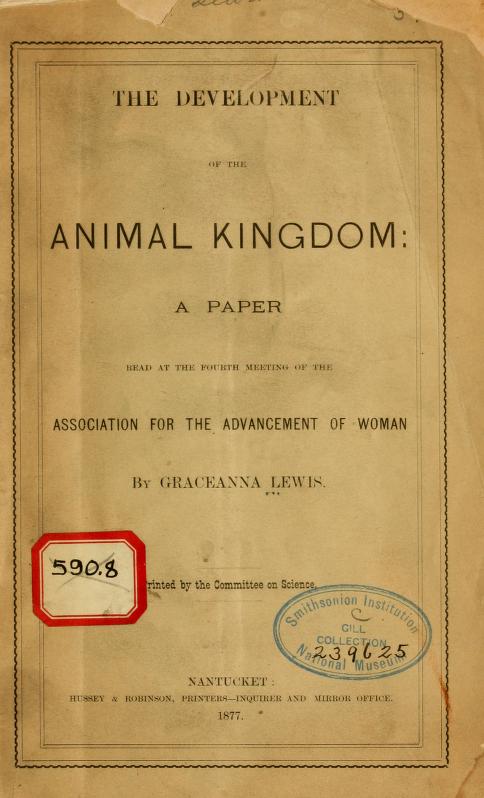 Cover, The Development of the Animal Kingdom (1877).
Lewis told Phebe A. Hanaford in 1882, “I feel that my life’s work is before me, in lecturing on zoology to girls just blooming into womanhood”. For the next twenty years, Lewis continued to teach and write about various natural history topics. Her article “On the Genus Hyliota”, discussing the distinction of two rare African birds, was published in The Annals and magazine of natural history in 1883. Her social reform interests turned to temperance and suffrage, serving stints as secretary for her local chapter of the Women’s Christian Temperance Union and suffrage association.
Graceanna Lewis died in 1912 in Media, Pennsylvania at the age of 90. Her contributions to both science and social progress leave a remarkable and inspiring legacy.
Further Reading from Smithsonian Libraries and Archives:
Baird, Spencer Fullerton, John Cassin and George N. Lawrence. The Birds of North America (1860).
Baird, Spencer Fullerton. Spencer Fullerton Baird Papers. Record Unit 7002. Smithsonian Institution Archives.
Hanaford, Phebe A. Daughters of America (1883).
Lewis, Graceanna. The Development of the Animal Kingdom (1877).
Lewis, Graceanna. “On the genus Hyliota”. The Annals and magazine of natural history, Series 5, Volume 12, No. 67, pp. 210-212.
Still, William. The Underground rail road (1872).
Warner, Deborah Jean. Graceanna Lewis, scientist and humanitarian (1979).
Other resources:
Bonta, Marcia. “Graceanna Lewis, Portrait of a Quaker Naturalist”. Quaker History, Volume 74, Number 1, Spring 1985, pp. 27-40.
Lewis-Fussell Family Papers, SFHL-RG5-087, Friends Historical Library of Swarthmore College
Lewis, Graceanna. “An appeal to those members of the Society of Friends who knowing the principles of the abolitionists stand aloof from the anti-slavery enterprise”. [between 1840 and 1849?].
Lewis, Graceanna. “The Lyre Bird” The American Naturalist (August 1870), pp 321.
Lewis, Graceanna. “Symmetrical Figures in Birds’ Feathers” . The American Naturalist (November 1871), pp. 675-678.
Truitt, James. “Digitizing the Papers of Graceanna Lewis, Ornithologist and Activist”. Cassinia. No. 77 (2017-2018), pp. 40-41.
Leisure Activities from the Past: Clues from the Trade Literature Collection
As winter winds down and spring approaches, outdoor activities start to look more appealing. How did people a 100 years ago spend their free time outside? The National Museum of American History Library’s Trade Literature Collection offers a few clues to some very recognizable pastimes.
Let’s take a look at two trade catalogs from the early 20th Century. One is from 1907 and the other is from 1915. The first trade catalog is titled Catalogue No. 101 (1907) by Herr, Thomas & Co. As highlighted in previous posts, this particular catalog advertises a variety of products such as furniture and writing supplies as well as toys, musical instruments, and jewelry. But there is so much more. It also includes a few pages focused on recreation and outdoor activities appropriate for all four seasons.
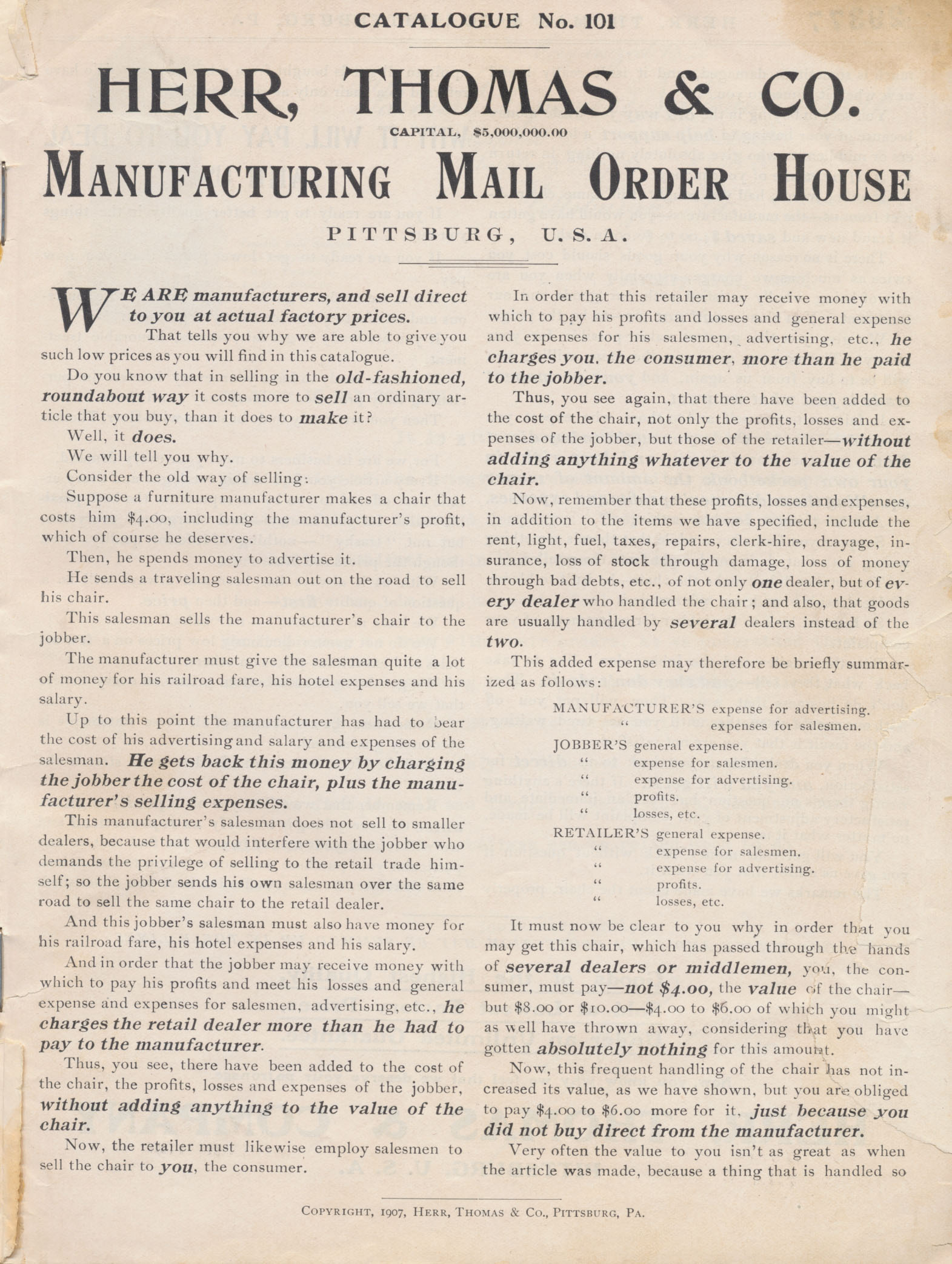 Herr, Thomas & Co., Pittsburg, PA. Catalogue No. 101 (1907), front cover [page 1], explanation of benefits of buying direct from the company.A winter activity some enjoy today is sledding. Judging from the fact that Catalogue No. 101 (1907) advertises sleds, children in the early 20th Century probably also enjoyed that activity. From this catalog, we gain a glimpse into the types of sleds they might have used. A page from the toy section, shown below, illustrates three sleds.
One sled was called the Flexible Flyer. It featured the ability to steer without decreasing speed. This was accomplished by applying just a slight pressure on the cross bar. Another sled, the Clipper Sled, was made of hardwood with steel runners. It included four hand grips to hold onto while coasting down hills. Two hand grips were positioned on each side of the runners. The seat of the sled was decorated with a design incorporating a ship. The third sled, simply labeled a “Sled” in the catalog, featured full-length hand rails on each side. It also conveniently came with a foot rest. The foot rest was positioned between the curved front pieces. Iron swan heads adorned the top of the curved front pieces which also held the guiding rope. According to this catalog, the seat of the sled was decorated in five colors but does not mention specific colors.
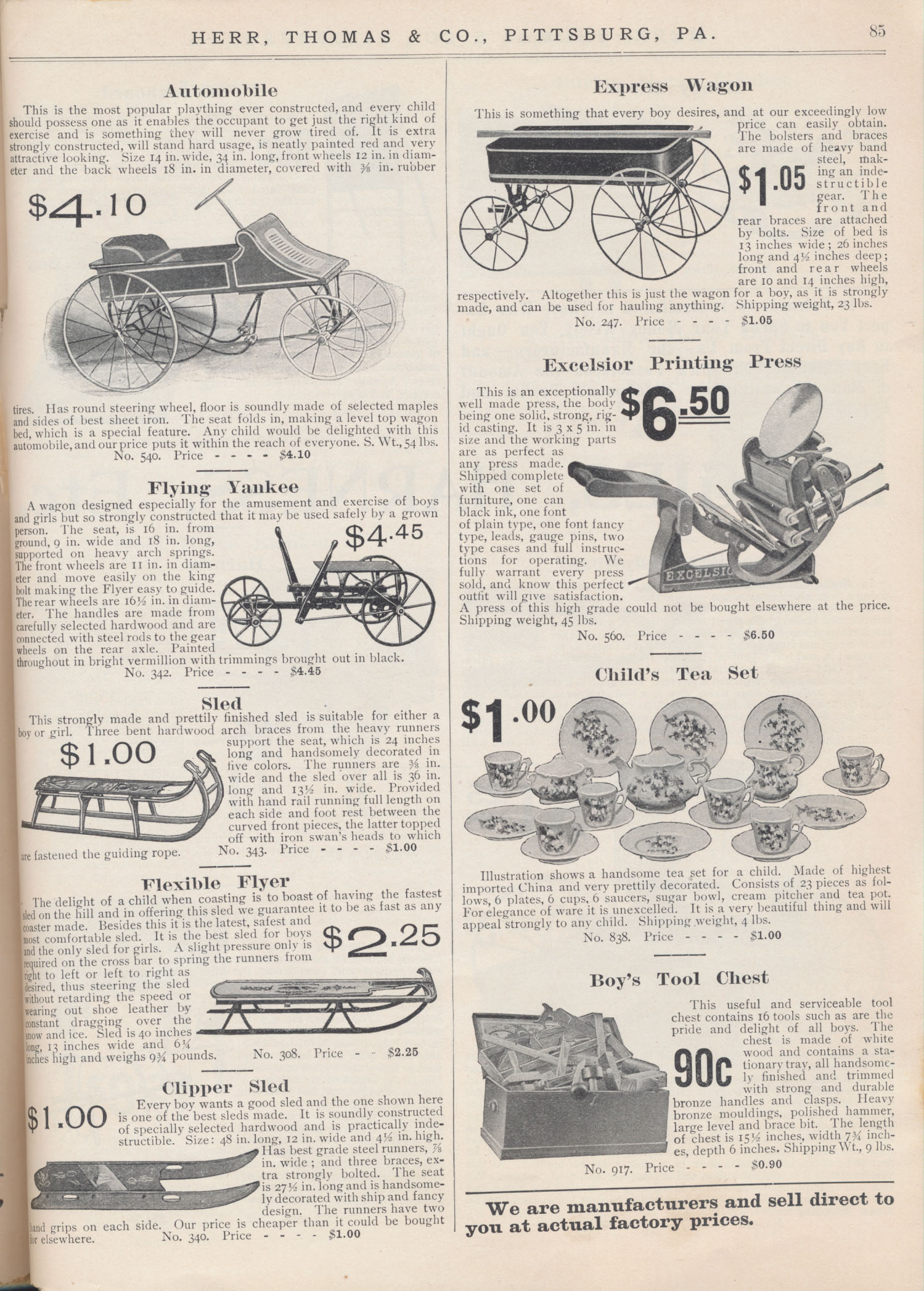 Herr, Thomas & Co., Pittsburg, PA. Catalogue No. 101 (1907), page 85, Automobile, Wagons, Sleds, Printing Press, Child’s Tea Set, and Boy’s Tool Chest.
After an afternoon spent outdoors sledding, cocoa might have been a pleasant surprise. Herr, Thomas & Co. also sold food and grocery products. This included cocoa and “sweet eating chocolate.” Bitter chocolate for cooking purposes, tea, coffee, pickles, and preserves are also described in this catalog.
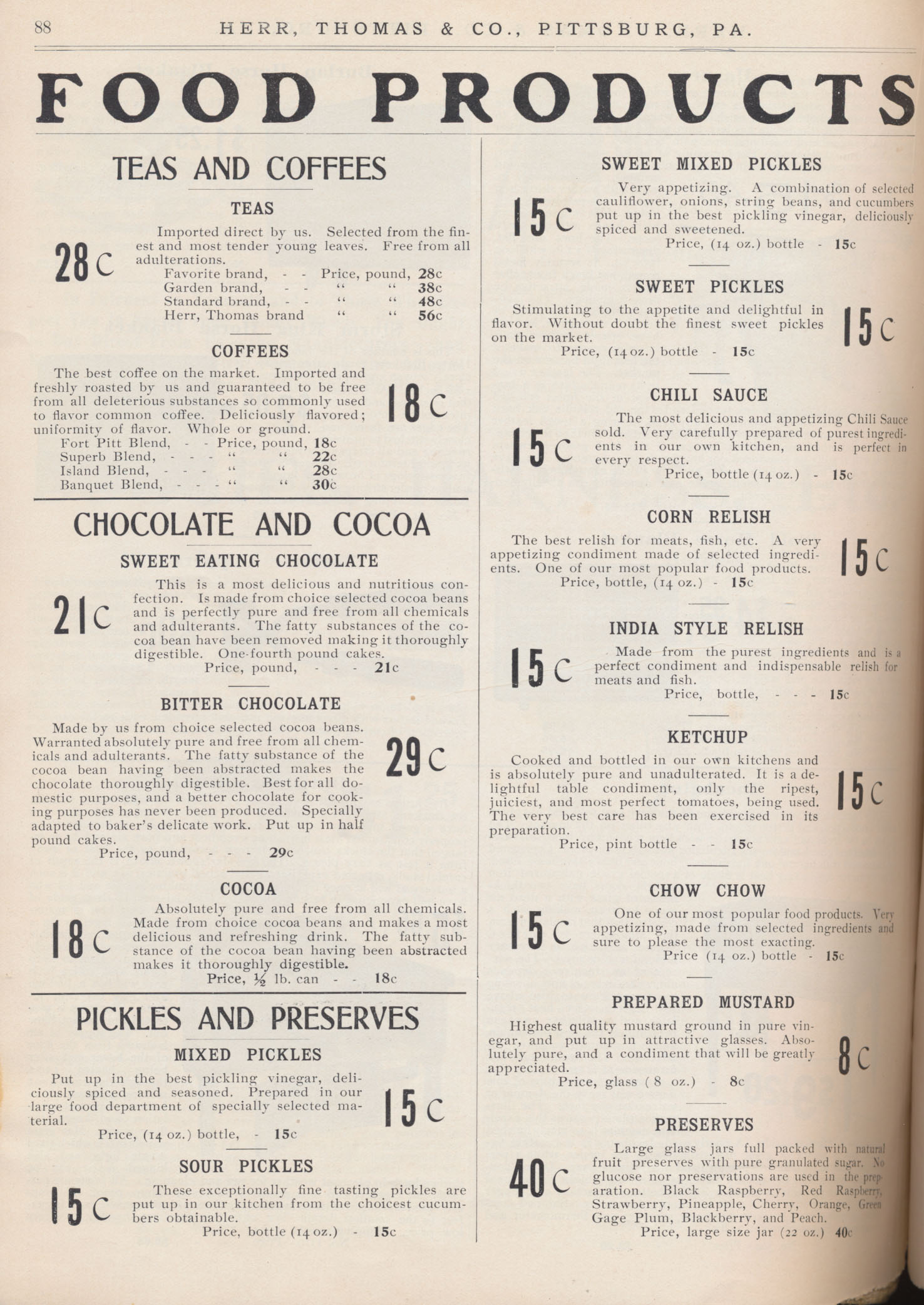 Herr, Thomas & Co., Pittsburg, PA. Catalogue No. 101 (1907), page 88, Food products (teas, coffees, chocolate, cocoa, pickles, preserves).
What about outdoor activities during spring, summer, and fall? Herr, Thomas & Co. trade literature also provides clues as to what people in 1907 possibly enjoyed during the warmer months. These activities might sound familiar to us today as well. The page below shows two hammocks. Perhaps someone enjoyed an afternoon reading a book or simply resting on a hammock. The hammocks shown below were woven with cotton yarn and available in green, yellow, or red. An added bonus for comfort was the roll pillow. The hammock shown below, middle left, was a bit more decorative due to the 15 inch deep valance.
Consumers in 1907 also had the option of buying a simple lawn chair for their backyard. The striped Lawn Chair (below, top right) was foldable. Its frame was made of hardwood. The Lawn Chair was also adjustable to either a sitting or reclining position. Other possibilities for relaxing outside in the garden included the Reed Tete and Lawn Settee, both shown below.
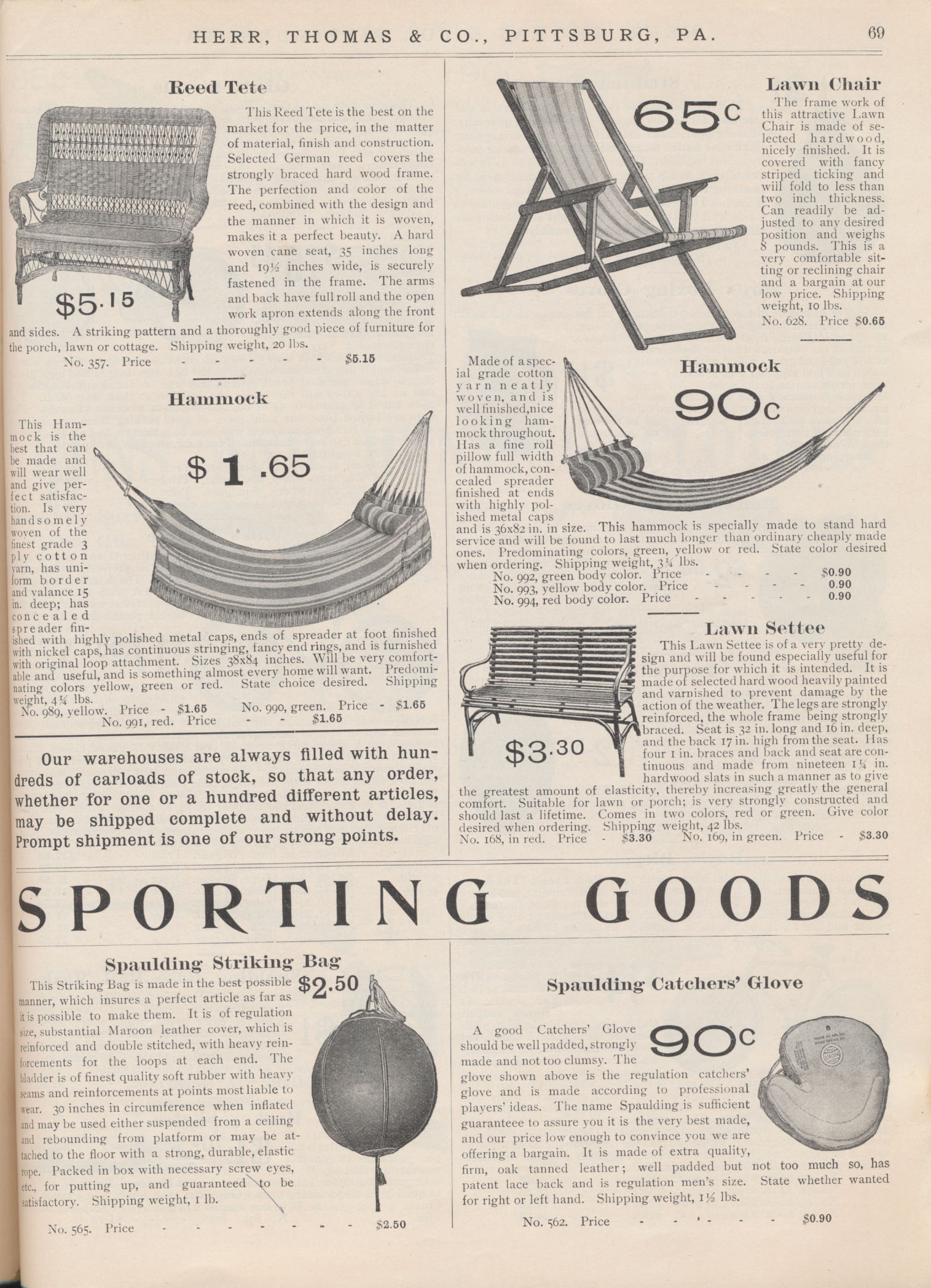 Herr, Thomas & Co., Pittsburg, PA. Catalogue No. 101 (1907), page 69, Lawn and Porch Furniture (Reed Tete, Lawn Chair, Hammocks, Lawn Settee) and Sporting Goods (Spaulding Striking Bag, Spaulding Catchers’ Glove).
Another idea for a relaxing afternoon is resting on a Porch Swing. The Porch Swing, shown below (bottom right), featured a slightly curved seat with the convenience of both a foot rest and leg rest. The leg rest extended 17 inches below the seat connecting to a solid foot rest which was covered in linoleum. While adults rested on the porch, perhaps children played in the Lawn Tent (below, bottom left). Maybe the Lawn Tent was a setting for their own tea party using the Child’s Tea Set, also sold by Herr, Thomas & Co. The Lawn Tent was made of cotton duck and measured 8 feet wide, 8 feet long, and 8 feet high.
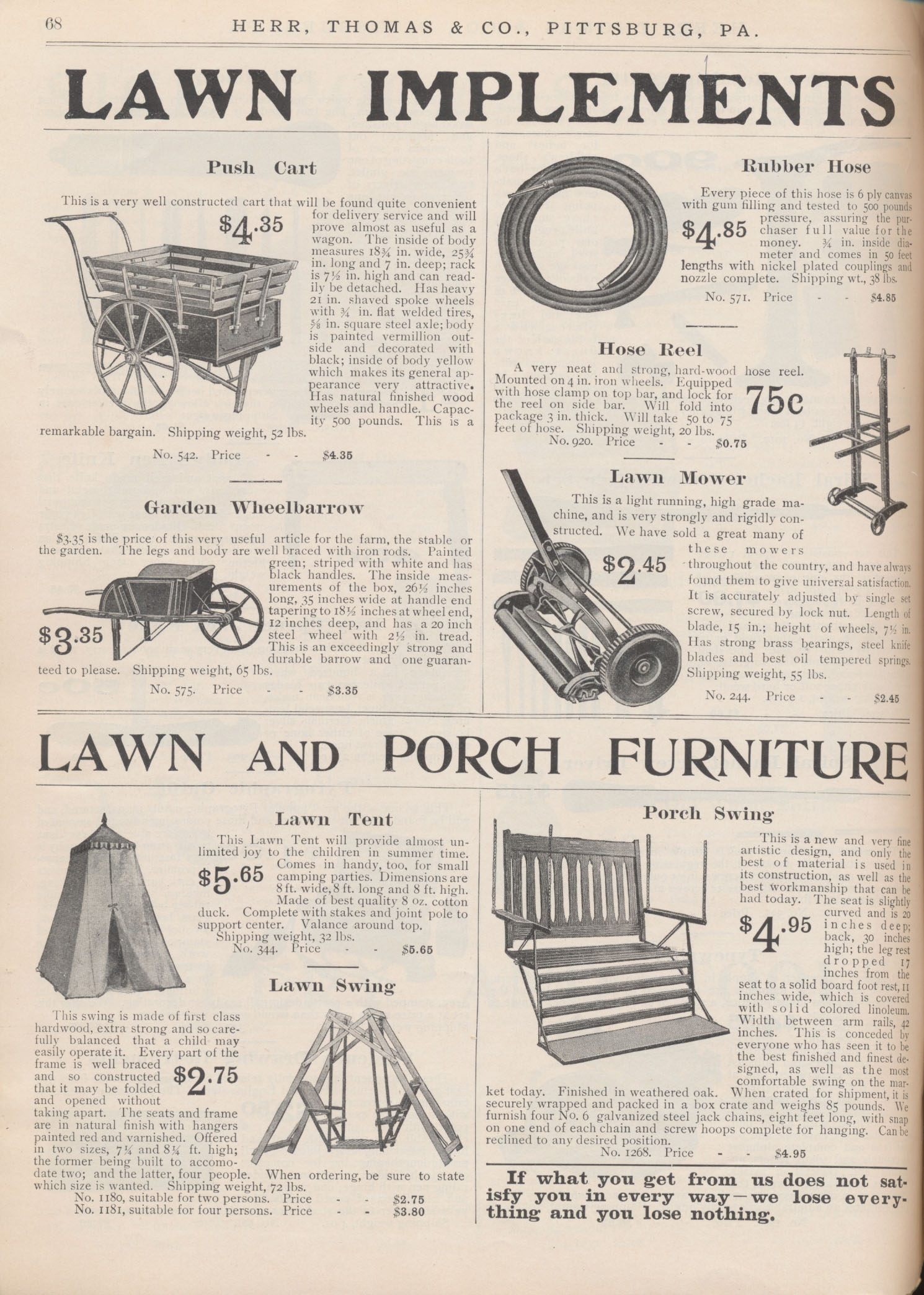 Herr, Thomas & Co., Pittsburg, PA. Catalogue No. 101 (1907), page 68, Lawn Implements (Push Cart, Garden Wheelbarrow, Rubber Hose, Hose Reel, Lawn Mower) and Lawn and Porch Furniture (Lawn Tent, Lawn Swing, Porch Swing).
Moving along, a little over a decade later, let’s take a look at Spring & Summer Catalog (1915) by John Wanamaker. As described in a previous post, this particular catalog illustrates clothing. This includes riding habits and other accessories for horseback riding.
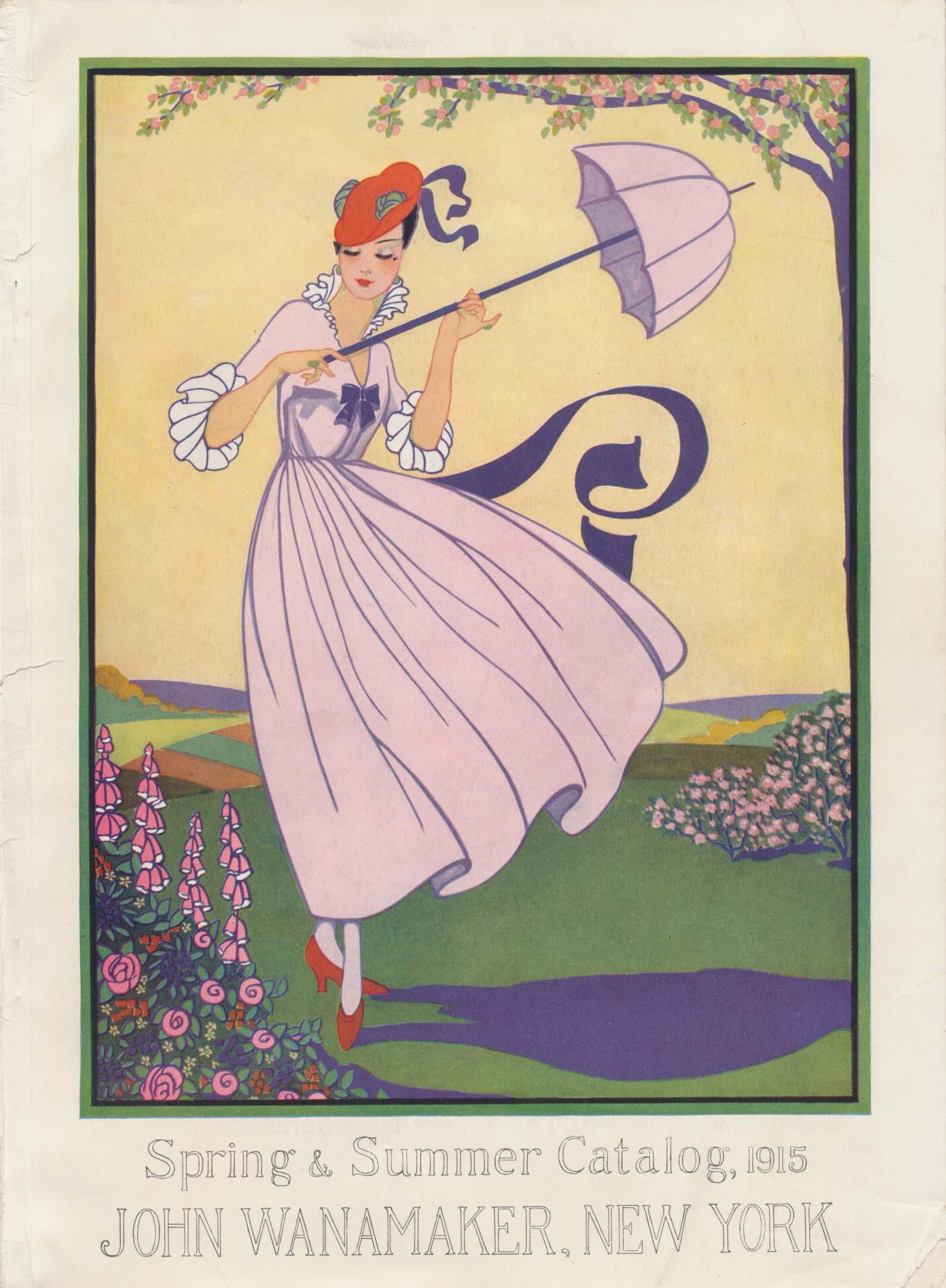 John Wanamaker, New York, NY. Spring & Summer Catalog (1915), front cover.
Both side-saddle and cross-saddle riding habits were available. “Cross-saddle”, or astride, refers to the more common type of saddle used today. The side-saddle habit (below, top right) was a three-piece set made of tan linen. It consisted of a safety skirt, three-quarter coat, and reinforced breeches. As might be expected, the cross-saddle habit pictured below (bottom left) consisted of two pieces, the long coat and reinforced breeches.
However, it was also possible to buy a different cross-saddle habit which came with a skirt. As a two-piece set, it included only a coat and breeches, but with the addition of a shell skirt, it was also available as a three-piece set. The shell skirt opened in the front and back making it a split skirt and providing the ability to ride cross-saddle. This particular riding habit with a black and white checkered pattern is shown below (bottom right). Other riding equipment and accessories illustrated in this catalog include riding boots, shirts, collars, bowties, and hats.
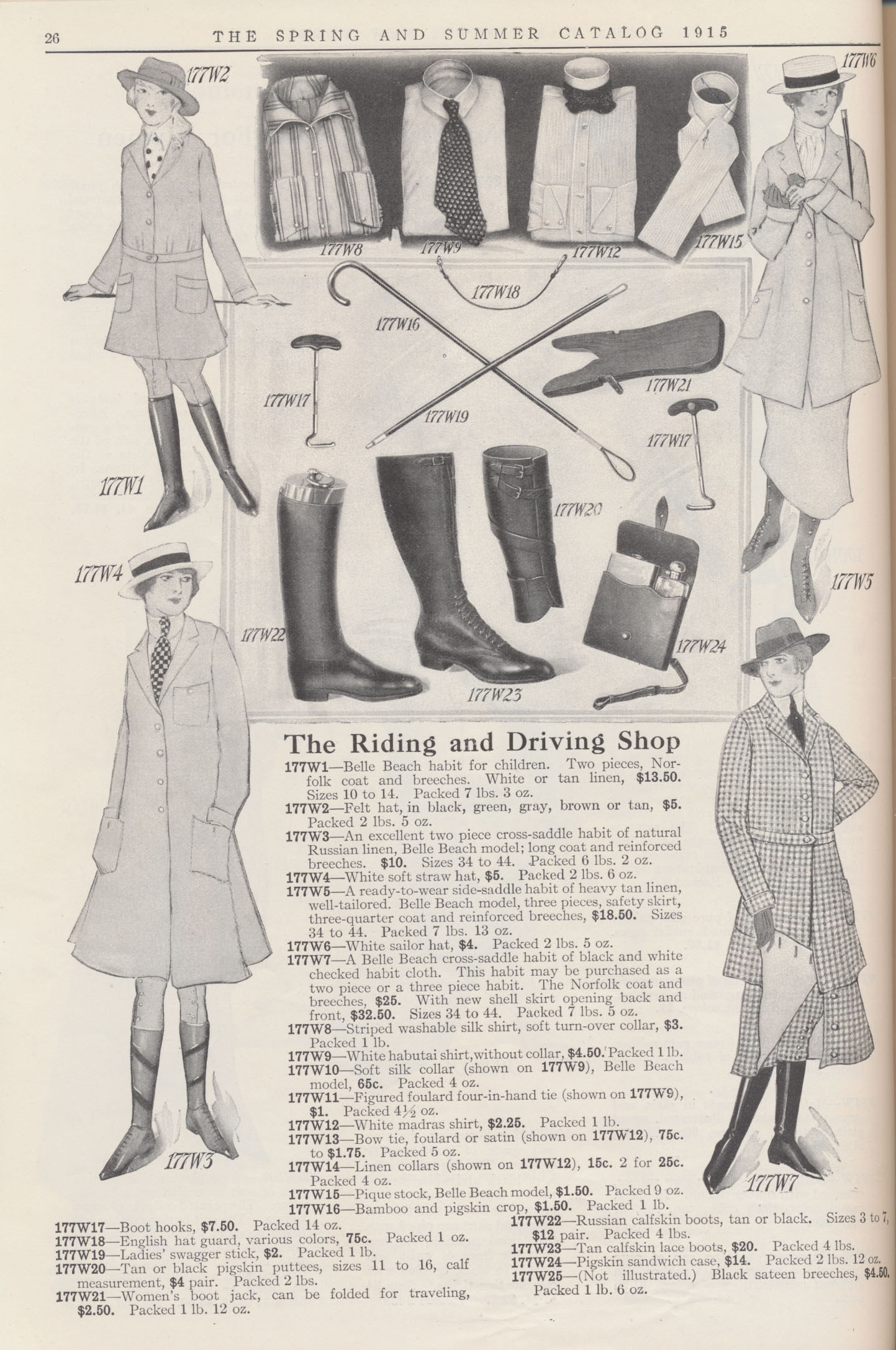 John Wanamaker, New York, NY. Spring & Summer Catalog (1915), page 26, horseback riding habits, equipment, and accessories.
Besides providing clues as to the types of products bought by consumers in the early 20th Century, these trade catalogs also show the types of activities they might have participated in and enjoyed. Catalogue No. 101 (1907) by Herr, Thomas & Co. and Spring & Summer Catalog (1915) by John Wanamaker are both located in the Trade Literature Collection at the National Museum of American History Library.
Upcoming Events: March and April
We’ll be busy over the next few months and you’re invited. Interested in Women’s History? Want to get a closer look at our collections? Join us for an upcoming event!
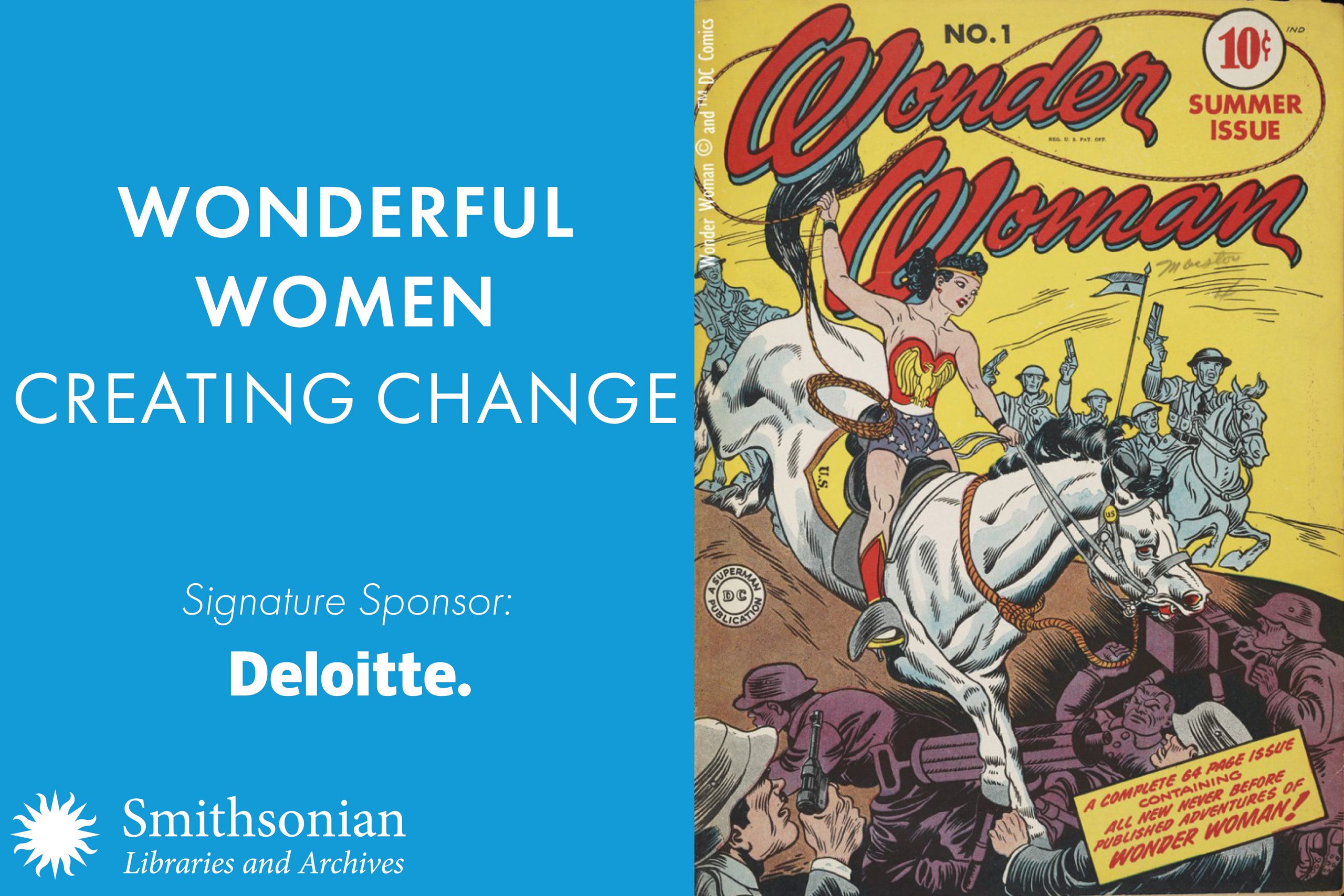
Wonderful Women Creating Change
Wednesday, March 10, 5 pm ET
Register here
To celebrate Women’s History Month in March and the recent release of Wonder Woman 1984 (filmed and set at the Smithsonian!), join us for the first in our Women’s History with Smithsonian Libraries and Archives program series, sponsored by Deloitte, “Wonderful Women Creating Change.” You’ll learn about our own connections to this iconic character and hear what it was really like to be a woman working at the Smithsonian in the 1970s and 1980s.
Lilla Vekerdy, Head and Curator of Special Collections, and Elizabeth Harmon, Digital Curator of the History of Smithsonian Women in Science, will share behind-the-scenes insights into the intriguing contents of our collection of materials from the creator of Wonder Woman, William Moulton Marston, and our fascinating Smithsonian records that document the experiences of real women.
Thank you to our generous sponsors of this program:
Signature Sponsor: Deloitte
Sponsor: Smithsonian’s Atlanta Regional Council, Co-Chaired by Cheryl Neal and Christine Ragland

Wikipedia & Women in Science: Smithsonian Groundbreakers Edit-a-thon
Thursday, March 25, 1 pm – 3 pm ET
Register here
There are so many inspiring stories about women in science at the Smithsonian in its 175-year history that can educate and embolden future generations, but only if their legacies are discoverable. On Thursday, March 25, join our #BecauseOfHerStory effort to uncover more about these often underrepresented women trailblazers in various disciplines, from astrophysics to zoology
During this training, attendees of all experience levels will learn the basics of how to edit Wikipedia by updating articles related to the history of women in science at the Smithsonian Institution in connection with the Funk List. Presenters will share how editors might research the work of these women in the absence of personal papers and institutional records.
As one of the web’s most visited reference sites, Wikipedia serves as a starting point for many individuals looking to learn about art, history, and science. However, less than 19% of Wikipedia biographies in English represent women, and less than 10% of Wikipedia editors identify as women. By increasing representation of women scientists on the site, your impact can spark the curiosities of future generations who see themselves in these Smithsonian groundbreakers.
This event is planned in conjunction with the Smithsonian Institution Archives, the Biodiversity Heritage Library, and the Smithsonian American Women’s History Initiative, a multiyear undertaking to document, research, collect, display, and share the history of women in the United States.
Adopt-a-Book Salons with Smithsonian Libraries and Archives
March 18, April 1, April 13, April 28
Registration details below
Get up close and personal with Smithsonian Libraries and Archives’ collections and experts through our new series of Adopt-a-Book Salons!
Our Adopt-a-Book program provides essential funding to support conservation, acquisition, and digitization of our materials while allowing you to commemorate an occasion, celebrate a milestone, or leave a legacy for a loved one. Each year, we invite guests to our Adopt-a-Book Evening to explore books available for adoption and learn why these items are crucial for researchers today.
This year, we’ve taken our annual event online and will be hosting a series of four intimate salons in March and April, where you’ll have the opportunity to interact with our librarians, archivists, and conservators. You’re invited to join us for all four events to see books and materials from all 21 of our library branches and the Archives!
Adopt-a-Book Salon: Global Perspectives
Thursday, March 18
5:30 to 6:45 pm ET
Focusing on the global breadth of our collections
Books from Anacostia Community Museum Library, Botany and Horticulture Library, Hirshhorn Museum and Sculpture Garden Library, Warren M. Robbins Library at the National Museum of African Art, National Museum of Asian Art Library, National Museum of Natural History Library, Smithsonian Libraries Research Annex, and Smithsonian Tropical Research Institute Library
Adopt-a-Book Salon: Off the Mall
Thursday, April 1
5:30 to 6:45 pm ET
Featuring an interdisciplinary selection of libraries located off the National Mall
Books from Cooper Hewitt Smithsonian Design Library, Museum Support Center Library, National Air and Space Museum Library, National Postal Museum Library, National Zoological Park Library, and Smithsonian Environmental Research Center Library
Adopt-a-Book Salon: America the Beautiful
Tuesday, April 13
5:30 to 6:45 pm ET
Focusing on American art, history, and culture
Books from American Art and Portrait Gallery Library, John Wesley Powell Library of Anthropology, National Museum of African American History & Culture Library, National Museum of American History Library, Vine Deloria, Jr. Library at the National Museum of the American Indian, and Smithsonian Libraries Research Annex
Adopt-a-Book Salon: From the Vaults
Wednesday, April 28
5:30 to 6:45 pm ET
Featuring special collections, preservation, and the Smithsonian Institution Archives
Books from Dibner Library of the History of Science and Technology, Joseph F. Cullman 3rd Library of Natural History, and the Smithsonian Institution Archives
Adopt-a-Book Salon Ticket Information
$35 per person, per event. Purchase tickets here.
We’re offering a discount if you attend multiple events: $60 for two events (save $10), $85 for three events (save $20), and $115 for four events (save $25).
If you are unable to attend, please consider adopting a book online or making a donation.
We are committed to providing access services so all participants can fully engage in these events. Optional real-time captioning will be provided. If you need other access services, please email SLA-RSVP@si.edu. Advanced notice is appreciated.
Questions? See our FAQs at the bottom of this page.
Freer’s Marginalia and Mandarin Ducks
 Title page of An Introduction to the History of Chinese Pictorial Art.
In 1906, industrialist Charles Lang Freer gave his collection of Asian and American art and related materials in a gift that began the Freer Gallery of Art. This gift included books which are now in the Freer-Sackler Library . Among them, some that contain Freer’s personal notes and marginalia. One of these is a first edition copy of Herbert Giles’ book An Introduction to the History of Chinese Pictorial Art. This book, originally published in 1905, was the first to provide a comprehensive history of Chinese painting in a European language. Freer made margin notes throughout the book, which help show his personal interests as he was building his art collection. His copy of this book has been digitized by the Smithsonian Libraries and Archives and can now be examined online.
An example of Freer’s notes can be found on page 75. Here Freer has underlined “Hsu Hsi” (Xu Xi), a Five Dynasties Southern Tang (tenth century) Chinese painter, and has written in the left margin: “Two ducks + flowering plant called ‘hung-loo-hua’ Hong Kong.” This seems to be a reference to the painting “Mandarin Ducks under Smartweed” which Freer purchased in 1909 from a Hong Kong dealer. Freer believed the painting to be by Xu Xi, although it is now known to be a Ming Dynasty reproduction.
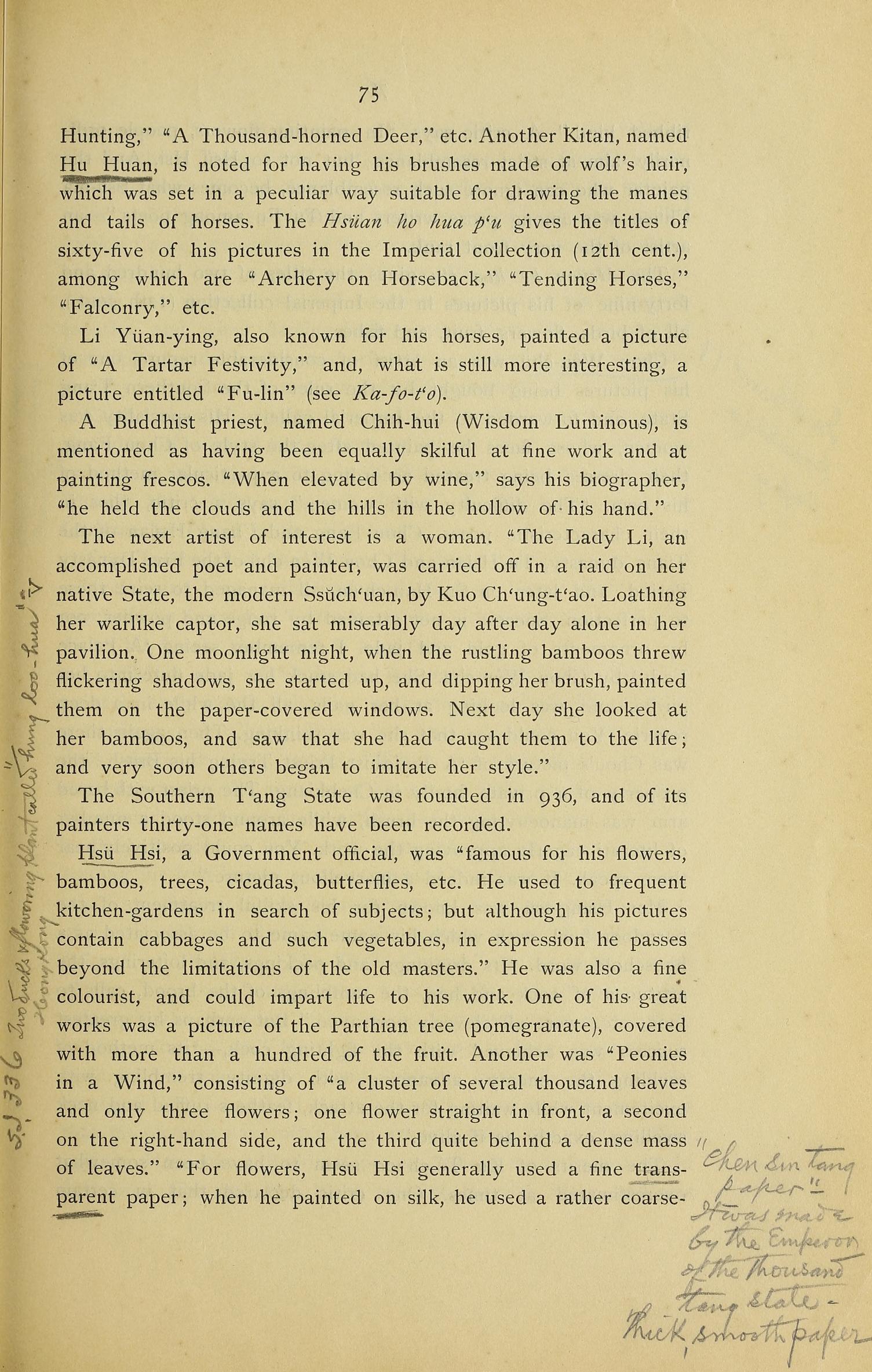 Page 75 of An Introduction to the History of Chinese Pictorial Art (1905) with marginalia by Charles Lang Freer. Click to enlarge.
On the same page in the lower right hand corner, Freer has underlined the word “transparent” relating to a type of paper on which Xu Xi painted flowers. He has written: “Chen Sin Tang paper” — it was made by the Emperor of the Thousand Tang State. Thick, smooth paper.” This is a reference to a type of Chinese paper that originated in the Five Dynasties Southern Tang that became much sought after in the Northern Song Dynasty. Over the centuries an air of legend and mystery came to surround Chengxin Tang paper, such that in the Qing Dynasty the Qianlong Emperor made it a project to try to recreate it.
 “Mandarin Ducks under Smartweed”, detail. Freer Gallery of Art, Smithsonian Institution, Washington, DC. F1909.192.
As the digitization of Freer’s books continues, more of the marginalia contained in them will be available for online research.
Reference:
He, Yan-chiuan. Chengxin Tang Paper and the Qianlong Emperor: With a Discussion of His Connoisseurship of Ancient Paper. The National Palace Museum Research Quarterly 33:1 (2015).
Thank you to Freer and Sackler Archivist Ryan Murray for his reference assistance.
Four New Members Join Smithsonian Libraries and Archives Advisory Board
The Smithsonian Institution’s Board of Regents appointed John Chickering, Christopher Clark, Christopher Lee and Nick Santhanam to the Smithsonian Libraries and Archives Advisory Board. They join 13 prominent community and business leaders dedicated to building the Libraries and Archives’ collections, increasing digital initiatives, advancing education, progressing library and archival preservation, creating high-quality exhibitions and programs and securing a financial legacy.
“It is my pleasure to welcome four outstanding new members to the Smithsonian Libraries and Archives Advisory Board,” said Scott E. Miller, interim director of the Smithsonian Libraries and Archives and the Smithsonian’s chief scientist. “Invaluable leaders in their fields, their experience and guidance will tremendously benefit the Libraries and Archives’ continued growth as a critical global resource. We are fortunate to tap into their extensive wisdom and diverse perspectives.”
The Smithsonian Libraries and Archives Advisory Board consists of members from across the United States. The mission of the board is to help the organization to provide authoritative information, steward the Smithsonian’s institutional memory and create innovative services and programs for Smithsonian researchers, scholars, scientists, curators, archivists, historians and other staff, as well as the public at large.
Please join us in welcoming our newest Advisory Board members!
 Smithsonian Libraries and Archives Advisory Board Member John Chickering
John Chickering
John Chickering advises boards and senior executives on strategy, technology and operations. He has a track record of effectively bridging business operations and information technology to deploy diverse digital transformation solutions across large enterprises.
As a pioneer in the development of digital archiving solutions, Chickering’s work was cited in industry trade press and he wrote papers for peer-review publications. For the Department of Defense, he defined a system to store over 100 million engineering drawings across dozens of domestic sites.
For Fidelity Investments, he deployed a cross-enterprise digital archive solution. While serving as a chief information officer in Fidelity’s private equity portfolio, Chickering built out the technology for a corporate off-site records storage facility and was a principal thought leader informing Fidelity’s digital records archive strategy. He led a multi-year enterprise digital transformation initiative that migrated complex high-volume customer communications from paper to eDelivery.
Chickering’s board experience includes both fiduciary and advisory boards for commercial, educational and other non-profit institutions where he has held various executive committee positions, including chair. He is a Fellow of the Association for Intelligent Information Management and is an occasional speaker at industry conferences and seminars hosted in academia.
Chickering volunteers with several community service organizations and has led over 15 hurricane/storm restoration work teams on the ground in Mississippi, New York, Vermont and Florida. He holds a Bachelor of Science in marine engineering from the U.S. Merchant Marine Academy and an MBA from the University of Maryland.
 Smithsonian Libraries and Archives Advisory Board Member Christopher Clark
Christopher Clark
Christopher York Clark joined Directorship as senior vice president and publisher in December 2002. In 2006, he was promoted to president and publisher of Directorship Services LLC. As senior director of Partner Relations and Publisher, he is presently responsible for the revenue development and conduct of NACD Directorship Magazine, NACD corporate governance forums and director roundtables. In addition, he currently heads the programming for NACD’s Leading Minds of Compensation Forum and NACD’s Leading Minds of Governance Conference. Further, he is the creator of NACD Private Company Directorship and the architect and day-to-day catalyst of NACD’s Power of Difference program.
Clark joined NACD following a decade of service at Forbes Inc. Most recently, he was vice president, sales for Forbes.com. Earlier he served as vice president and general manager of the Forbes Management Conference Group, a leading producer of senior-executive meetings. In this capacity, he oversaw P&L, sales, marketing, program development and logistics for all Forbes conferences. Prior to that position, he served as Forbes magazine’s financial services advertising director.
Presently, Clark is a member of the Broadridge Virtual Shareholder Meeting Best Practices Working Group, and a contributing member of NACD’s Flag and General Officer Advisory Council. He received a Bachelor of Arts from Denison University. In 2006, he was promoted to president and publisher of Directorship Services LLC. As senior director of Partner Relations and Publisher, he is presently responsible for the revenue development and the marketing of NACD Directorship Magazine, NACD corporate governance forums and custom roundtables. In addition, he currently heads the programming for NACD’s Leading Minds of Compensation Forum and NACD’s Leading Minds of Governance Conference and serves as host and moderator at both events. Further, he is the architect and day-to-day catalyst of NACD’s Power of Difference program.
Clark joined NACD following a decade of service at Forbes Inc. Most recently, he was vice president, sales for Forbes.com. Earlier he served as vice president and general manager of the Forbes Management Conference Group, a leading producer of senior-executive meetings. In this capacity, he oversaw P&L, sales, marketing, program development and logistics for all Forbes conferences. Prior to that position, he served as Forbes magazine’s financial services advertising director.
Presently, Clark is a member of the Broadridge Virtual Shareholder Meeting Best Practices Working Group, and a contributing member of NACD’s Flag and General Officer Advisory Council. He received a Bachelor of Arts from Denison University.
 Smithsonian Libraries and Archives Advisory Board Member Christopher Lee
Christopher Lee
Chris Lee is a partner at FAA Investments, a private investment group focusing on real estate, early-stage companies and in-depth research on hedge funds and private equity managers. With home bases in San Francisco and Hong Kong, Lee and his partners allocate capital globally. He is fluent in English and Chinese.
Additionally, Lee is a board director with expertise in financial markets, risk management, governance and leadership development. Currently, he serves as an Independent Board Member with Matthews Asia Funds, the largest US Investment Company (’40 Act) with a dedicated focus on Asia Pacific markets.
Previously, Lee was an investment banker for 18 years, acting as managing director and divisional and regional heads at Deutsche Bank AG, UBS Investment Bank AG and Bank of America Merrill Lynch. He worked in global capital markets, managed derivative product development and provided equity sales and trading functions to institutional investors.
He is an advocate of sustainable enterprises and environmentally conscious projects, serving on various boards with a passion for promoting education, conservation, energy efficiency and sustainability. Lee also serves on the boards of University of California, Berkeley-Haas Dean’s Advisory Circle, African Wildlife Foundation, Hong Kong Securities and Investment Institute and Salzburg Global Seminar.
Academically, Lee is an associate professor of science practice at HKUST and teaches financial mathematics and risk management courses. He completed the AMP at Harvard University and holds a Bachelor of Science in mechanical engineering and an MBA from the University of California, Berkeley.
 Smithsonian Libraries and Archives Advisory Board Member Nick Santhanam
Nick Santhanam
Nick Santhanam is a senior Partner in McKinsey & Company’s Silicon Valley Office and leads their global industrials practice. Nick also leads their S5C (Sub $5 billion companies) practice. Nick serves industrials/industrial-tech companies on their end-to-end strategy and performance transformation efforts. He has led their work on “McKinsey on industrials,” “McKinsey on Packaging,” “McKinsey on flow control,” “McKinsey on food processing and handling,” “McKinsey on construction” and several other knowledge efforts, which are deep dives in various industrial micro verticals, to map the secular growth headwinds and tailwinds as well as what it takes for companies to create and capture value. He also hosts their annual CEO summits—Industrial CEO (GILS), Tech CEOs (T-30), Family-owned companies CEO (L-20)—as well as he the host and convener of their executive learning programs including board learning event on disruptions (NWDS), investor learning on disruptions (NWDS-I) and executive learning event on transformations (APT-30). In the past 36 months, he has led multiple successful transformations of companies, which has led to 200-500 basis points of margin expansion and significant shareholder value creation.
Prior to joining McKinsey, Santhanam worked as a technical manager at Taconic (a PCB/ceramics manufacturer), Petersburgh, New York. Prior to Taconic, he worked as a manufacturing engineer at Arlon in their Bear, Delaware facility.
Santhanam has a Master of Science in chemical engineering from University of Illinois and an MBA in strategic management and finance from the Wharton School, University of Pennsylvania. He graduated as a Ford and Palmer scholar from Wharton.
John Wesley Cromwell and the Importance of Representation
John Wesley Cromwell was an influential African American lawyer, educator and activist. He was also an early advocate for a concept librarians and educators still struggle with today: representation of historically marginalized voices in American literature.
 Portrait of John Wesley Cromwell, from Men of Mark (1887) . Courtesy of Emory University, Manuscript, Archives and Rare Book Library, accessed via Internet Archive.
Cromwell was born enslaved in Virginia in 1846, the youngest of seven children. His father was able to obtain freedom for the family and relocated to Pennsylvania during John’s childhood. Cromwell attended school in Philadelphia, graduating from the Institute for Colored Youth, and soon took up teaching in Virginia. He moved to D.C. and graduated from Howard University Law School in 1874. Cromwell held several civil service jobs and practiced law for over a decade while maintaining positions in African American educational organizations and publishing his own paper, People’s Advocate.
Cromwell’s contributions were significant enough in the late 19th century that William J. Simmons profiled him in Men of Mark (1887) alongside notable figures like Frederick Douglass and Crispus Attucks. Simmons claimed, “If you ask me for the best English scholar in the United States, I would unhesitatingly refer you to John Wesley Cromwell.” Cromwell helped form the American Negro Academy in 1897, an organization dedicated to the advancement of African Americans in higher education, arts and sciences.
Between his teaching career and his deep interest in literature, Cromwell identified a hole in American education, one in which African American children “learn little or nothing of their kith or kin that is meritorious or inspiring”. He sought to address this issue of representation in his book The Negro in American History, published in 1914 by the American Negro Academy. When it was published, the Journal of Negro History reviewed it as a “very important work”.
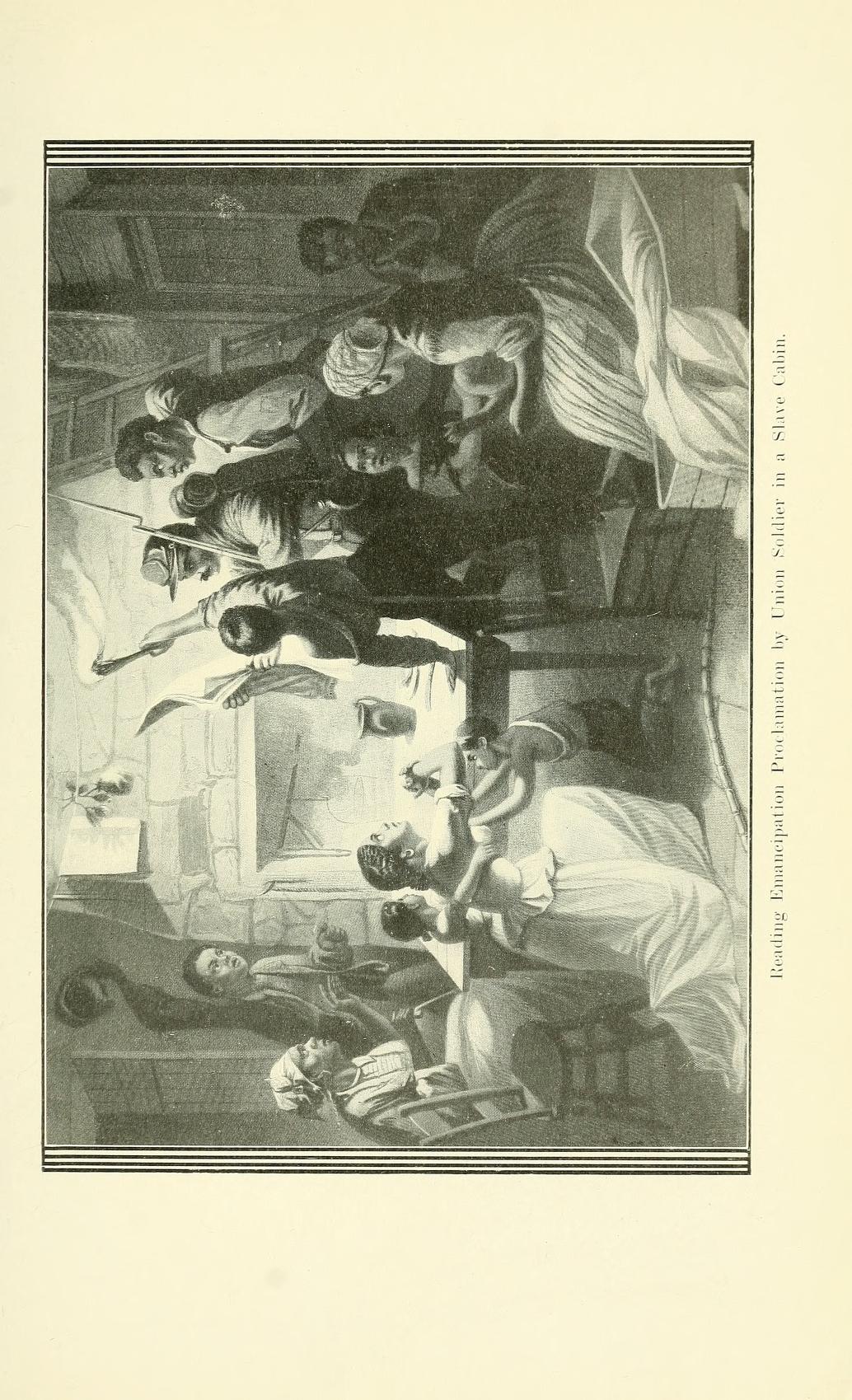 “Reading Emancipation Proclamation by Union Soldier in a Slave Cabin”, plate from The Negro in American History (1914).
The book, available in our Digital Library, describes the involvement of Black men and women in many areas of American history, from colonization through the Spanish-American War and beyond. It also discusses African American culture in chapters like “Negro Church”. Much of the book profiles remarkable Black men and women. Some are still household names: Benjamin Banneker, Sojourner Truth, and Booker T. Washington. But others are not as well known. Fanny Muriel Jackson Coppin was a skilled orator and educator who was also the first African American woman to graduate from a recognized college. Robert Brown Elliott was a Reconstruction era lawyer and politician who helped draft legislation to fight the Ku Klux Klan in the South.
Cromwell provided the introduction for another book related to African American representation in history, Emancipation and the Freed in American Sculpture (1916). Freeman Henry Morris Murray’s self-published book, part of his Black Folk in Art series, investigates how the enslaved were depicted in sculpture, from Hiram Power’s “Greek Slave” to proposed plans for the Lincoln Memorial. In his introduction, Cromwell notes that Murray was compelled to pursue the subject after observing “omissions of proper representation of the darker races”. An observation Cromwell could certainly relate to.
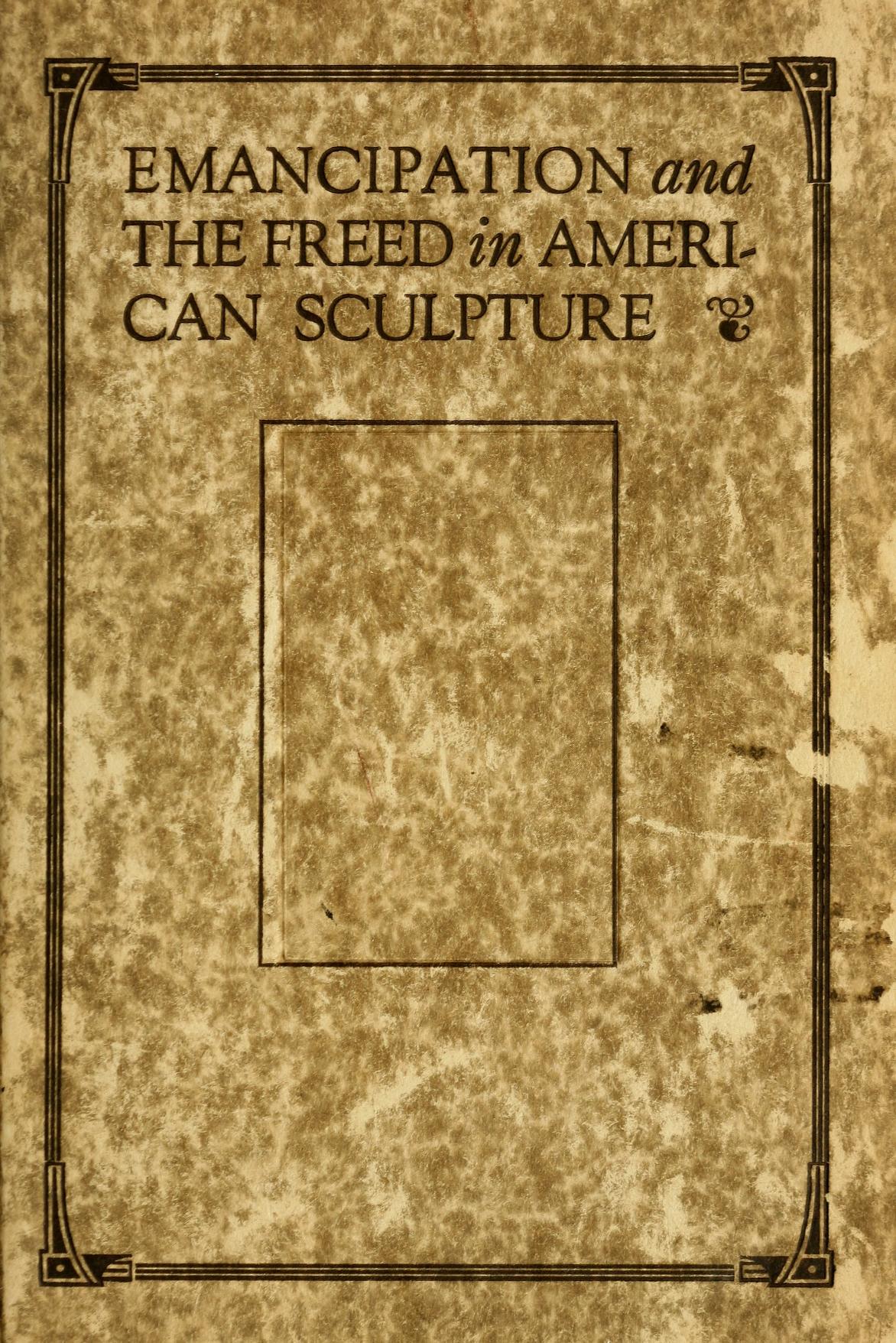 Cover, Emancipation and the freed in American sculpture (1916).
Over a hundred years after the publication of Cromwell’s The Negro in American History, educators and librarians continue to work towards fair representation in literature, seeking out stories that tell the experience of all Americans. The Smithsonian Libraries and Archives’ newest exhibition, Magnificent Obsessions: Why We Collect, highlights the importance of building collections at the Vine Deloria Jr. Library, National Museum of the American Indian and the Anacostia Community Museum Library that represent the diverse communities they serve. Our staff continue to work with curators and researchers across the Smithsonian to acquire books, journals and other resources with diversity, equity and inclusion in mind. The problem John Wesley Cromwell identified is unfortunately far from solved, but his legacy lives on.
Further Reading:
Cromwell, Adelaide M., Unveiled Voices, Unvarnished Memories: the Cromwell Family in Slavery and Segregation, 1692-1972.
Zhong Kui and the Chinese New Year
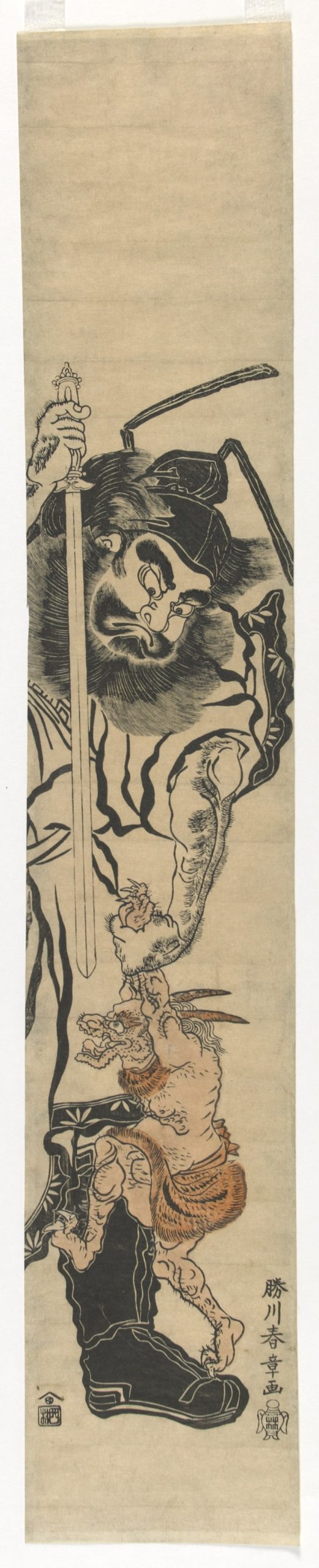 Shoki (Zhong Kui) Vanquishing a Demon, Katsukawa Shunsho (1726–1792), Japan, Edo period, early 1770s, woodblock print, ink and color on paper, The Anne van Biema Collection, Arthur M. Sackler Gallery, S2004.3.323.
Zhong Kui is a legendary figure in East Asian countries. In China, it is customary that by the end of the year in preparation for the New Year, people hang his portrait on their doors as he is the auspicious spirit that protects people from demons and cures incurable diseases.
Zhong Kui was first mentioned in Dream Pool Essays by Song author Shen Kuo (1031-1095). He recounts how Zhong Kui entered a military examination where people would be judged on their military skills and then possibly selected to serve in the country’s military. Despite Zhong Kui’s outstanding performance, he was eliminated due to his unconventional appearance. He was regarded as grotesque looking. Zhong Kui was so upset with the injustice of his rejection that as a form of protest, he committed suicide.
Then, one day, an ailing emperor, Xuanzong of Tang (685-762) had a dream in which Zhong Kui killed the evil–spirited ghost who sickened him. The next day, the emperor felt healthy and well. He ordered the great Tang painter Wu Daozi (680-760) to paint a portrait of Zhong Kui and issued an imperial edict to have his subjects hang Zhong Kui’s portrait at the New Year. A tradition was born and Zhong Kui became a legend.
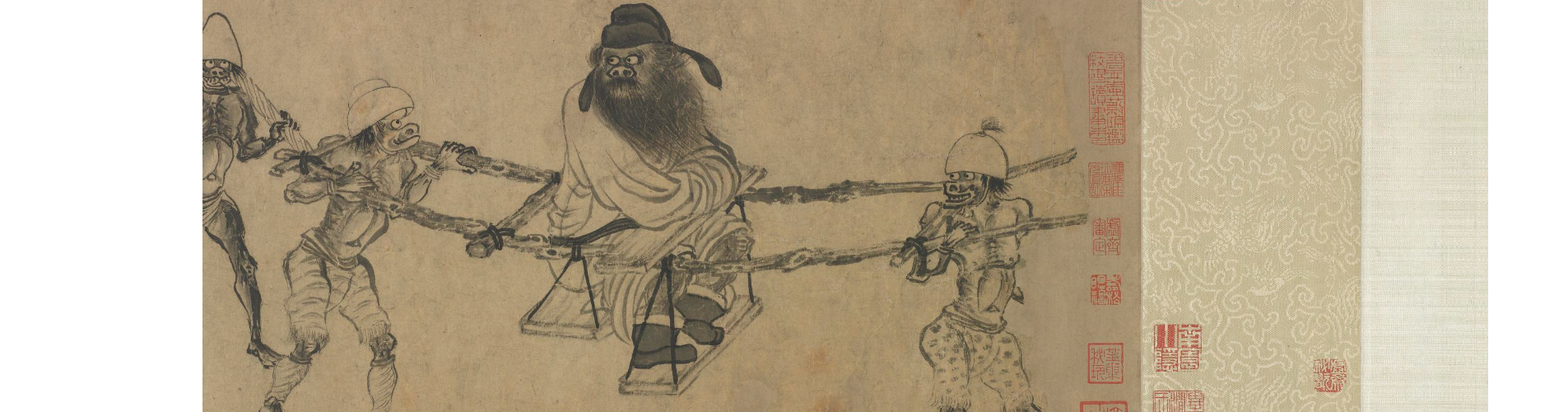 Detail, Zhongshan Going on Excursion, Gong Kai (1222–1307), China, Yuan dynasty, late 13th–early 14th century, Ink on paper, Purchase—Charles Lang Freer Endowment, Freer Gallery of Art, F1938.4.
The tradition of Zhong Kui is particularly important as we celebrate this Lunar Chinese New Year which falls on February 12, 2021. With the COVID-19 virus relentlessly killing and sickening people all over the world, we need Zhong Kui, the Demon Queller more than any other time to protect us and provide hope that this pandemic will end soon.
To see more images of Zhong Kui, please visit the Freer and Sackler website.
Further reading from Smithsonian Libraries and Archives collections:
Guo li gu gong bo wu yuan 國立故宮博物院. Ying sui ji fu: yuan cang Zhong Kui ming hu ate zhan 迎歲集福:院藏鐘馗名畫特展. Taibei: Guo li gu gong bo wu yuan, 1997.
Hu, Wanchuan 胡萬川. Zhong Kui shen hua yu xiao shuo zhi yan jiu 鐘馗神話與小說之研究. Taibei: Wen shi zhe chu ban she, 1980.
Lee, Sherman, “Yuan Hui, Zhong Kui, Demons and the New Year,” Artibus Asiae 53, no. 1/2, 1993, pp. 211-227.
Tsai, Chun-Yi Joyce. “Imagining the supernatural grotesque: paintings of Zhong Kui and Demons in the late Southern Song (1127-1279) and Yuan (1271-1368) dynasties”. Accessed Jan. 28, 2021. https://academiccommons.columbia.edu/doi/10.7916/D8RR1X2W
The Garden: A Place to Learn and Experiment
A garden is a place to rest, relax, rejuvenate. It also provides an opportunity to learn about nature. Staff at Smithsonian Libraries and Archives are also learning and developing new skills. Some of these new skills are related to digitization and accessibility of biodiversity literature.
During these months of telework, I am assisting the Digital Library and Digitization Department to enhance page-level and image-level access to previously digitized books for the Biodiversity Heritage Library (BHL). This involves improving page-level metadata for items in BHL, uploading full-page illustrations to the BHL Flickr photostream, and tagging the images in Flickr with species’ common and scientific names. These digitized books include a variety of content: plants, birds, mammals, reptiles, crustaceans, insects, and so much more. In the course of this work, I have the opportunity to view lovely illustrations. Recently a horticultural catalog caught my attention. The item is titled Vick’s Flower and Vegetable Garden (1878) by James Vick.
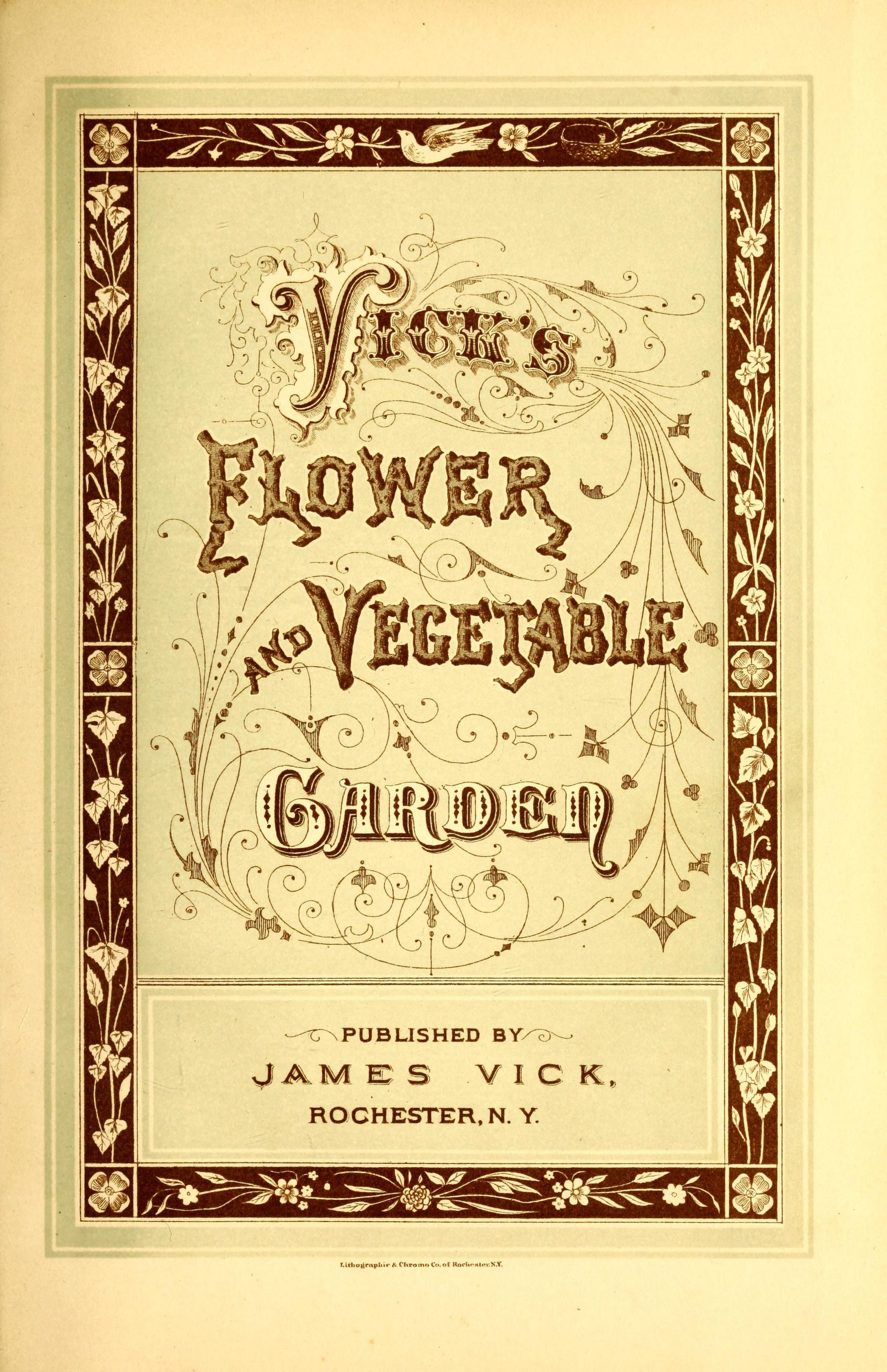 James Vick, Rochester, NY. Vick’s Flower and Vegetable Garden (1878), title page. Available online in the Biodiversity Heritage Library.
James Vick was born in England and arrived in New York City at a young age. There, he learned the printer’s trade. He later moved to Rochester, New York. In Rochester, he set type for several newspapers and went on to serve as writer, editor, owner, or publisher of various publications. In 1862, he issued the first Floral Guide and Catalogue. Based on his past experience in the print and journalism fields, he created a personal style offering gardening advice, anecdotes, correspondence, a complaint section, a children’s section, and color prints. James Vick also began a seed store which later became a well-known seed-display garden. After his death, the company continued into the 20th Century until it was sold to Burpee Seed Co.
 James Vick, Rochester, NY. Vick’s Flower and Vegetable Garden (1878), page preceding page 99, Perennials including (1) Aquilegia, (2) Perennial Pea, (3) Digitalis (Fox Glove), (4) Double Pink, (5) Perennial Larkspur, (6) Campanula (Canterbury Bell), (7) Sweet William, (8) Picotee, (9) Pentstemon. Available online in the Biodiversity Heritage Library.
This particular item, Vick’s Flower and Vegetable Garden (1878) by James Vick, is filled with gardening advice, botanical descriptions, and many illustrations. It seems to speak directly to the reader with a conversational tone and focus on learning. As it states on page 5,
“The study of Agriculture and Horticulture has engaged the attention of the wisest from the earliest ages, and yet what wonderful discoveries and improvements have we witnessed in our own day; and we are still learners.”
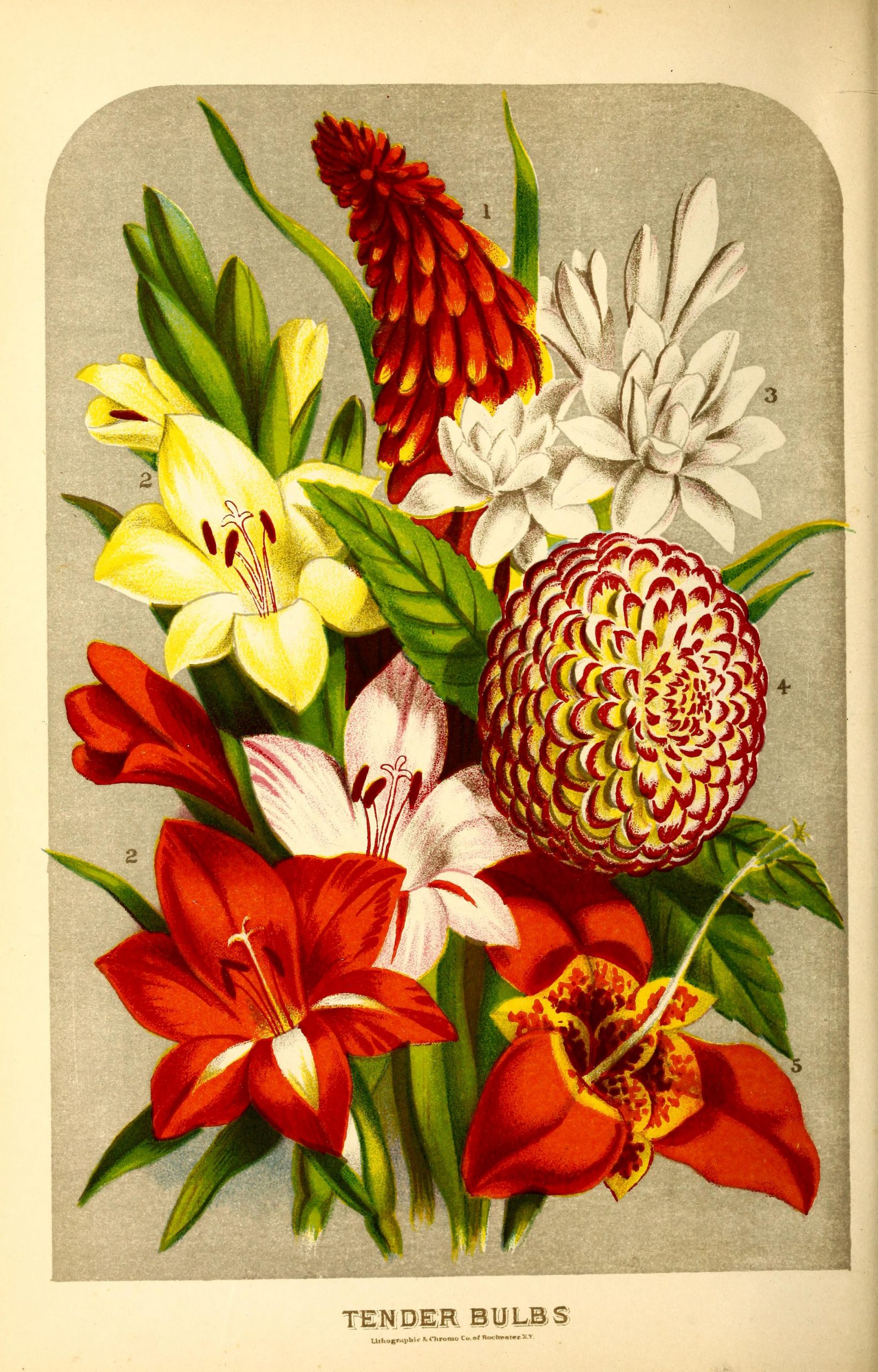 James Vick, Rochester, NY. Vick’s Flower and Vegetable Garden (1878), page preceding page 109, Tender Bulbs including (1) Tritoma uvaria, (2) Gladioli, (3) Tuberose, (4) Dahlia, (5) Tigridia. Available online in the Biodiversity Heritage Library.
The catalog includes practical suggestions for selecting seeds, preparing soil, and planting gardens. On the subject of garden design, it suggests keeping the future in mind. When planting trees, it emphasizes the awareness of knowing the size, form, and habits of the full-grown tree as opposed to only thinking of its small size when planted. For those with little outdoor space, there are ideas for creating balcony gardens and window boxes.
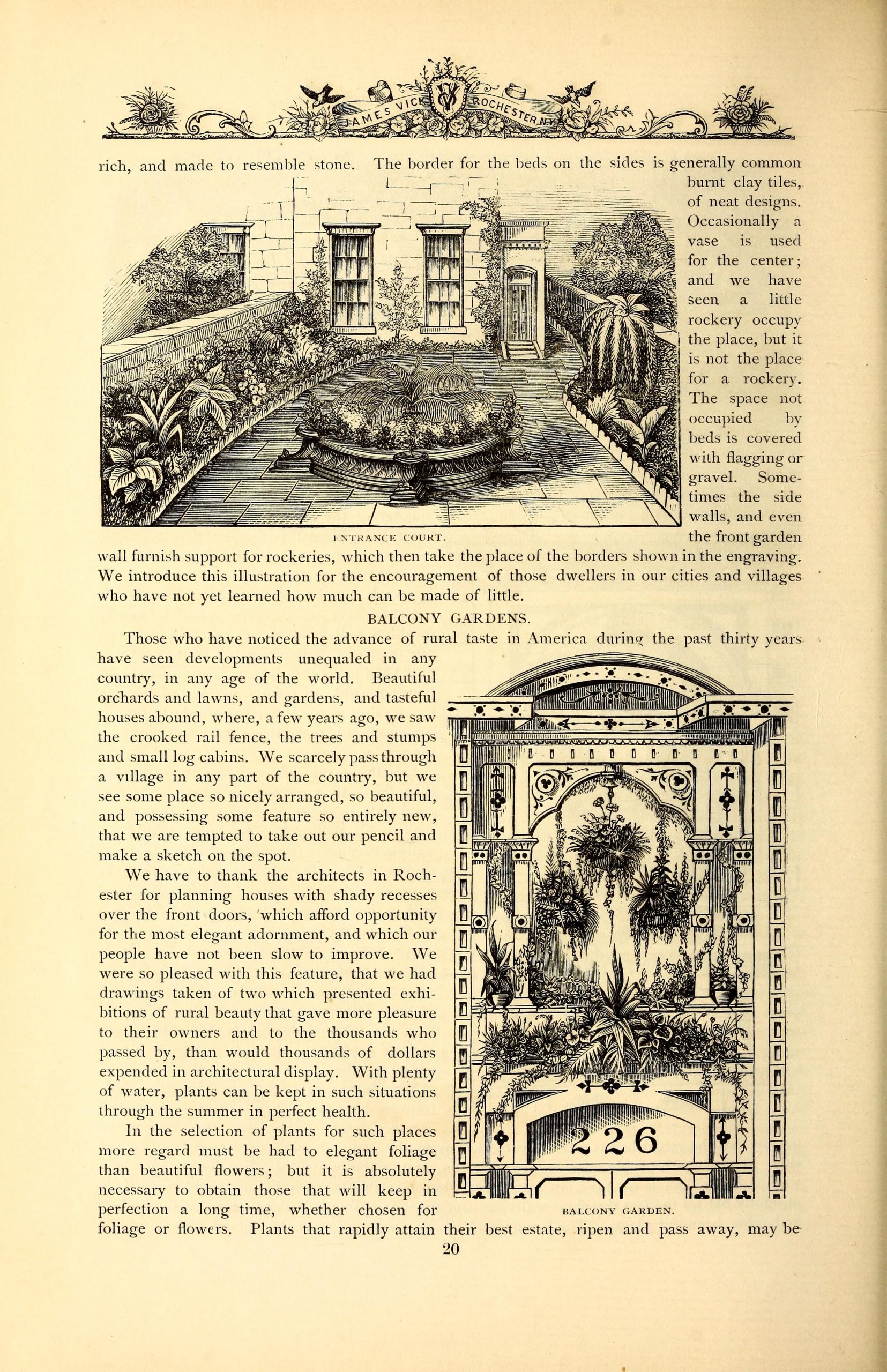 James Vick, Rochester, NY. Vick’s Flower and Vegetable Garden (1878), page 20, Entrance Court and Balcony Garden. Available online in the Biodiversity Heritage Library.
Another section focuses on floral decorations, such as incorporating greenery and flowers into decorations. This might include covering letters with greenery to form welcoming words for a guest, adorning a table with a floral centerpiece, decorating a room with garlands, or creating bouquets and button-hole flowers.
Let’s take a closer look at one of these floral decorations, forming and covering letters with greenery and flowers. Perhaps, someone wanted to welcome a guest by displaying a “Welcome” sign or, as in the example below, decorate the words, “Peace on Earth.” As the catalog explains, the first step was to determine the height of all letters. Then, the width of each letter was determined proportional to its height. For example, if six inches was chosen for the height of all upper-case letters, the proportional width for “P” would be four inches, “E” three and a half inches, “A” four and a half inches, and so on, as detailed in the explanation shown in the image below. Once the letters were outlined on heavy straw board, each letter was cut out and dark thread was used to fasten small branches of evergreens or dry moss to the letters. Finally as a finishing touch, berries or everlasting flowers were added to brighten the decoration, as detailed below.
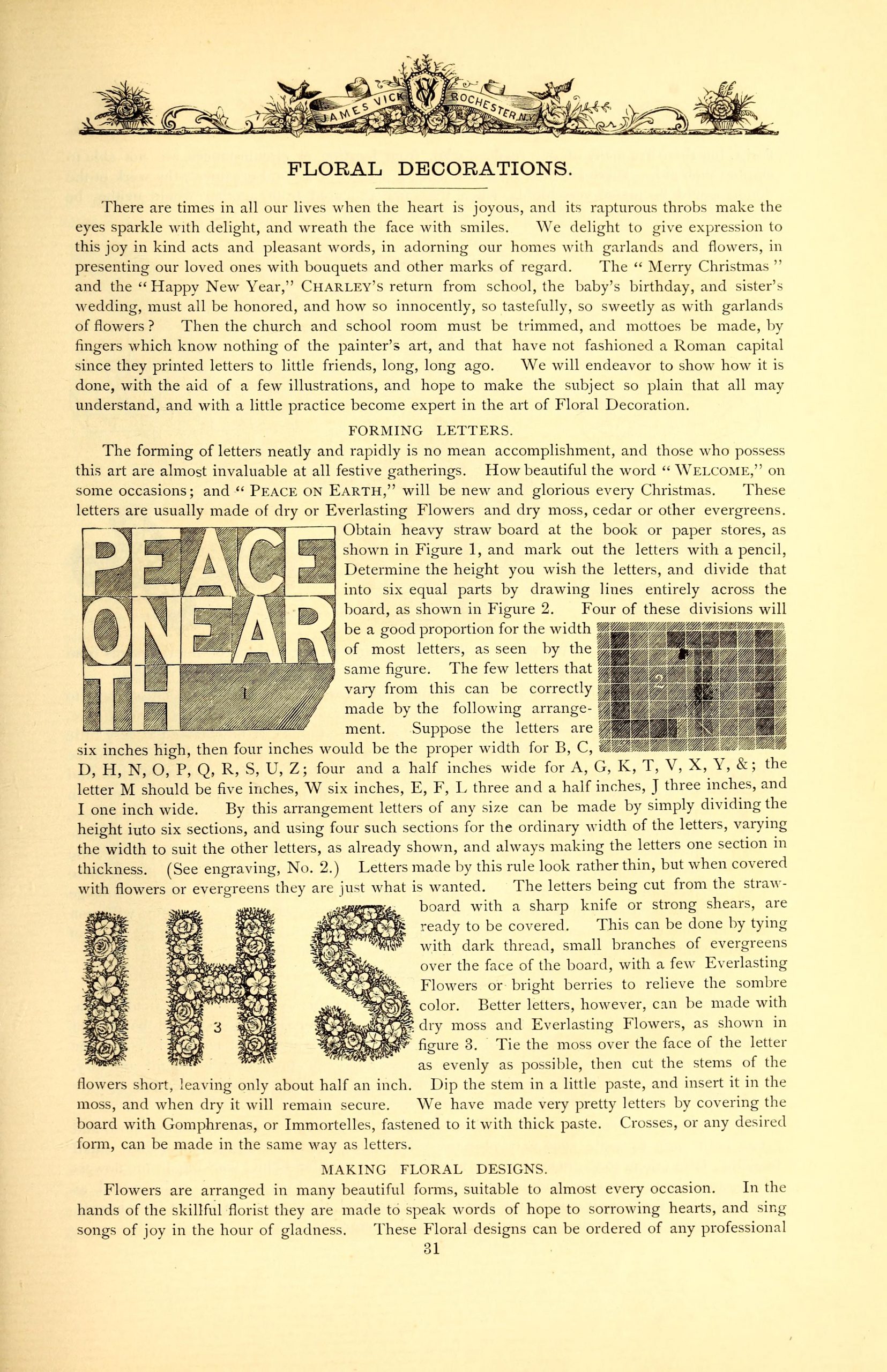 James Vick, Rochester, NY. Vick’s Flower and Vegetable Garden (1878), page 31, Forming Letters for Floral Decorations. Available online in the Biodiversity Heritage Library.
Another floral decoration is the button-hole flower or bouquet. The button-hole flower was simply that, a single flower with a “pretty, sweet-scented leaf” positioned behind it. Thread or string was used to attach the two together (below, bottom right), and then it was inserted into the bouquet holder which was already filled with water. To fasten the button-hole flower to clothing or hair, a pin was attached to the bouquet holder.
On the other hand, the button-hole bouquet was composed of “a few very fine flowers” (below, bottom left). Once the flowers were nicely arranged, the stems were covered with damp moss or cotton and then tinfoil. The button-hole bouquet was inserted into the bouquet holder or attached directly to clothing with a pin.
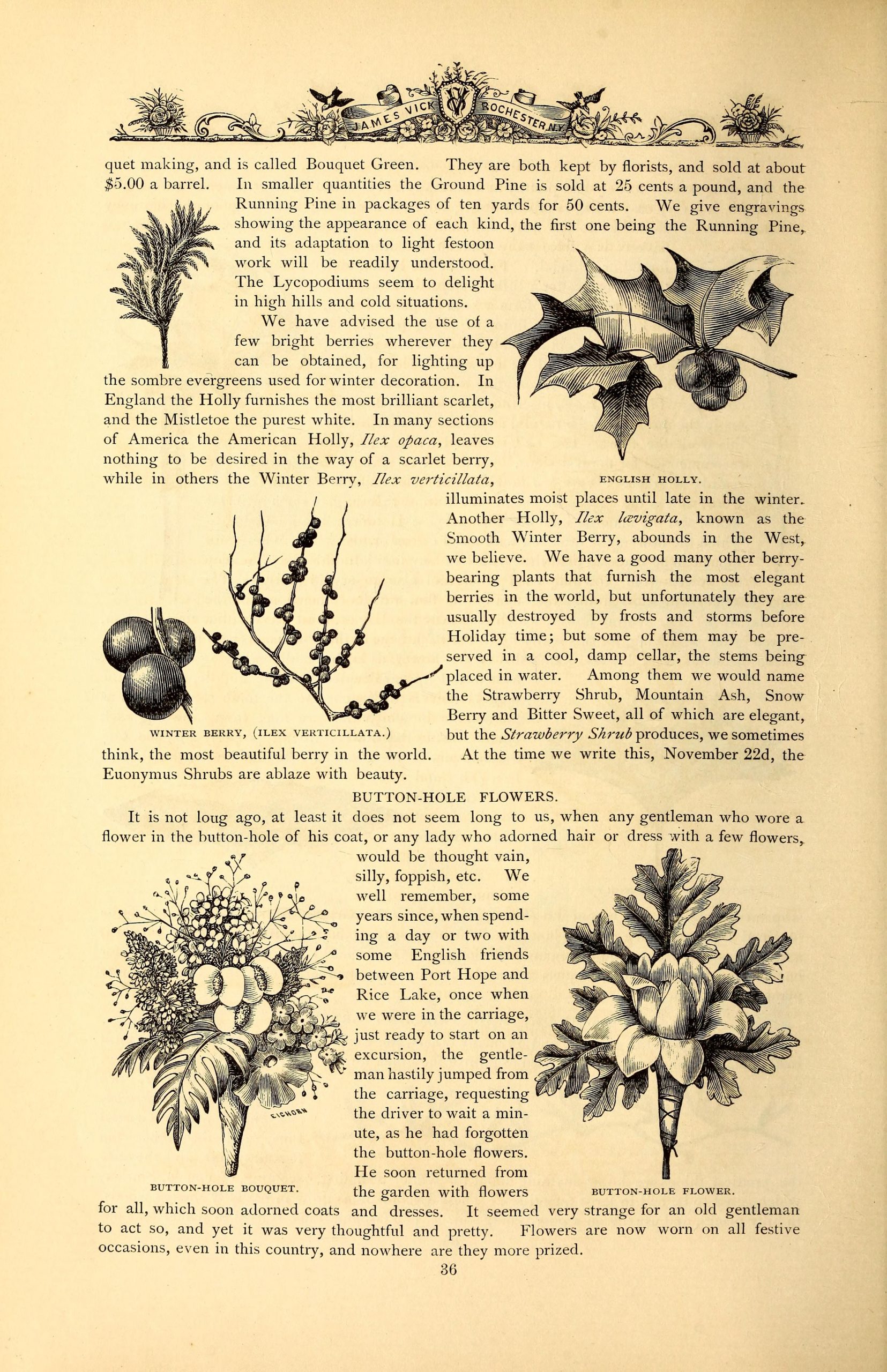 James Vick, Rochester, NY. Vick’s Flower and Vegetable Garden (1878), page 36, English Holly, Winter Berry (Ilex verticillata), Button-hole Bouquet, and Button-hole Flower. Available online in the Biodiversity Heritage Library.
Almost every page of Vick’s Flower and Vegetable Garden (1878) includes an illustration. With its conversational style and focus on learning, it encourages readers to try their hand at something new. This might be designing their own garden, planting a small garden in a window box, placing vases or ornamentation around the garden, or creating a floral decoration for a party. For reference purposes, it includes a handy “Botanical Glossary” and guide to “Pronouncing Vocabulary of Botanical Names.”
Towards the end, there are many pages illustrating and describing specific plants. A page focusing on “Classification and Names of Flowers” assists with understanding the divisions of plants as described in this catalog. These divisions include Annuals, Perennials, Greenhouse, Bulbs and Plants, and Holland Bulbs. There is also a section devoted to Vegetables. Detailed information for specific plants includes such things as descriptions, origin, and tips for planting. Every so often, the reader might stumble across a full-page illustration, like the Annuals shown below. Perhaps an illustration such as this might have inspired a bouquet or floral decoration to brighten a room for a holiday or special occasion.
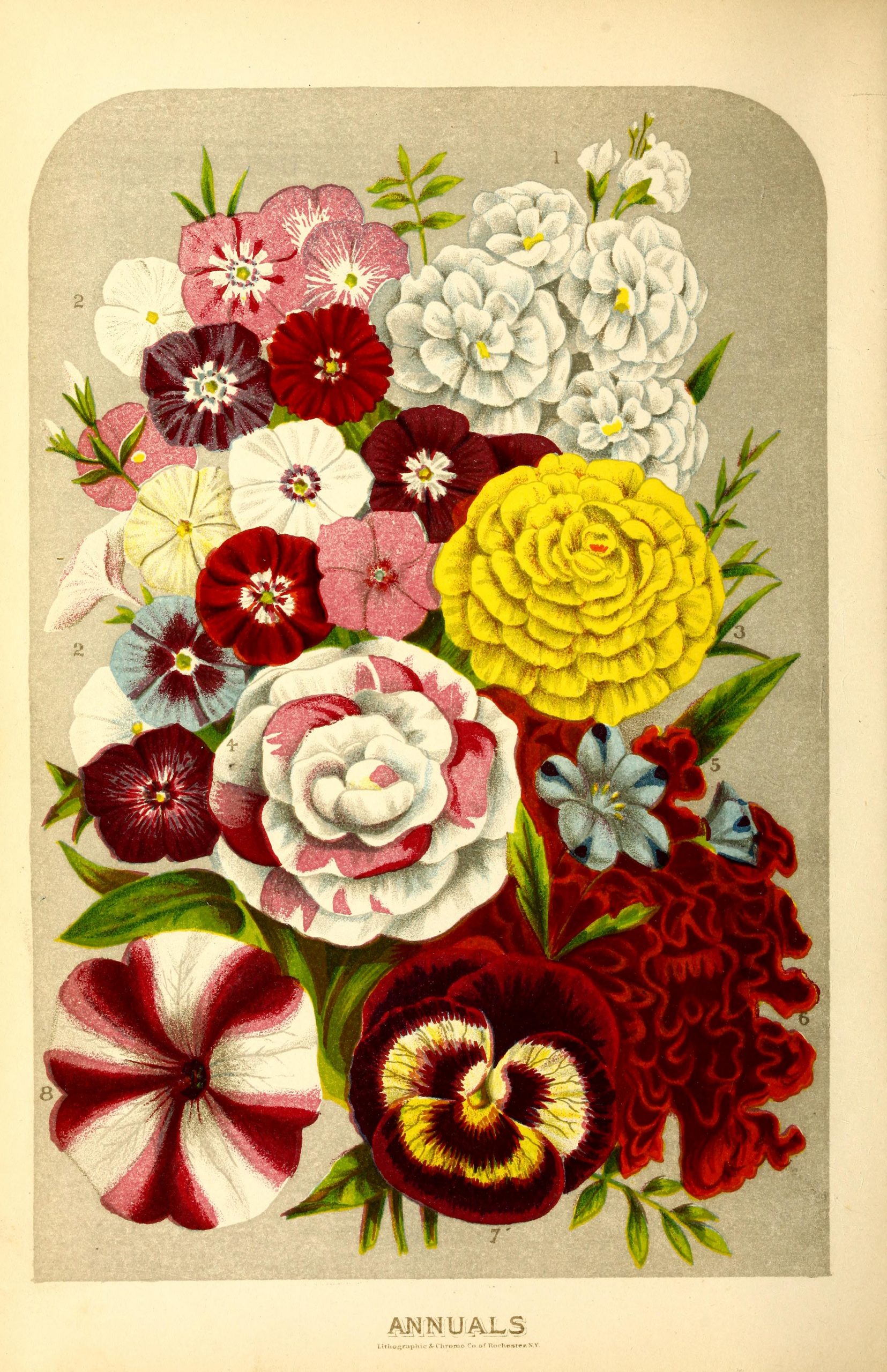 James Vick, Rochester, NY. Vick’s Flower and Vegetable Garden (1878), page preceding page 55, Annuals including (1) Ten-Weeks Stock, (2) Phlox drummondii, (3) Double Portulaca, (4) Balsam, (5) Nemophila, (6) Japan Cockscomb, (7) Pansy, (8) Striped Petunia. Available online in the Biodiversity Heritage Library.
Vick’s Flower and Vegetable Garden (1878) by James Vick is located in the Joseph F. Cullman 3rd Library of Natural History. A digitized version is available on the Biodiversity Heritage Library (BHL) and a Flickr album of its full-page illustrations is available on the BHL Flickr. For more information about James Vick, take a look at this BHL Blog post.
Other seed catalogs by James Vick’s Sons are located in a horticultural collection within the Trade Literature Collection at the National Museum of American History Library. For more information on one of these catalogs, take a look at this post about Vick’s Garden and Floral Guide (1898) by James Vick’s Sons.
Reference:
“Vick, James.” Biographies of American Seedsmen & Nurserymen, compiled by Marca L. Woodhams, Librarian, Horticulture Branch Library, Smithsonian Institution Libraries, December 1999. Accessed January 8, 2021. https://www.sil.si.edu/SILPublications/seeds/bios.html#Vick,%20James
Color Our Collections for 2021
Calling all coloring enthusiasts! #ColorOurCollections is back for 2021 and we have a brand new coloring packet just for you. We’ve teamed up with our colleagues at Smithsonian Institution Archives to bring you ten coloring pages to help break your winter boredom. Download them now!
During Color Our Collections, organized by the New York Academy of Medicine, cultural institutions from around the world provide inspiration and free coloring sheets for artists of all ages. At-home artists can share their creations on social media by tagging the organization and using the hashtag #ColorOurCollections. Our coloring book uses images that are freely available in our Digital Library, Biodiversity Heritage Library and Smithsonian Institution Archives Collections.
 Cover of Smithsonian Libraries and Archives #ColorOurCollections 2021Coloring Book. Download the full booklet.
Below, we’ll give you a bit more information about the coloring book images based on books and journals in our library collections. Curious about the Smithsonian Institution Archives images in the packet? Head over to The Bigger Picture blog to learn more!
“Die Insel”, Die entwicklung der modernen buchkunst in Deutschland (1901).
Otto Grautoff’s book Die entwicklung der modernen buchkunst in Deutschland (Development of the modern book in Germany) contains page after page of fascinating examples of German book illustration. This elaborate scene by Heinrich Vogeler of “Die Insel” (“The Island”) is no exception. If you’re interested in creating your own coloring pages, or just want to flip through fantastic examples of 19th and early 20th century illustration, Grautoff’s book in our Digital Library is a great starting point.
 Coloring page featuring “Die Insel”, in Die entwicklung der modernen buchkunst in Deutschland (1901). Download the full booklet.
“Design for Plate”, Keramic Studio, Volume 5 (1904).
Mrs. Dante C. Babbitt was one of many talented woman illustrators whose work was highlighted in Keramic Studio, a ceramics design journal started by Adelaide Alsop-Robineau in 1899. The original book page includes instructions for exactly what colors to use when applying this design. But if Apple Green and Deep Blue aren’t part of your preferred palette, feel free to choose your own shades.
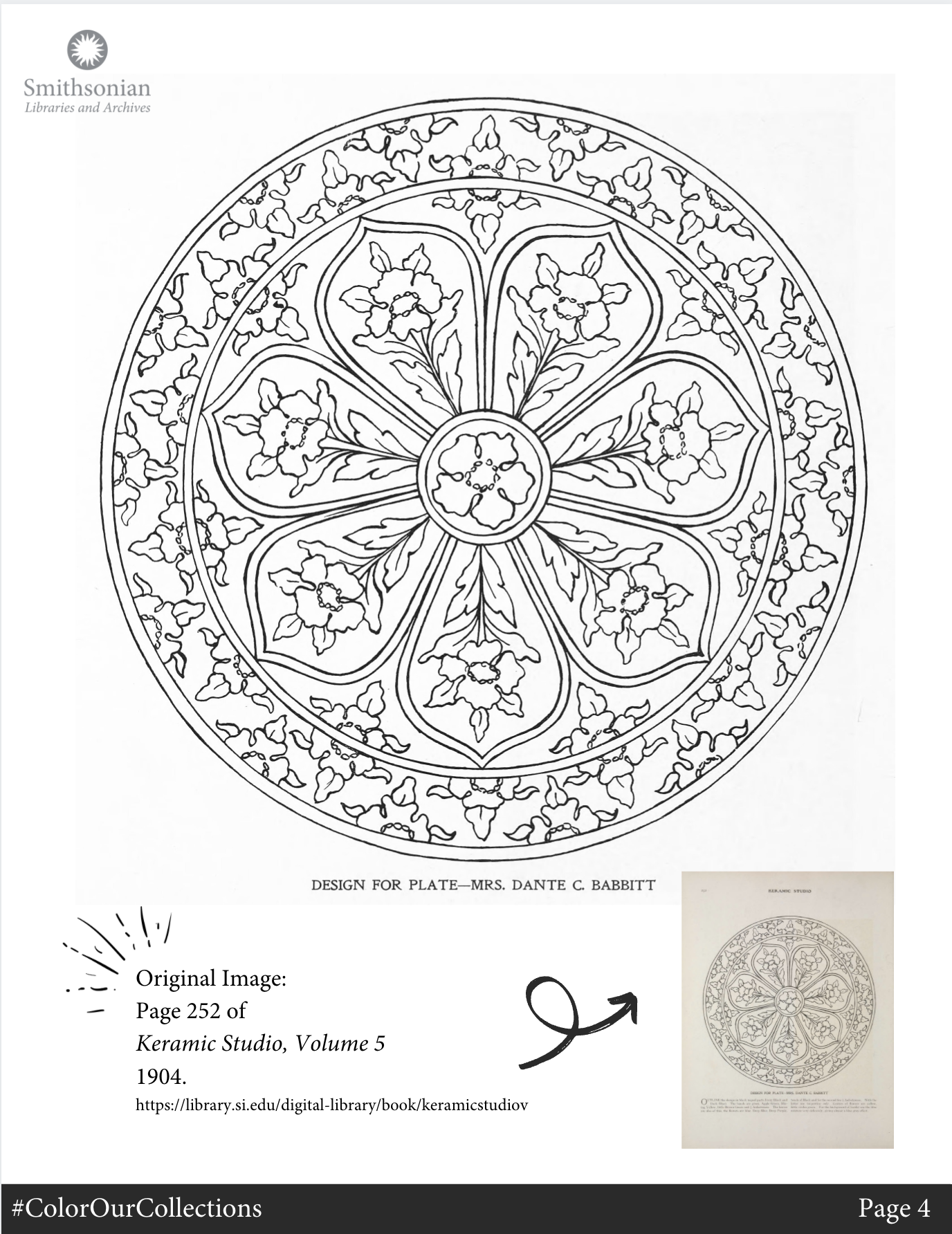 Coloring page for “Design for Plate”, Keramic Studio, Volume 5 (1904). Download the full booklet.
“Key to Terms in Glossary”, The Genus Rosa, Part III , 1910.
With The Genus Rosa (1910-1914), English horticulturalist Ellen Ann Willmott brought together information about known rose species from a multitude of sources. The work was illustrated by Alfred Parsons, a prominent English illustrator, landscape painter and garden designer. Two volumes are available in the Biodiversity Heritage Library.
 Coloring page for “Key to Terms in Glossary”, The Genus Rosa, Part III , 1910. Download the full booklet.
Plate IX, Gothic Alphabets, 1897.
In 2019, Smithsonian Libraries staff members Morgan Aronson and Lilla Vekerdy published Abecedarium: An Adult Coloring Book for Bibliophiles , part history, part coloring book, and part guide to historic books. Where possible, the rare books featured in Abecedarium were digitized cover-to-cover and made available in our Digital Library. Among them, Gothic Alphabets, published in 1897 by International Chalcographical Society with text by Jaro Springer.
 Coloring page for Plate IX, Gothic Alphabets, 1897. Download the full booklet.
“Il Pleut Encore . . .” Gazette du Bon Ton, Tome II 1915.
Rainwear, but make it fashion. This illustration (“It’s still raining . . .) by artist Valentine Gross Hugo is a wonderful example of how anything could be chic when seen through the lens of French periodical Gazette du Bon Ton. The art and style journal was published by Lucien Vogel between 1913 and 1925.
 “Il Pleut Encore . . .” Gazette du Bon Ton, Tome II 1915. Download the full booklet.
You’ll rarely hear us say this but in this instance it’s true: We hope you enjoy coloring in our books! Share your creations via social media and tag us (@SILibraries on Twitter and Instagram). We can’t wait to see what vibrant combinations you come up with.
Summer 2021 Virtual Internships Available
The Smithsonian Libraries and Archives has just opened applications for virtual, paid internships for Summer 2021 through our 50th Anniversary Internship Program. The projects are in a variety of subject areas and are open to both undergraduate and graduate students. Application deadline is March 1, 2021.
Each unique project offers an opportunity to explore current topics in archives, libraries and information science and learn from experienced Smithsonian Libraries and Archives staff in a virtual environment.
Projects include:
- Advancement: delve into online donor engagement and stewardship by assisting with digital marketing and donor relations
- Born Digital Collections: learn how to extract and analyze metadata from born digital holdings and develop and implement a preservation treatment plan for this type of material
- Cataloging: explore bias in current Library of Congress Subject Headings and help make collections description more open, accurate, and inclusive
- Communications: learn how the Smithsonian Libraries and Archives shares its collections and programs with various audiences by evaluating and creating marketing and social media content
- Digital Curation: contribute to the creation of digital resources and exhibitions about the history of Smithsonian women in science by learning how to manage a dataset, developing biographies and researching representation in data
See complete program details and application instructions on our 50th Anniversary Internship page. Learn more about academic appointments and related policies on our Internship and Fellowship page.
Curious about the work of past interns? Read more about their experiences.
Funding for the 50th Anniversary intern class was provided by the Secretary of the Smithsonian and the Smithsonian National Board.
The Prickly Meanings of the Pineapple
The pineapple, indigenous to South America and domesticated and harvested there for centuries, was a late comer to Europe. The fruit followed in its cultivation behind the tomato, corn, potato, and other New World imports. Delicious but challenging and expensive to nurture in chilly climes and irresistible to artists and travelers for its curious structure, the pineapple came to represent many things. For Europeans, it was first a symbol of exoticism, power, and wealth, but it was also an emblem of colonialism, weighted with connections to plantation slavery.
Originating from the region around the Paraná and Paraguay Rivers (present-day Brazil, Paraguay, and Argentina), it was an important economic plant in the development of Indigenous civilizations in the Americas. The Tupi-Guarani and Carib peoples called the fruit, a staple crop, nanas (excellent fruit) and several varieties were grown. As well as food, the pineapple was a source of medicine, fermented to become alcohol, its fibers made into robes and bow strings and thread for cloth.
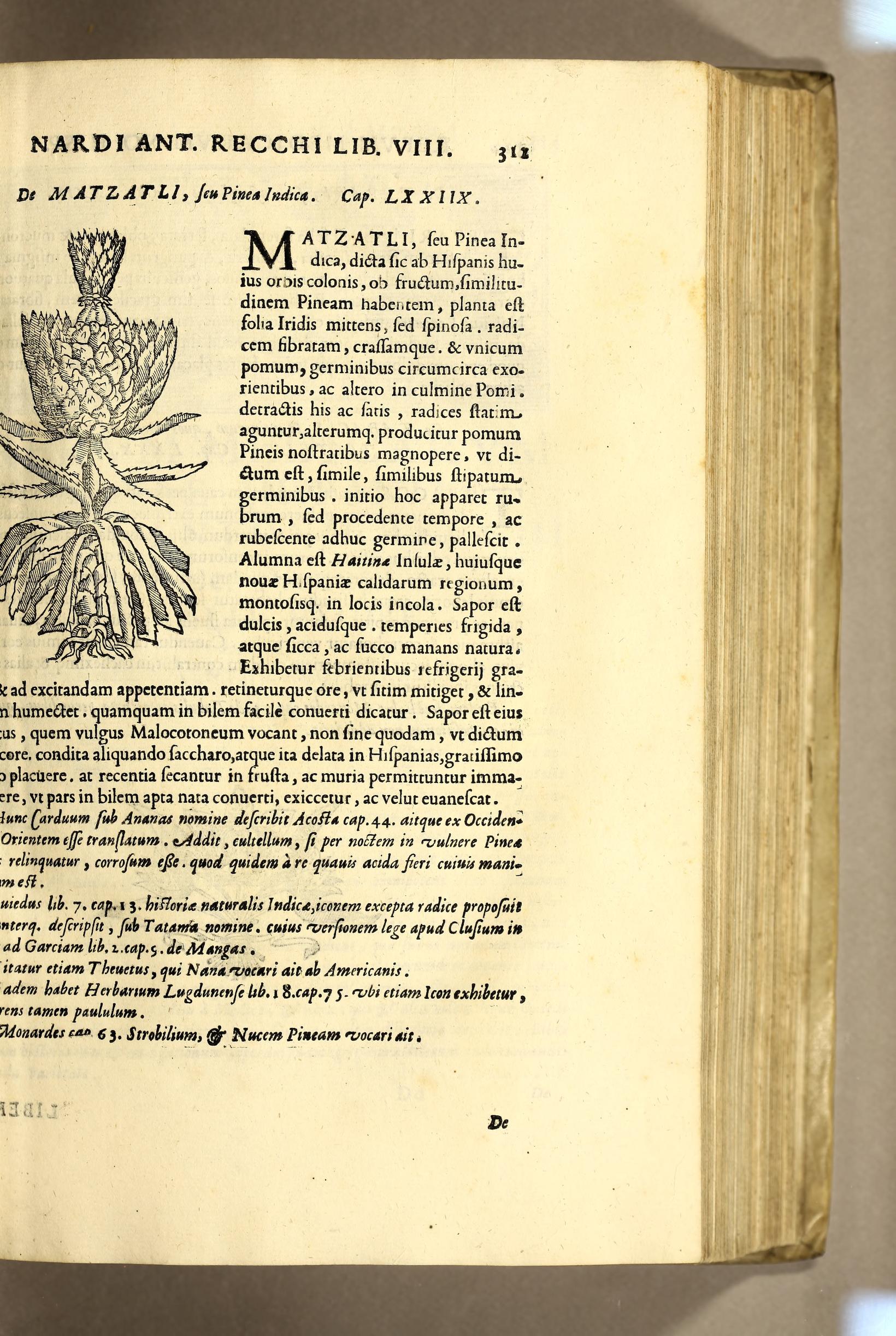 The Aztec word for pineapple is matzatli as seen here is Francisco Hernández’s, Nova Plantarum, Animalium et Mineralium Mexicanorum Historia (1651). The Mayans also cultivated the plant. Image from the Biodiversity Heritage Library. Contributed by John Carter Brown Library.
From South America, the cultivated pineapple spread to Central America, Mexico, and the Caribbean. Christopher Columbus encountered the pineapple (Ananas comosus, of the extensive bromeliad family) in the West Indies on the island he named Guadeloupe in November 1493.
Columbus may have brought one back successfully to Spain, although pineapples tended to rot on the long return voyages across the Atlantic. He called it piña de Indes (“little pine of the Indians”) for its resemblance to the pinecone and declared it “the most delicious fruit in the world.” For the Spanish-Italian historian Pietro Martire d’Anghiera, not unreasonably, the pineapple resembled the artichoke. This author of De Orbe Novo (On the New World, 1530) found it “not unworthy of a king’s table.” The early European explorers and colonizers were enamored with it, often praising the pineapple in their chronicles of their voyages. The first identified illustration of the pineapple is in the historian Oviedo’s Historia General de las Indias of 1535, where it is again connected with royalty as “the prince of all fruits.”
Gonzalo Fernández de Oviedo y Valdés‘ Historia General de las Indias, folio lxxvi (verso) woodcut illustration (Seville, 1535; link). The author was a keen chronicler of what was new from the New World to Europe. Image from the Biodiversity Heritage Library. Contributed by Missouri Botanical Garden, Peter H. Raven Library.
This pineapple became a treasured possession in Europe, but it was of practical use for sailors in tropical regions, who were vulnerable to developing scurvy from a lack of vitamin C during long voyages. They observed the healthful effects of eating pineapple, even though the connection between the devastating disease and diet deficiencies was not yet scientifically understood. The Portuguese introduced the fruit (that they called abaxaci) to their colonies in Africa, India, and perhaps other parts of Asia in the mid-sixteenth century. For Tamil-speaking peoples, pineapples were known as annachi pazham.
It was much later that the intriguing tropical fruit was able to be grown in cold climates with the development, at huge costs, of glass houses and their reliable heating systems to warm the air and soil continuously. The fruit needed a controlled environment, run by complex mechanisms and skilled care, to thrive in Europe. Pineapples, thus, became a class or status symbol, a luxury available only to royalty and aristocrats. The fruit appeared as a centerpiece on lavish tables, not to be eaten but admired, and was sometimes even rented for an evening. The pineapple was also a symbol of colonialism, one of the trophies brought back from conquered territories.
The pineapple can be said to first appear in England by way of the printed title page of John Parkinson’s Paradisi in sole paradisus terrestris (Park-in-Sun’s Terrestrial Paradise) of 1629. In its representation of the Garden of Eden, the fruit takes prime spot in between the valuable and wildly fashionable tulips. This may be a symbol of temptation for Adam, as there was also an erotic, seductive association in contrast to the staid, old apple. The pineapple was the fruit of the new Eden, the New World. In his Theatrum Botanicum of 1640, the botanist Parkinson provided a description: “Scaly like an Artichoke at the first view, but more like to a cone of the Pine tree, which we call a pineapple for the forme … being so sweete in smell … tasting … as if Wine, Rosewater and Sugar were mixed together.”
 Paradisi in sole paradisus terrestris, or, A garden of all sorts of pleasant flowers (London, 1629). Image from the Biodiversity Heritage Library. Contributed by Research Library, The Getty Research Institute.
Richard Ligon, part-owner of a sugar plantation run with enslaved labor, in his A True & Exact History of the Island of Barbadoes (1657), was fascinated with the pineapple he found there: “When this fruit is grown to a likeness, you shall perceive it by the smell, which is far beyond the smell of our choicest fruits of Europe, as the taste is beyond theirs.” The kitchen gardens of Caribbean plantations grew pineapples to supply the white households. Ligon tried to import plants back to England, but they did not survive the voyage. Since Columbus, Jamaica had been a possession of Spain, but the British Navy seized the island in 1655. Hans Sloan in his Voyage to the Islands of Madera, Barbados, Nieves, S. Christophers and Jamaica (1707-1725) reported:
“The Fruit is planted and us’d by way of desert (having a very fine flavor and tast[e]) all over the hot West-Indies, either raw or, when not yet ripe, candied, and is accounted the most delicious Fruit these places, or the World affords … The slices are soaked in Canary [a sweet wine] to take the sharpness which commonly otherwise inflames the Throat, and then they are eaten.”
 A True & Exact History of the Island of Barbadoes, by Richard Ligon (London, 165). Image from the Biodiversity Heritage Library. Contributed by John Carter Brown Library.
In the 1680s, Pieter de la Court, with the help of his gardener, Willem de Vink, attempted to cultivate the tropical plant at an estate near Leiden, and this effort is sometimes credited with being the first for growing one in Europe. But it was the remarkable woman, botanist, collector, and patron Agneta Block who achieved the first success with fruiting the pineapple from a slip. This took place in 1687 in a hothouse at her country house, Vijverhof, located between Amsterdam and Utrecht.
The pineapple can be viewed as an early example of a global commodity. And of slavery with the unfathomable number of enslaved Africans brought to the New World. The Dutch had started exporting the fruit to the Netherlands and Surinam, their colony in Guianas. A ship’s captain first managed to transport the plant to the botanical gardens of Amsterdam and Leiden in 1680. Surinam became wealthy in trading humans and was marked by its brutal plantations. Cash crops grown in the Americas for trade—sugar cane, tobacco, coffee, rice, for example—relied on enslaved labor as well as local expertise. In two successive plates of Metamorphosis insectorum Surinamensium, the famed naturalist and artist Maria Sibylla Merian gave prominence to the fruit. She had sailed to Dutch Surinam in 1699 to study tropical insects. There, for two years, she relied on enslaved African and Indigenous peoples as guides, household help, and sources for botanical information.
 “Pineapple with Cockroaches,” the first plate in Metamorphosis insectorum Surinamensium by Maria Sibylla Merian (Amsterdam, 1705).
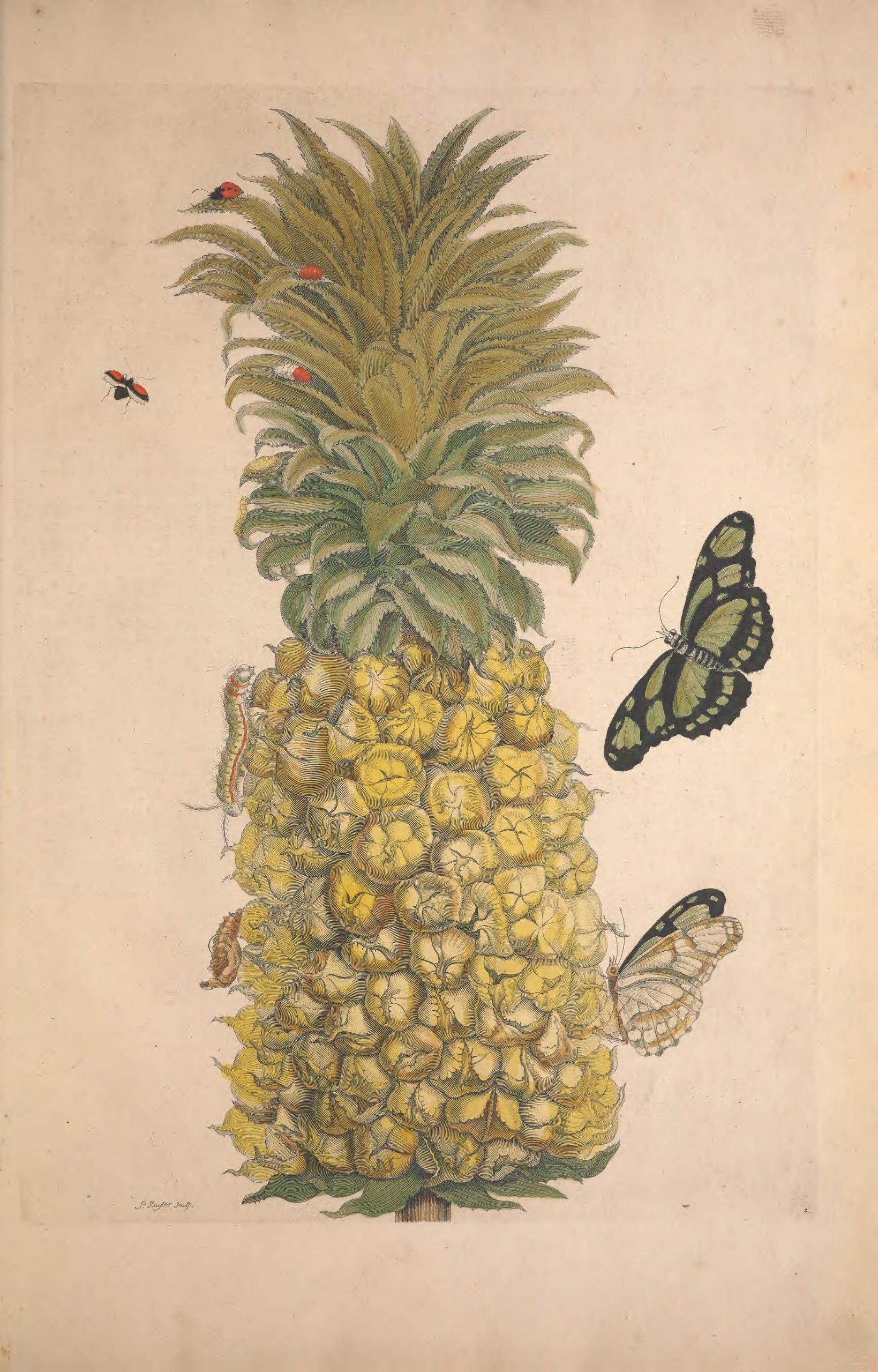 “Ripe Pineapple with Dido Longwing Butterfly” in Metamorphosis insectorum Surinamensium . Maria Sibylla Merian described Ananas comosus as producing “the most outstanding of all edible fruits.”
It was in a German book solely devoted to citrus fruits that the pineapple was illustrated in a manner reflecting its exalted position as symbol of social status and refined collecting. Johann Christoph Volkamer’s Nürnbergische Hesperides (The Garden of Hesperides at Nuremberg) contains wonderfully inspired, dreamlike images from the author’s garden ‘Gostenhof’ and its orangeries. Untethered, fruits float above various etched scenes of elaborate gardens of the Alps and Italy, country landscapes, villas, and seaports. There are five uncolored, double-size plates of pineapple, the “Queen of Fruits,” elements of which show the artist’s debt to Merian and her scientific observations (one almost a mirrored image). However, the Nürnbergische Hesperides is very much of the world of the merchant Volkamer, one of the few of the time who had the means and interests to both nurture exotic fruits and undertake such an opulent publication, a more lasting testament to the aristocrat’s cultivation and refinement.
 The pineapple plates of Nürnbergische Hesperides (1708-1714) appear in the second volume (link), Continuation, here with a hairy spider, a reference to Metamorphosis insectorum Surinamensium. Image from the Biodiversity Heritage Library. Contributed by Wellcome Library.
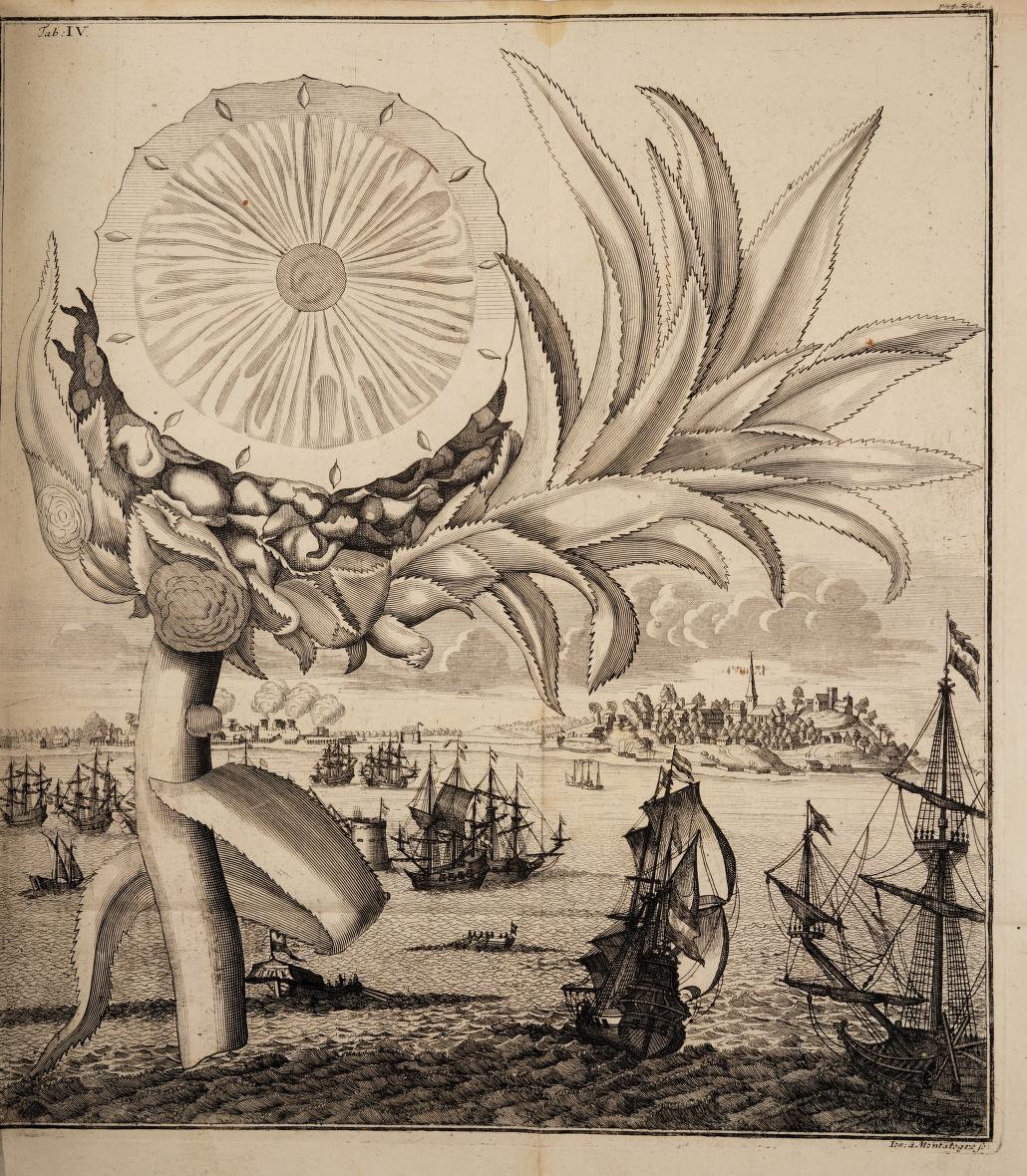 One of the imaginative pineapple plates from Nürnbergische Hesperides (volume two of 1714) above a bustling port scene with tall ships, suggesting its importation from foreign lands. Image from the Biodiversity Heritage Library. Contributed by Wellcome Library.
The pineapple became fashionable in England after the arrival in 1688 of the Dutch King, William III and Queen Mary, daughter of James II, who were keen horticulturalists and, not incidentally, accompanied by skilled gardeners from the Netherlands. Pineapples were soon grown at Hampton Court. The hothouses in Great Britain became known as pineries. With its distinctive form, the cult of the pineapple extended to architecture and art. Carved representations sit atop the towers of St. Paul’s Cathedral in London and other prominent buildings, perhaps an adaptation or reference to the pinecones used on ancient Roman buildings.
Most famously, John Murray, the fourth Earl of Dunmore in Scotland, had a stone-carved pineapple sitting atop his folly or summerhouse perhaps around 1761. The reason for that massive construction is unknown (although certainly boastful), as is the architect. The fruit had been grown in Scotland since 1732. The hapless, diplomatically inept Dunmore was the last Colonial Governor of Virginia and in that colony’s capital, Williamsburg, the pineapple had also become fashionable and a common motif in decorative arts. It was there that Dunmore incurred the wrath of George Washington in 1775 by proposing to arm his own 56 enslaved people as well to grant freedom to Black Loyalists.
During the 18th century, the pineapple was established as a symbol of hospitality, with its prickly, tufted shape incorporated in gateposts, door entryways and finials and in silverware and ceramics. The motif continues, prevalent in Christmas decorations in Williamsburg today. But with pride of place on the lavish dining tables of enslavers in North America, the pineapple continued its association with slavery. George Washington, who first encountered the pineapple at the plantations of Barbados, had them imported from the West Indies, a port in the triangular trade of enslaved Africans.
 The 37-foot-high Dunmore Pineapple, the north front, showing the entrance (photograph by Keith Salvesen from geograph.org.uk (via Wikimedia Commons)
With technological developments in growing and preserving throughout the wealthy 18th century, the tropical fruit, once an expensive novelty, became a more common commodity in Europe. Helping to make the pineapple more accessible by describing cultivation methods in Great Britain were the writings of Richard Bradley, Philip Miller and William Speechly. The Reverend William Smith in A Natural History of Nevis and the Rest of the English Leeward Charibee Islands in America (1745) declared that “Ananas, or Pine-Apples, are so common at Chelsea and other fine Gardens here in England, that they need no description, and I shall refer you to Laurence Miller, Sir Hans Sloane, and other books that treat of Gardening.”
Returning to the thought of the pineapple as a symbol of globalization, the Spanish had brought the pineapple to Hawaii sometime by the late 18th to early 19th century. The first commercial crop enterprise was established there in 1886 and others soon followed, often settling on land stolen from the Hawaiian people. A plantation system was developed, exploiting workers, both Indigenous and imported. With cheap labor and new canning technology, Hawaii quickly became the dominant market for pineapples in the world. With extensive advertising, the fruit evolved into a cliche of the Islands. But the big agricultural companies began moving their operations out of Hawaii to Asia and Central America for cheaper land, transportation, and labor in the 1970s. The pineapple’s reign as an economically important and popular fruit throughout the world was firmly in place.
The vast literature of accounts of the pineapple by travelers, explorers, plant enthusiasts, those in the plant and nursery trade, and gardeners— so taken with the distinctive plant— can be found and further studied in the Biodiversity Heritage Library. The pineapple’s distribution throughout the world is told in so many works, reflecting a range of histories— botanical, horticultural, historical, cultural, economic, architectural, and art— in a single tropical fruit. There is much for plant scholars, scientists, historians, artists, and others to discover in the digitized works, tracing the biodiversity and meaning of the pineapple. It still evokes a balmy, tropical paradise and the wondrous beauty of the natural world. As the 17th-century Dutch businessman Pieter de la Court declared, “One can never be tire’d with looking at it.”
 Hand-colored engraving by Johann Jacob Haid after Georg Dionysius Ehret. Plantae Selectae Quarum Imagines ad Exemplaria Naturalia Londini, in Hortis Curiosorum Nutrita. (Nuremberg, 1750-1773). Image from the Biodiversity Heritage Library. Contributed by Missouri Botanical Garden, Peter H. Raven Library.
Julia Blakely
Cape Cod, Massachusetts
Former Smithsonian Librarian
For more in-depth information of the pineapple, a few of the works in the Smithsonian Libraries collections:
The pineapple: botany, production and uses, edited by D.P. Bartholomew, R.E. Paull, and K.G. Rohrbach. c. 2003.
Pineapple culture: a history of the tropical and temperate zones, by Gary Y. Okihiro, c. 2009.
Fifty plants that changed the course of history, by Bill Laws. 2010.
Pineapple: a global history, by Kaori O’Connor. 2013.
For further reading on the history of pineapple production:
Jesse Rhodes, “It’s Pineapple Season, But Does Your Fruit come from Hawaii?” Smithsonian Magazine.
Digital Jigsaw Puzzles: January Edition
Another season, another set of digital jigsaw puzzles! Ahead of National Puzzle Day (January 29th), we’ve put together one more round of images for you to piece together. They include a few snowy scenes as well as some warmer images to brighten your winter months.
Play them right here on our blog or use the links to play full screen. Each puzzle is set at about 100 pieces but they are customizable to any skill set. Click the grid icon in the center to adjust the number of pieces. All of the images are freely available in our Digital Library, Image Gallery, Biodiversity Heritage Library or Smithsonian Institution Archives Collections. Feel free to explore and make your own!
Miss our previous puzzles? See “Digital Jigsaw Puzzles” and “Digital Jigsaw Puzzles: Fall Edition”.
“Victorian Garden in the South Yard”, Record Unit 95, Box 31, Folder 20, Smithsonian Institution Archives
This photograph of a garden urn with floral arrangement was taken by Charles Sandy Brenner in 1976 while documenting the Victorian Garden in the South Yard. The garden was located behind the Smithsonian Institution Building, or Castle, in the space that is now the Enid A. Haupt Garden. Developed by the Office of Horticulture, the design for the Victorian Garden was based on the horticultural displays at the 1876 Centennial Exhibition in Philadelphia. Fair warning: this black and white photograph is probably our toughest puzzle yet!
Play online: https://jigex.com/DS2m
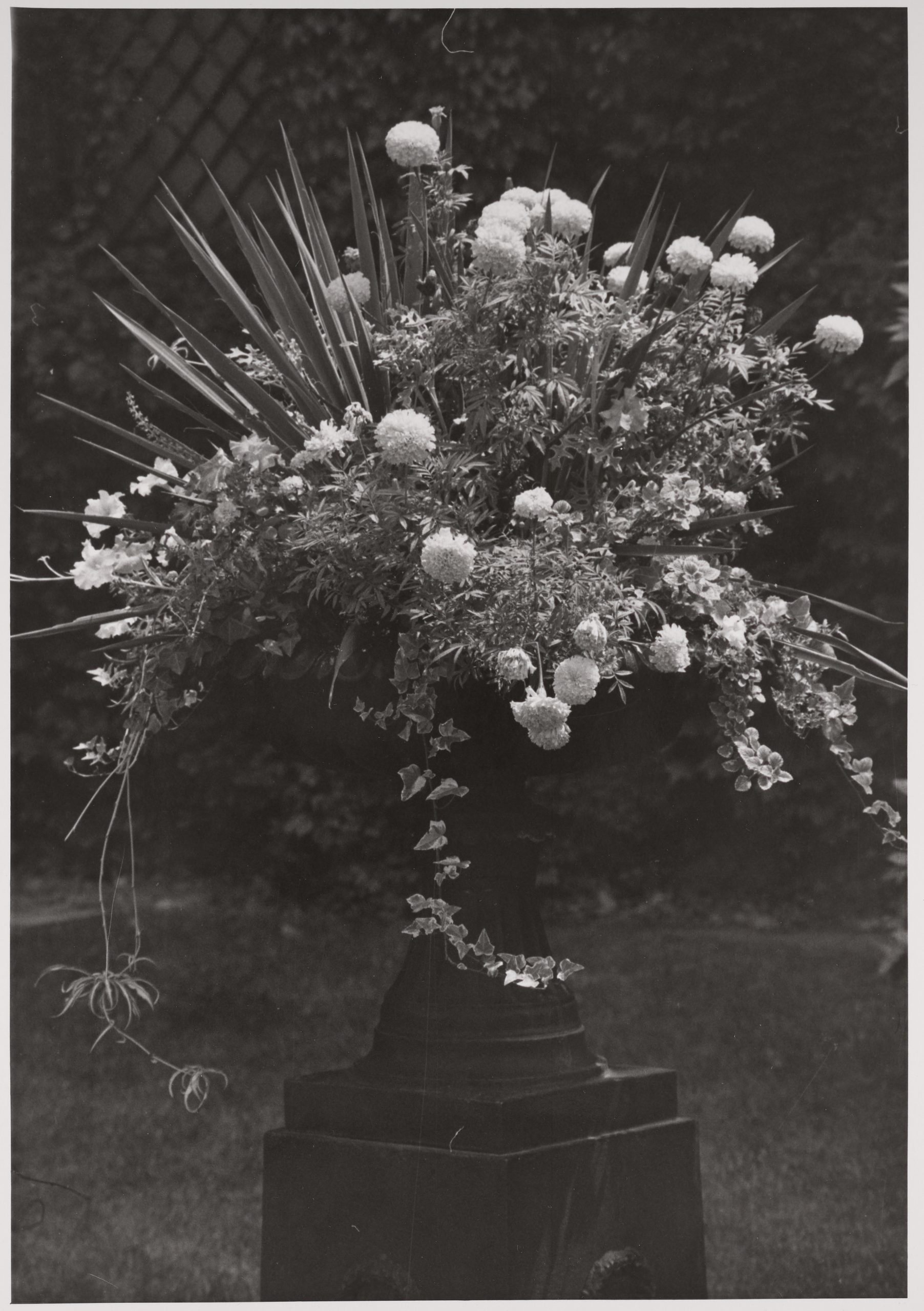 “Victorian Garden in the South Yard,” 1976, by Charles Sandy Brenner. Smithsonian Institution Archives, Record Unit 95, Box 31, Folder 20, Image no. SIA_000095_B31_F20_007, detail.
Jigsaw Puzzle
Front Cover, John A. Salzer’s Catalogue of Plants and Seeds (1895)
The Smithsonian Libraries and Archives holds more than 10,000 seed and nursery catalogs dating from 1830 to the present. This example from John A. Salzer Seed Co., likely distributed in early autumn of 1895, advertised bulbs to keep your garden colorful in winter. With special handling, varieties of crocus, daffodils and hyacinth can bloom in the colder months.
Play online: https://jigex.com/auap
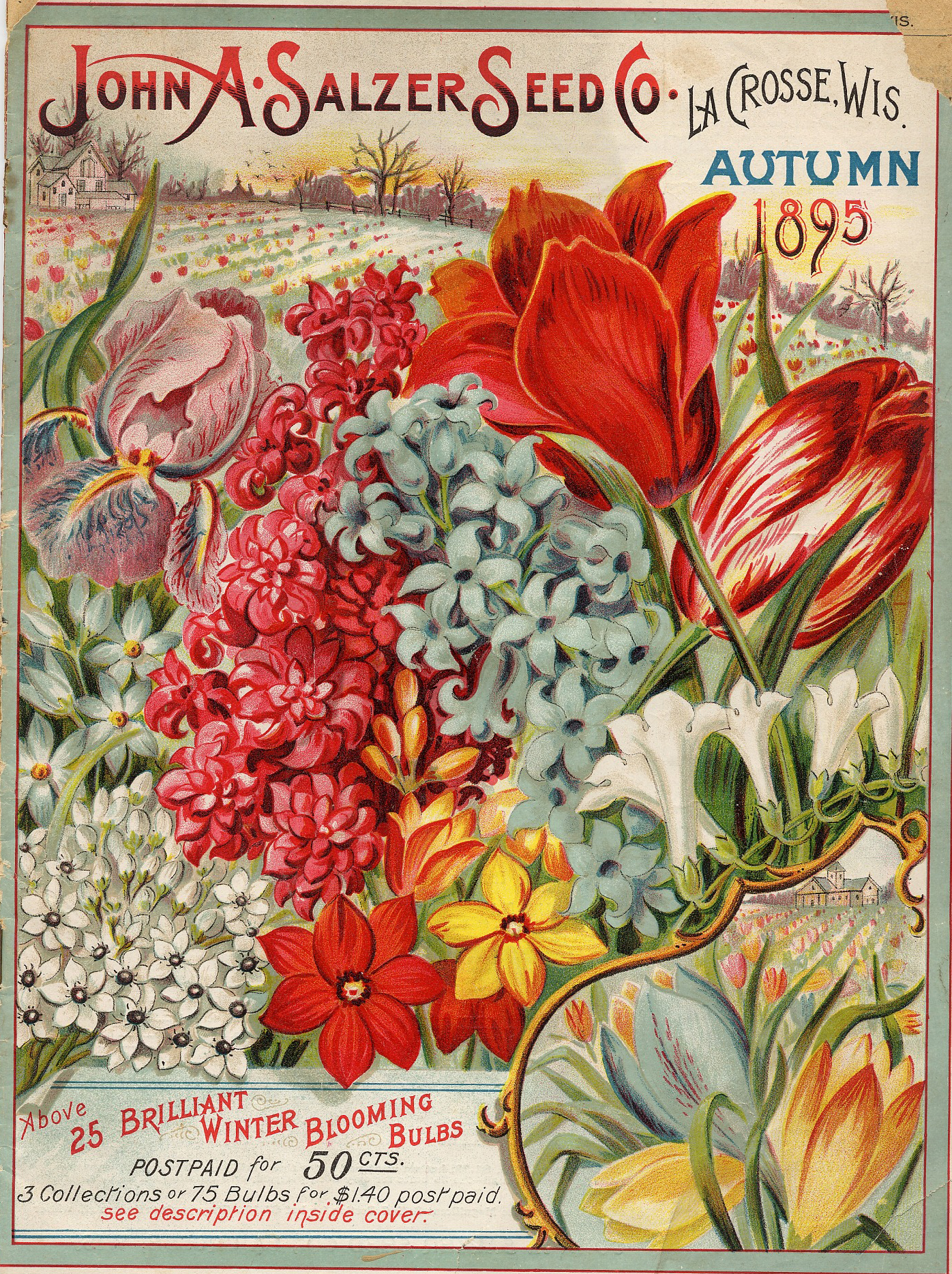 Front Cover, John A. Salzer’s Catalogue of Plants and Seeds (1895)
Jigsaw Puzzle
Plate LIV, “Renaissance”, Polychromatic Ornament (1877)
Need some inspiration for an upcoming craft or art project? Auguste Racinet’s Polychromatic Ornament (1877) might have just the pattern or design motif you didn’t know you needed. Racinet’s work was considered a masterpiece in chromolithography. It featured 100 plates illustrating various styles of art through history.
Play online: https://jigex.com/Ghhg
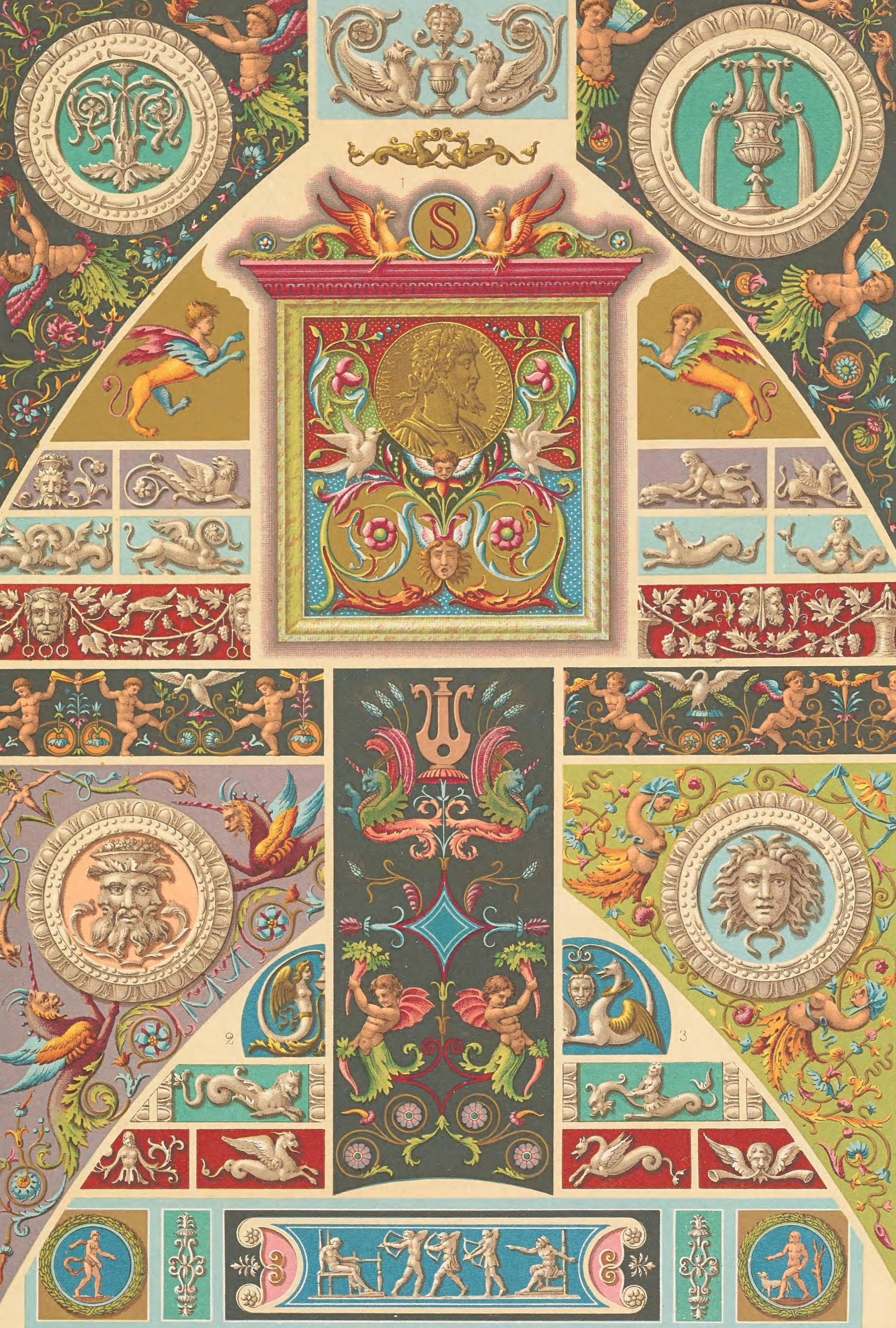 Plate LIV, “Renaissance”, Polychromatic Ornament (1877)
Jigsaw Puzzle
Winter scene, Tokaido Gojusantsugi Zokuga [Edo period, 1600-1868]
Some of Japanese artist Hiroshige Ando’s most famous works are 53 Stations of the Tokaido, a series of woodcut prints showing stations on the Tokaido road that linked Kyoto and Edo (now Tokyo). This winter scene is a town of Ejiri, looking towards Shimizu Port in the distance. Tokaido Gojusantsugi Zokuga is one of the many Japanese illustrated books from the Edo and Meiji periods available in our Digital Library.
Play online: https://jigex.com/W84B
 Winter scene, Tokaido Gojusantsugi Zokuga [Edo period, 1600-1868]Jigsaw Puzzle
“Irish Wolfhound”, The Book of Dogs: An Intimate Study of Mankind’s Best Friend [c. 1919]
Raise your hand if you’ve been spending a lot more time with your canine companions these past few months? We love how artist Louis Agassiz Fuertes captures the relationship between a lovable Irish Wolfhound and his human friend in this illustration from The Book of Dogs: An Intimate Study of Mankind’s Best Friend available in Biodiversity Heritage Library. The book was written by both Fuertes and Ernest Harold Baynes. Fuertes was a talented natural history artist, best known for his ornithological illustrations.
Play online: https://jigex.com/PbYT
 “Irish Wolfhound”, The Book of Dogs: An Intimate Study of Mankind’s Best Friend [c. 1919]Jigsaw Puzzle
“Roses”, New Illustration for the Sexual System of Carolus von Linnaeus (1807)
“Roses” is one of many gorgeous plates in the third volume of Robert John Thornton’s New Illustration for the Sexual System of Carolus von Linnaeus, a steamy name for a book on plant reproduction by a middle-aged doctor. With its grand illustrations, this final volume of the title is commonly known as “The Temple of Flora”. Published at the height of Romanticism, the unusual botanical plates, slightly moody and ethereal, made the book famous.
Play online: https://jigex.com/jbaA
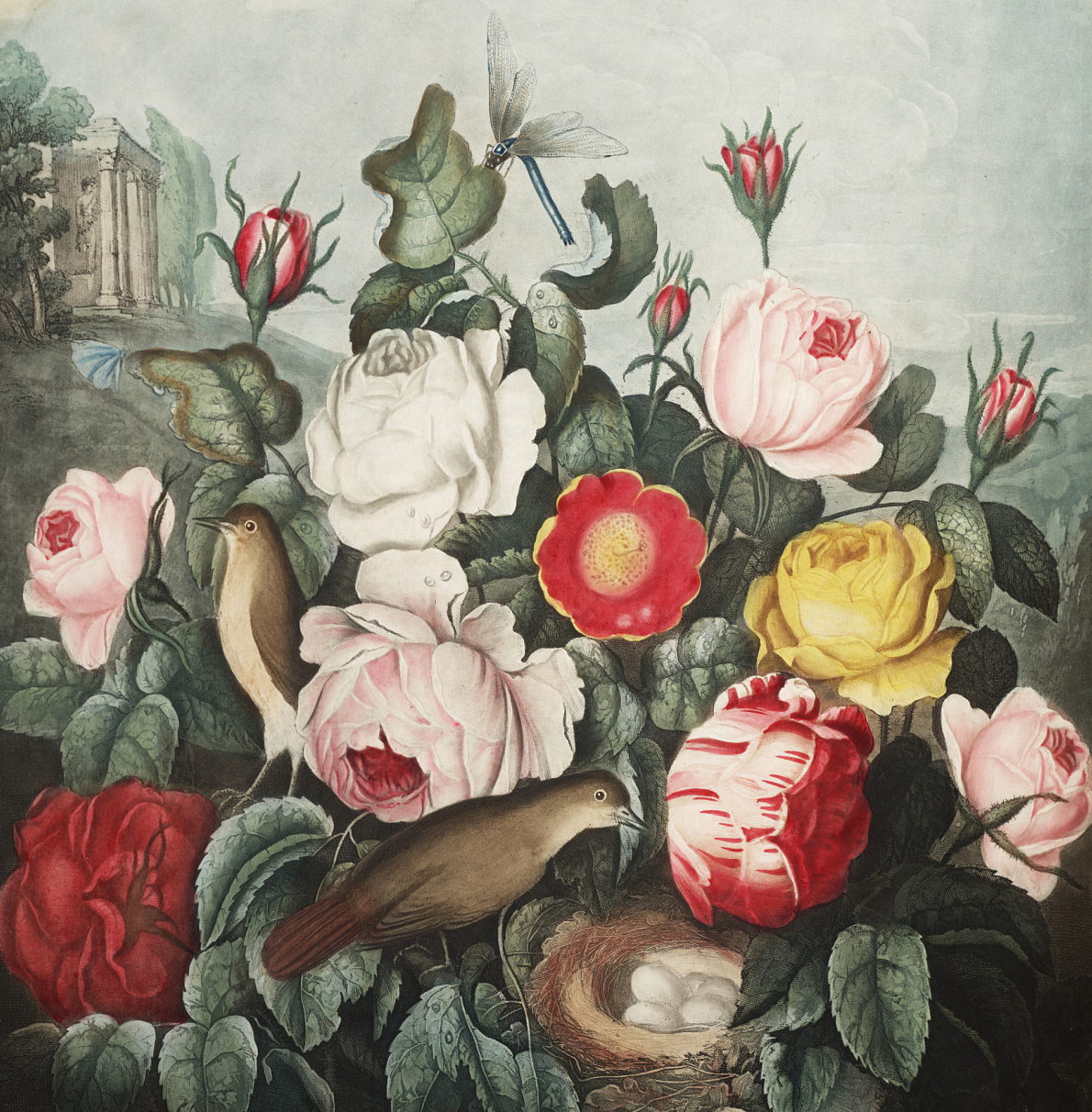 “Roses”, New Illustration for the Sexual System of Carolus von Linnaeus (1807)
Jigsaw Puzzle
The Staple of Libraries Past
With the beginning of a new semester, many students will resume research. Today we might be familiar with electronic resources and online library catalogs, but in the past people searched for and located library materials in a different way. Let’s take a look at the card catalog.
Classified Illustrated Catalog of the Library Department of Library Bureau (1899) by Library Bureau is packed with illustrations and descriptions of library supplies and equipment. This includes card catalogs and related accessories.
 Library Bureau, Boston, MA. Classified Illustrated Catalog of the Library Department of Library Bureau (1899), front cover.
 Library Bureau, Boston, MA. Classified Illustrated Catalog of the Library Department of Library Bureau (1899), title page.
The card catalog was a case of drawers or trays filled with a series of cards cut to exact dimensions. Each card noted bibliographic information about a specific book. Cards were filed in a pre-determined sequence to aid in searching for specific books. The filing sequence was typically alphabetical by author, title, or subject. Other filing options included number or date. This made it easy to insert a card when adding a book to the collection or remove a card when withdrawing a book from the collection. It also allowed altering of the filing sequence. Changing the filing sequence simply required a shuffling of cards within the drawers or trays. The set-up of the card catalog provided an “ease of keeping it up to date and in perfect order.”
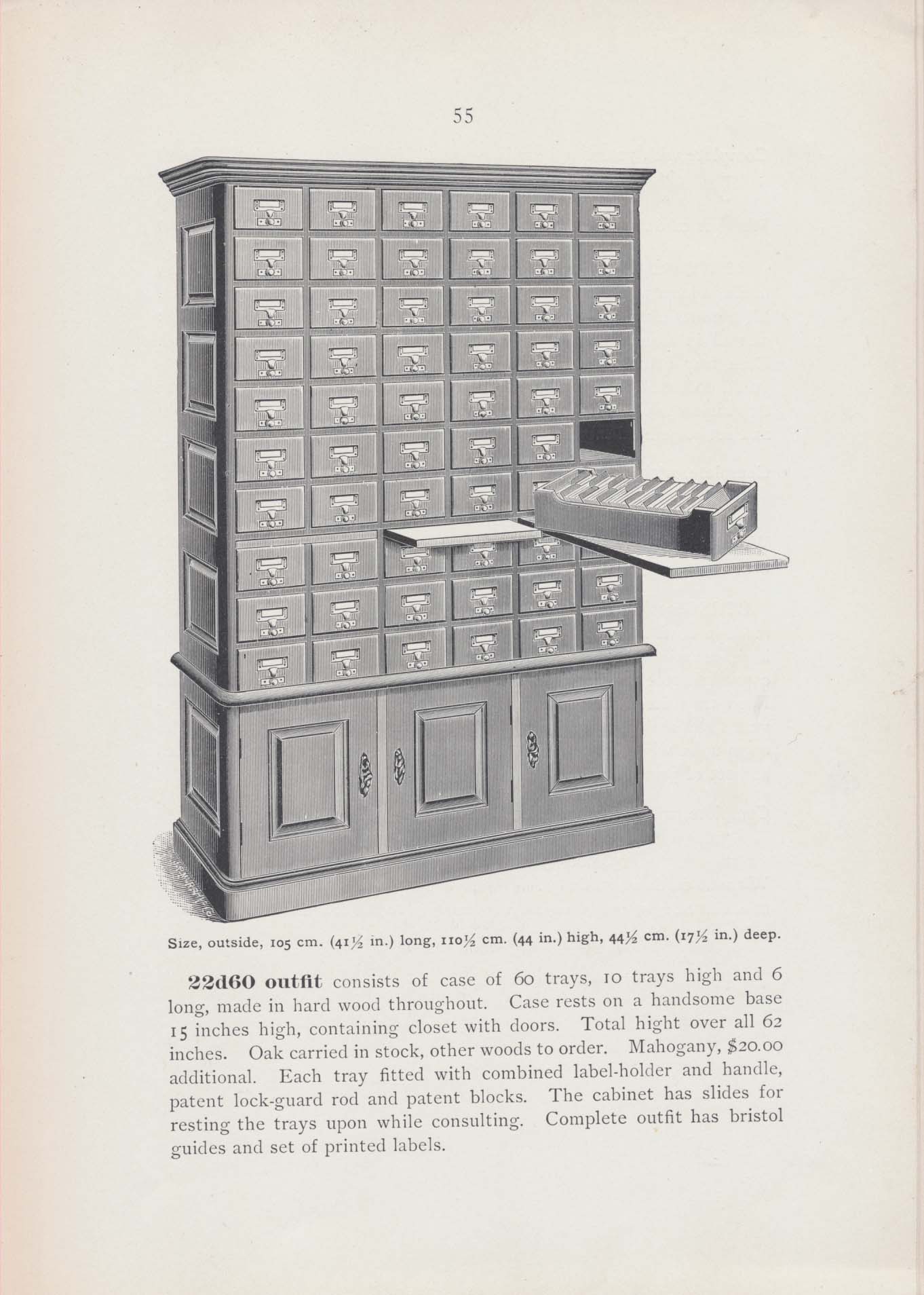 Library Bureau, Boston, MA. Classified Illustrated Catalog of the Library Department of Library Bureau (1899), page 55, 60-tray card catalog with one tray resting on a slide.
The cases housing card catalogs were made of wood and available in varying sizes and styles. Cases were fitted with either drawers or trays. Drawers were not removable while trays were completely removable, as shown in the image below. Some cases rested on bases which doubled as closets providing extra storage, like the card catalog shown above. Other cases had a revolving top for easier access. There was also a handy feature called the slide. When pulled out, the slide created a flat surface or platform to rest a tray, as shown below.
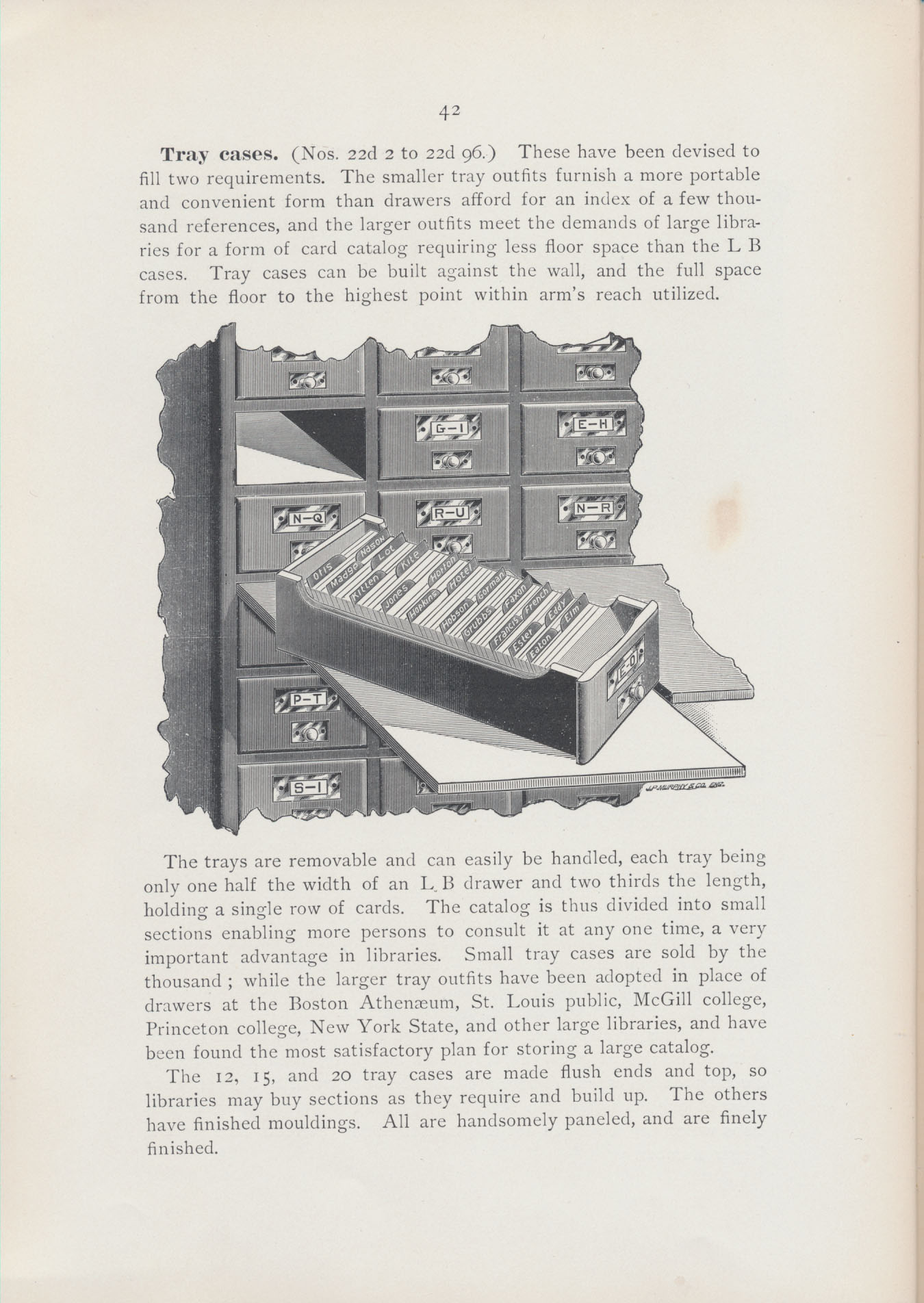 Library Bureau, Boston MA. Classified Illustrated Catalog of the Library Department of Library Bureau (1899), page 42, portion of card catalog showing tray removed from card catalog and resting on a slide.
The case for the card catalog was important, but the cards themselves, complete with bibliographic information describing books, were integral to the whole system. The cards were cut to a specific size with square edges (no round edges) for easy handling. Size No. 32 was approximately 2 x 5 inches while size No. 33 was slightly larger at approximately 3 x 5 inches. According to this 1899 trade catalog, No. 33 was the standard and most used card size at the time. The weight of the cards, which determined thickness, was important as well. Weight was available in “l,” “r,” or “x” with “x” being the heaviest. Cards were available as either ruled or plain and colors included white, salmon, buff, or blue. The No. 33 card, ruled, is shown below.
 Library Bureau, Boston, MA. Classified Illustrated Catalog of the Library Department of Library Bureau (1899), page 48, No. 33 ruled card.
Cards were typically punched with a hole. This allowed the cards to be threaded onto a lock-guard rod which ran from front to back through each row of cards. By placing cards on the rod, it prevented cards from mistakenly being removed or shuffled out of place. When needed, unlocking the rod to remove or add a card was a simple process.
 Library Bureau, Boston, MA. Classified Illustrated Catalog of the Library Department of Library Bureau (1899), page 40, portion of card catalog showing an empty drawer with lock-guard rod.
A small two-tray case, like the one illustrated below, held 2,000 cards, size 33 l. Larger cases held as many as 96 trays housing between 56,000 and 112,000 cards, depending on the weight of cards used. Heavier weight cards limited the number of cards that fit in a drawer or tray.
 Library Bureau, Boston, MA. Classified Illustrated Catalog of the Library Department of Library Bureau (1899), page 52, two-tray card catalog and four-tray card catalog with open tray filled with guides and cards.
A printed label inserted in a label-holder displayed on the outside of each drawer or tray indicated the range of cards filed in that section. Inside the drawer or tray, guides were placed at various points within the series of cards to further break it down into smaller sections. In the image below, the open drawer shows guides labeled “Abel,” “Albright,” “Appleby,” and so forth leading the user to the appropriate card. Another accessory was the triangular block. Its placement at the end of each row of cards created an easily readable angle for the cards. By sliding the rear block, a series of cards could be shortened or lengthened to accommodate a desired quantity of cards in the drawer or tray.
 Library Bureau, Boston, MA. Classified Illustrated Catalog of the Library Department of Library Bureau (1899), page 45, portion of card catalog with drawer of printed guides and cards.
Just like today’s online library catalog, the card catalog of the past was essential to the work of both researchers and library staff. It led researchers to books and assisted staff with collections management decisions. Classified Illustrated Catalog of the Library Department of Library Bureau (1899) and other trade catalogs by Library Bureau are located in the Trade Literature Collection at the National Museum of American History Library. Want to check out more Library Bureau trade literature? Take a look at a post about school libraries and another post highlighting various library charging systems.
Amateur Astronomy in the Digital Library
The skies of 2021 will provide quite a few celestial events for the amateur astronomer. National Geographic notes a conjunction of Venus and Jupiter in February, a “Blood moon” total lunar eclipse in March, as well as other astronomical events throughout the year. If you’re a backyard star-gazer with your own telescope, you’re in good company. By the mid-nineteenth century, advances in both telescopic and photographic technologies helped popularize the field of astronomy, bringing it to the masses. In 1890, the hobby was so popular in Britain that the British Astronomical Association was formed to support these astronomy enthusiasts.
The Smithsonian Libraries and Archives contains many early guides for at-home astronomers, several of which have been digitized and made available in our Digital Library. Even if your telescope is in the shop or you miss the next round of Perseid showers, you can flip through these volumes and gaze upon the heavens, any time.
Sir John Herschel, Outlines of Astronomy (1858)
Sir John Frederick William Herschel (1792-1871) — astronomer, mathematician, and chemist — was one of the most important English scientists of the nineteenth century. In his Outlines of Astronomy, he provides a complex review of what was known of the physical world in his era. His textbook appeals to both the general and the specialist reader as it discusses a range of phenomena from Earth’s basic characteristics to astronomy, as it covers the basics of outer space knowledge, Copernican views, atmospheric phenomena, instruments and tools of astronomy, earth geography, effects of gravity, celestial bodies and motion, and much more.
 Plate 1 from Outlines of Astronomy (1858).
Asa Smith, Smith’s Illustrated Astronomy (1849)
Asa Smith, the Principal of a New York City public school, felt there was a need for an introductory astronomy textbook both affordable and accessible to “common readers” who may lack the mathematical background presumed by more sophisticated options. Smith’s goal was to “present all distinguishing principles in physical Astronomy with as few words as possible; but with such ocular demonstrations, by way of diagrams and maps, as shall make the subject easily understood.” The woodcut diagrams that face the Q&A-style lessons were drawn on the blocks by Smith himself, and then engraved, and he felt these “ocular demonstrations… shall make the subject easily understood.” Included in the illustrations are Kepler’s Laws, Cut Section of the Sun, Transits to the Year 1900, Signs of the Zodiac, and Telescopic Views of the Moon. Interest in astronomy had grown in the United States in the years leading up to 1848, when the first edition appeared. This copy is the 4th edition (New York, 1849), but Smith’s successful work would be reprinted and put to use in schools for nearly two decades.
 Page 11 from Smith’s Illustrated Astronomy (1849).
Charles Blunt, Beauty of the Heavens (1842)
This little astronomical work contains 104 beautifully hand-colored lithographs of the moon, planets, and constellations, along with eclipses and atmospheric phenomena. The constellations dotted with golden stars are great examples of the elegance and simplicity of the book’s execution. Author Charles Blunt’s introduction to the book explains that it was created so that a family need not “quit their own parlour, or drawing-room fireside, to enjoy the sublime ‘beauty of the heavens.’” With every plate comes a ‘lecture’ or description designed to be read aloud, facilitating at-home learning. The Beauty of the Heavens is a wonderful example of a mid-nineteenth-century home instructional tool designed to be both scientifically accurate and inspiring.
 Plate No. 6 from Beauty of the Heavens (1842).
All three books featured here have been adopted through the Smithsonian Libraries and Archives’ Adopt-a-Book program, allowing us to preserve books in need of care and purchase additional works for the collection. Book descriptions provided by staff of the Dibner Library of the History of Science and Technology.
At Home with the Smithsonian Libraries and Archives: Meet the Archives
The Smithsonian Libraries and the Smithsonian Institution Archives have joined forces as the Smithsonian Libraries and Archives to better serve researchers, curators, educators, and learners of all ages at the Smithsonian and around the world. Our collections include nearly 3 million library volumes in subjects ranging from art to zoology. Consisting of more than 44,000 cubic feet, our archival records chronicle the growth and development of the Smithsonian throughout its history.
Now the world’s largest museum library and archives system, the Smithsonian Libraries and Archives aims to fulfill the Institution’s mission for “the increase and diffusion of knowledge” while committing to meet the expanding needs of a 21st-century organization and the communities we serve. Our libraries and archives share an ambitious vision for the future, as we push the margins for innovative digitization, robust services, diverse collections, creative educational resources, thought-provoking exhibitions, and critical preservation.
On Thursday, January 14, we’re giving you the special opportunity to learn more about our new organization and to “Meet the Archives” with Ellen Alers, Reference Team Leader, Tammy Peters, Chief Archivist, and Jennifer Wright, Archives and Information Management Team Leader. They will share about what can be found in our archival collections, how we collect these materials, and how people all over the world can access these records for all kinds of purposes. And of course, they’ll answer your questions!
Registration
Registration is optional–you do not need to register to participate. However, by registering you help us learn about who is attending our programs, so we can better serve our audiences. You’ll also get an opportunity to opt in to receive emails from us, including invitations to future programs. Register here.
How to Join the Live Event
You can watch this event on Facebook. To access the event, please be sure you are following Smithsonian Libraries and Archives. We recommend having our page open when it starts.
This program will be recorded and made available following the event, both on Facebook and our YouTube channel.
Happy Holidays from Smithsonian Libraries and Archives!
Wilson “Snowflake” Bentley (1865–1931), a pioneer in photomicrography, captured detailed images of thousands of individual snowflakes. His photography and publications advanced the scientific record of snow crystals and their many types. Five hundred of these photographs are part of the Smithsonian Libraries and Archives collections.
Looking for a fun activity for the whole family? Craft your own Bentley-inspired snowflakes!
Individual snowflake photographs by Wilson A. Bentley, Record Unit 31, Smithsonian Institution Archives, Smithsonian Libraries and Archives.
Lydia Maria Child: Home Economy and Human Rights
Long before Fannie Farmer, Betty Crocker, or Martha Stewart, Lydia Maria Child provided American women with tips and tricks for running a smooth household. Her most successful book, The Frugal Housewife: Dedicated to Those Who Are Not Ashamed of Economy, was first published in 1829 and went through 33 editions. Though Child is often remembered for her domestic guidance, her literary legacy includes a heaping helping of activism. She became one of the most prolific and progressive female authors of the nineteenth century.
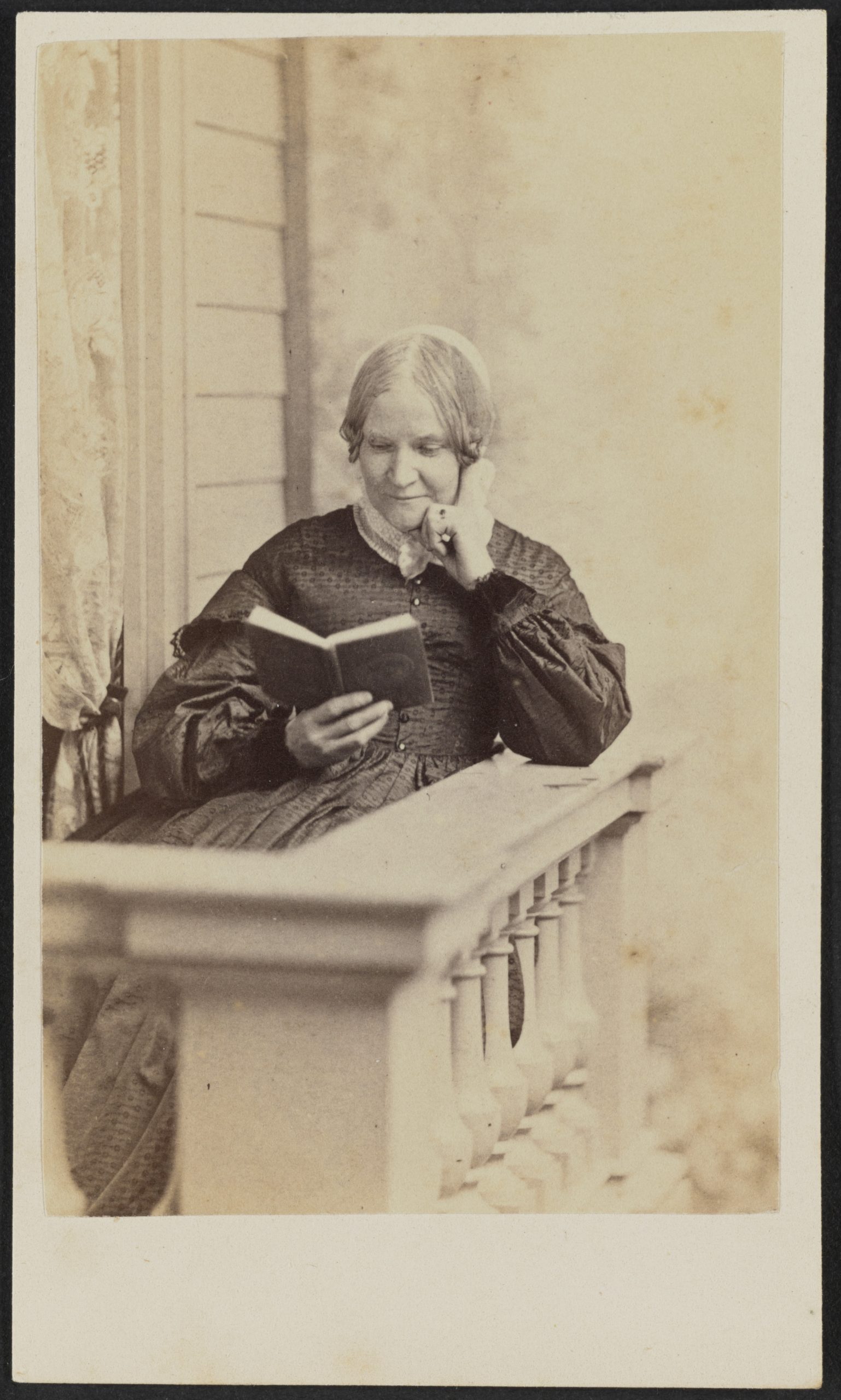 Carte-de-visite portrait of Lydia Maria Child, photographed by John Adams Whipple ca. 1865. Object Number 2017.30.21. Courtesy of National Museum of African American History and Culture.
Born Lydia Maria Francis in 1802, she grew up in Massachusetts and Maine and preferred to go by Maria (with an emphasis on the i). She attended girls’ schools but her brother Convers Francis, a Unitarian minister, was responsible for much of her literary education. She became a teacher herself at age 18.
Lydia Maria Francis’ first book was a rather racy title for a nineteenth century woman. Hobomok (1824) was the fictional story of an interracial couple, white Mary Conant and Native American Hobomok. The book was initially published anonymously, written by “An American,” but it was so well received in the Boston area that eventually word of Francis’ authorship got out. It’s considered the first New England historical novel. We have a modern edition edited by Carolyn L. Karcher in the Smithsonian Libraries and Archives, but you can read the University of Wisconsin-Madison’s first edition via Google Books.
After Hobomok, Francis began to dabble in children’s literature. She founded and edited The Juvenile Miscellany, the first children’s periodical in America. The Juvenile Souvenir, a compilation of its stories, is held in our Cooper-Hewitt, Smithsonian Design Library. It was in 1829, one year after marrying lawyer and journalist David Lee Child, that she published her most successful book – The Frugal Housewife.
 Frontispiece and title page from The Frugal Housewife: Dedicated to Those Who Are Not Ashamed of Economy (1832). Courtesy University of Leeds Library, available via Internet Archive.
Writing The Frugal Housewife was almost out of necessity – David had debts and the couple needed money. Lydia Maria shared the domestic economy tips that kept their home afloat and, in doing so, made a bit of profit. The book was a hit, one of the most popular of its time. Our Dibner Library of the History of Science and Technology holds a sixth edition of this book, not yet digitized, but you can read a first edition online from the Library of Congress. Other contemporary homemaking handbooks existed, but most were published in London for an English audience. Child had felt there was a particular need for an American-focused version. Eventually the title of her book was tweaked to recognize this distinction – The American Frugal Housewife. It was followed up by The Mother’s Book (1831).
As her books of household hints took off, Child turned her writing to issues of national importance – particularly, abolition and women’s rights. In 1833, she wrote An Appeal in Favor of Americans Called Africans. (We hold several copies of a 1968 edition from Arno Press.) Child supported immediate emancipation of enslaved men and women and is thought to be the first white American woman to do so in print. Following the publication of her Appeal, Child became increasingly active in abolition associations like the Boston Female Anti-Slavery Society and the New England Anti-Slavery Society. Between 1833 and 1838, she continued to publish prolifically – more household guides and children’s’ stories, but also The History of the Condition of Women, in Various Nations and Ages (1835), and she continued contributions to the abolitionist paper The Liberator.
In 1841, with the couple still plagued by financial troubles, husband David was offered the position of editor at another abolitionist publication, the National Anti-Slavery Standard, which was the new newspaper of the American Anti-Slavery Society. He turned it down to focus on beet farming, but it was later offered to Lydia Maria, who accepted. On her own, she moved from the family farm in Massachusetts to New York. Child documents some of her time during this period in Letters from New York, a collection of her essays and correspondence from 1841-1843. The third edition of this work is now available in our Digital Library.
 Title page text from Lydia Maria Child, Letters from New York (1844). Smithsonian Libraries and Archives.
Though Child’s attention often focused on weightier causes, she did find time in 1844 to pen a popular poem you might recognize today. “The New England Boy’s Song About Thanksgiving Day,” also known as “Over the River and Through the Wood,” appeared in Flowers for Children, Volume 2. The nursery rhyme has evoked warm childhood memories of visiting Grandma’s house for generations of Americans. In her life, Child authored dozens of books and countless articles that not only entertained and educated but also advocated for the rights of women, enslaved persons, and Native Americans. She died in 1880 at the age of 78.
A compelling testament to Lydia Maria Child’s literary influence in the nineteenth century can be found in Art and Handicraft in the Woman’s Building of the World’s Columbian Exposition, Chicago, 1893. At the World’s Fair in 1893, the Woman’s Building held thousands of examples of the work and artistry of women. This book, available in our Digital Library, provides a glimpse of women whose contributions were well known in their own time but have since been forgotten in history books – women artists, writers, and scientists who are far from household names today. The Women’s Building at the Fair contained a library, filled with writings of both American and international women, as well as a special “New York Literary Exhibit” featuring women from that state. Child’s works, a total of 31 titles, were key among them. On page 117 in the commemorative book, Blanche Wilder Bellamy offered this accolade:
It is of interest to note that one of the few Afro-Americans connected with the World’s Fair, in an official way, is a member of the New York State Board of Women Managers, who volunteered to collect the works of Mrs. Child as a tribute from the blacks to her noble work in the anti-slavery cause.
Further Reading:
Baer, Helen G. The Heart is Like Heaven: The Life of Lydia Maria Child.
Carcher, Carolyn, L. The First Woman in the Republic: A Cultural Biography of Lydia Maria Child.
Child, Lydia Maria. Lydia Maria Child, Selected Letters, 1817-1880.
Clifford, Deborah Pickman. Crusader for Freedom: A Life of Lydia Maria Child.
